






最相信 AGI 加速的多头,Q1 买了数十亿的名义 put?


- 核心观点:前OpenAI研究员Leopold Aschenbrenner管理的基金Situational Awareness LP(SALP)在Q1大量建仓AI龙头看跌期权,这并非看空AI,而是从单边做多转向"带防守进攻",对冲宏观风险并优化持仓结构,核心策略仍是押注AI基础设施的长期资本开支方向。
- 关键要素:
- SALP在Q1新建巨额PUT仓位,涵盖SMH、NVDA、ORCL、AVGO、AMD等AI核心标的,名义价值合计超66亿美元,但13F数据无法反映行权价、到期日及真实净敞口。
- 建仓PUT的主要背景是3月末中东局势推高油价,加剧通胀黏性,压制降息预期,对高估值、高波动的AI基建资产构成双重压力。
- SALP多头仓位仍聚焦AI基建,加仓了Sandisk、CoreWeave、IREN、Applied Digital等数据中心、存储与电力相关标的,减持了部分高弹性仓位如Lumentum,并清仓了Intel CALL。
- 该基金2025年上半年扣费后净回报约+47%,显著跑赢标普500,其策略根植于"AGI加速到来,最先受益的是算力、电力、数据中心等基础设施"的核心判断。
- 调仓本质是从"全线押注AI"切换为"只保留更能承接长期资本开支、穿越宏观波动的资产",并利用期权工具管理组合回撤风险。
During this 13F filing season, one of the most closely watched funds in the market is not Bridgewater or Berkshire Hathaway, but a fund with a very unique name—Situational Awareness LP.
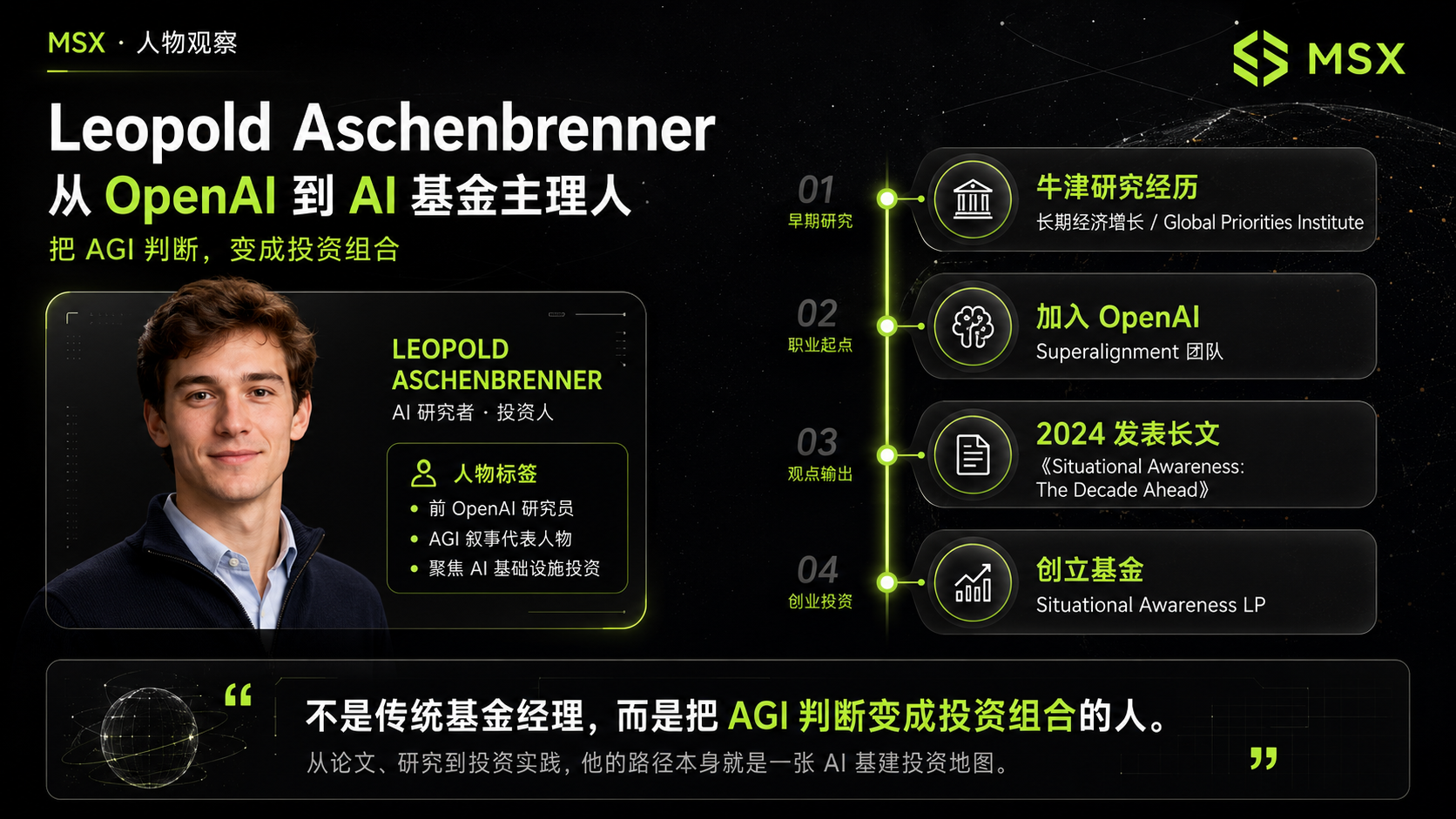
Its manager, Leopold Aschenbrenner, is not a traditional Wall Street veteran but a former member of OpenAI's Superalignment team. In 2024, he published a lengthy article titled "Situational Awareness: The Decade Ahead," which made a very aggressive core judgment, bluntly stating that AGI might arrive faster than most people imagine, and that what will truly be scarce in the future is not just model capabilities themselves, but computing power, electricity, data centers, chips, storage, and the national-level resource competition centered around the AI arms race.
Two years later, it turns out he was right.
Leopold internalized a set of judgments about the next decade of AGI and then mapped these judgments onto the capital market. For this reason, Situational Awareness, right from its inception, has not resembled an ordinary tech fund but rather translated the AGI roadmap directly into an AI infrastructure investment map.
This is also why, in the field of AI investing, its every move attracts significant market attention. The latest 13F filing reveals that this most knowledgeable AI bull seems to be quietly building large-scale put option positions.
1. SALP: A Fund Built on the AGI Thesis
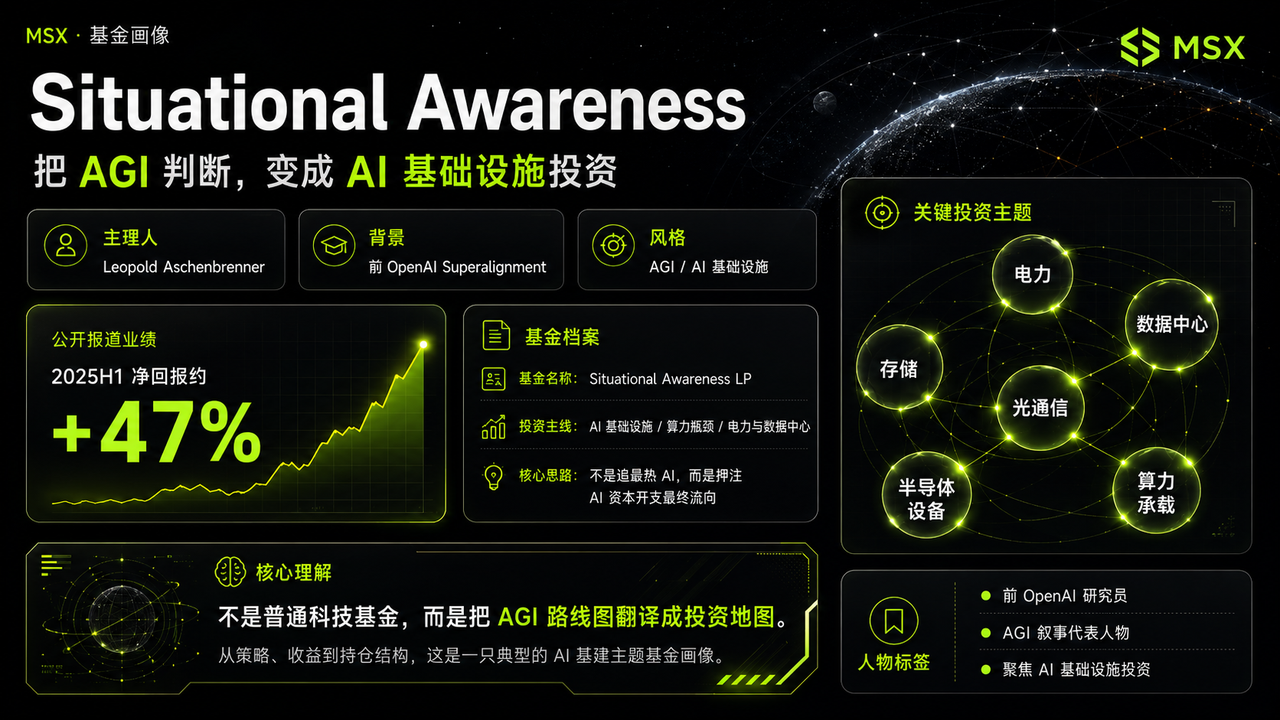
Public information shows that Leopold founded an investment company focused on AGI, backed by prominent Silicon Valley figures including Patrick Collison, John Collison, Nat Friedman, and Daniel Gross.
According to market reports, Situational Awareness delivered a net return of approximately +47% after fees in the first half of 2025, significantly outperforming the S&P 500 and tech hedge fund indices over the same period. Its distinctiveness lies in the fact that it's not simply bullish on "tech stocks," but is highly concentrated on AI infrastructure, betting on where AI capital expenditures will ultimately flow.
As mentioned at the outset, his underlying logic is that if AGI truly accelerates, the first companies to be revalued might not be application-layer companies, but those controlling computing power, electricity, data centers, storage, optical communications, semiconductor equipment, and energy resources. Therefore, its high returns don't rely on simply buying an index but on a set of high-beta AI infrastructure holdings that widen the performance gap: names like Bloom Energy, Sandisk, Lumentum, CoreWeave, and Core Scientific.
First, a quick explanation of what 13F is.
A 13F is a quarterly filing of holdings submitted to the SEC by institutional investment managers in the US, typically used to observe changes in large funds' quarterly holdings of US stocks, ETFs, and related options. However, it is essentially just a snapshot at the end of the quarter. It tells the market "what was disclosed at a specific point in time" but cannot fully reconstruct a fund's complete trading strategy. Specifically for the options portion, 13F filings do not reveal strike prices, expiration dates, or whether positions are paired with others, nor can they directly deduce the fund's true net exposure.
This is also the most common point of misunderstanding when interpreting this document.
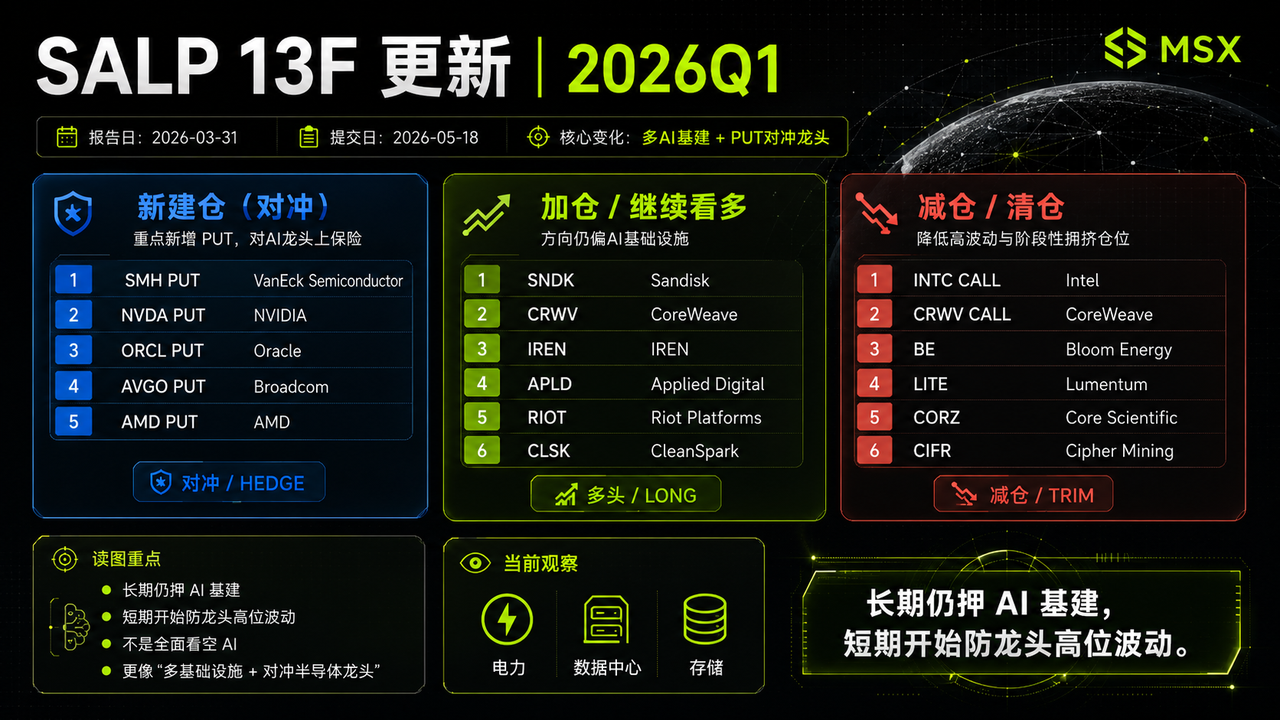
For this Q1 13F, the reporting date was March 31st. Last10K shows the filing was submitted on the evening of May 15th Eastern Time, but the SEC's acceptance time was May 18th. This means it wasn't simply "late"; there's a time lag between submission and when the market actually sees the disclosed results. Hence the numerous discussions on social media platforms about "waiting for Leopold's 13F."
More importantly, the disclosed results of this 13F differed somewhat from market expectations. Many originally assumed Leopold would continue heavily adding to core AI assets like Nvidia, Broadcom, AMD, TSMC, and ASML. However, the reality is that SALP established a large number of new put option positions covering SMH (Semiconductor ETF), Nvidia, Oracle, Broadcom, AMD, Micron, TSMC, ASML, Intel, and a host of other key AI and semiconductor stocks.
This has led the market to reconsider a question: Why is the person most convinced of AGI's accelerated arrival starting to buy insurance on AI leaders?
Simply attributing this to "being bearish on AI" is too crude. What's truly worth analyzing is the macro backdrop against which he made this move and what it reveals about the evolving structure of AI trading.
2. Decoding SALP's Latest 13F: From Betting on AI to Managing AI Volatility
The most striking action revealed in this 13F is undoubtedly SALP's establishment of a massive number of new put option positions:
- The largest is the SMH Semiconductor ETF PUT, with a disclosed value of approximately $2.043 billion.
- Followed by the NVDA PUT, at roughly $1.568 billion.
- Then the ORCL PUT, at approximately $1.073 billion.
- The AVGO PUT, at about $1.006 billion.
- And the AMD PUT, at roughly $969 million.
- Additionally, it established new positions in MU PUT, TSM PUT, ASML PUT, INTC PUT, etc.
Superficially, this looks like bearish bets on AI leaders. However, the issue is that a PUT does not necessarily represent a one-sided short position—after all, the option amounts in a 13F are mostly notional values disclosed based on the scale of the underlying security, and they don't equal the actual premium cost incurred by the fund. More importantly, the 13F doesn't show strike prices, expiration dates, whether they pair with other positions, or the portfolio's true net exposure.
Therefore, stating outright that Leopold is "completely bearish on Nvidia and semiconductors" is imprecise. A more reasonable interpretation is that he is buying "insurance" for his long AI infrastructure portfolio. Many of SALP's original holdings are inherently high-beta, high-volatility, interest-rate-sensitive companies, such as Bloom Energy, CoreWeave, Core Scientific, IREN, Applied Digital, and Sandisk. Their long-term thesis is tied to AI infrastructure, but their short-term stock prices heavily depend on risk appetite and valuation environment.
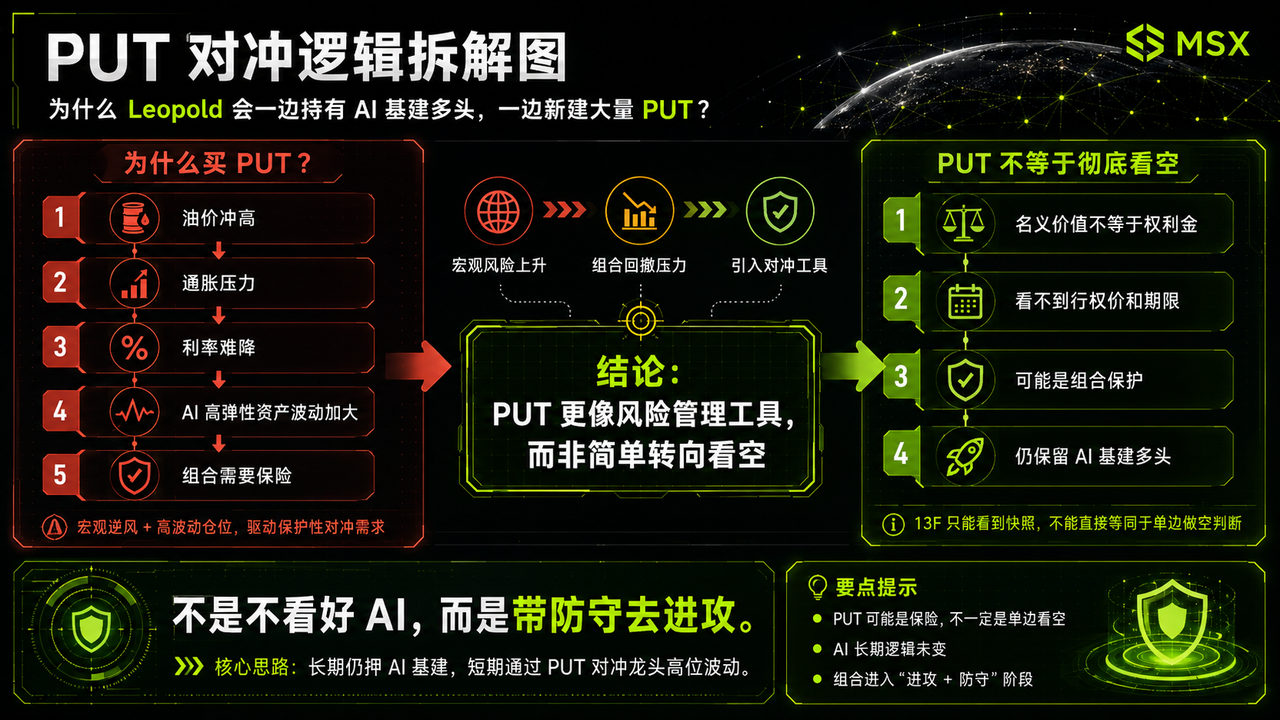
Once the market starts de-risking due to rising oil prices, persistent inflation, higher interest rates, or geopolitical conflicts, these high-beta assets tend to be sold off first. This aligns with the macro backdrop at the end of March: on one hand, tensions in the Middle East and risks of US-Iran conflict pushed up oil price expectations; on the other, rising oil prices exacerbate inflation stickiness, reducing market confidence in rate cuts.
For high-valuation growth stocks, this constitutes a "double whammy": oil pushes up inflation, inflation hinders rate cuts, rates stay high, and the valuations of long-duration tech assets come under pressure.
Viewed against this backdrop, Leopold's move to build a large number of PUTs becomes easier to understand. It is not a negation of AI, but an acknowledgment that no matter how strong the long-term AI thesis, it cannot completely ignore macro headwinds.
Especially for a fund like SALP, with a portfolio heavy on high-beta assets, the net value would be highly volatile if the market experienced a systemic selloff. By purchasing puts on highly liquid, representative core AI assets like SMH, NVDA, AVGO, AMD, and ORCL, it can use standardized tools to hedge against systemic downside risk across the AI trade.
The real meaning behind this is that Leopold hasn't turned from an AI bull into an AI bear. He has switched from "aggressively betting long on AI unilaterally" to "continuing to bet on AI infrastructure, but starting to manage path volatility."
This reflects a more mature portfolio management approach.
3. So, Where is Leopold's Offensive Focus?
If the new PUTs address the "defense question," then the lists of additions, reductions, and closures truly tell us where Leopold's offensive focus lies.
Based on the disclosure, SALP still retains and has added to a number of AI infrastructure-related holdings. For example, common stock of Sandisk was slightly increased. CoreWeave common stock, IREN, Applied Digital, Riot Platforms, CleanSpark, Bitfarms, Bitdeer, etc., are also on the list of additions. Key long positions retained include Bloom Energy, Sandisk, CoreWeave, IREN, Core Scientific, Applied Digital, and others.
This indicates he hasn't given up on AI. On the contrary, he is still betting on the same long-term thesis: AI capital expenditure will continue to flow downstream, and the true beneficiaries are companies that control electricity, data centers, storage, computing capacity, and infrastructure bottlenecks.
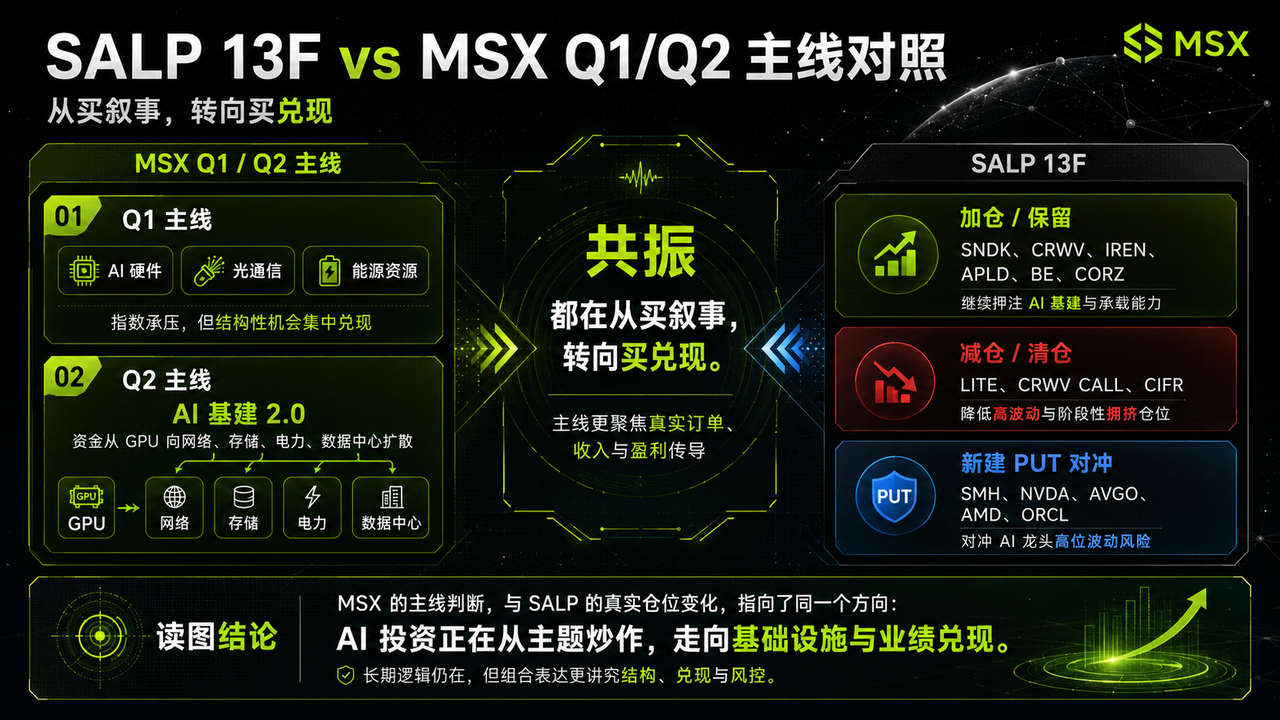
This is very close to MSX Q2's main judgment. In our article "AI Infrastructure Rose All Through Q1. In Q2, Who Can Sustain 'High Valuations'?," we emphasized that the center of gravity for AI trading has shifted from simple GPUs to networks, storage, and electricity. The market now cares more about where the continuously expanding CapEx of big tech actually flows—into whose orders, revenue, and profits. Segments like equipment, networks, storage, and electricity are favored not because they are sexier, but because they better align with the market's current preference for deliverability and monetization.
From this perspective, SALP's long positions are quite representative: Bloom Energy corresponds to electricity and independent energy supply; CoreWeave, Applied Digital, Core Scientific, and IREN correspond to data centers, computing hosting, and infrastructure capacity; positions related to Sandisk, Micron, and TSM correspond to storage, semiconductor manufacturing, and hardware supply.
In other words, Leopold hasn't stopped buying AI; he cares more about where the AI money ultimately gets spent and who can convert that money into revenue on their financial statements.
Looking at the reductions and closures provides equally valuable information. SALP closed positions in INTC CALL, Lumentum, and Cipher Mining, and reduced holdings in CoreWeave CALL, Bloom Energy, Core Scientific, etc. The most notable aspect here is that he isn't simply abandoning a direction, but reducing some positions that have appreciated significantly, carry higher volatility, or have greater leverage characteristics.
For instance, with CoreWeave, he reduced CALLs but still holds common stock. This suggests he isn't completely giving up on CoreWeave, but switching from a more aggressive options expression back to a more manageable common stock position. Similarly, reducing Bloom Energy and Core Scientific doesn't mean their theses are invalid; it's more likely risk control and profit-taking at the portfolio level.
The closure of the Lumentum position is particularly telling. In the MSX Q1 review, AI hardware and optical communications were the two strongest themes. Companies like AXTI, AAOI, LITE, and LWLG saw double-digit percentage gains. The strength in optical communications fundamentally stemmed from exploding demand for optical interconnects, optical modules, and network links driven by AI data centers. However, the problem is that the more aggressively a theme runs in Q1, the more likely it is to face overcrowded trades and deteriorating risk-reward ratios upon entering Q2.
Therefore, Leopold closing LITE and reducing some high-beta AI infrastructure positions doesn't necessarily mean he is bearish on this direction. It might be a more pragmatic acknowledgment that: The most successful trade of Q1 is not necessarily the highest value trade for Q2.
This is the most important aspect of this portfolio adjustment. It is not a denial of AI, but an active structural shift. It moves from "buy anything on the AI value chain" to "retain only assets better positioned to capture long-term capital expenditure, possess stronger infrastructure characteristics, and better navigate macro volatility."
What he is giving up is not AI, but the linear fantasy that "all AI will go up together."
This 13F is essentially just a snapshot as of March 31st. It doesn't mean Leopold holds the exact same positions today in May. However, it still offers strong insights for the current market.
First, the long-term AI trend hasn't ended, but the trading structure has changed. The future isn't about buying any AI stock and watching it rise. It's about who can deliver results, who commands a premium, what's too crowded, and what needs hedging.
Second, in an environment of high oil prices, high interest rates, and high volatility, an effective strategy is neither pure offense nor pure defense. It is playing offense with a defense—core positions bet on certainty, marginal positions bet on beta, while using hedging tools to control portfolio drawdowns. Leopold's recent actions effectively demonstrate this logic using real positions.
Third, this also confirms a major shift in the US stock market in 2026: Index Beta is weakening, while Structural Alpha is strengthening. In the past, just buying the "Magnificent Seven" or Nvidia might have guaranteed easy wins. But now the market is more discerning. It will scrutinize each company: Can your AI story ultimately translate into orders? Into revenue? Into profit? If not, even high valuations will be compressed.
This is why AI Infrastructure 2.0 is becoming important. Going forward, capital won't just look at GPUs. It will follow the chain of Computing → Interconnect → Storage → Electricity → Data Center Infrastructure downstream to find links that can truly monetize.
Final Thoughts
If you only look at the surface, the most eye-catching part of this 13F is the string of massive PUTs.
But if you truly review the entire portfolio, you'll see that Leopold hasn't "switched from AI bull to bear." He has made a more mature upgrade: Long-term still betting on AI infrastructure, short-term starting to acknowledge the volatility risks of high-valuation, high-beta assets.
This is the most valuable takeaway from this 13F. It tells us that the direction of AI might still be correct, but the path to that destination will certainly not be a straight line.
For a true portfolio manager, what matters is never just betting on the right endpoint, but surviving the volatility along the way.
And for ordinary investors, the biggest insight from this 13F is clear: AI trading in 2026 has shifted from "buying stories" to "buying delivery"; from "buying leaders" to "finding bottlenecks"; from "unilateral offense" to "playing offense with a defense."
This is the most intriguing signal, one that absolutely should not be overlooked.


