






AI牛市重新定价一切,包括婚恋市场的“男性估值体系”


- 核心观点:AI牛市重塑全球婚恋市场估值体系,英伟达、SK海力士等AI公司员工因高额奖金与股权变现,取代传统金融从业者与三星员工,成为最抢手的相亲对象,形成基于公司职位的“新财富排名”。
- 关键要素:
- SK海力士员工因营业利润10%的奖金分配制度,人均奖金达1.4亿韩元(约65万人民币),使其成为韩国相亲市场的“硬通货”,甚至引发内部联姻趋势。
- 英伟达作为AI算力核心供应商,股价创历史新高,其员工被视为“AI世界石油”的持有者,具备稳定现金流与财富增值预期。
- OpenAI与Anthropic通过员工股票套现实现财富落地,超600名OpenAI员工合计套现66亿美元,人均高达3000万美元,代表高波动高成长资产。
- 字节跳动与DeepSeek以高估值股权回购及庞大AI投资(字节2025年投入达2000亿人民币)吸引人才,员工账面财富大幅增值,跻身“人上人”评级。
- 三星因HBM技术路线失误被SK海力士压制,员工发起罢工要求提高奖金;腾讯因AI投入保守(仅180亿元)且增速放缓,传统行业光环褪色,降至“NPC”评级。
Original|Odaily Planet Daily (@OdailyChina)
Author|Wenser (@wenser 2010)
Recently, a new "hard currency" has emerged in South Korea's dating market: SK hynix employees.
Kang Eun-sun, an executive at the matchmaking agency Gayeon, admitted: "In the past, we would match SK hynix employees with partners around a B+ grade, but now they are unconditionally considered A-grade." One anonymous hynix employee even said: "When we go on blind dates, we usually pretend we work at Samsung Electronics first. Only if the person has a good character do we confess that we actually work at hynix."
The pecking order in South Korea's, and indeed the global, marriage market has quietly been rewritten.
If the most sought-after people in the past were "Samsung people," finance guys, and civil servants, then after the AI bull market swept the globe, those truly being revalued by the market have become:
NVIDIA employees;
SK hynix engineers;
Researchers at OpenAI and Anthropic;
AI team members at DeepSeek and ByteDance.
The primary market revalues companies, the secondary market reprices stocks, and now the market has started to reprice "men on the dating scene."
With this in mind, Odaily Planet Daily has compiled a "Most Wanted List of AI-Era Bachelors for Dating," based on multiple dimensions like company valuation, employee income, industry status, and wealth potential, for your casual perusal.
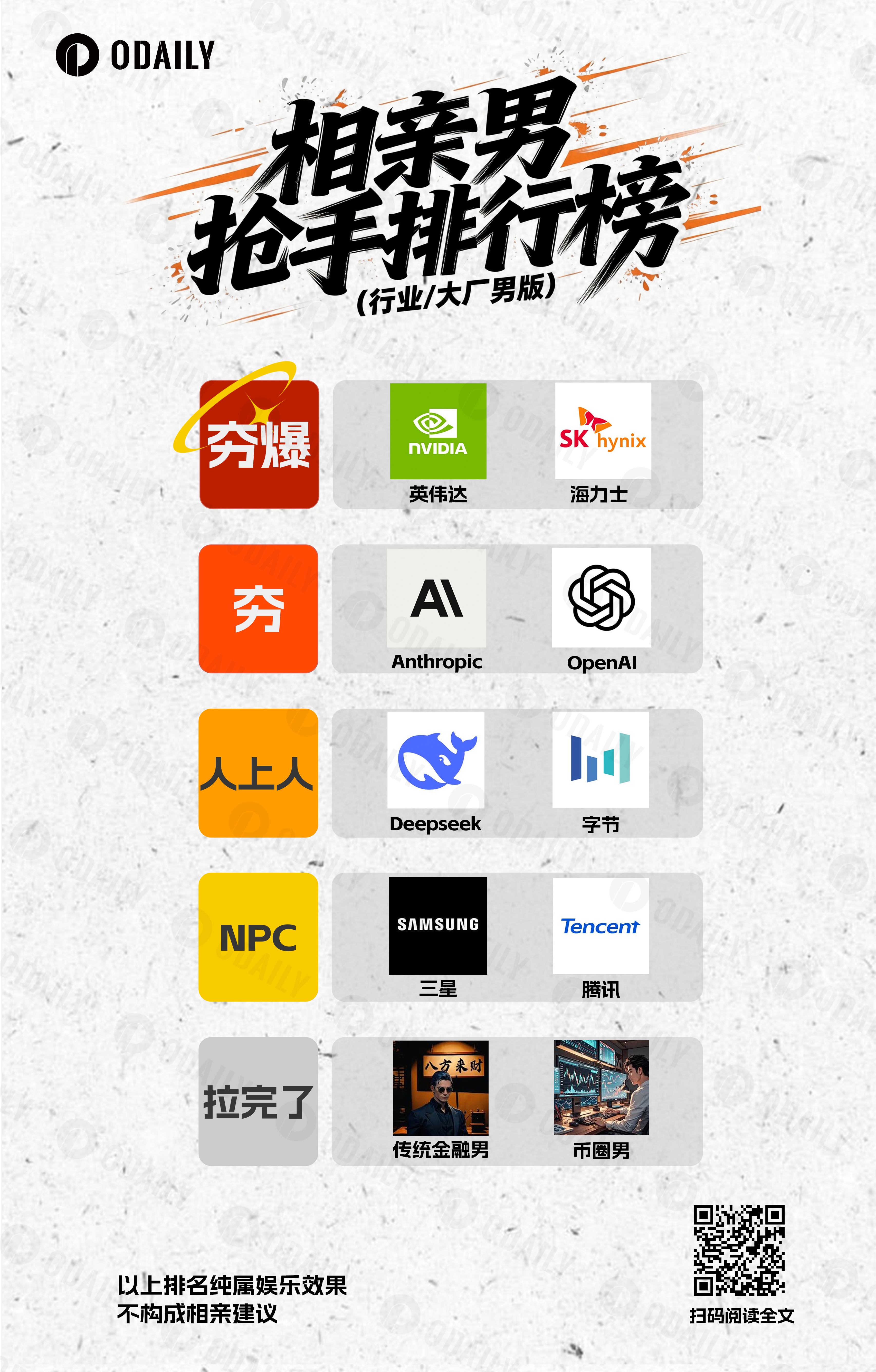
Top Tier: NVIDIA & SK hynix
If there's a "Version T0" in the current dating market, it almost unquestionably belongs to NVIDIA and SK hynix.
The former is the biggest "money printer" in the AI world.
With the continuous explosion in AI computing power demand, NVIDIA has become one of the biggest beneficiaries of the global AI wave. After the US stock market opened yesterday, NVIDIA's stock price hit another all-time high; simultaneously, Wells Fargo raised its target price again, maintaining an "Overweight" rating.
A consensus is gradually forming in the capital markets: in today's era, GPUs are no longer just chips; they are the "oil" of the AI world.
On the other hand, what has truly driven the South Korean dating market collectively wild is the almost absurd scale of SK hynix employee bonuses.
Last year, SK hynix modified its "Profit Sharing (PS)" system, agreeing to put 10% of operating profit directly into the bonus pool while removing the bonus cap.
The result is:
With the surge in demand for HBM (High Bandwidth Memory), hynix employee bonuses have entered the era of "hundreds of millions of Won."
Last year, SK hynix modified the payout method for its "Profit Sharing (PS)," agreeing to allocate 10% of operating profit to a bonus pool while removing the mechanism that caps it relative to annual salary targets.
The company's operating profit for the 2025 fiscal year reached 472 trillion Won. Based on 10%, over 30,000 hynix employees could receive an average bonus of 140 million Won (approximately $110,000 or RMB 650,000).
In the first quarter of this year, the average employee bonus was already as high as 107 million Won, approximately RMB 500,000. According to further predictions by international investment bank Macquarie Securities, SK hynix's operating profit could soar to 447 trillion Won in 2027, leading to an average employee bonus of 1.29 billion Won, approximately RMB 6.1 million.
With such generous rewards, hynix employees are not only extremely sought after in the dating market but are even seriously considering "internal solutions."
One anonymous employee stated: "Mutual attention among unmarried colleagues has noticeably increased recently. After all, the economic synergy of marrying a colleague is too significant. Office romances are now being seriously considered a strategic choice."
When bonuses start being calculated in the hundreds of millions of Won, "office romances" suddenly transform from HR's biggest headache into a household asset allocation strategy. Furthermore, because performance bonuses are heavily tied to attendance time, many employees are actively avoiding parental leave. Some married coworkers even say: "With hundreds of millions of Won in bonuses staring us in the face, who can afford to take time off?"
SK hynix employees are no longer just engineers; they are more like AI concept stocks in the South Korean marriage market.
Therefore, NVIDIA, with its halo of "the world's most valuable company," and SK hynix, the "bonus myth maker," undoubtedly rank in the top tier of this list, earning a "Top Tier" rating.

Clip from the Korean variety show SNL: "Hynix workwear becomes a luxury store pass"
High Tier: Anthropic, OpenAI
If NVIDIA and hynix represent AI infrastructure, then OpenAI and Anthropic represent the most sought-after "new aristocrats" of the AI era.
Over the past year, valuations for both companies have ballooned. Simultaneously, employee wealth has entered a genuine "cash-out phase."
Last October, OpenAI completed a massive employee stock sale. According to the Wall Street Journal, over 600 current and former employees cashed out a total of $6.6 billion (approximately RMB 48 billion) in this round. About 75 people received the maximum amount, $30 million each. After completing a $122 billion funding round at an $852 billion valuation this year, OpenAI has further relaxed restrictions on employee stock sales.
The situation is similar at Anthropic.
In April this year, Anthropic conducted another employee equity sale at a $350 billion valuation, but due to significant employee reluctance to sell, many investors couldn't even buy their expected share.
Unlike the "paper options" narrative of the previous internet era, this round of AI companies is genuinely allowing employees to cash out their "equity wealth."
In other words: the actual wealth levels of employees at these AI companies far exceed those of most employees at traditional big tech companies from the internet era.
However, compared to the "stable cash flow money printers" like NVIDIA and hynix, OpenAI and Anthropic are more like "high-volatility, high-growth assets."
Therefore, we are giving them a provisional "High Tier" rating.

Premium Tier: DeepSeek, ByteDance
One of the biggest changes in this bull market is that global internet companies have begun to realize: the most expensive thing is no longer GPUs, but people, especially AI talent.
In December last year, ByteDance was reported to be planning a massive increase in AI investment. This year, with its AI strategy further upgraded, its AI-related expenditures have reached an astonishing scale of RMB 200 billion.
At the same time, ByteDance's valuation continues to rise. According to the latest market news, ByteDance's valuation has now exceeded $600 billion, $50 billion higher than three months ago.
In April this year, it launched a new round of employee share buybacks. The repurchase price for current employees was raised to $229.5, an increase of 14.52% from the previous price; for former employees, the price was $201.96, up about 11.97% from the previous round. Employees' book wealth continues to appreciate significantly.
On the other side, DeepSeek is also starting its own "AI talent war."
With the departure of some core personnel, DeepSeek's Liang Wenfeng also needs to use equity to retain his core team.
In May, news first emerged that DeepSeek was seeking funding at a $45 billion valuation; subsequently, news that DeepSeek planned to raise RMB 50 billion was officially made public.
It is worth noting that sources suggest only RMB 30 billion of DeepSeek's RMB 50 billion fundraising target will come from external sources, with the remaining RMB 20 billion to be covered by Liang Wenfeng through internal fundraising. As the boss of quant fund High-Flyer, Liang Wenfeng certainly has the capacity, and High-Flyer's RMB 70 billion assets under management and 58.5% annualized return rate give him ample confidence.
Clearly, while OpenAI and Anthropic retain talent with US dollars, Chinese AI companies are starting to fight their own AI talent wars with RMB.
In today's market, those who can get a seat at the AI table are themselves extremely scarce, high-tier players.
Therefore, whether it's ByteDance or DeepSeek, their employees deserve a "Premium Tier" rating in the dating market.
Average Tier: Samsung, Tencent
If the companies mentioned above are already on the AI express train, Samsung Electronics and Tencent seem more like players still trying hard to find their "AI ticket."
Let's start with Samsung.
For decades, being a "Samsung person" was one of the strongest professional auras in South Korean society. But in the AI era, Samsung has unexpectedly become the one being re-evaluated by the market.
Due to missing the initial HBM layout, making wrong technology roadmap choices, and product certification issues, Samsung has been increasingly suppressed by hynix in the AI memory competition.
Meanwhile, Samsung employees are beginning to "look towards hynix." Recently, Samsung's national union even planned a large-scale strike, demanding the company increase bonus ratios and abolish bonus caps. If these demands are not met, the Samsung union will launch an 18-day (starting May 21) massive strike. JPMorgan estimates this could cause 4 trillion Won in losses and reduce DRAM and NAND chip production.
It must be said, the earlier mentioned case of SK hynix employees "posing" as Samsung employees in the dating market is quite understandable.
Talks Break Down, Samsung Strike Likely
On the other side, things aren't great for Tencent either.
Compared to ByteDance's aggressive AI spending, Tencent appears more cautious. Previously, Tencent President Martin Lau stated the company's investment in new AI products last year was about RMB 18 billion, and it would double this year. However, the gap remains significant compared to ByteDance's hundreds of billions in AI investment.
At the same time, Tencent faces the issue of slowing growth in its traditional businesses.
On May 13, Tencent released its Q1 2026 financial results. Revenue was RMB 196.458 billion, a year-over-year increase of 9%; Non-IFRS operating profit was RMB 75.63 billion, also up 9% year-over-year. Overall, revenue and profit growth slowed to single digits, with AI investments dragging down short-term gross margins. In terms of gaming performance, domestic market game revenue was RMB 45.4 billion, a 6% year-over-year increase, lagging behind the growth rate of domestic game gross billing.
This is a significant reason why Tencent didn't hold a strong position in the DeepSeek funding round. Media reports previously indicated that Tencent proposed subscribing for up to 20% of DeepSeek's shares, but DeepSeek was unwilling to cede such a large control stake.
This is also why the market is increasingly discussing: Has Tencent truly secured a real "ticket" for the AI era?
After all, what Tencent built in the mobile internet era was the most expensive "Noah's Ark"—WeChat. But who will eventually get the new ticket for the AI era is still unknown.
Therefore, we have provisionally given Samsung and Tencent employees an "Average Tier" rating.
Lowest Tier: Traditional Finance Guys, Crypto Bros
Finally, compared to the employees of the AI giants mentioned above, traditional finance guys and crypto bros are gradually losing their era-related advantages.
The reason is simple: the most sought-after profession in an era often represents the core distribution rights of wealth in that era.
In recent decades: finance represented capital; the internet represented traffic; and crypto represented getting rich overnight.
But AI has long since begun to redefine everything.
Compared to the AI giant teams with multi-million dollar bonuses and hundreds of millions in equity cash-outs, traditional finance guys and crypto bros suddenly seem somewhat "out of place in the era."
Especially against the backdrop of the continuously AI-driven US stock market, the structural trends in A-shares, and the loss of new wealth effects in the crypto market, the halos of "financial elites" and "crypto gods" have faded.
Based on current dating market conditions and the judgment standards of the older generation, these two groups can only be given a "Lowest Tier" rating in the dating market.

Typical Avatar of a Traditional Finance Guy

Current State of the Crypto Bro
Do you think this ranking is fair? Do you have any other reference ratings? Feel free to leave your thoughts and opinions in the comments.
P.S. A ranking generator from Top to Bottom Tier: https://tool.dayun.cool/ranking
```


