






สัมภาษณ์ CEO ของ Bitget, Gracy: พิมพ์ "ความเข้าใจผิด" ลงบนถุงผ้าสร้างสรรค์ ใช้เสียงหัวเราะตอบสนองต่อโลก


- ประเด็นหลัก: Gracy CEO ของ Bitget เปิดเผยถึงการเปลี่ยนแปลงเชิงกลยุทธ์ของบริษัทภายในสองปีจาก "การเน้นปริมาณ" สู่ "การเน้นคุณภาพ" ซึ่งรวมถึงการเปิดตัวกลยุทธ์ UEX เพื่อรองรับสินทรัพย์แบบดั้งเดิม การนำ AI มาใช้กับพนักงานทุกคนเพื่อเพิ่มประสิทธิภาพ และเส้นทางการเติบโตส่วนตัวของเธอในฐานะผู้นำหญิงที่เผชิญกับความคิดเห็นสาธารณะและสร้างสมดุลระหว่างการทำงานและครอบครัว
- องค์ประกอบสำคัญ:
- ในไตรมาสแรก ปริมาณการซื้อขายสินทรัพย์ที่ไม่ใช่คริปโตบนแพลตฟอร์ม Bitget คิดเป็นเกือบ 40% ระยะแรกของกลยุทธ์ UEX ครอบคลุมสินทรัพย์แบบดั้งเดิม ในขณะที่ระยะที่สองมุ่งเน้นไปที่การปรับปรุงกลไกการจ่ายเงินปันผลและสภาพคล่อง
- Bitget ร่วมมือกับ Republic เปิดตัวผลิตภัณฑ์ Pre-IPO (เช่น SpaceX) โดยใช้โครงสร้าง SPO ที่เป็นไปตามข้อกำหนดพร้อมกลไกการจองซื้อที่มีโครงสร้าง เพื่อให้แน่ใจว่ามีการจับคู่แบบ 1:1 โดยมูลค่าประเมินอ้างอิงจากต้นทุนการซื้อกิจการเมื่อหกเดือนก่อน
- ปริมาณการซื้อขายของผู้ใช้ในเขตภาษาจีนคิดเป็น 25%-33% ของทั่วโลก ความขัดแย้งทางภูมิรัฐศาสตร์ (เช่น ในเดือนมกราคม-กุมภาพันธ์) ผลักดันให้ปริมาณการซื้อขายทองคำรายวันใกล้เคียงกับ比特币 ซึ่งกลายเป็นตัวเร่งให้ผู้ใช้ยอมรับสินทรัพย์แบบดั้งเดิม
- นำ AI มาใช้กับพนักงานทุกคน ครอบคลุมการบริการลูกค้า การแปล การตรวจจับการปฏิบัติตามข้อกำหนด และเครื่องมือการเทรด (เช่น GetClaw) โดยเชื่อว่าการประยุกต์ใช้ AI ไม่ใช่ฟองสบู่ และสามารถเพิ่มประสิทธิภาพได้ 5-10 เท่า
- การปรับกลยุทธ์มุ่งเน้นไปที่มูลค่าตลอดอายุการใช้งานของผู้ใช้ (LTV) แทนที่จะเป็นจำนวนผู้ใช้ใหม่ ตอบสนองต่อการหลั่งไหลของ ETF และเงินทุนจาก Wall Street พร้อมเปิดรับการปฏิบัติตามข้อกำหนดและเงินทุนของสถาบัน
- Gracy เปลี่ยนจากบุคลิกภาพแบบ E ไปเป็น I ในเชิงบุคคล คำสำคัญ ได้แก่ "การก้าวเข้าสู่เวทีที่ใหญ่ขึ้นอย่างต่อเนื่อง" "ความสงบในมุมหนึ่ง" และ "หยุดเสแสร้ง" บทบาทของคุณแม่เลี้ยงเดี่ยวช่วยเสริมสร้างการเป็นแบบอย่างที่ดีให้กับลูกชายของเธอ
Author: Deep Tide TechFlow
She's jokingly called "the one who can really play the part," yet she simply had that phrase printed on a tote bag and took it with her to an industry conference.
As the helmswoman of Bitget, one of the world's leading crypto exchanges, Gracy has led this 2,000-person ship from a focus on "quantity" to a focus on "quality" in her two years as CEO.
From deep engagement in the Chinese-speaking market to a global layout, from pioneering the UEX strategy to embrace traditional assets, to going all-in on AI to welcome the era of silicon-based life, Bitget is reshaping the trading ecosystem at an incredibly rapid pace of evolution.
During Web3 Carnival, we had an in-depth conversation with Gracy covering personal publicity, corporate strategy, and family. For the first time, Gracy fully shared Bitget's strategic evolution and business logic. She also spoke about her own transformation from Managing Director to CEO. In this cycle full of uncertainty, let's see how this female leader uses a "quiet mind in a corner" to navigate a "bigger stage." After shedding the CEO aura, she also revealed her tenderness and resilience as a single mother.
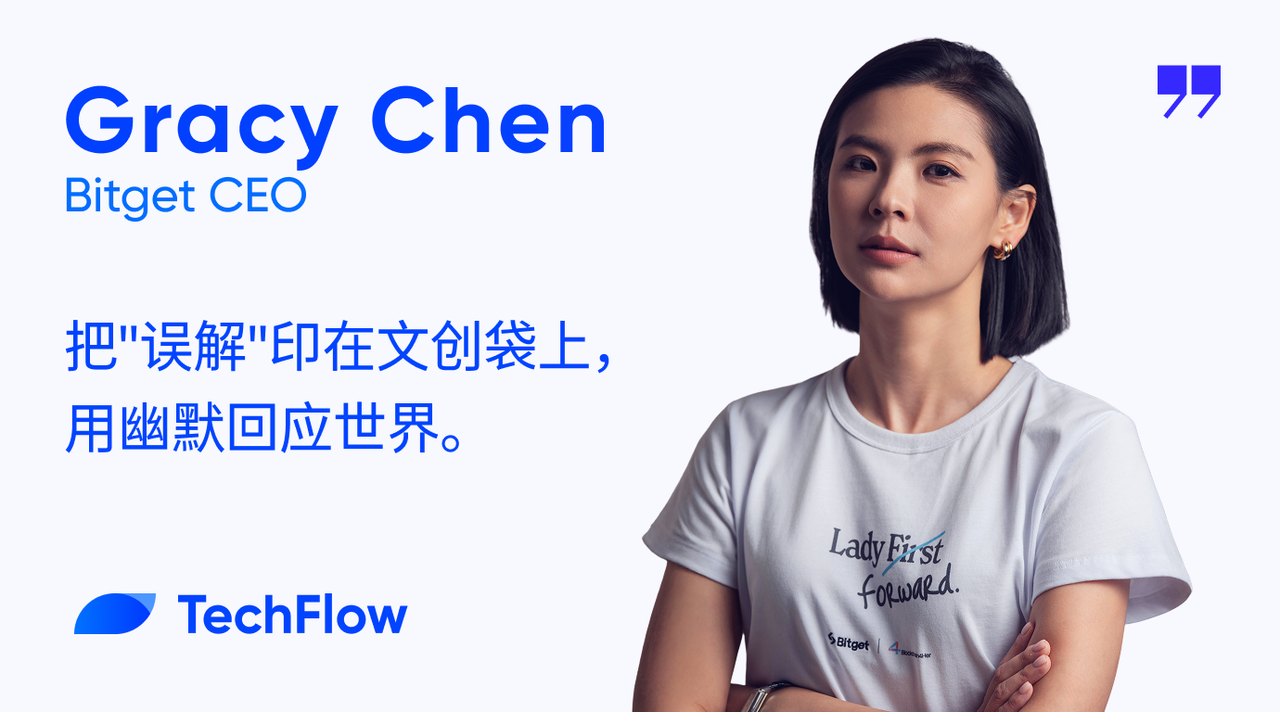
Facing Online Hate with Confidence, Printing "Misunderstandings" on a Tote Bag
Q1: You frequently appear in the Chinese-speaking market. In your view, which regions is Bitget currently most focused on, and how does the Chinese-speaking market differ from other regional markets?
Gracy: The regions Bitget focuses on are the most active regions in the entire crypto industry.
The Chinese-speaking region's user base and trading volume account for 25% to 1/3 of the global market share, similar to the US market. The European English-speaking region (EUEN) has a large market volume but is geographically dispersed, with differing languages and cultures across countries; the characteristics of Eastern and Western European markets are also completely different. In the derivatives (perpetuals) trading space, some East Asian countries stand out. But when looking at the spot market, the core regions mentioned earlier are the primary markets, while emerging regions like Latin America, Southeast Asia, and Europe represent new business growth areas.
Bitget has been deeply involved in the industry for over seven years, serving users in over 100 countries with a global operational perspective. The core team members are mostly Chinese, and I grew up in the Chinese-speaking region. Chinese is my mother tongue, and many team members come from traditional finance and Web2 tech backgrounds. Therefore, our emphasis on the Chinese-speaking market is undeniable. It is the business region we know best and is also one of the world's mainstream markets.
Q2: I see many posts about your travel and personal growth on Xiaohongshu (RED). How do you balance travel with your CEO responsibilities? What's your favorite travel destination and why?
Gracy: This kind of question is quite fun to chat about – we can't just talk about work all the time.
New Zealand was my travel destination for last year's National Day holiday. Christmas, National Day, Labor Day (May Day), and Spring Festival are major core holidays, and many team members choose to take time off. During last year's National Day, I was invited to participate in and speak at a local innovation and entrepreneurship competition in New Zealand. I also connected with several local friends, including a former classmate from MIT who is now a female member of the New Zealand Parliament; she accompanied me on a tour of the New Zealand Parliament Building. I'm used to doing deep cross-border trips, usually staying for five to six days. The New Zealand trip lasted about seven or eight days, and it felt very in-depth and very enjoyable.
Regarding travel, for me and for our company, although everyone works hard – we're even notoriously known for being intensely hardworking, sometimes jokingly called the "Huawei of crypto" – I want to clarify this title. I accept it, but it doesn't just mean long working hours. It's more about the spirit of "Work hard and play hard." For example, we don't require clocking in or coming to the office every day, even though we have offices in many parts of the world. We focus more on results. As long as you deliver results, you have great flexibility.
Our team members also need time off, but you can't just disappear and ignore your work during holidays; that would be a problem for us. So my travels usually align with these holidays. This Labor Day, I'm going to Miami for Consensus, as we have some ongoing matters in the US.
For pure leisure travel, my favorite places so far are probably exotic locations like Morocco and Turkey. If I want a more relaxing style, I really like Italy. But my bucket list still has some places I haven't been to, like Tanzania to see the Great Migration, and then more adventurous trips like the Arctic and Antarctic, which I'm also very much looking forward to.
Q3: On Xiaohongshu, you share content facing online criticism head-on. What do you think are the most misunderstood perceptions about you, and what are the facts?
Gracy: Haven't those bags been quite trending lately? At this year's conference, since we didn't have a booth, our marketing colleagues said, "Let's create a mobile booth instead." They asked if I would mind them using my photo to make a distinctive bag. I said yes without a second thought. I remember one slogan was "I'm socially anxious, but this bag is socially confident." So, one misunderstanding is that people think I'm a huge extrovert. But I'm not an introvert either; I've recently started really enjoying being alone.

Deep down, I think I'm an E person, but this job is making me more I (Introverted). The second misunderstanding is also on the bag: "Zhuāng" (can be playful or pretentious). So, we straightforwardly printed these misunderstandings on the bag. It's a way of responding. Besides, this industry is fiercely competitive; getting people's attention is a good thing, in my view. Some say any publicity is good publicity.
On the other hand, society is quite tolerant nowadays. For instance, people are accepting of female CEOs or women leaders who can be assertive, have sharp viewpoints, have a playful/showy side, and have a personal life. I also think that brands, when doing marketing and communication, are allowed to find ways to break through the noise.
However, there was a somewhat controversial incident where Bitget Wallet used a photo of a couple kissing in Dubai that went viral. Our Wallet team got consent from the individuals but sent it out without my approval. When I saw it, I also felt it was a bit much. Many netizens criticized it, so it was taken down.
My point is that from a company perspective, we are open to innovative ideas. And I think in the process of such innovation, things like this can happen; it's about finding the right balance. First and foremost, we need to encourage innovation. If we can't tolerate even small mistakes, people won't dare to innovate. But the core communication power and creativity of a brand are often reflected precisely in these areas.
Breaking Ground and Reshaping: UEX Strategy, the RWA Wave, and a New Transaction Paradigm for the Silicon-Based Life Era
Q4: Bitget actively listed assets like stocks, IPOs, and precious metals early on. I heard that stock trading volume already accounts for a significant portion for some exchange users. Can you share how user behavior and portfolio structure have changed since listing traditional assets on Bitget? From a data perspective, what percentage of Bitget's UEX plan do you think has been achieved?
Gracy: UEX is our long-term strategy. Aggregating various assets is just the first step. Data already shows some shifts; for instance, in Q1 of this year, non-crypto trading volume on our platform reached nearly 40%. We also see significant regional characteristics in user acceptance of the non-crypto assets on the UEX segment.
Taking US stock tokens as an example, user acceptance is higher in regions with asset control, foreign exchange restrictions, and difficulty opening US stock brokerage accounts. Firstly, we don't do business in sanctioned countries like Iran; no amount of money would make us do that. But in many regions where opening a US brokerage account is genuinely difficult, users see us as a natural choice for global asset allocation because they lack other channels. We are not a nice-to-have, but a necessity. This characteristic is observed in such regions, showing higher acceptance.
Secondly, over half of Bitget's users are from Asia. During the geopolitical conflicts in January-February this year, which caused significant price fluctuations in precious metals and oil, trading volume surged suddenly. On the highest volume day, gold trading volume on our platform nearly rivaled Bitcoin's trading volume.
Since launching the UEX strategy in September last year, we completed listing numerous US stock assets in Q4, and in January this year, we expanded into commodities like gold and oil, and forex assets via CFDs. However, users need an adaptation period for new products. Geopolitical events and other unexpected incidents act as catalysts for improving user acceptance. For example, when gold prices corrected significantly, user trading activity increased. Combined with leverage factors, we saw a certain scale of liquidations, which is normal for a highly volatile market.
Looking back at the UEX strategy now, I feel we've only completed the first phase. In my definition, the first phase is to achieve relatively comprehensive coverage of these assets. The next phase involves continuous optimization of the products already listed.
Let me give you an example. US stock tokens are now quite mainstream in the RWA world, to our mind. But there are players like Ondo and xStocks who have been at it for almost a year. Although we launched ours last September/October, we still see many problems. For instance, a major user question is whether dividends are paid. The mechanism for paying dividends is not very transparent, but dividends are indeed paid. However, they aren't directly credited to your account; the underlying SPV buys the asset in the reverse direction, and the value is reflected in the token price. So you receive the economic benefits of dividends, but you don't see a direct dividend payment. Because of this mechanism, the price of the underlying SPV token might increase by the amount of the dividend. For example, if Meta stock (hypothetically) is $500 and pays a dividend, the tokenized product might become $510, while the underlying Meta stock remains $500. Users see this widening price gap and feel uncomfortable. These problems are very subtle.
If you don't operate in this space or aren't a trader yourself, you might not think of this problem. This is precisely what we need to optimize in the second phase. Can we, for example, design a more transparent dividend distribution method or make it better perceived by users? Also, 24/7 or 24/5 trading sounds great, but how do we optimize liquidity on weekends when the US stock market is closed? There are many such issues we encounter when dealing with traditional assets.
Q5: I noticed Bitget recently launched IPO Prime. I understand this is a key step in extending the UEX strategy from the secondary market to the primary market. What was the logic behind choosing to partner with Republic and launching Pre-SPAX first? Compared to other exchanges' on-chain models or subscription/derivative models, what do you see as the advantages of Bitget's "compliant SPV + structured subscription" design?
Gracy: I wrote an article sharing the story behind our partnership with Republic. I've known the two co-CEOs of Republic Crypto for many years. Here's a fun fact: because both their co-CEO Andrew and I were investee companies of Dragonfly, Dragonfly once hosted a closed-door event where Andrew and I were grouped together to complete tasks. We even won first place! It was a very interesting experience that brought me closer to Republic and Andrew personally.
We started planning to launch a Pre-IPO product last year. Knowing their deep involvement in this space, I asked our team to talk to Republic. However, the decision couldn't be made just because of my personal relationship with Andrew. Objectively speaking, the team conducted extensive market research, and ultimately, their choice landed on Republic. This is because they hold abundant licenses in many places like the US and Europe. At the same time, they had issued US stock Pre-IPO tokens with other exchanges before, encountering some pitfalls along the way. Those lessons helped us avoid similar issues in our product design, like risks in wording. For instance, during promotion, we clearly state it's a debt instrument, not an equity stake. We do have a third-party SPV holding the equity, but our external messaging incorporates compliance risk controls.
Our core reasons for choosing Republic are: first, their licenses; second, their existing experience; and third, their transparent mechanism.
Republic's Pre-IPO products are even more complex than standard US stock tokens because a company's IPO timeline and price are unpredictable. Take SpaceX, for example. When will it go public? Only Elon Musk can decide. We started designing this product last year. But in February-March this year, the merger of SpaceX and xAI happened, where they acquired and integrated Grok. Suddenly, the secondary sellers our SPV was negotiating with either withdrew or changed their prices completely, requiring all negotiations to restart. There are many such details you only realize when you actually build this product – quite a few pitfalls. We also passed on the product to users near our cost price, meaning we aren't aiming to profit from it; it's more about offering benefits to users.
Many users ask: our valuation is 1.5 trillion, Reuters estimates a post-IPO value of 2 trillion, and some on-chain platforms already trade at over 2 trillion. So why is Bitget's price so low? Could it be a lack of 1:1 mapping? I want to explain that this is because our third-party SPV went to the market six months ago to acquire and confirm a valuation. Essentially, the low valuation users are getting is due to this time lag. It's the valuation we secured six months ago, offered to you now. So, you're getting a bargain, not dealing with a lack of underlying backing. For us, 1:1 mapping is the most critical aspect when designing any RWA product. From the Pre-IPO product mechanism design, we also ensure that once the IPO occurs, the "presale" token price aligns 1:1 with the asset's stock token.
Q6: You mentioned in a previous interview that "the four-year cycle pattern still exists but is being 'smoothed out' by Wall Street capital represented by ETFs and DAT." The global market is reassessing macro risks faster. In this context, what are the implications for exchanges like Bitget, and what strategic shifts have you made?
Gracy: We've certainly made significant strategic adjustments. Why did we even create the UEX concept? Because we found that pure Crypto [assets] are no longer sufficient for our users or for our own development cycle. We've identified certain definite trends in the market that we need to capture.
First is the growth of stablecoins. Stablecoins are rapidly attracting more traditional capital, including family offices and endowments, especially for cross-border payments. I chatted with a friend recently, totally unrelated to our industry. His family runs many stores in Yiwu, and he told me he holds a lot of USDT. I asked why. He said they all use USDT in Yiwu for cross-border transfers because it's the most convenient asset for that purpose.
There are many such scenarios. I'm certain people will hold more and more stablecoins, and the proportion of stablecoins to fiat will increase. We want to capture the incremental trading volume of stablecoins because Bitget's core is trading. (Bitget Wallet or other sister companies focus more on payments). But we believe that when stablecoins are used more for payments, they will also be used more for trading. This is our first opportunity: enabling trading with U (stablecoins).
The second opportunity is RWA, as mentioned. US stock tokens vs. US stocks are currently at 0.1%. For products like money market funds and private credit RWAs, this proportion might already be


