






Kalshi Raises Another $1 Billion, Prediction Markets Propelled to the Financial Main Table by Capital


- Core Insight: Prediction market Kalshi has completed a $1 billion funding round at a $22 billion valuation, signaling the evolution of prediction markets from niche event trading tools into mainstream financial infrastructure. Capital is betting on its ability to transform real-world uncertainties into tradable and hedgeable risk assets.
- Key Elements:
- Kalshi's valuation surged from $2 billion to $22 billion in just seven months, a more than tenfold increase, led by Coatue Management.
- The value of prediction markets lies in breaking down hard-to-price uncertainties—such as elections, economic data, and policy changes—into tradable contracts, creating a new "event trading market."
- Kalshi's core moat is its CFTC-regulated compliance license, allowing it to attract institutional capital and integrate prediction markets into the federal financial regulatory framework.
- The central regulatory controversy revolves around the classification of event contracts—whether they are financial derivatives or a form of disguised gambling—which will determine the industry's expansion ceiling and product boundaries.
- Insider trading is a key fairness issue facing prediction markets. While informed participants can enhance information efficiency, they undermine market fairness, prompting institutions to demand more robust monitoring and penalty mechanisms.
- By April 2026, the monthly trading volume of prediction markets reached approximately $30 billion. Kalshi holds a 50% market share, Polymarket accounts for 34%, and other platforms like predict.fun are also accelerating growth.
Original by Odaily Planet Daily (@OdailyChina)
Author: Asher (@Asher_0210)

Kalshi has once again thrust prediction markets into the spotlight of capital markets.
Last night, prediction market Kalshi announced the completion of a new $10 billion funding round, led by Coatue Management, at a post-money valuation of $22 billion. Prediction markets are moving from being fringe event-trading tools into the purview of mainstream capital and institutional finance.
In the past, prediction markets were mostly discussed in the context of elections, sports, entertainment, and short-term hot topics. This latest funding round for Kalshi indicates that capital is looking beyond just how hot a particular market is. The real question is whether the uncertainties of the real world can be structured into a long-term, operational trading mechanism. If this path can be paved, prediction markets will no longer just be a traffic business, but will edge closer to becoming a piece of financial infrastructure.
Behind the $10 Billion Raise, Capital Bets on a New Asset Class
This funding round for Kalshi is not an isolated high-valuation event.
Over the past 7 months, Kalshi has completed three consecutive funding rounds, with its valuation nearly doubling each time. In June 2025, Kalshi closed a $1.85 billion Series C at a ~$2 billion valuation; in October, a ~$3 billion Series D pushed the valuation to $5 billion; in December, a $10 billion Series E brought the valuation to $11 billion. Following this latest round, Kalshi's post-money valuation has reached $22 billion. In just a few months, the valuation has skyrocketed from $2 billion to $22 billion, an increase of over 10 times.
Relying solely on elections, sports, and hot topics to attract users for betting could hardly support such a valuation. The real story Kalshi tells is that prediction markets have the potential to evolve from a niche trading venue into a new asset class for event-driven trading.
Traditional financial markets allow trading in stocks, bonds, commodities, forex, interest rates, and volatility. But the real world is filled with uncertainties that are difficult to price directly. Election outcomes, policy changes, economic data, weather events, and geopolitical shifts all impact corporate decisions, asset prices, and public expectations, yet have long lacked standardized trading tools.
Prediction markets aim to break down these uncertainties into tradable contracts, allowing prices to directly reflect the probability of an event occurring. This is where Kalshi's potential lies. It's not just about enabling more people to bet on the future; it's about attempting to turn future uncertainties into a risk asset that can be traded, managed, and hedged.
From Election Betting to Pricing Real-World Risk
Prediction markets first gained widespread attention through elections. Compared to polls, they offer a more direct mechanism, compressing disparate judgments into a real-time price. Candidate win probabilities, policy passage likelihoods, and whether economic data will surprise can all be quickly expressed through market prices.
However, relying only on elections and sports is insufficient to support today's valuation. The real narrative Kalshi aims to establish is whether prediction markets can enter broader risk-pricing scenarios. Think interest rate decisions, CPI, employment data, weather disasters, policy shifts, and supply chain shocks. In the past, these risks were mostly tradable only indirectly; now, they can potentially be broken down into individual event contracts.
Therefore, the long-term value of prediction markets doesn't lie in helping more people predict outcomes correctly, but in whether they can transform real-world uncertainties, previously difficult to trade, into a continuously updated set of prices that the market can reference.
Kalshi's Most Valuable Asset: Its Regulatory License
In Kalshi's growth story, trading volume and fees are certainly important, but its position within the US regulatory framework is even more critical.
Unlike platforms like Polymarket, which are more crypto-native and globally liquid, Kalshi pursues a US domestic compliance route. It is a Designated Contract Market (DCM) regulated by the CFTC. This means Kalshi is attempting to place prediction markets within the federal financial regulatory framework, rather than just operating as an open event-betting platform.
For average users, a prediction market is just a platform to trade event outcomes. But for institutional capital, compliance is the primary threshold. Before hedge funds, asset managers, and market makers can enter, they need clear confirmation regarding contract specifications, clearing and settlement, audit trails, and risk control processes.
Consequently, a part of Kalshi's valuation prices its growth, while another part prices its license. As prediction markets move closer to mainstream finance, regulatory status becomes increasingly important. For Kalshi, which has secured a federally compliant entry point, regulation is not just a constraint but potentially its most significant moat.
The Core Controversy: Finance or Gambling?
The central point of contention remains whether event contracts are financial derivatives or a form of disguised gambling. Markets for sports, entertainment, and elections, in particular, easily create boundary conflicts with traditional gambling. Regulators in multiple states argue that some of Kalshi's products bypass state-level gambling oversight. Kalshi, however, maintains that event contracts are financial products under CFTC regulation and should be handled within the framework of the Commodity Exchange Act.
This struggle is not just about Kalshi; it defines the ceiling for the entire prediction market industry. If state-level gambling logic prevails, prediction markets might be forced into a model of applying for licenses and seeking product approval on a state-by-state basis, limiting expansion speed and product scope. If federal financial regulatory logic is further solidified, event contracts could gain recognition as a standalone financial product, further amplifying the value of Kalshi's license.
Therefore, the regulatory debate is not a side plot in Kalshi's story; it's integral to its valuation logic. Capital is willing to assign a high valuation to Kalshi precisely because it believes Kalshi has a strong chance of winning this regulatory game and converting its compliance advantage into market share.
Insider Trading: The Inescapable Dark Side of Prediction Markets
Beyond regulatory classification, prediction markets face a more challenging issue: insider trading.
The value of a prediction market stems from information being incorporated into prices. The more informed participants trade, the closer the market price should be to the true probability. However, information distribution about real-world events is inherently unequal. Politicians, campaign staff, athletes, production personnel, and corporate insiders often know results earlier, or are closer to the outcome, than ordinary users.
This creates a paradox. If insiders don't participate, the market's informational efficiency may suffer. If they participate heavily, ordinary users may feel they are merely providing liquidity to be harvested. The more a prediction market emphasizes information efficiency, the harder it is to evade the fairness issues arising from information asymmetry.
Currently, Kalshi has strengthened its monitoring and enforcement mechanisms, including restricting related parties from trading their own markets, investigating abnormal trades, and penalizing violative accounts. But this is likely insufficient. For prediction markets to transition from traffic platforms to financial markets, they must prove not only their ability to attract trading but also their capacity to handle issues of insider trading, information asymmetry, and market fairness. Otherwise, institutional capital will struggle to treat them as serious, long-term markets.
Kalshi is Not Alone: The Prediction Market Sector is Heating Up
Based on data from April 2026, the prediction market landscape is no longer a simple duopoly between Kalshi and Polymarket. Kalshi captured approximately 50% market share with $14.8 billion in volume, becoming the first platform to secure over half the monthly volume this year, and has maintained its volume lead for eight consecutive months. Polymarket recorded $10.2 billion in volume (34%) during the same period, remaining a key competitor. Notably, predict.fun and Limitless also generated volumes of $1.5 billion and $1.7 billion respectively.
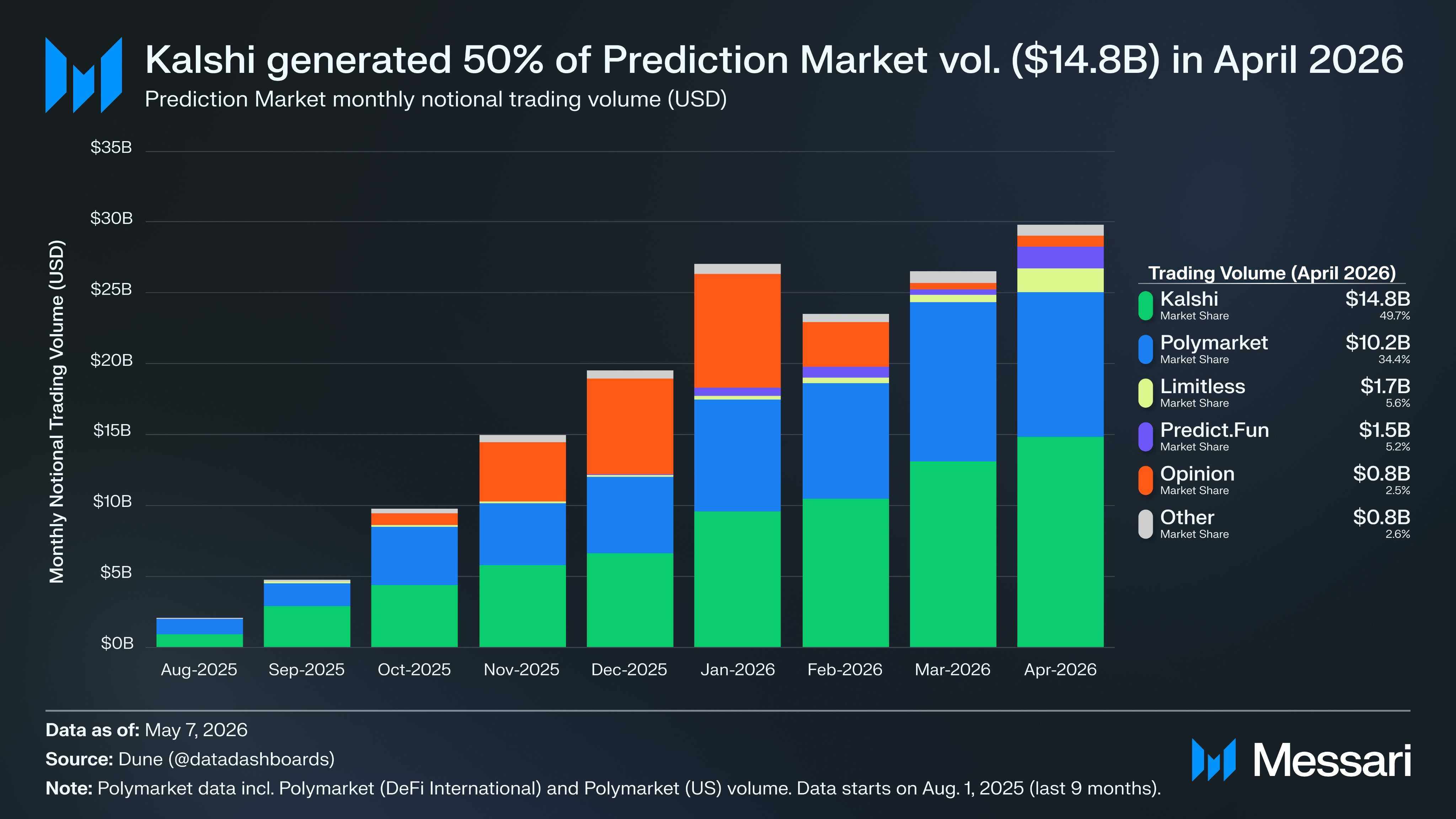
Prediction Market Platform Volume Data - April
While Kalshi holds a leading advantage, the prediction market space hasn't become a one-company show; other platforms are accelerating their efforts. More accurately, Kalshi's lead hasn't stifled the growth of other platforms; instead, it suggests that demand for prediction markets is spreading from the top platforms to multiple entry points.
The future prediction market will likely not have a single winner. Compliant institutional markets, crypto-native markets, exchange-integrated offerings, and vertical-specific event markets may coexist. Different platforms will compete not just for users, but for liquidity and pricing power across various real-world events.
Capital Has Arrived; Prediction Markets Must Prove They Belong at the Big Table
This funding round is not the finish line; it's the beginning of a much larger test.
The significance of Kalshi's raise goes beyond pushing its own valuation to $22 billion. It has placed prediction markets squarely within mainstream financial narratives for the first time. Once seen merely as a trading gateway for elections, sports, and trending topics, capital now begins to believe that real-world uncertainties can be structured into a continuously operating price system.
But this task cannot be accomplished by Kalshi alone. Platforms like Polymarket, predict.fun, and Limitless are also expanding liquidity, improving user experience, and exploring different market entry points. Kalshi represents the compliant institutional route; Polymarket represents crypto-nativity and global liquidity; predict.fun, leveraging Binance's resources, brings prediction markets to exchange users while generating discussion and virality on Platform X through differentiated events.
Only when prediction markets are used not just to chase trending topics, but are adopted by institutions for hedging, utilized by businesses for decision-making, and referenced by markets as signals of real-world risk, will they truly have earned their seat at the financial main table.
Capital has priced in this potential early. Now, Kalshi and the entire prediction market industry must prove that prediction markets are more than just turning news into trades; they can truly transform the uncertainties of the real world into prices that can be trusted and used.


