






Bitcoin faces resistance at $79,000, with $65,000-$70,000 serving as key support


- Core View: Bitcoin price faces strong resistance near the Real Market Price of $78,000-$79,000 and the short-term holder cost basis, reinforcing a medium-term bearish bias. Although spot selling pressure has eased and institutional capital flows have stabilized, weak demand and record short open interest have led the market into a range-bound consolidation pattern, with the $68,000-$70,000 zone acting as key support.
- Key Elements:
- Price is rejected at the Real Market Price (~$79,000) and the short-term holder cost basis, with short-term profit-taking surging to $4 billion per hour, creating strong overhead supply pressure.
- Spot volume delta has recovered from deeply negative levels to near-neutral, indicating easing selling pressure and renewed buyer interest, but demand has yet to generate a sustained breakout.
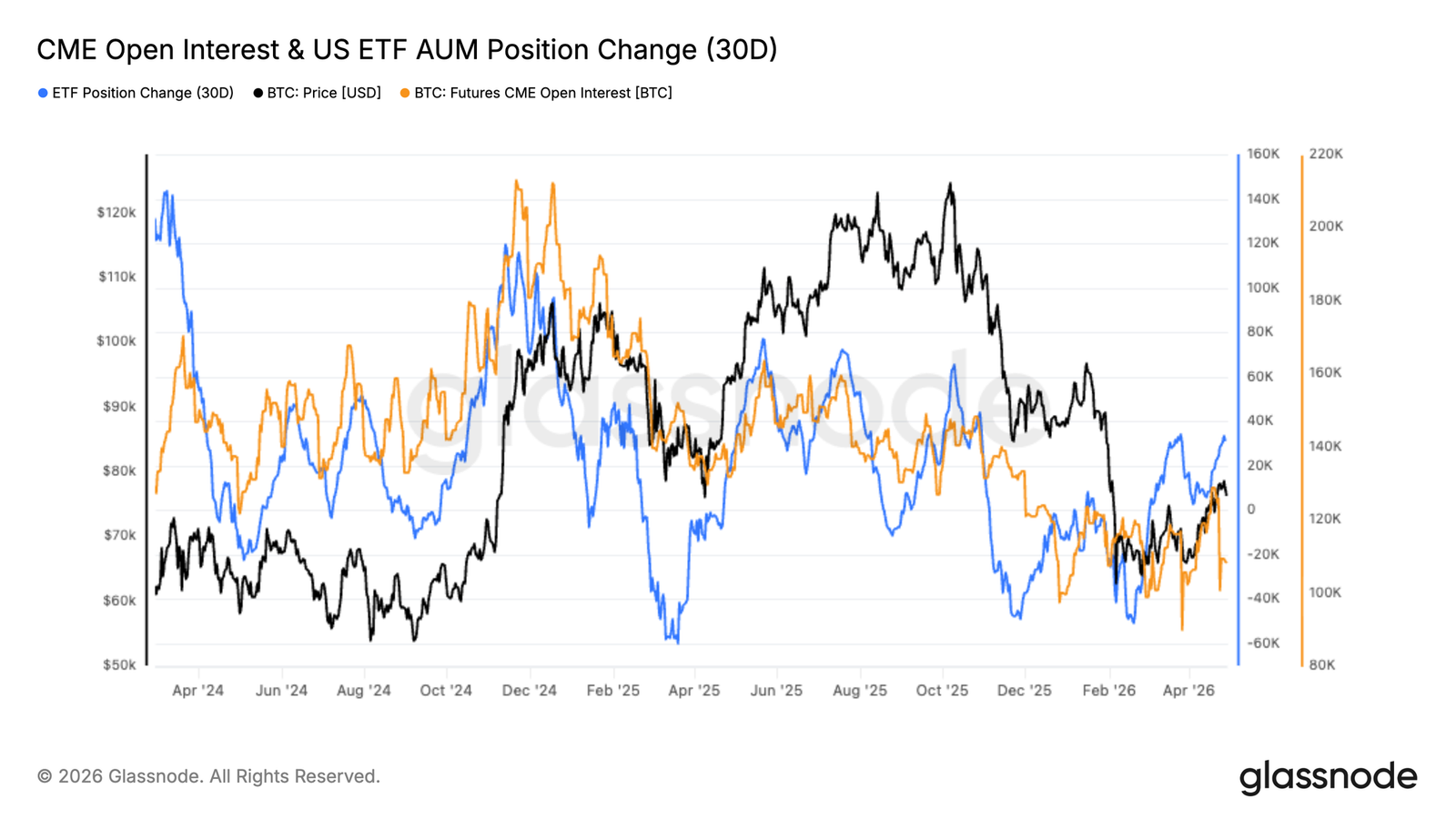
- Institutional positioning shows early signs of recovery: the US spot ETF asset under management (AUM) has rebounded, and CME open interest is beginning to stabilize after a period of sustained outflows.
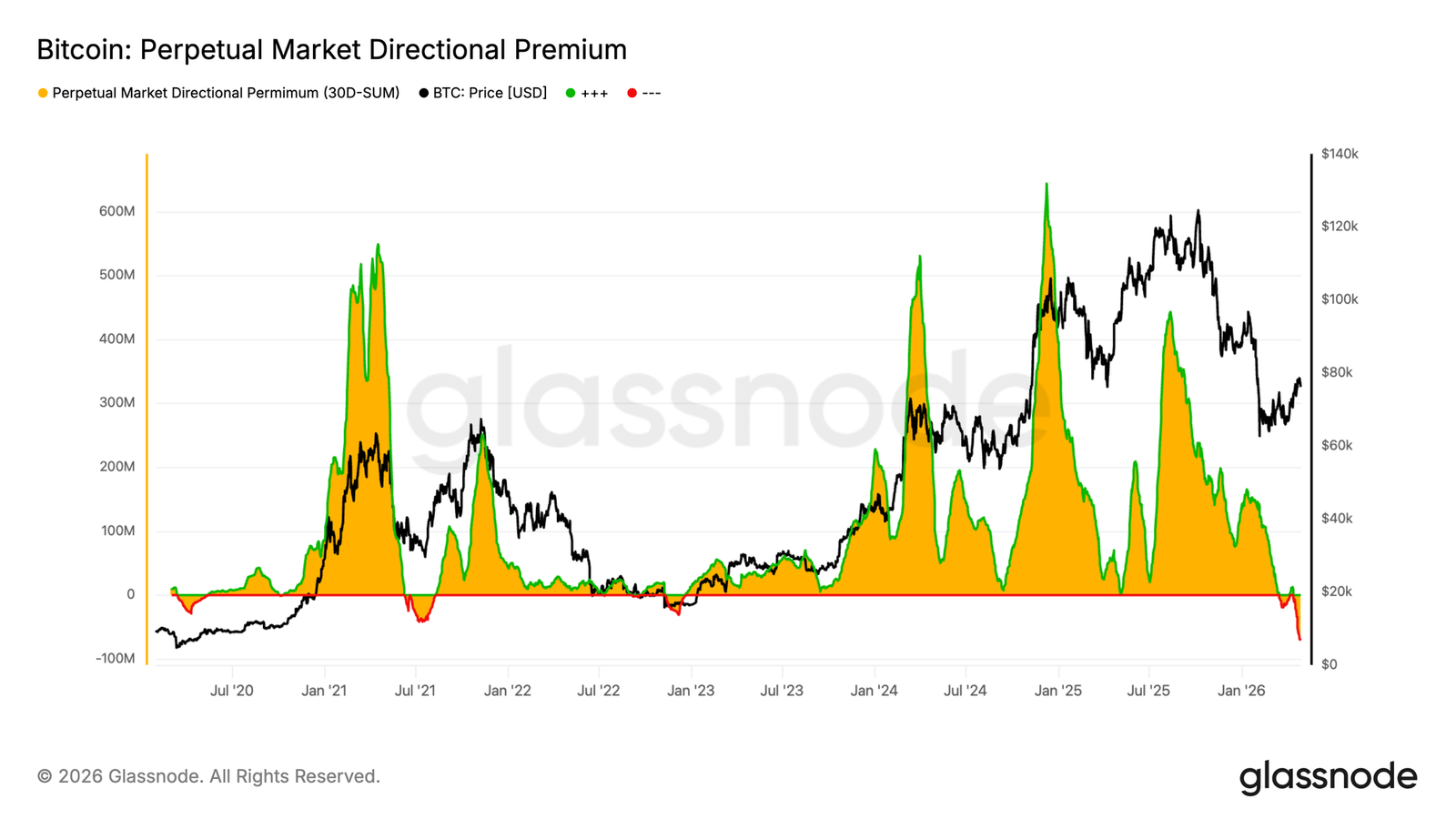
- Net short positioning in the perpetual contract market has reached a record high. The extreme discount reflects a highly hedged and defensive stance, setting the stage for a potential short squeeze.
- A dense accumulation cluster formed within the $65,000-$70,000 range provides near-term support. However, a break below this level could weaken the market structure, with attention on the short-term holder cost basis minus one standard deviation ($68,000).
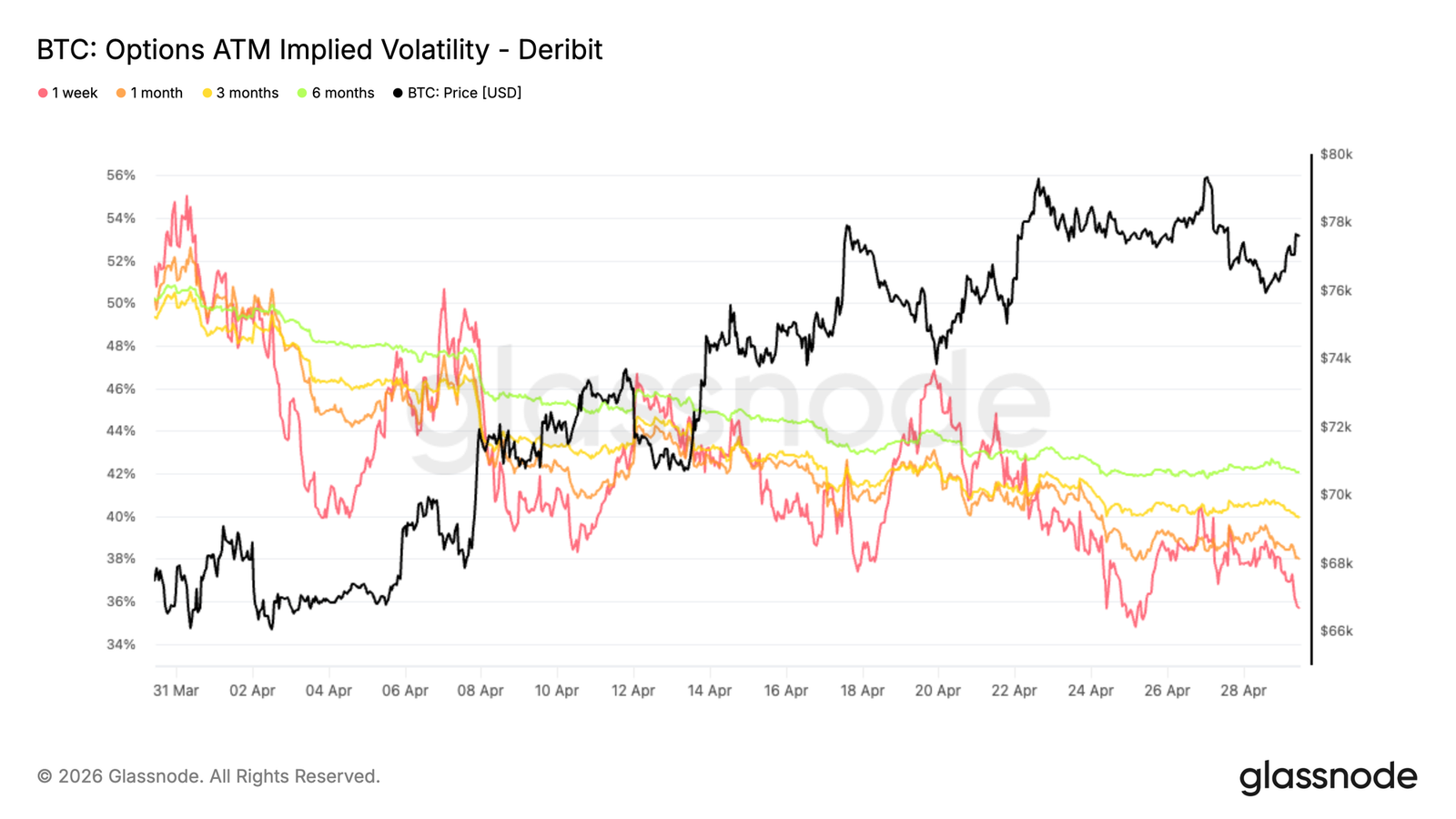
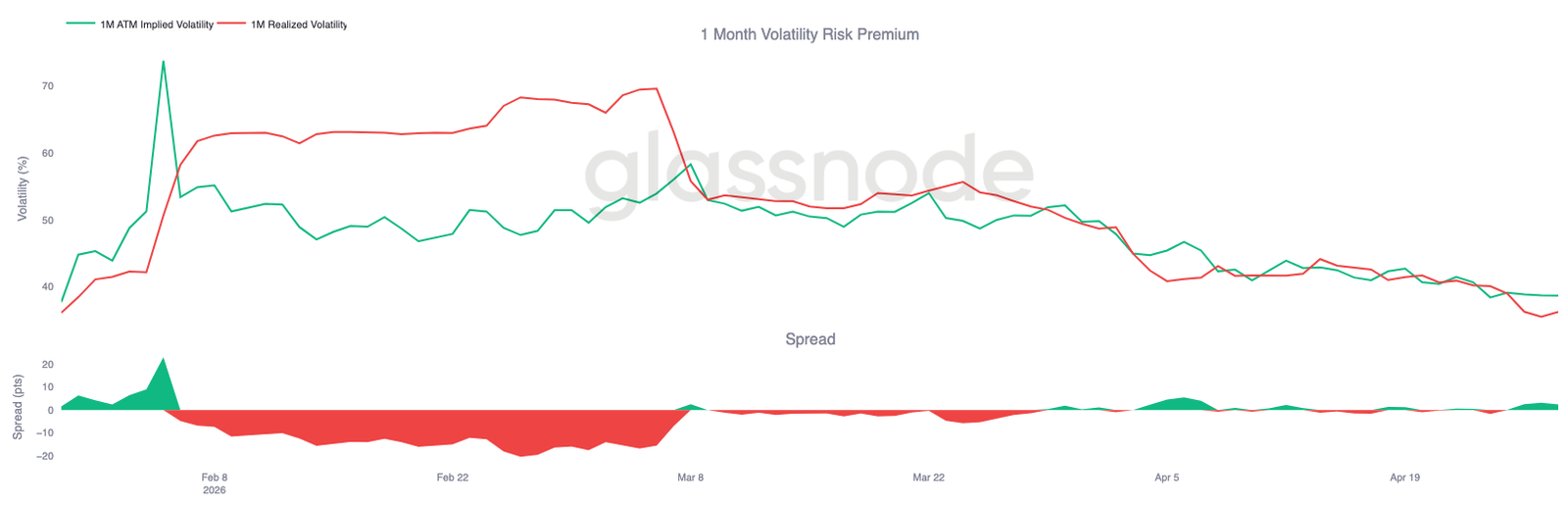
- Implied volatility continues to compress across all tenors. One-month realized volatility has dropped to 36, close to implied volatility (38), suggesting market pricing is stabilizing but directional conviction is limited.
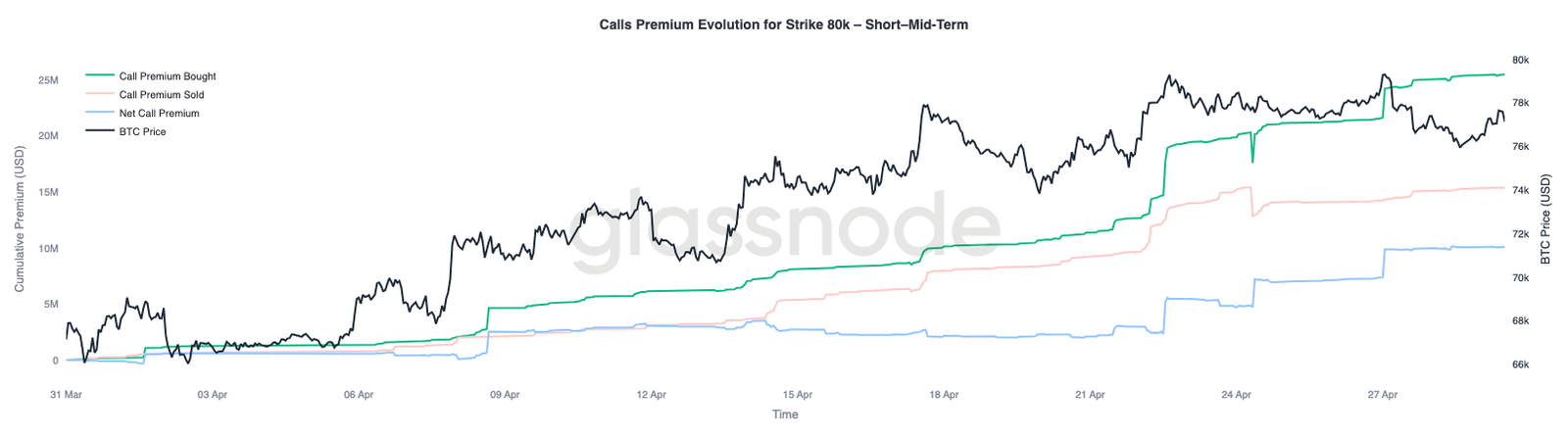
- Persistent buying interest is observed at the $80,000 strike price. Combined with negative Gamma zones around $76,000 and $82,000, a breakout above $80,000 could trigger a sharp upward reaction.
Original Author: Glassnode
Original Translation: AididiaoJP, Foresight News
Bitcoin remains suppressed below the Real Market Price, with support located in the $65,000 to $70,000 range. Spot selling pressure is easing, capital flows are stabilizing, but demand remains weak. Heavy short positioning leaves room for a squeeze in a range-bound market.
Summary
- Price breakout faced resistance at the Real Market Price (~$79,000) and the Short-Term Holder cost basis, reinforcing a medium-term bearish bias.
- Short-Term Holder realized profits surged to $4 billion per hour, reflecting significant profit-taking sell pressure that limited the sustainability of the rebound.
- A dense accumulation cluster between $65,000 and $70,000 constitutes short-term support, but a breakdown below this level would weaken the short-term structure.
- Spot selling pressure is easing, with volume delta recovering to near-neutral levels and early signs of buyers re-engaging.
- Institutional capital flows are stabilizing, with ETF AUM rebounding and CME open interest beginning to bottom after sustained outflows.
- Perpetual futures positioning has shifted to a record net-short bias, highlighting heightened hedging activity and potential for a squeeze.
- Volatility continues to compress, with protection demand rising but conviction weak, reinforcing a cautious, range-bound pattern.
- Realized and implied volatility are closely aligned, confirming a calmer market backdrop with limited directional conviction.
On-Chain Insights
Breakout Fails, Focus Shifts to Support
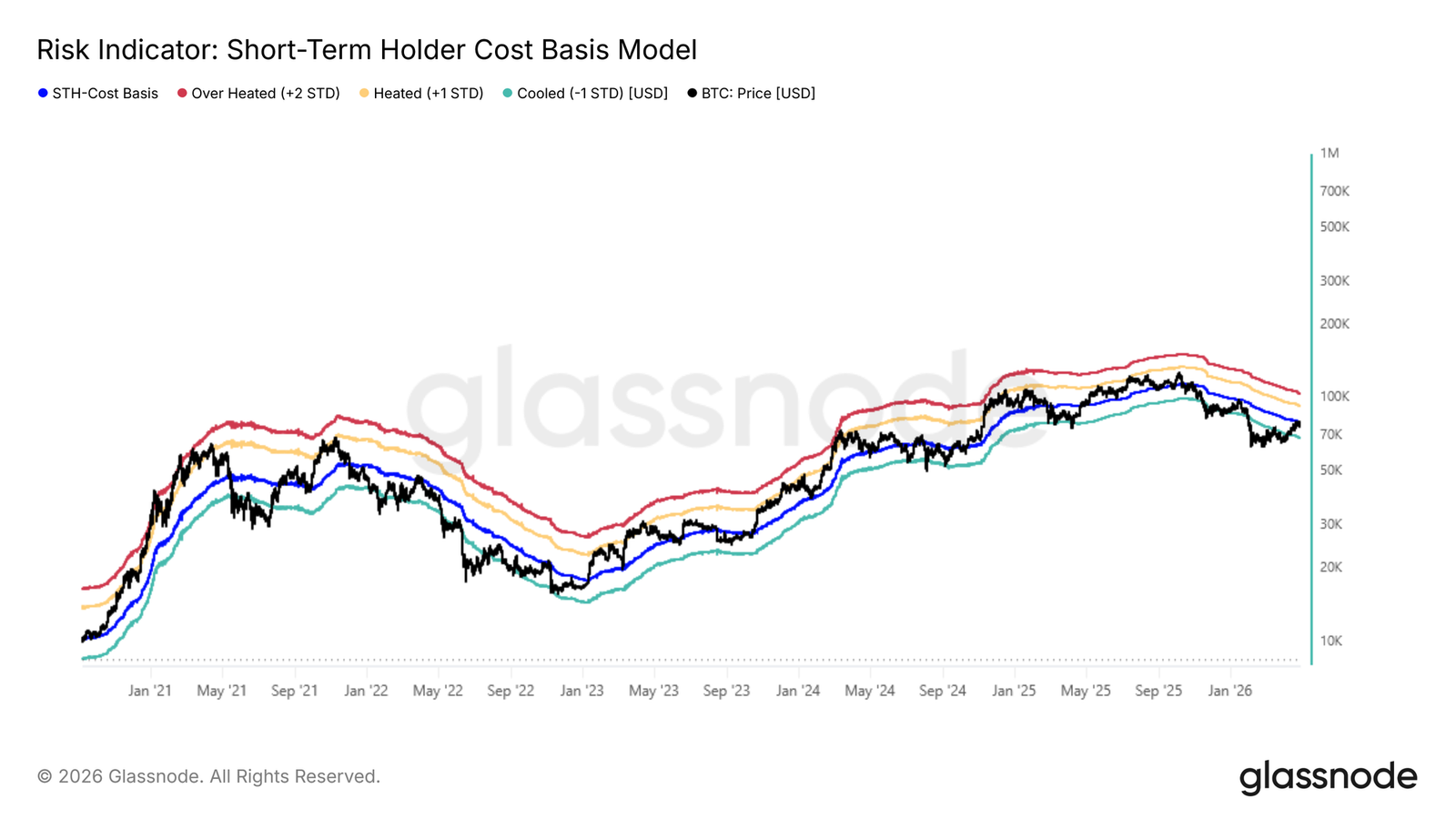
Last week, this report identified the Short-Term Holder cost basis and the Real Market Price as the most likely resistance zones for the current bear market rally, with profit-taking by recent buyers surging to levels historically associated with local tops. Subsequently, the price was rejected precisely in this area, failing to sustain levels above the Real Market Price of $78,000 and the Short-Term Holder cost basis of $79,000. This behavior is a textbook pattern in bear markets: price approaches the breakeven point of the most price-sensitive cohort, exit incentives overwhelm growth demand, depleting upward momentum.
With this rejection confirming overhead resistance and tilting the medium-term bias towards further downward pressure, attention now turns to the -1 standard deviation level near $68,000 as the most immediate structural support level to monitor.
Analyzing the Pullback
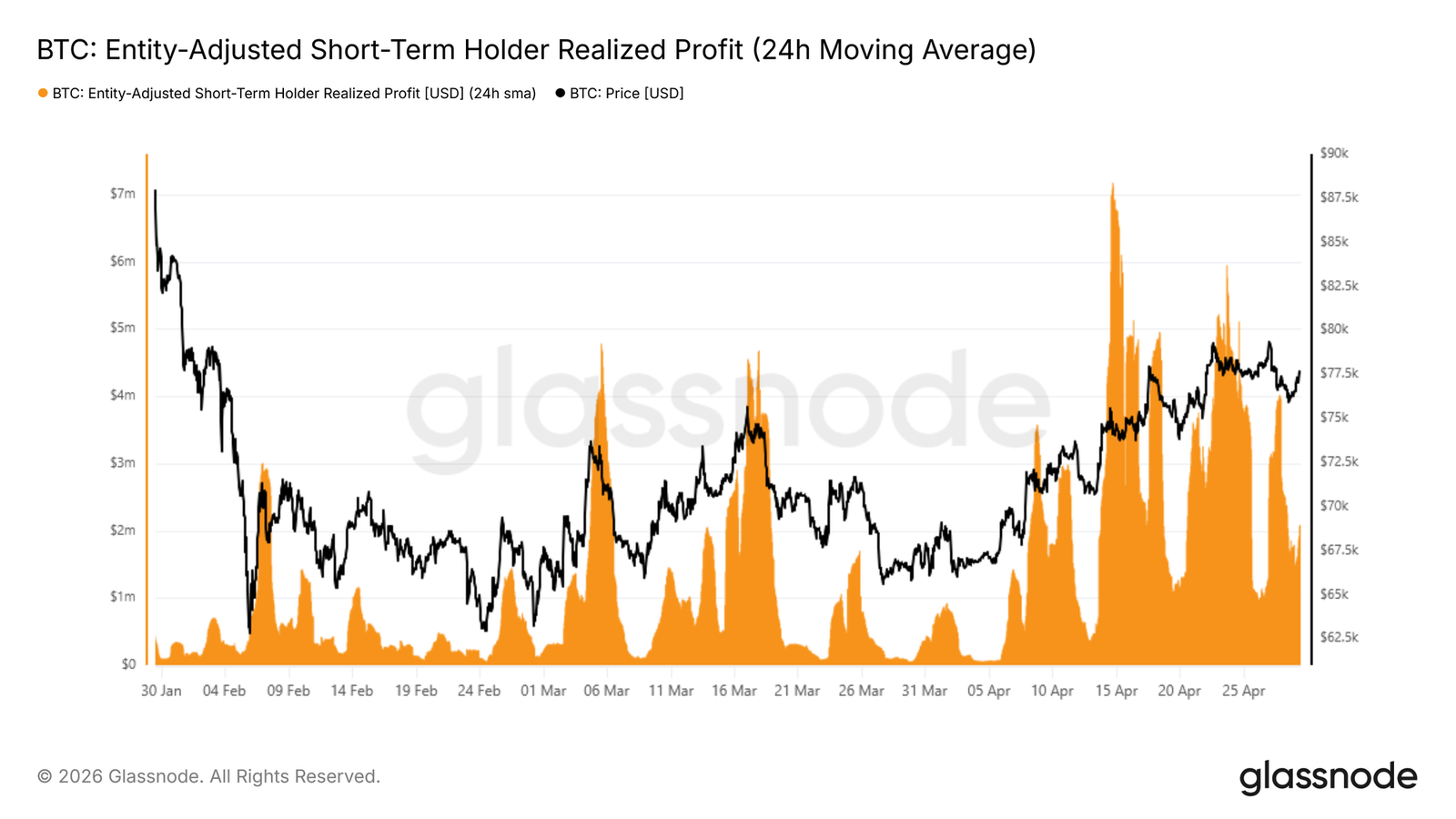
The rejection at the Short-Term Holder cost basis is not just a price observation; on-chain spending data precisely captures how it unfolded. The 24-hour simple moving average of realized profit volume from Short-Term Holders is a real-time measure of the aggressiveness with which recent buyers convert unrealized gains into exits.
As the price approached $80,000, this metric surged to approximately $4 million per hour, roughly four times the baseline level established since mid-April, confirming that Short-Term Holders seized the rebound as a distribution opportunity. Buyer liquidity was entirely insufficient to absorb this wave of profit-taking, limiting momentum and triggering the subsequent rejection.
This metric is most useful when analyzing two dimensions simultaneously: the baseline (as a proxy for the broader trajectory of buyer liquidity) and the peaks (which have consistently served as reliable local top indicators in the current bear market cycle).
Two Scenarios, One Cluster
The resistance at the Real Market Price and Short-Term Holder cost basis reinforces the broader structural weakness characteristic of this bear market. However, the picture is not entirely bearish.
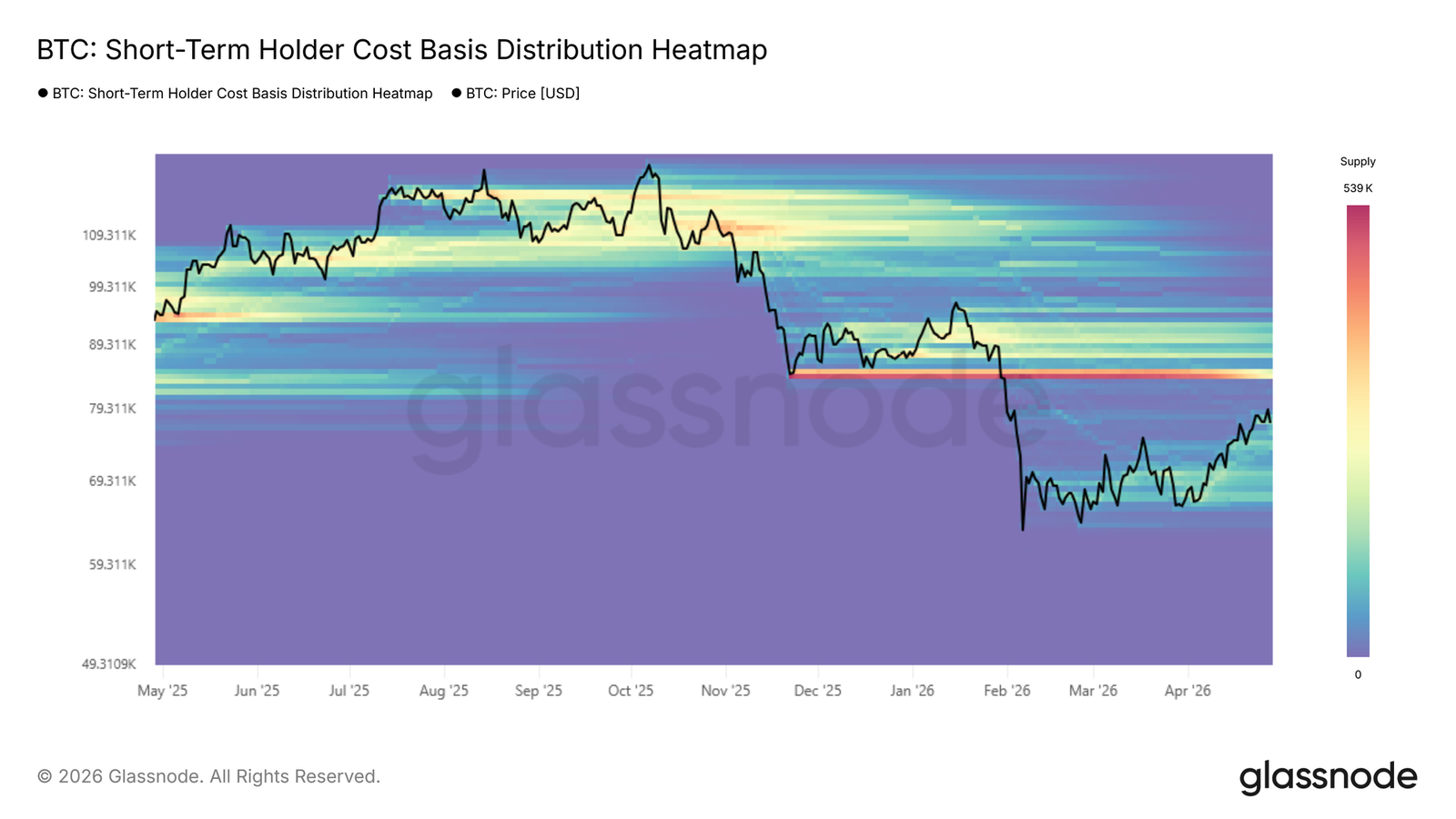
The dense accumulation cluster built between $65,000 and $70,000 over the past two months reflects significant buyer conviction at these levels, providing a foundation for a short-term rebound towards the lower edge of the overhead supply cluster near $84,000.
Conversely, if the market fails to absorb sustained selling pressure from the Real Market Price zone, then this same $65,000–$70,000 accumulation cluster—more specifically, the -1 standard deviation level of the Short-Term Holder cost basis near $68,000—will become the primary support reference for the short-to-medium term. Therefore, the path forward depends on whether buyers within this range can maintain enough conviction to overcome overhead distribution pressure.
Off-Chain Insights
Selling Pressure Eases, Buyers Re-emerge
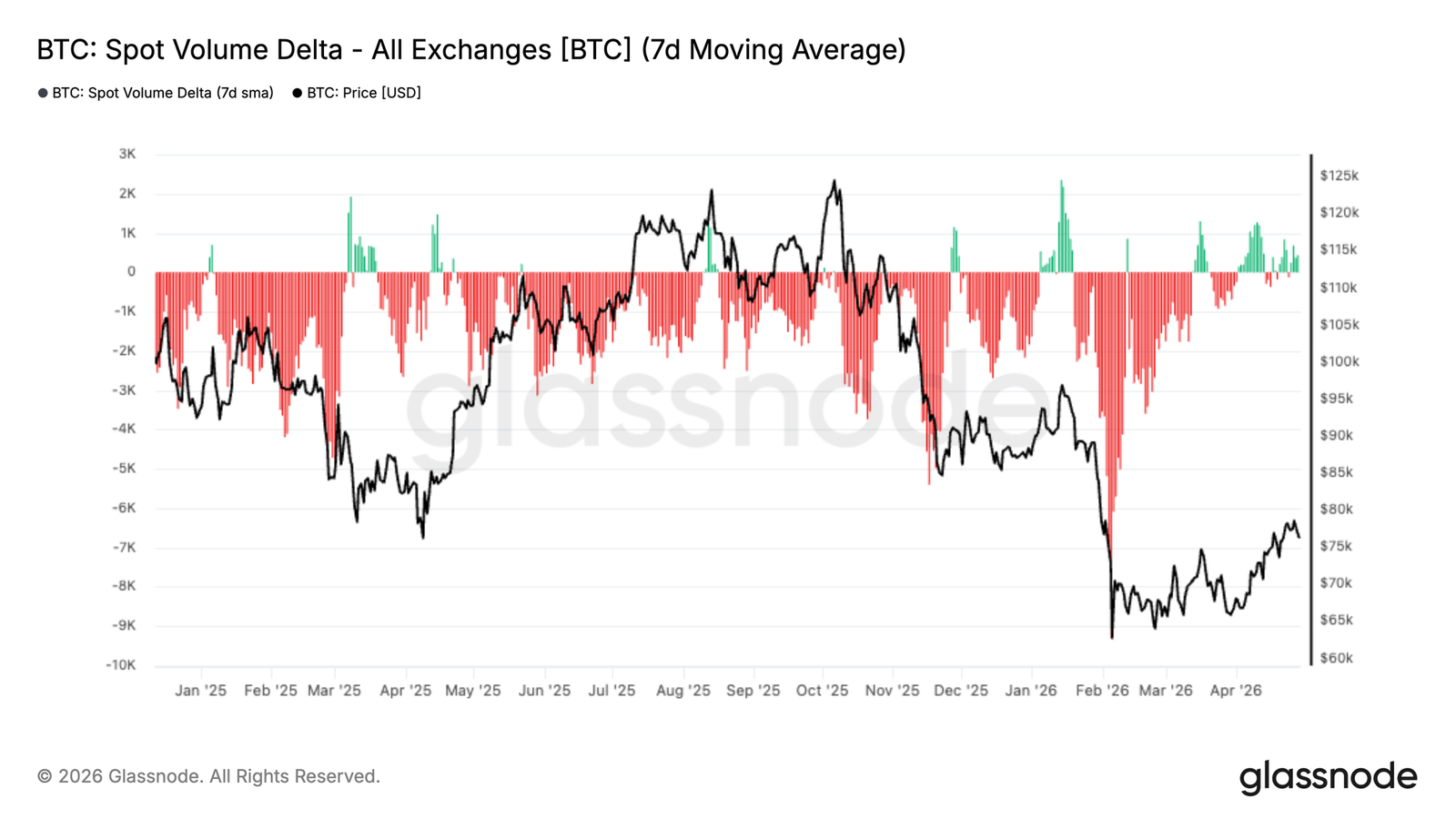
Spot volume delta has been in deeply negative territory for most of the past few months, reflecting sustained net selling pressure on exchanges. This persistent seller dominance aligned with the broader pullback, particularly during the sharp declines into the $60,000–$70,000 range.
However, recent data shows a distinct shift. The 7-day moving average has now recovered to near-neutral levels and is beginning to show intermittent positive delta bursts. This suggests that selling pressure is abating while buyers are starting to re-engage at current levels.
From a market structure perspective, this shift is significant. While not yet indicative of strong accumulation, the move towards balance points to improved spot demand and reduced seller urgency. A more durable recovery would require sustained expansion into positive territory to confirm that buyers are regaining control.
Institutional Liquidity Rebuilding
Institutional positioning is beginning to stabilize, with both CME open interest and U.S. spot ETF AUM showing early signs of recovery after a period of outflows. ETF position changes have rebounded from deeply negative levels, while CME open interest appears to be bottoming, suggesting early re-engagement.
The earlier decline reflected broad risk aversion, with capital exiting both futures and ETF channels during the pullback. The recent uptick points to cautious re-accumulation rather than aggressive positioning.
Sustained inflows would be needed to support a stronger trend. For now, the data indicates early institutional re-entry, but not yet full conviction.
Record Short Bias
The directional premium in the perpetual futures market has fallen to its most negative level on record, marking the deepest sustained short bias in this dataset. Unlike short-lived negative readings in previous cycles, this move reflects a more persistent defensive stance.
The extreme discount is driven by several factors. The recent price weakness triggered an increase in both hedging and outright shorting in the perpetual market, while the liquidation of previously crowded longs accelerated the move through cascading liquidations. Meanwhile, sluggish spot demand and softer ETF flows reduced natural buying pressure, allowing derivatives to dominate short-term price action.
Historically, such extremes occur during periods of high uncertainty and often precede turning points. While short-term uncertainty persists, the market is increasingly set up for a squeeze if sentiment or spot demand improves.
Implied Volatility Declines Across the Curve
Looking back at April, starting with implied volatility, the dominant theme was a broad compression across all tenors.
1-week at-the-money volatility fell by approximately 16 percentage points, while the 6-month tenor declined by about 8 percentage points. Other tenors fell within this range, averaging a decline of around 10 volatility points.
The curve remains in contango, meaning longer-dated options still trade at a premium to short-dated ones, but at lower levels. This reflects market pricing for a more stable environment ahead.
Lower implied volatility reduces the cost of options, particularly upside options. Concurrently, protection demand appears to have eased. Traders are no longer willing to pay high premiums for volatility exposure, aligning with the recent price recovery and pointing towards normalization of expectations rather than accumulation of conviction.
25-Delta Skew Trends Down, but Protection Remains
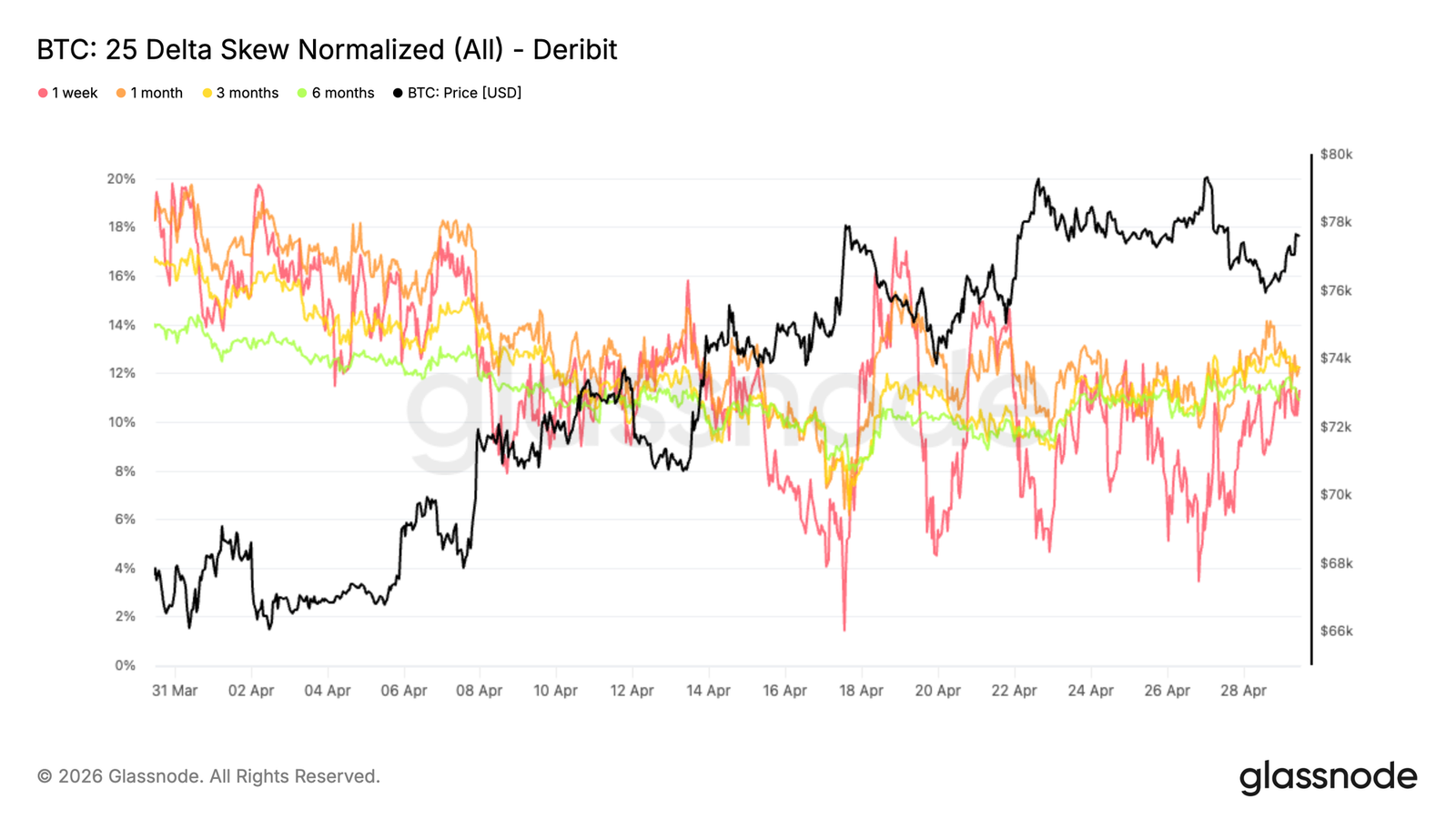
As implied volatility compressed, the skew reveals how protection demand evolved in April. The broader trend was a steady decline in put option premiums, with 1-month skew falling from about 18% to 12%. This reflects a pronounced reduction in downside protection demand as conditions stabilized.
At the short end, the 1-week skew reacted more sharply, with several surges towards neutral (2%–4%) at multiple points in April. These moves were largely tactical, as pullbacks were used to buy call options and sell downside puts, temporarily flattening the skew.
Recently, as the price approached the $80,000 resistance, put demand picked up again, pushing skews across tenors back into the 11%–12% range. Protection persists, with the market making tactical adjustments at the short end while maintaining a cautious stance further out the curve.
Realized Volatility Confirms the Downward Shift
As implied volatility continues to compress, realized volatility has also moved in the same direction, reinforcing the trend. Bitcoin's realized volatility has steadily declined. This is significant because realized volatility anchors how options should be priced. When realized volatility falls, it naturally drags down implied volatility, as the need to price large price swings diminishes.
This creates a feedback loop: cheaper options reduce the urgency to hedge, leading to fewer hedge-driven price moves.
1-month realized volatility stands around 36, while implied volatility is near 38, leaving only a small premium for volatility sellers to assume risk.
The current environment reflects a shift from stress towards a more balanced state. Volatility is no longer being aggressively bought, and the market appears comfortable with a narrower expected trading range.
$80,000 Strike Premium Accumulates as Key Pivot Point
With both volatility and skew easing, positioning becomes the next layer to monitor, with the $80,000 level emerging as a key focal point.
Sustained buying has been observed at the $80,000 strike across short and medium tenors, indicating growing interest in exposure above this level. This suggests traders are positioning for a test of resistance rather than shorting.
Meanwhile, two key negative gamma zones stand out: at $76,000 on the downside and $82,000 on the upside. These levels could become areas where hedging flows amplify price action, particularly in a low-liquidity environment.
A breakout above $80,000 would bring spot closer to the $82,000 zone, where negative gamma could force market makers to buy strength, reinforcing the move. Positioning remains cautious, but it is increasingly setup for a more violent upside reaction if resistance is cleared.
Conclusion
In summary, the market remains trapped below key resistance, with the Real Market Price consistently capping upside attempts, while the support cluster near $65,000–$70,000 provides a floor. Spot selling pressure is beginning to ease, and early signs of institutional re-engagement have appeared, but demand has not yet shown the strength needed for a sustained breakout.
Meanwhile, derivatives positioning has decisively turned bearish, with record net-short exposure and elevated protection demand reflecting a defensive mindset. This leaves the market in a fine balance. While positioning weights are tilted towards caution, it also leaves room for significant upside dislocations if capital flows turn.
Without a clear expansion in spot demand or institutional inflows, the most likely outcome remains a choppy, range-bound environment. The next directional move is likely to be driven not solely by positioning, but by whether real capital steps in to absorb supply and reclaim higher levels.


