






Tonight, Powell’s "Last FOMC": Likely to Hold Steady, but with a Stronger Hawkish Tone


- Core View: The Fed’s April FOMC meeting is expected to keep the benchmark interest rate unchanged. Market focus is on the hawkish signals from Powell’s final chairperson meeting and whether the committee will formally hint that "rate cuts are basically off the table," with the policy path risk shifting to two-sided.
- Key Elements:
- Rate decision is a foregone conclusion: Market consensus expects rates to remain in the 3.5%-3.75% range, with only Governor Miran possibly being the sole supporter of a 25-basis-point rate cut.
- Inflation and employment data: The Iran conflict and energy shocks have pushed up oil prices, delaying the expected inflation decline by another year; March employment data showed resilience, reducing the urgency for rate cuts.
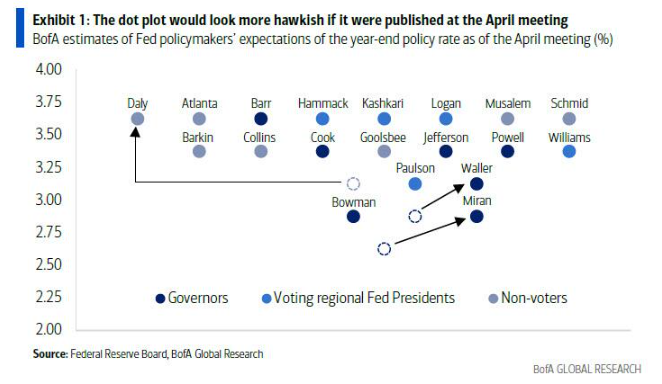
- Dovish stance tightening: Previously dovish committee members like Waller and Daly have highlighted inflation risks. Daly’s baseline scenario now sees rates unchanged for the full year, and Miran has also trimmed rate cut expectations.
- Statement wording is key: If "additional adjustments" is changed to "any adjustments," it would mean the predetermined path for rate cuts has disappeared, shifting to a two-sided risk; however, most voting members favor maintaining current guidance.
- Hawkish tilt in Powell’s press conference: He is expected to reiterate a pause and emphasize inflation as the policy priority. If he stresses that the war has a greater impact on inflation, it will be seen as a very hawkish signal.
- Powell’s final act: His term ends on May 15. Successor Kevin Warsh’s nomination path is clear, and this meeting sets the tone for the policy handover.
Original author: Zhao Ying
Original source: Wall Street News
The outcome of the Fed's April FOMC meeting is almost a foregone conclusion — interest rates will remain unchanged. However, the real focus of this meeting lies in the signals that will be released at Powell's last policy meeting as Chair, and whether the committee will formally convey a hawkish stance to the market that "rate cuts are essentially off the table."
The Federal Reserve will announce its interest rate decision at 2:00 AM Beijing time on April 30. The benchmark rate is expected to remain unchanged in the 3.5% to 3.75% range. Market consensus is highly unanimous, with only Governor Miran expected to dissent, supporting a 25-basis-point rate cut.
The latest changes come from the inflation front. The Iran conflict and energy shocks continue to disrupt the outlook, with gasoline prices still above $4 and traffic through the Strait of Hormuz remaining highly obstructed. Meanwhile, recent employment data has shown resilience, diminishing the urgency for dovish committee members to push for a quick support to the labor market.
Fed officials generally expect the decline in inflation to be delayed by a full year again. Market expectations for rate cuts have narrowed significantly. Deutsche Bank has retracted its earlier prediction of a September rate cut, adjusting its base case to the Fed "staying on hold indefinitely" near the neutral rate.
The core contention at this meeting centers on the statement's wording and the risk characterization in the press conference — the addition or deletion of a single word in the forward guidance could send starkly different policy signals to the market. At the same time, with the DOJ terminating its investigation into Powell, Kevin Warsh's path to being nominated as Fed Chair is largely clear, adding historical weight to this meeting.
Holding Steady is the Consensus, Debate Shifts to 'What's Next'
This FOMC meeting has no dot plot, and the rate decision itself holds little suspense. The focus is on whether the Fed is still willing to retain the policy hint that "the next move is more likely to be a cut," or if it will begin to acknowledge that risks have become two-sided.
According to Bank of America, the current inflation outlook is just as unclear as it was at the March meeting. Although the stock market is trading as if the Iran conflict is over, energy and shipping disruptions persist, and the transmission of the conflict to core inflation remains highly uncertain.
The employment side has not provided sufficient reasons for the Fed to pivot dovish quickly. March data on non-farm payrolls, ADP, and initial jobless claims all indicate a resilient labor market, showing some signs of improvement. This makes it harder for committee members who previously advocated for rate cuts to continue emphasizing "downside risks to employment" as their primary policy rationale.
Even Doves Turn Hawkish, Urgency for Cuts Diminishes
Before this meeting, the most notable shift within the Fed was the increasingly hawkish tone from previously dovish committee members.
In his speech last week, Waller emphasized not only the upside inflation risk from the Iran conflict but also the labor supply shock. He argued that the economy might "need little to no net new jobs" to keep the unemployment rate stable. BofA believes Waller may still hope for a rate cut this year, but the magnitude might be smaller and the timing later than previously anticipated.
Daly's stance went further. She stated that if policy remained unchanged for the entire year, it would provide good constraint on inflation without harming the labor market. She also suggested that the impact of the Iran conflict on inflation might be greater than its impact on growth. Daly's current base case has shifted to a flat interest rate path for the year.
Even Miran, the most dovish member of the FOMC, indicated a preference for three rate cuts this year instead of four, citing the worsening inflation mix since the start of the year. BofA believes that if the April meeting had a dot plot, some committee members' 2026 rate expectations would already be higher, and the risk of more "dots" shifting higher by June is increasing.
Statement Wording: One Word Difference, Vastly Different Signals
The biggest flashpoint in this FOMC statement is whether the Fed will signal that risks to the policy path have become "two-sided."
The current statement's language regarding "additional adjustments" implicitly carries a dovish assumption that the next move is a rate cut. Changing it to "any adjustments" or simply deleting "additional" would mean the direction of the next move is no longer pre-set for a cut, formally opening the policy path to two-sided risk. The March meeting minutes showed that the number of committee members supporting adopting two-sided risk language increased from "several" in January to "some," with firmer wording.
Bank of America views this as a near 50-50 call, but believes a majority of members still prefer to keep the current forward guidance language unchanged. Deutsche Bank leans towards the view that substantive guidance adjustments will be postponed until June, when the committee will have clearer judgment on the Middle East situation, labor market stability, and inflation transmission channels, but the risk is decidedly tilted towards the hawkish side.
Additionally, one adjustment is expected in the statement: given the downward revision to Q4 GDP and weak consumer spending in January-February, the Fed may downgrade its description of economic activity from "solid" to "moderate." However, BofA notes that this adjustment in itself is dovish, somewhat contradicting the committee's overall intention to send a hawkish signal to the market.
Press Conference: A Hawkish Stance from Powell is Imperative
If this is indeed Powell's final press conference as Chair, he will almost certainly maintain a moderately hawkish stance.
According to BofA, Powell's core message might be that the Fed is firmly on hold, and current policy is well-positioned to address the risks to its dual mandate. With uncertainty remaining high, the Fed sees no reason to push back against market pricing of a flat rate path.
The most sensitive question at the press conference will be the threshold for a rate hike. If Powell reiterates that a rate hike is not the base case for a majority of the committee, the market might interpret this as a dovish signal. If he emphasizes the importance of completing the mission to combat inflation or points out that inflation has been above target for several consecutive years, it would be seen as a hawkish signal.
Notably, at the March press conference, "inflation" was mentioned 67 times, while "labor market/employment/unemployment" was mentioned only 40 times, clearly making inflation the heaviest weight on the policy scale. He is not expected to provide a quantitative threshold for rate hikes.
Regarding the Iran conflict, Powell is expected to acknowledge both upside risks to inflation and downside risks to growth and the labor market. However, the market will focus on which side he leans towards. If his remarks are close to Daly's, suggesting the conflict's impact on inflation is greater than its impact on growth, the market might view this as very hawkish.
Focus: Are Rate Cuts Shelved or Just Delayed?
Nick Timiraos, known as the "Fed whisperer," wrote before the meeting that the April meeting marks a juncture for a deeper policy debate: how long can the Fed maintain its stance that "the next move is more likely to be a cut than a hike."
Timiraos pointed out that two years ago, Powell downplayed stagflation concerns, saying he "sees neither stagnation nor inflation." But now, the energy shock from the conflict combined with inflation that hasn't returned to the 2% target makes the historical reflection of 1970s stagflation seem less distant.
He emphasized that the Fed is observing how the US economy digests the fourth supply shock in five years, including the pandemic restart, the Russia-Ukraine conflict, tariff disputes, and the Iran conflict. Each shock alone might be dismissed as an isolated incident requiring no policy response, but their cumulative effect makes managing inflation expectations more challenging.
Timiraos believes the statement itself could be as important as the rate decision. If the Fed modifies the official statement wording to imply that rate cuts are essentially off the table, its market impact could be as significant as an actual policy action.
The Final Dance and the Handover
This meeting is garnering more attention also because it might be Powell's last FOMC as Chair.
Powell's term as Fed Chair ends on May 15. He has previously committed to serving as "interim Chair" until his successor is confirmed. With the DOJ ceasing its investigation into matters related to Powell, the Senate confirmation path for Kevin Warsh has become clearer.
UBS expects Kevin Warsh could be sworn in before the June 16-17 FOMC meeting. If this timeline materializes, the April meeting will be the final complete policy communication window of the Powell era, and the market will pay closer attention to whether he leaves his successor a policy starting point of "no rate cuts for longer."
Market Reaction: Tail Risk Beneath a Non-Event Veneer
Goldman Sachs' trading desk view suggests the market broadly considers this FOMC a low-volatility event, but different assets still have directional sensitivity points.
On the rates front, Goldman analyst Brian Bingham expects no significant hawkish shift in inflation wording in the statement, with Powell likely reiterating a wait-and-see approach. However, the market is currently pricing in only about 5 basis points of change by December, setting a high bar for a significant sell-off and actual pricing of rate hike probabilities. If the base case deviates, the risk is more likely to point towards higher rates, fewer cuts, and a flatter curve.
On the FX front, Goldman trader Carlie Ladda believes a slightly hawkish Fed could trigger some USD buying, but it's unlikely to form a sustained trend. The market remains more focused on the Iran situation, corporate earnings, and month-end factors. The trading desk leans towards selling USD on a bounce.
On the equity front, Goldman's Vickie Chang notes that the main risk from the FOMC for stocks is if Powell more cautiously emphasizes the inflation risk from commodity price shocks, potentially hurting risk appetite. Risk assets have largely priced in a benign view of the conflict's impact, meaning downside tail risks might be underestimated.


