






最Crypto的那批人,正在变得最不Crypto


- 核心观点:Web3行业叙事退潮后,最核心的从业者正转向务实,将区块链技术融入传统金融与AI等真实场景。稳定币支付和RWA成为金融基建核心,而AI标签通胀反映了行业在寻找新叙事。
- 关键要素:
- 香港区块链周与曼谷Money 20/20显示,行业焦点从炒币叙事转向RWA(现实资产代币化)和稳定币跨境支付等金融基建。
- 稳定币公司不再卖币,而是提供支付链路、结算与托管服务,正通过合规渠道渗透传统金融,类似“特洛伊木马”。
- AI与Web3结合概念热度高,但多数项目缺乏清晰落地用例,存在“标签通胀”现象;部分公司转向为AI企业提供真实支付服务。
- 行业分化明显:香港聚焦金融产品化(RWA与理财),曼谷主攻支付通道(稳定币跨境),共同构成区块链留下的金融基建,而非颠覆性革命。
- 基建层已拥挤,差异化关键转向应用层,即谁能将稳定币嵌入高频刚需场景,以及Agentic Payment的信任框架与跨境场景落地。
Original author: Web3 Xiao Lü
What left the deepest impression on me during this year's Hong Kong Blockchain Week in April wasn't any particular panel, but a scene.
Around ten at night, at a cha chaan teng in Wan Chai, four or five people were squeezed around a table, eating stir-fried beef ho fun while chatting about what each of them planned to do next. A friend who used to work on stablecoin payments said their team had fully pivoted to AI; another person working on on-chain data mentioned that half his energy was now spent building data pipelines for AI companies.
No one talked about coin prices. No one discussed narratives. The word "Web3" barely came up.
I wasn't so much surprised as struck by a strange sense of familiarity—three years ago, the same group sitting at the same table would have been talking about DeFi, NFTs, and blockchain games. They were the same people, with the same excitement, the same wholehearted commitment.
After attending the Hong Kong Carnival and Bangkok Money 20/20, one thought kept echoing in my mind: *The most crypto people are becoming the least crypto.*
What remains after the Web3 tide recedes? After these two trips, I think I have my own answer.
1. Hong Kong: Familiar Faces, Unfamiliar Topics
Let's start with Hong Kong. During this carnival, there were noticeably fewer crypto project teams compared to the past two years, when the scene was buzzing with T-shirt giveaways and non-stop narrative-spinning.
This year's official theme was "Mountain, Wind, Cloud, Sea," with a clear intention: bidding farewell to the trading narrative. If someone had said this three years ago, they would have been booed. But this year, no one found it odd, because everyone had long stopped talking about coins. A silent consensus had formed.
Walking around the expo, the faces were familiar: OKX Wallet, TRON, ZA Bank, HashKey, New Fire. But the topics they discussed had changed. The main themes were overwhelmingly focused on two words: RWA and AI.
RWA continued its momentum from last year, but honestly, everyone knows who is genuinely building and who is putting on a show. There's one judgment I find valid: For Hong Kong, RWA is essentially the productization of wealth management and investment—moving real-world assets onto the chain for greater efficiency and easier cross-border distribution. This is precisely what Hong Kong excels at: institutional design and financial productization. As the bubble recedes, Hong Kong actually feels more comfortable—the restless energy that was never meant for it in the first place has finally dissipated.

AI was even more interesting. Almost every panel discussed the combination of AI and Web3. But after listening to several sessions, frankly, most discussions stayed at the level of "these two things should be combined." As for *how* to combine them and *what problem* they solve, no one could clearly articulate.
My feeling is that Web3's jump on the AI bandwagon isn't because the industry thought it through. It's because without jumping on it, there really isn't any story left to tell. And those guests on stage probably knew they were just jumping on it themselves. But first, survive—and that's always been the survival philosophy of this circle.
As for the HKD stablecoin, there was nothing new. Licenses have been issued, but after asking around, the two major banks each have their own pace and are not rushing to make a big splash. It turns out that nobody really cares.
But what truly moved me were the people off-stage. The busiest people at the venue weren't the speakers. They were those wearing casual clothes, hanging exhibitor badges, and moving back and forth in the networking area—people doing BD, managing communities, creating content, and helping projects connect with resources. They don't have impressive résumés and might not sound "professional," but their understanding of the industry grows out of countless dinner meetings and repeated rejections. This kind of understanding isn't acquired from reading reports; it's earned through time.
Whether an industry can survive a cycle depends not only on how many star companies lead the way, but also on how many people are willing to keep grinding when there's no applause.
Web3's foundation is still there. But what runs on top of that foundation has completely changed.
2. Bangkok: The Trojan Horse of Stablecoins
Flying from Hong Kong to Bangkok felt like a shift in scenery.
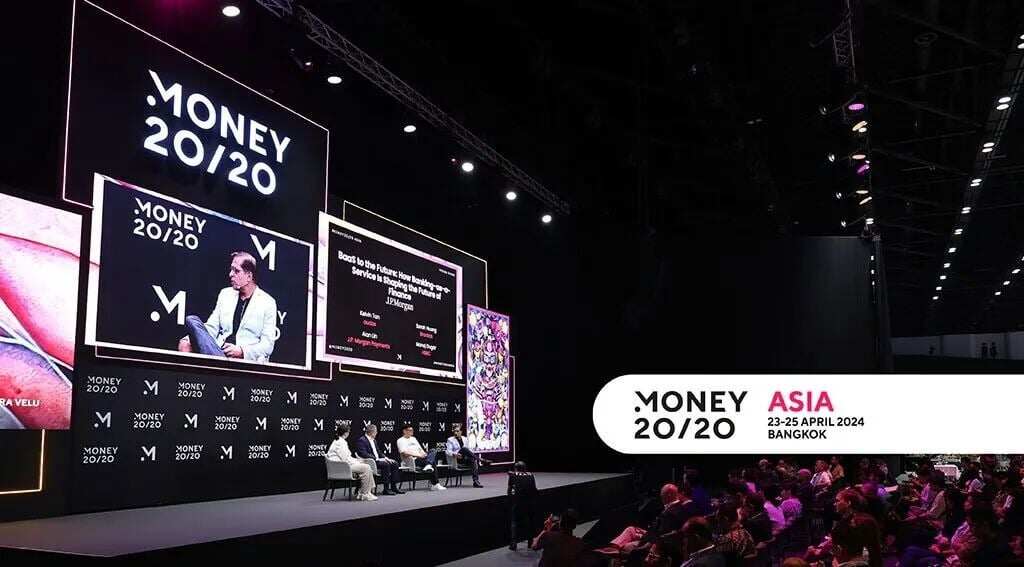
Money 20/20 is a pure fintech B2B expo with a hefty entry fee. Attendees dress as if they're meeting clients. The panel area often had empty seats, but the business networking area was packed from open to close.
What surprised me was that stablecoin and crypto-native companies accounted for about one-third of the exhibitors. OSL, Circle, Ripple, Fireblocks, Cobo, Pyth… at least a dozen companies, many of them first-time exhibitors. Money 20/20 even added a dedicated zone called "Intersection" this year, positioned as the convergence of TradFi and DeFi. Stablecoins are no longer a fringe topic at fintech expos—they are part of the main agenda.
But here's the interesting part: Not a single one of these crypto companies was selling crypto at their booths.
What they were selling, all of it, was payment rails, settlement channels, and asset custody. Some exhibitors even explicitly defined themselves as "Web 2.5 finance"—one foot in crypto-native territory, the other in traditional payments. The people negotiating deals didn't care what chain the underlying system ran on. They wanted three things: fast settlement, low costs, and compliant operations.
I spent two afternoons in the networking area. At the table next to me, "stablecoin" was heard every ten minutes. No one talked about coin prices; the conversations were all about how to build the pipeline, how to onboard merchants, and whose compliance solution to use. Everyone present had business they needed to get done.
In one panel, the host directly challenged the guests: "Brazil's Pix already offers instant free transfers, so why do you still need stablecoins?" The guest's answer was blunt—"Pix solves domestic problems; cross-border is still a mess." Perhaps that's the most honest positioning for stablecoin payments: not replacing local payment systems, but filling the gap in cross-border transactions that traditional finance has never managed to handle well.
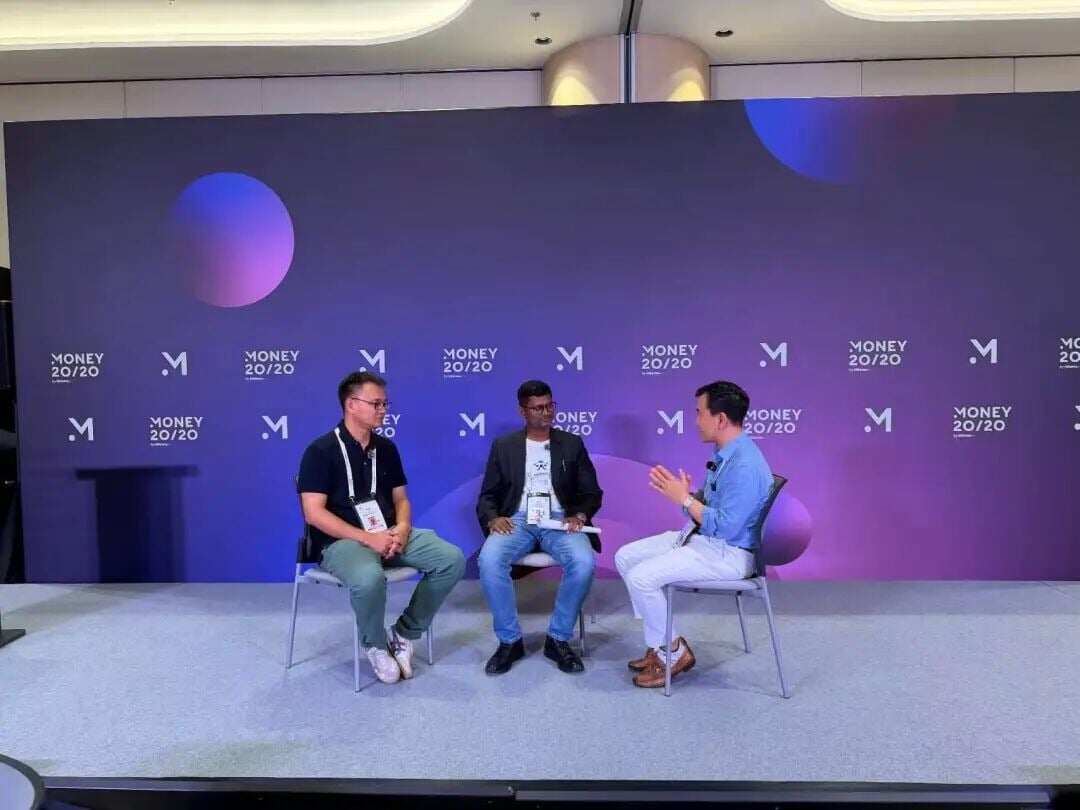
Thanks to an invitation from Finternet, I conducted an interview with Sumsub. After our conversation, I was particularly impressed. This KYC/KYB company's earliest clients were all Web3 projects—exchanges, wallets, DeFi protocols. But now, their biggest growth in new clients is coming from Web2: payment institutions, banks, and companies expanding overseas. The massive client background from Web3 actually served as a credential, allowing them to seamlessly cut into the traditional financial market. Web3 gave them practice; Web2 is the real market.
See, this is the footnote to what I said earlier: *The most crypto people are becoming the least crypto.* Stablecoins are no longer "entering" traditional finance; they have fully integrated—so much so that at the expo, you couldn't tell which company was a stablecoin company and which was a fintech. Even if those traditional financial institutions don't run stablecoin businesses themselves, their clients will force them to integrate.
Stablecoins didn't storm the castle of traditional finance through the front gate. They slipped in through the back door, and by the time the people inside the castle noticed, the passage was already laid.
3. AI Label Inflation
The passage was laid, but new labels were slapped on top of it.
At the Bangkok expo, I counted that roughly eight out of ten booths I passed had the words "AI" or "Agentic" printed on them—Agentic Payment, Agentic Wallets, Agentic Banking.
I stopped by a few products to ask the specific question: "What is your AI module's most mature use case?" The answers were quite vague, mostly pointing to future A2A (Agent-to-Agent) scenarios. As for actual transaction volumes, everyone tacitly avoided giving numbers.
One company, previously in stablecoin payments, made a choice many were thinking about but hadn't yet executed. When the infrastructure layer is already crowded enough, building another channel just means squeezing in among a bunch of similar channels. Instead of waiting for the water to come, they chose to switch to a river that already has water—charging straight into a payment solution for the hot AI industry. Not by slapping an AI label on themselves, but by serving AI companies. Compared to the vague A2A concepts floating around the expo, this was a much clearer approach: Don't wait for agents to one day start paying on their own; solve the payment pain points that AI companies have *today*.
But back to the AI frenzy at the expo—it really did look a lot like Web3 in 2021: infrastructure first, killer applications nowhere to be found. There is one difference, though: In 2021, demand was artificially created to find users. Today's "agentic payment" has at least one genuine premise—AI agents are indeed growing exponentially, and they will eventually need to pay and get paid on their own. The question isn't whether demand exists, but when it will arrive and in what form.
During this window period of "when it will arrive," slapping on a label is the safest choice.
What if it *does* arrive?
4. The Passage is Laid: What Next?
Comparing Hong Kong and Bangkok, a clear divergence emerges.
Hong Kong focuses on financial productization—RWA, wealth management, asset management, where the game is about product design and distribution channels, overlaid with crypto-style operational thinking. Bangkok focuses on payment channels—stablecoin cross-border settlements, where the game is about compliance licenses and local channels. Put these two paths together, and you get what truly remains of blockchain after the Web3 tide recedes: *financial infrastructure*.
Not the yield carnival of DeFi Summer. Not the mass FOMO of NFTs. It's dozens of channels, a stack of licenses, and countless partnerships.
Boring, but real.
Web3's original promise was to "decentralize and rebuild everything." What survived the downturn is patches and extensions of the centralized financial system. The Cypherpunk revolution didn't happen. But the pipes were laid inside the castle walls—and that itself might be more enduring than any revolution.
The passage is laid, but three questions remain unanswered:
- Is it too late for stablecoin infrastructure? There are already too many infrastructure companies at the Bangkok expo. The room for differentiation is shrinking fast. New entrants don't need to build another channel; they need to find what water should flow through the existing channels. Whoever can embed stablecoins into high-frequency, essential-needs scenarios will be the winner of the next phase. Not the channel builders, but the channel users.
- Application solutions are the direction. The infrastructure layer is thick enough; value is beginning to migrate to the application layer. Broadband companies in the 2000s made the first wave of money. The truly big businesses were Taobao and WeChat that ran on top of it. Stablecoins are approaching that tipping point.
- What about Agentic Payment? I've been tracking this field for a while. Visa, Mastercard, and Stripe are all positioning for it; the x402 protocol is also advancing. But to go from protocol to real-world deployment, the gap isn't technology—it's a trust framework and a sufficiently large cross-border transaction scenario. Otherwise, it will remain stuck in demos and panel discussions.
But then again, when someone first talked about stablecoin cross-border payments in 2021, they probably got the same reception: "The concept makes sense, but it's too early for real-world application." Five years later, stablecoins are integrated into the capillaries of traditional finance. Agentic payment might be at a similar stage. It's just that this iteration's window will be much shorter.
5. Final Thoughts
On the flight back, what kept replaying in my mind wasn't the panel content. It was that table in the cha chaan teng.
One person pivoted to AI. One is building data pipelines for AI companies. The few remaining are still figuring out how to get stablecoin payments into more merchants. Three years ago, they were talking about a different world, but one thing hasn't changed: they are still in the game, still working, still throwing themselves into the pool.
The most unique thing about the Web3 circle isn't its cutting-edge technology. It's that it naturally attracts a certain kind of person—the ones who dive in first, no matter how cold the water is. The tracks change. The narratives shift. But this wild, visceral sense of participation doesn't disappear. It just changes its clothes.
After the tide receded, the revolution didn't happen. But the most crypto people—carrying their strategies, speed, and survival instincts—are infiltrating bigger battlegrounds: traditional finance, AI, cross-border payments. They don't shout slogans anymore. But they are more dangerous than ever.
Because this time, they are wearing a suit.


