OpenClaw กระแสคลั่งใคล้ CEX แย่งชิงทางเข้าธุรกรรม AI Agent


- มุมมองหลัก: เมื่อเร็วๆ นี้ แพลตฟอร์มแลกเปลี่ยนคริปโตเคอร์เรนซีชั้นนำที่นำโดย OKX, Binance, Gate และ Bitget กำลังแข่งขันกันเพื่อห่อหุ้มความสามารถหลักในการซื้อขายของตนเอง (เช่น ราคา, กระเป๋าเงิน, การสั่งซื้อ) ให้เป็นโมดูลที่ AI Agent (เช่น Skills, MCP, CLI) สามารถเรียกใช้ได้ เป้าหมายเชิงกลยุทธ์ไม่ใช่เพียงแค่ไล่ตามกระแสร้อนของ AI แต่เป็นการแย่งชิงตำแหน่ง "เลเยอร์การเรียกใช้เริ่มต้น" และโครงสร้างพื้นฐานของรุ่นใหม่สำหรับการซื้อขายที่มีอินเทอร์เฟซการสนทนาเป็นทางเข้า เพื่อป้องกันไม่ให้ตัวเองกลายเป็นเพียงผู้ให้สภาพคล่องแบ็กเอนด์ในยุคของ Agent
- องค์ประกอบสำคัญ:
- จุดสนใจของการแข่งขันเปลี่ยนไป: การแข่งขันของแพลตฟอร์มแลกเปลี่ยนเปลี่ยนจากสภาพคล่องและค่าธรรมเนียมไปสู่การเป็นแพลตฟอร์มที่ AI Agent เรียกใช้เป็นลำดับแรก สิ่งสำคัญคือการปรับเปลี่ยนอินเทอร์เฟซระบบภายใน เพื่อให้ Agent สามารถดำเนินการคำสั่งซื้อขายได้โดยตรง แทนที่จะให้เพียงคำแนะนำในการวิเคราะห์
- การห่อหุ้มความสามารถและความแตกต่าง: OKX มุ่งเน้นที่วงจรการดำเนินการซื้อขายและการควบคุมความเสี่ยง Binance เสริมความแข็งแกร่งให้กับทางเข้าข้อมูลและการกระจาย Skill Bitget มีความลึกในธุรกิจที่กว้างกว่า ครอบคลุมการคัดลอกการซื้อขาย การจัดการเงิน ฯลฯ ในขณะที่ Gate มุ่งมั่นที่จะสร้างฐานแพลตฟอร์มที่สมบูรณ์ซึ่งรวมถึง CEX/DEX
- แรงขับเคลื่อนในความเป็นจริง: แพลตฟอร์มแลกเปลี่ยนมีระบบธุรกิจที่มีโครงสร้างและเป็นโมดูลที่ครบครัน (ข้อมูล, คำสั่งซื้อ, กระเป๋าเงิน) สิ่งที่พวกเขากลัวที่สุดคือการสูญเสียทางเข้าของผู้ใช้ การเกิดขึ้นของระบบนิเวศเช่น OpenClaw ได้จัดเตรียมมาตรฐานและช่องทางการกระจายใหม่ ซึ่งบังคับให้พวกเขาต้องเข้าไปกำหนดตำแหน่งเชิงรุก
- ข้อจำกัดในปัจจุบัน: ในขั้นตอนนี้ การใช้งานที่ราบรื่นส่วนใหญ่อยู่ในขั้นตอน "ก่อนการสั่งซื้อ" เช่น การวิจัยและการสั่งซื้อแบบมีเงื่อนไข การซื้อขายอัตโนมัติเต็มรูปแบบยังคงเผชิญกับปัญหาที่ซับซ้อน เช่น สิทธิ์ ความปลอดภัย และความรับผิดชอบ การย้ายถ่ายความไว้วางใจและพฤติกรรมของผู้ใช้ต้องใช้เวลา
- ความสำคัญของอุตสาหกรรม: นี่เป็นสัญญาณว่าแพลตฟอร์มแลกเปลี่ยนเริ่มจัดการอย่างเป็นระบบกับการปรับโครงสร้างกระบวนการซื้อขายโดย AI Agent ใจกลางของการแข่งขันอยู่ที่ใครสามารถทำให้ความสามารถเป็นโมดูลาร์ ทำให้อินเทอร์เฟซเป็นมาตรฐาน และแก้ไขปัญหาด้านความปลอดภัยและความไว้วางใจได้ เพื่อที่จะกลายเป็นระบบปฏิบัติการทางการเงินแบบเข้ารหัสเริ่มต้นในอนาคต
Original | Odaily@OdailyChina)
Author | Ethan (@ethanzhang_web3)
"Lobster fever" has spread to crypto exchanges, becoming one of the most interesting scenes in the OpenClaw frenzy. In recent days, OKX, Binance, Gate, and Bitget have almost simultaneously pushed Skills, MCP, CLI, Agent Hub, and Wallet Skill into the spotlight.
This time, the exchanges are not just chasing a trend; they are transforming their capabilities, previously encapsulated within apps, web pages, and APIs, into an interface layer that Agents can understand, call upon, and execute. In the past, the competition was about liquidity, fees, and listing speed; now, they are starting to vie for a more forward position: when users delegate research, filtering, and pre-order preparation to an Agent, which platform will be the first to be called upon.
This is also where the real significance of this round of changes lies.
First, let's see what these exchanges have been updating in recent days
In this round of action, the update pace of each exchange has been very dense.
OKX's moves actually unfolded in two steps. On March 3rd, Odaily cited official news stating that OKX OnchainOS had opened AI-related capabilities, allowing Agents to execute on-chain transactions, gain market insights, perform address analysis, and make on-chain payments through three methods: AI Skills, MCP, and Open API. According to the OnchainOS official documentation, this system itself already covers core capabilities such as wallet, trading, market data, and payments, claiming to cover 130+ mainstream public chains and aggregate 500+ DEX routes on the trading side. By March 10th, the OKX Agent Trade Kit took another step forward, bringing the two access paths okx-trade-mcp and okx-trade-cli, along with 4 pluggable Skills, to the forefront. What's truly noteworthy is not the "AI trading" label, but the detailed explanation: AI can complete spot, perpetual, and conditional order operations through a single MCP interface; keys are only stored in local configuration, and signing is done locally; if an API Key lacks trading permissions, the corresponding order tool simply won't be registered in the toolbox. The official scale mentioned is 82 tools, 7 modules, also highlighting live options market and simulation mode. Looking at OnchainOS and Agent Trade Kit together, it's clear that OKX's goal in this round is not just to create a trading assistant, but to align both on-chain and trading capabilities with Agent infrastructure.
Binance's pace was earlier and more continuous. On March 3rd, the first batch of 7 AI Agent Skills were announced, followed by the Skills Hub bringing these capabilities to the front, publicly listing modules like crypto-market-rank, meme-rush, query-address-info, query-token-audit, query-token-info, spot, trading-signal. The next day, it was disclosed that MPC Wallet and DeFi Wealth Management had entered the audit stage; by March 12th, 4 new AI Agent Skills directly expanded capabilities to Alpha market data, USDⓈ-M futures trading, margin trading, and asset management. This means Binance's line is no longer just the initial 7 informational Skills, but has rapidly extended from information entry to derivatives, margin, and account management. The most interesting line on the page isn't the feature introduction, but that all Skills undergo review before going live. This indicates Binance wants to capture not just the traffic entry point, but also the rules for capability distribution in the Agent era.
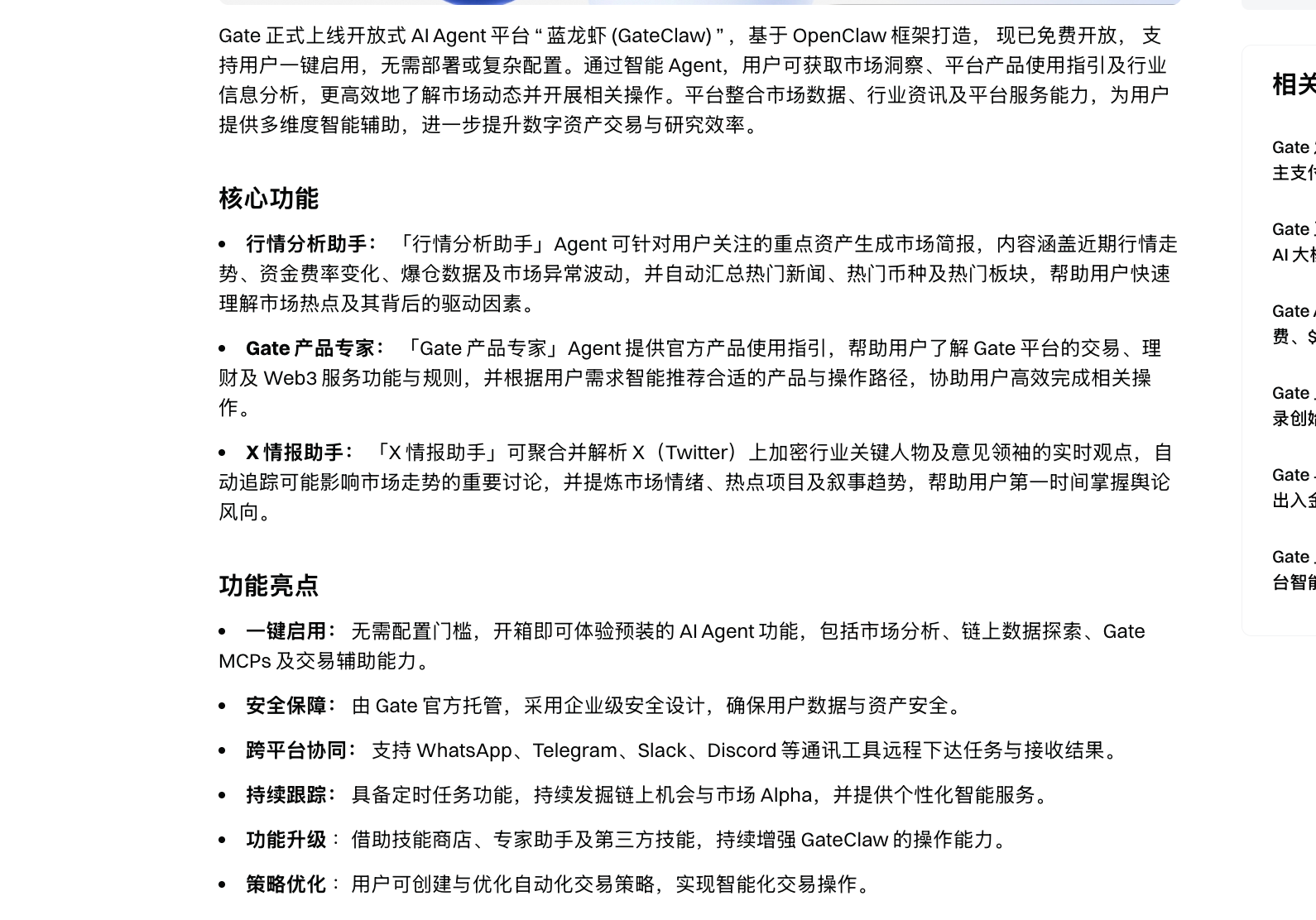
Gate's updates were more like a rapid-fire sequence. On March 5th, Blue Lobster was released first, lowering the barrier for ordinary users to experience GateClaw; on March 7th, DEX MCP went live; on March 10th, CEX MCP followed, by which point Gate had connected both on-chain and centralized trading capabilities to the Agent scenario. Then, on March 11th alone, it consecutively pushed forward Skills Hub, new version of Blue Lobster, Gate CLI, Blue Lobster Operation Guide, and 20 AI Agent Skill updates. This means Gate isn't just putting up a "Gate for AI" page; within days, it has rolled out the experience entry point, DEX/CEX MCP, CLI, Skills Hub, and Agent Skill layers. Looking back at the architecture of Gate for AI—application layer, capability layer, protocol layer, infrastructure layer, and the five core modules of Exchange, DEX, Wallet, News, Info—it becomes clearer: its goal isn't a single-point tool, but packaging CEX, DEX, wallet, information, and on-chain data together into a set of Agent infrastructure.
Bitget's actions have also formed a very complete line. The earliest was on February 27th, with the Bitget Wallet Skill beta released, focusing on allowing large models and automation tools to access on-chain data and trading infrastructure using natural language, with transactions still requiring user signature confirmation; then on March 2nd, Bitget Wallet initiated exploration of Agent scenario capabilities and launched the Skills beta, bringing the Wallet line fully to the forefront. By March 9th, the Bitget Agent Hub received a major upgrade, connecting the Skills and CLI modules to form a complete calling system with the MCP and API launched last month, claiming 9 major modules, 58 tools, and 3-minute integration with OpenClaw; on the same day, Bitget Wallet announced integration with Paydify, bringing consumer payment scenarios into the Agent ecosystem; then on March 12th, Bitget Wallet MCP opened for user testing, further pushing on-chain wallet capabilities towards a callable interface layer. Looking further, the March monthly report presented another set of numbers: approximately $205.95 million net inflow in February, ranking third globally among CEXs, with BTC reserves rising to 36,700. Connecting these actions, Bitget is clearly not just temporarily riding the lobster wave; while experiencing platform growth, capital inflow, and brand expansion, it is integrating Wallet, payments, Agent Hub, MCP, and other capabilities into its infrastructure narrative.
Looking at the timeline of these past few days reveals a clear change: This wave is no longer just exchanges collectively issuing a round of AI press releases; several leading platforms have started to sequentially repackage capabilities like market data, addresses, audits, wallets, order placement, and risk control—previously scattered across pages and APIs—into modules that Agents can call upon.
In a nutshell, the difference is: Previously, most products just made AI better at talking; this round, leading exchanges are starting to make AI actually capable of calling things.
The industry hasn't been silent about AI trading in the past year. Auto-copy trading, signal bots, strategy generation, research report summaries—all have been discussed. The problem was, those products often just added a smarter front-end to the existing trading process. AI analyzed on one side, trading executed on the other, with users still needing to switch pages, copy parameters, and click confirm in between. Essentially, they were still helping you watch, not connecting the systems for you.
This round is different. It's no longer satisfied with keeping research and suggestions within a dialog box, but is starting to move towards system calls, permission boundaries, and execution chains. Precisely because of this, what exchanges are now releasing is not just simple dialog layer enhancement, but starting to touch real system interfaces.
Comparing the exchanges, the gap is no longer about "having it or not," but "how far along they are"
Based on the author's hands-on experience, if we really put the four into a table, spot and conditional orders are no longer scarce capabilities. The gap mainly lies in deeper aspects. (Agent tutorials for each are attached at the end; here we only share the author's experience.)
Starting with the most basic spot scenario. Buying some ETH while placing take-profit and stop-loss orders—this kind of action is already supported by three. Binance's Spot Skill supports OCO, OKX's spot module can handle take-profit/stop-loss, and Bitget's spot conditional orders are also out. At this stage, the difference isn't about capability, but who integrates more smoothly and whose Agent understands intent more accurately.
Futures start to differentiate the layers. OKX and Bitget can already directly handle instructions like opening positions, stop-loss, and take-profit. Binance did not put futures at the forefront during the first batch of Skills phase, so that version felt more like a research and spot execution entry. Although it later added USDⓈ-M futures, margin, and asset management, judging from the current public product completeness, the smoothest parts are still the information layer and standardized spot scenarios.
Looking further, Bitget's boundaries are more open. Modules like copy trading, wealth management, and account management are already publicly displayed. Trader screening, automatic copy trading activation, wealth product queries, and subscriptions—these are no longer just slogans. OKX and Binance haven't yet placed these parts at the same depth. Therefore, Bitget gives a more direct impression: it's not just making a few more Agent tools; it's moving the entire trading environment into the dialog box.
Binance also has its own strengths. In several public hands-on reviews, the chain of address query, hot token analysis, token audit, and spot trading is the smoothest. Especially in the pre-order layer, capabilities like wallet address insights, token security audits, and market rankings are well-suited for Agents to handle first. However, its boundaries are also clear; for example, wallet queries currently only support BSC, Base, and Solana chains. Many capabilities first establish the entry point, then gradually add depth.
OKX seems to focus its efforts more on the execution layer. By putting spot, perpetuals, conditional orders, options, local signing, and simulation environment together, it's clearly prioritizing solving a harder problem: once an Agent truly interfaces with the order system, how are permissions managed, risk controls maintained, and simulations run? OKX's thinking here seems more advanced.
Gate is not yet easy to compare using a few single-point scenarios. Compared to the previous three, its currently publicly visible third-party hands-on scenarios are relatively fewer, making it hard to directly say it surpasses anyone in a specific trading action; but judging from the consecutive rollout of DEX/CEX MCP, CLI, Skills Hub, and 20 Agent Skills in recent days, Gate isn't just patching a feature; it's laying a foundation. In the short term, it might not be the most aggressive in usability; in the medium term, it aims to capture a more critical platform position. Beyond features, there's another intuitive feeling: in this wave, even exchange naming conventions are becoming more similar. As the heat rises, distinctiveness hasn't fully kept up.
Using Bybit as a control group makes the difference more apparent. As of March 13, 2026, its most visible public actions are still event-driven narratives like the AI vs. Human 1v1 Trading Competition, which can drive traffic, but are clearly not the same as the product rhythm of pushing Skills, MCP, CLI, and modular interfaces forward like the others.
Therefore, looking at them together, the conclusion is already quite clear: Binance first secured the information and Skill distribution entry point, OKX is closest to a trading execution loop, Bitget currently shows the deepest business vertical publicly, Gate is more like building a platform foundation, and Bybit remains at the activity and communication layer, not yet entering this round of real product competition.
Why are exchanges the ones rushing out first?
This question is actually more important than who is currently more comprehensive. Exchanges are precisely the companies least likely to slow down in this matter.
Market data, depth, accounts, orders, wallets, risk control—these are inherently the most mature, structured, and most suitable for modularization among an exchange's daily business capabilities. For large models, the difficulty has never been "understanding a human sentence," but whether there are reliable external systems to connect to after understanding. Exchanges happen to have all these ready-made systems in hand.
A more realistic layer is that exchanges fear losing the entry point more than other projects. In the past, users opened the app first, then checked the market, then placed orders; later, users started entering through wallets, quantitative tools, Telegram groups, and on-chain dashboards. Now, Agents have created a new layer of entry. In the future, users might not open a trading page first, but first say in Claude, OpenClaw, ChatGPT, or a terminal: "Help me see which coins are moving the most today, and if the risk is controllable, give me a batch buying plan." If the first touchpoint becomes a dialog box, and exchanges don't proactively make themselves the default capability layer for Agents to call, they risk being relegated to mere liquidity backends.
The OpenClaw wave of popularity has just pushed this forward. Previously, terms like Skills, MCP, and CLI were more developer-oriented; now exchanges, media, and KOLs can use them to tell stories. For exchanges, this isn't just a few new buzzwords; it's a new layer of distribution channels suddenly taking shape. Whoever enters first has the chance to secure a position before standards solidify. (Recommended reading: "11 Key Questions About Lob