Securitize上市一周跌去四成,代币化行业迎来专利战


- 핵심 의견: 토큰화 플랫폼 Securitize 상장 후 주가가 약 40% 폭락했습니다. 이는 토큰화 산업의 펀더멘털 붕괴가 아닌, SPAC 메커니즘에 내재된 가치 재평가 리스크와 특허 소송의 먹구름을 반영한 것입니다. tZERO가 제기한 특허 소송은 전 산업을 대상으로 한 특허전의 서막을 열 가능성이 있습니다.
- 핵심 요소:
- Securitize가 SPAC을 통해 상장한 후, 주가는 1주일 만에 최고점 대비 약 40% 하락해 8.06달러를 기록했습니다. 이러한 하락은 회사의 펀더멘털 악화보다는 SPAC 투자자 구조의 변화에서 비롯된 것입니다.
- 유사한 SPAC을 통해 상장한 암호화폐 회사들(Twenty One Capital, ProCap Financial)도 각각 최고점 대비 80% 이상, 76% 이상 급락하는 등 유사한 폭락을 겪었으며, 이는 가격 결정 메커니즘의 시스템적인 결함을 보여줍니다.
- tZERO는 Securitize가 두 가지 핵심 특허(증권형 토큰 스마트 계약 규칙 및 암호화폐 통합 플랫폼)를 침해했다고 주장하며, 상업화 중단과 손해배상을 요구하고 있습니다. Securitize는 이에 대해 비침해 확인 소송을 제기했습니다.
- tZERO는 토큰화 인프라의 핵심 부분을 포괄하는 105개의 특허를 보유하고 있으며, 이미 최소 6개의 다른 잠재적 침해 대상을 식별하고 추가 협조 공문을 발송할 계획입니다.
- 업계 RWA 시장 규모는 연초 약 220억 달러에서 현재 330억 달러 이상으로 확장되었으며, 특허 장벽과 상업화 간의 충돌이 본격적인 단계에 접어들었습니다.
Original author: Sanqing, Foresight News
On July 2, Securitize (NYSE: SECZ) officially landed on the New York Stock Exchange through a SPAC merger with Cantor Equity Partners II. The stock initially rose on its first trading day, with the market viewing it as a landmark event signaling traditional capital market recognition for the tokenization industry. However, just a few trading days later, the script took a sharp turn. As of the close on July 7, SECZ was priced at $8.06, a single-day plunge of 25.92%, hitting an intraday low of $8.00, representing a retracement of approximately 40% from its peak in the first week of listing.
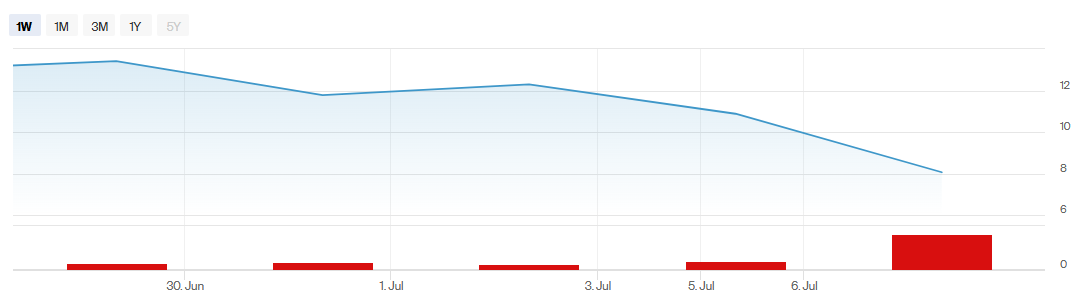
Source: NYSE
This is a company selected as the transfer agent by BlackRock's tokenized money market fund BUIDL, a recognized leading platform in the field of tokenization by the capital markets, with a pre-merger valuation of $1.25 billion. The stark contrast of the continuous decline after listing has led many investors to scrutinize the gap between the "tokenization narrative" and the "secondary market reality."
SPAC Mechanism Exposes Problems Before Fundamentals
Over the past few years, almost all crypto-related companies that went public via SPAC have experienced similar valuation repricing during the lock-up period.
Twenty One Capital (XXI), also orchestrated by Cantor Fitzgerald affiliates, fell about 25% on the day of its SPAC merger listing on the NYSE on December 9, 2025, closing at $11.42. Since then, its stock price has trended downward, briefly dropping below $6, losing over 80% of its value from its peak of $49. Similarly, ProCap Financial (BRR), a Bitcoin treasury company that merged concurrently, had an offering price of $10, and its stock price now hovers around $2.4, a decline of approximately 76%.
Many market participants attribute this crash to the SPAC structure itself, rather than a deterioration in the company's fundamentals.
According to CoinDesk, Arca's Jeff Dorman publicly stated that this volatility is more a result of the SPAC mechanism than fundamental degradation. After a SPAC listing, the investor base undergoes a complete shift, from SPAC subscribers who originally preferred fixed-income-like returns to stock holders genuinely focused on long-term fundamentals. This churn process inherently creates significant volatility.
Market confidence in the "tokenization" narrative itself hasn't collapsed; what has collapsed is confidence in the SPAC pricing mechanism. Despite the falling stock price, Securitize tokenized $295 million worth of its own stock on its first day of listing and deployed it on Solana and Avalanche.
Securitize's decline also occurred against a backdrop of overall pressure on US-listed crypto concept stocks. As of early July, Coinbase and Circle stock prices were down approximately 63% and 74%, respectively, from their all-time highs set in July 2025. During the same period, the S&P 500 index only retraced about 2% from its June high. When an entire sector's stocks are more volatile than the underlying assets, a newly listed tokenization platform can hardly buck the trend.
Patent Lawsuit Exposes Industry Cracks
On June 15, tokenization infrastructure company tZERO sent a "cease and desist" and letter of reservation of rights to Securitize, alleging that its two core products, DS Protocol and Vault Registrar, infringe upon patents held by tZERO. Specifically, this involves US Patent 11,216,802 (Smart Contract Rules for Self-Executing Security Tokens) and 11,394,560 (Cryptographic Integration Platform).
tZERO demanded that Securitize cease the commercialization of the related products by June 18, or else it would seek injunctive relief and monetary damages.
Securitize went on the offensive, filing a "Declaratory Judgment of Non-Infringement" (Case No. 1:26-cv-00722, Securitize, Inc. v. tZERO Group, Inc. et al.) in the US District Court for the District of Delaware on June 22. It asked the court to confirm that its products do not infringe on tZERO's patents, characterizing the allegations as "baseless," "lacking substance," and stating they are "contrary to the spirit of fair competition in the industry."
The case is currently in its early stages, assigned to Judge Gregory B. Williams. No substantive pleadings, counterclaims, motions to dismiss, or settlement news have yet emerged. This means multiple outcomes remain possible, including out-of-court settlement, partial dismissal, or even tZERO withdrawing its claims.
The weight of this lawsuit far exceeds an ordinary commercial dispute.
tZERO's patent claims are not an impulsive act. Founded in 2014 and born out of Overstock.com's vision for a security token trading platform (founder Patrick Byrne was an early blockchain evangelist), the company initiated a strategic review of its intellectual property portfolio after completing a management change at the end of 2025.
According to tZERO's announcement on June 15 regarding the progress of its IP portfolio enforcement, it holds 105 patents spanning 23 patent families. Its business scope covers core areas of tokenization infrastructure, including compliant security token systems, crypto asset integration, and KYC authentication processes.
More critically, tZERO has explicitly stated that its patent review has identified at least six other market participants with potential infringement, covering areas such as compliant RWA platforms, institutional infrastructure, prime brokers, and decentralized exchanges. It plans to send infringement warning letters to more companies after completing its analysis.
As of July 8, the case remains in its early stages, with neither party having submitted substantive pleadings, counterclaims, or settlement documents.
However, Securitize's patent pressure is not limited to tZERO. During the same period, Liquid Rarity Exchange has also filed separate lawsuits against Securitize regarding two other patents, seeking damages and injunctive relief.
In other words, Securitize might be the first, but not the only one. According to data from rwa.xyz, the RWA market size has accelerated from approximately $22 billion at the start of the year to over $33 billion, moving the industry from the "proof-of-concept" to the "actual deployment" phase.
This is the context in which tZERO has chosen to convert its long-dormant patent portfolio into commercial leverage. As patent barriers in the tokenization industry begin to be actively asserted, almost any platform claiming to "possess core technology" could be drawn into similar disputes. This warrants more long-term attention than a single stock price retracement.
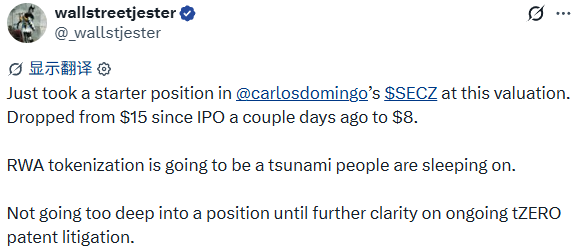
As X user wallstreetjester noted, he had "just established a position" in SECZ but explicitly stated he "won't add significantly until there's clearer progress on the lawsuit." This reflects the genuine sentiment of a portion of potential buyers.
Primary Market Trusts Endorsements, Secondary Market Trusts Liquidity
Securitize's shareholder lineup is impressive. BlackRock's BUIDL fund chose it as its transfer agent. Institutions like Borderless Capital and Hanwha Investment were brought in during the PIPE financing stage. The SPAC transaction itself was initiated by Cantor Fitzgerald affiliates.
This narrative of "collective endorsement by traditional financial institutions" is highly persuasive during the primary market fundraising stage and was a crucial support for Securitize's pre-merger valuation of $1.25 billion.
But the secondary market doesn't endorse endorsements; it only endorses liquidity. The market still buys the "tokenization" story; what has truly cooled is the short-term pricing of Securitize's specific stock.
The BlackRock name can make primary market investors willing to pay for a valuation story, but it cannot buy continued holdings in the secondary market when patent disputes are unresolved and SPAC churn pressure remains. Trust is a static brand asset; liquidity is a dynamic outcome of game theory. This crash precisely proves there is no inherent conversion relationship between the two.
Securitize's stock price will eventually stabilize or rebound once the investor base churn is complete—an almost inevitable stage of pain for SPAC-listed companies. However, the patent war initiated by tZERO should serve as a wake-up call for participants across the tokenization industry.
With tZERO holding 105 patents and having identified at least six potential infringement targets, the next phase of competition in the tokenization industry may no longer be solely about securing compliance licenses, institutional relationships, or trading volumes.
For those platforms still telling valuation stories based on "we were the first to implement a certain technology solution," a cease-and-desist letter could bring the story to an abrupt halt at any moment.
Securitize's fall represents a loss in short-term valuation; tZERO's legal action, however, may be unveiling a patent war that the entire tokenization industry is not yet ready to face.