Sharplink CEO: 백만 명의 이더리움 개발자, 누가 그들과 겨룰 수 있을까?


- 핵심 요지: 이더리움의 핵심 강점은 속도가 아니라 100만 명이 넘는 방대한 개발자 생태계, 상호운용성(Composability), 표준 제정, 그리고 신뢰할 수 있는 중립성(Trusted Neutrality)을 기반으로 구축된, 복제가 불가능한 해자(Moat)를 통해 금융 인터넷의 기본 운영체제로서의 지위를 공고히 하는 데 있다.
- 핵심 요소:
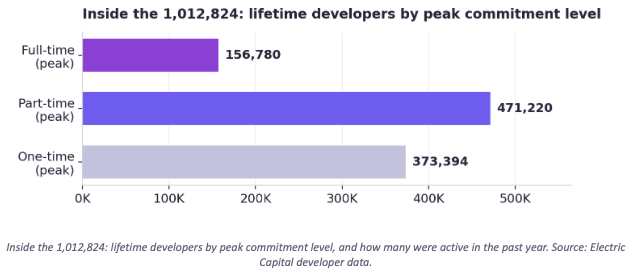
- 개발자 규모 선도: Electric Capital 데이터에 따르면, 이더리움의 평생 개발자 수는 이미 100만 명(1,012,824명)을 돌파했으며, 이 중 23만 2천 명이 지난 12개월 동안 꾸준히 활동해 다른 생태계를 크게 앞서고 있다.
- 핵심 프로토콜 업그레이드: 2026년으로 예정된 Glamsterdam 업그레이드는 내장형 제안자-빌더 분리(ePBS)와 블록 수준 접근 목록(BALs)을 통해 신뢰할 수 있는 중립성을 유지하면서 레이어 1의 처리 용량을 향상시킬 계획이다.
- 동기식 상호운용성(Synchronous Composability): 네이티브 롤업 및 "Based Rollup" 설계를 통해 롤업 간 원자적 트랜잭션(Atomic Transaction)을 가능하게 하여 파편화 문제를 직접 해결하고 수십 개의 네트워크가 협력하여 작동할 수 있게 한다.
- 양자 컴퓨팅 대비 준비: 이더리움은 "이더리움 경량화(Ethereum Simplification)" 로드맵, 포스트 퀀텀 보안 전담 팀 및 클라이언트 네트워크 테스트를 통해 2029년까지 오픈소스 마이그레이션을 완료할 계획으로, 주류 생태계를 선도하고 있다.
- 네트워크 효과 주도: EVM 및 Solidity 기술은 수백 개의 네트워크에서 범용적으로 사용되어 "더 많은 개발자 → 더 나은 도구 → 더 높은 유동성 → 더 강력한 기관 신뢰"로 이어지는 자기 강화 선순환(Flywheel)을 형성한다.
- 세 가지 핵심 강점: 약 90만 명의 검증자가 제공하는 신뢰할 수 있는 중립성, 롤업이 메인넷의 보안을 상속받을 수 있게 하는 모듈식 설계, 그리고 최고 수준의 연구 인력을 끌어들이는 문화적 가치.
Original Author|Sharplink CEO Joseph Chalom
Translation|Jiǎn xiǎo fēng of Odaily Planet Daily (@QinXiaofeng 888 )
Editor's Note: On June 15, ETH staged a strong rebound, surging over 10% in a single day, shaking off its recent slump. Sharplink CEO Joseph Chalom published a long post on X titled "Milestone: Ethereum Developer Count Exceeds One Million."
He noted that Ethereum's core strength is not speed, but its ability to attract the largest and deepest pool of talent in the crypto space. The true moat lies in the long-term ecosystem built on composability, standard-setting, and credible neutrality. These builders are now focused on frontier issues like scalability and quantum resistance, continually solidifying Ethereum's position as the default operating system for the financial internet. (Recommended reading: "Sharplink CEO: Selling ETH Now Is Like Selling Amazon During the Dot-Com Bubble")
Below is Joseph Chalom's original post, translated by Odaily Planet Daily. Enjoy~
————————
I just returned from Asia, where I spoke with Ethereum developers and ecosystem leaders. Special shout-outs to Nonce Classic, Four Pillars, and DSRV in Seoul, our friends at SNZ, and the recently launched Ethereum Community Hub in Hong Kong – Asia's first permanent physical Ethereum community space, supported by the Ethereum Foundation.
What struck me most wasn't just the enthusiasm, but the rigor and ambition of the local builders. The caliber of projects, the experimental spirit, and the long-term thinking emerging from the global Ethereum ecosystem are deeply impressive and inspiring.
These vibrant individuals give a face to a number: According to Electric Capital, Ethereum's lifetime developer count has surpassed one million – 1,012,824 distinct contributors to be exact. No other ecosystem in crypto comes close.
A Milestone Worth Pausing For
One million is a round number. Round numbers are often hollow, but not this time. It represents the largest technical talent pool ever assembled around an open, permissionless blockchain network – and crucially, this pool continues to deepen and expand.
Of this million, approximately 232,000 developers have been active in the last twelve months.
Why Ethereum: The Truly Important Question
For years, discussions in crypto revolved around speed, fees, and throughput. Every new chain claimed to be "faster than Ethereum." But the most important question in crypto has never been "which chain is fastest?" It's this:
"Where will the best builders choose to build for the long term?"On this question, Ethereum remains unique. Its advantage is not just technological but institutional, cultural, economic, and combinatorial – a decade-long accumulation of developers, infrastructure, standards, tools, liquidity, research, applications, and social coordination that no other ecosystem can replicate.
Ethereum has become the default operating system for programmable finance and internet-native capital formation.
What Are These Million Builders Building, and Why Does It Deepen the Moat?
The million developers are crucial because of *what they are doing right now*. The current focus is on the industry's hardest and highest-risk challenges: core protocol scalability, privacy, quantum resistance, and the agentic systems that will run on top.
Glamsterdam – Protecting Core Values Amidst Innovation. Scheduled for 2026, the Glamsterdam upgrade demonstrates how Ethereum can advance while safeguarding its core values. Key changes include: in-protocol proposer-builder separation (ePBS), block-level access lists (BALs) enabling parallel execution and higher throughput, and a potentially higher gas limit – significantly boosting Layer 1 capacity. Scaling for future demand while ensuring credible neutrality, security, and MEV fairness – this is the moat in action.
Synchronous Composability – Making Many Rollups Feel Like One Chain. Composability has always been Ethereum's superpower; the next leap is extending it across Layer 2s. Native rollups and "Based Rollups," combined with synchronous composability, are the answer. A contract on one rollup can directly call a contract on L1 or another rollup within the same atomic transaction – no bridges, no waiting. Teams from Linea, the Ethereum Economic Zone, Gnosis, Zisk, and the Ethereum Foundation are combining this design with real-time proofs. The result: dozens of rollups stop acting like isolated networks and start working like a single chain. This is a direct response to critics pointing to "fragmentation."
Quantum Resistance – Ethereum's Most Significant Lead. No major ecosystem is better prepared for the post-quantum era than Ethereum. The "Lean Ethereum" roadmap, the dedicated EF Post-Quantum Security team formed in early 2026, the pq.ethereum.org information hub, and over a dozen client teams running post-quantum interoperable devnets weekly – all this constitutes a coordinated open-source migration plan targeting around 2029. When quantum risk becomes a reality, institutions managing trillions in assets will care about one thing: which chain was ready earliest and most thoroughly.
The Moat Beyond Developers: Composability, Standards, and Trust
This developer advantage is self-reinforcing, stemming from how Ethereum is built. Its deepest network effect isn't liquidity, but the depth of composability: applications act like interoperable financial legos – lending, stablecoins, exchanges, wallets, tokenized assets, oracles, L2 rollups – all interacting via shared standards, so developers never start from scratch. The EVM is crypto's application layer; Solidity skills are portable across Base, Arbitrum, Optimism, Polygon, zkSync, Scroll, Linea, and hundreds of other networks.
Learning the Ethereum tech stack maximizes optionality, driving a flywheel: more developers, more tools, more liquidity, more institutions, which in turn attract more developers to build composable protocols and assets. Liquidity attracts liquidity; composability attracts composability.
And Ethereum dominates where value truly aggregates, not just where the noise is loudest:
Three major forces further deepen this lead:
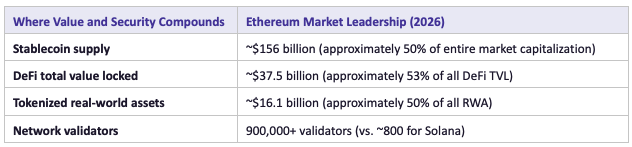
- Credible Neutrality – Secured by over 900,000 validators (versus ~800 for Solana), this decentralization and platform neutrality is highly valued by large institutions.
- Modularity – Rollups like Base, Arbitrum, and Optimism don't fracture Ethereum; they expand it into an increasingly connected modular internet economy, inheriting L1 security.
- Culture – Ethereum disproportionately attracts top-tier researchers, cryptographers, and EIP standard authors who set the direction for the entire industry. This last advantage is the hardest to fork.
There Is Only One Ethereum
Generating on-chain activity is one thing. Being the long-term coordination layer for internet-native finance – the layer trusted by the world's largest financial institutions – is another. Ethereum holds a dominant position in the minds of large asset owners, who prioritize trust, security, and liquidity. I felt this firsthand during my time at BlackRock.
In technology markets, ecosystems consolidate around standards, liquidity, and developer mindshare over time. This is Ethereum's moat.
After speaking with these developers, builders, and ecosystem leaders in Seoul and Hong Kong, I am more convinced than ever of Ethereum's competitive advantage. I met the talent building the next generation of financial infrastructure – the future founders of our industry and the architects of agentic finance. These are the people and teams that will change the world.
Ethereum's future is happening now.