Bitcoin's Four-Year Cycle: The Pattern Remains, But the Game Has Changed


- Core View: Bitcoin's 4-year cycle has not died out; the 2025 top arrived as expected. However, traditional on-chain indicators have collectively failed due to the institutional dominance of the market, as retail capital is being drained by Memecoins and high-FDV tokens before it can even flow into Bitcoin.
- Key Elements:
- Bitcoin hit a top of $126,296 on October 6, 2025, before declining by approximately 50%, aligning with the historical pattern of peaking 480-550 days after the halving. However, traditional top indicators (such as MVRV, Pi Cycle Top, NUPL) were not triggered.
- Institutional buyers (ETFs, Strategy) have replaced retail investors as the dominant force. The net inflow into ETFs peaked at $63.1 billion, but transactions occur through custodians, reducing on-chain activity and preventing indicators from reflecting true demand.
- Retail capital is being decimated before it can reach Bitcoin: Over 10 million Memecoin and high-FDV (Fully Diluted Valuation) token issuance structures are absorbing retail liquidity, with 84.7% of new tokens launched in 2025 trading below their issuance valuation.
- Bottom predictions are based on historical cycle rhythm and structural indicators: The 200-week moving average (approximately $68,832) is a historical support level. Combined with the death cross and the trend of diminishing drawdowns, the base bottom range is $45,000 - $55,000, with the timing pointing towards Q3 to Q4 of 2026.
Original author: Bull Theory
Original translation: Yuliya, PANews
Is Bitcoin's 4-year cycle still valid? This is the most predictable crash in cryptocurrency history, yet no one was prepared.
At the peak of the 2025 bull market, one of the most common narratives in the crypto space was that the 4-year cycle was dead, that institutional entry had changed everything, and that the old patterns no longer applied. However, Bitcoin topped out almost exactly as expected, subsequently dropped 50%, and is now exactly where the cyclical framework predicted it would be. So, let's honestly talk about what actually happened.
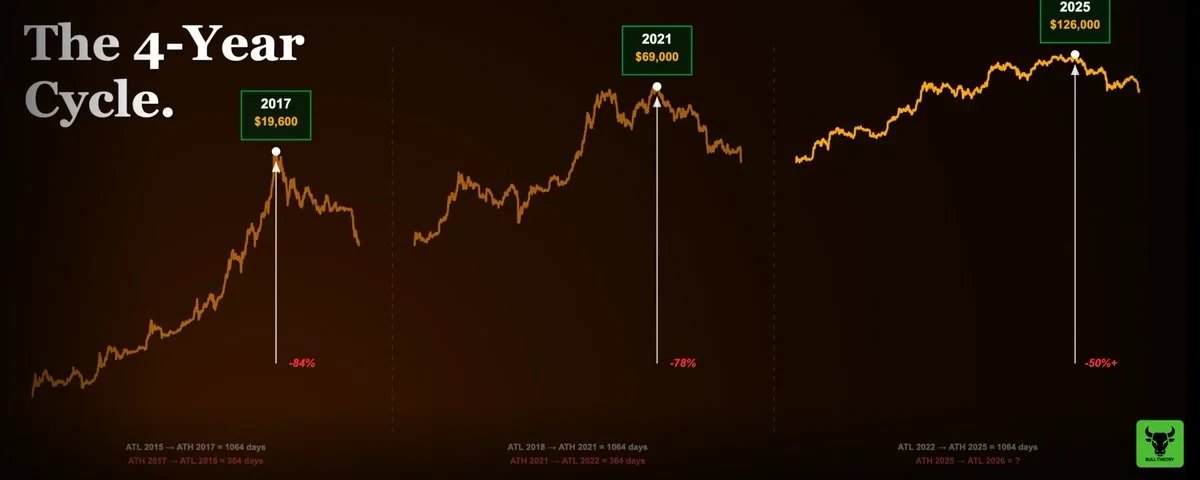
The 4-Year Cycle Isn't Dead, Just the Buyers Are Different
Throughout 2024 and early 2025, the crypto market was filled with the narrative that Bitcoin ETFs changed everything, institutions were buying in, and the traditional 4-year cycle driven by halvings and retail FOMO was no longer relevant. This was a super-cycle; the bear market would never return.
This argument sounded compelling. Bitcoin hit a new all-time high before the halving had even occurred, something unprecedented. ETF inflows broke records. Michael Saylor was buying billions of dollars worth of Bitcoin weekly. Mainstream financial media reported on Bitcoin as a legitimate asset class for the first time. The market atmosphere suggested the old rules no longer applied.
Yet, Bitcoin peaked at $126,296 on October 6, 2025, and then began to decline. It's now roughly 50% below its high, the Fear & Greed Index is in extreme fear territory, and a death cross has appeared on the charts. The cycle deemed dead is playing out with the same precision as in 2013, 2017, and 2021.
The 4-year cycle isn't dead; it's just become more subtle. The reason it became subtle – the reason no one saw the top coming, why none of the top indicators triggered – is the most important factor in understanding where we are now and where we are heading.
But before diving into that, it's crucial to understand what the cycle is and why it has persisted for over a decade. Because those who deny the cycle aren't entirely wrong. The market has indeed changed. The cycle wasn't broken; it evolved along with the market.
Every four years, a halving event reduces the number of newly created Bitcoins by 50%. Miners are Bitcoin's largest and most consistent sellers, mining coins and selling them to cover operational costs. When a halving cuts their production in half, the daily supply hitting the market drops significantly. If demand remains constant or increases, the price must eventually rise. This is the fundamental mechanism of Bitcoin's price movement – not a theory, but supply and demand.
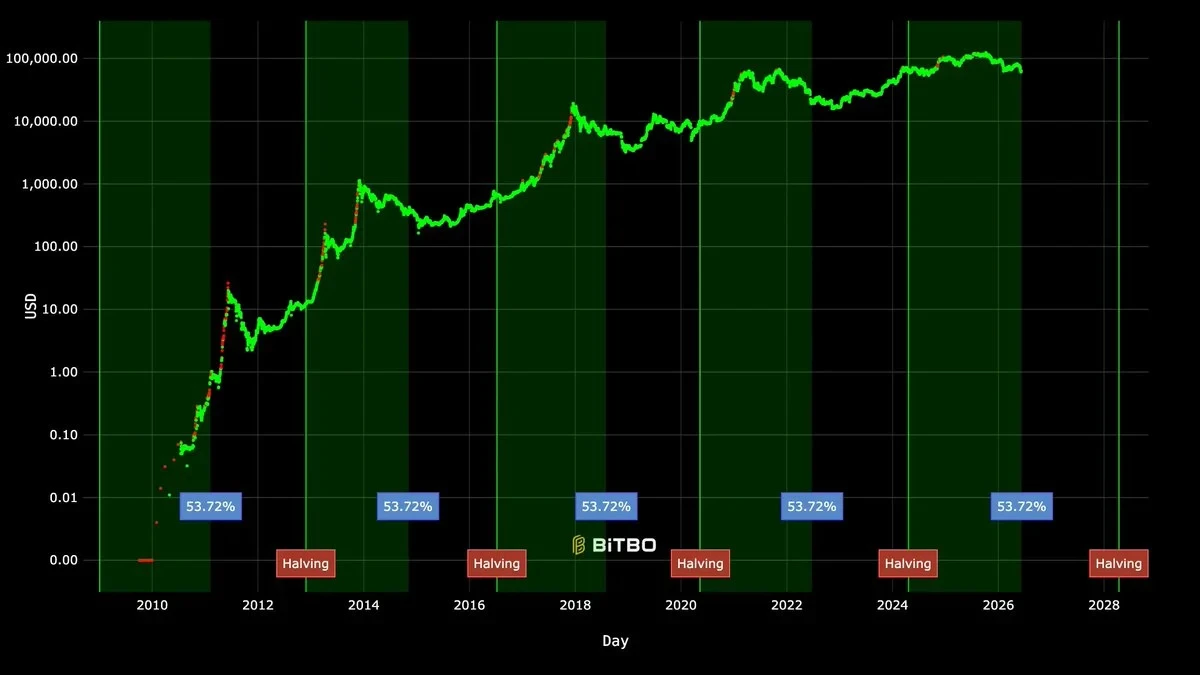
Looking back at halvings since 2012, the bull-bear transitions in Bitcoin's price have repeated without exception.
Four cycles, four halvings. The basic structure of each has been identical. And this is what those proclaiming the cycle dead miss: the cycle doesn't care about narratives. It operates on supply and demand mechanics, which don't change just because institutions start buying via ETFs. The April 2024 halving occurred as scheduled. Bitcoin topped on October 6, 2025, 535 days later. This fell squarely within the historical window of 480 to 550 days post-halving seen in every previous cycle.
The cycle never died. It only looked different on the surface because the buyers were different. And this difference – institutional demand replacing retail demand – is precisely why no top indicators were triggered, and why most people focused on top signals completely missed the peak.
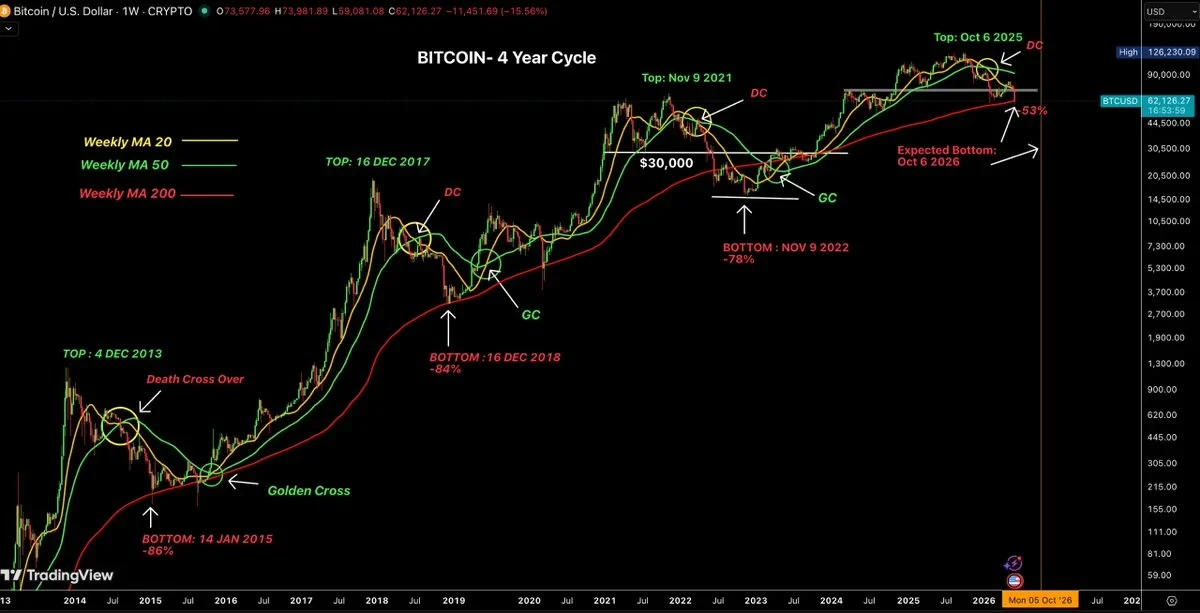
Tracking these four Bitcoin cycles, recording tops, bottoms, death crosses, golden crosses, and the 200-week moving average.
There's another consistent pattern in these cycles that hasn't received enough attention: the bottom occurs roughly a year after the top. Not exactly a year, but the range is remarkably tight. After the 2013 top, the bottom came 410 days later. After 2017, it was 363 days. After 2021, 376 days. If this rhythm holds true for the current cycle, the bottom would fall between late September and mid-November 2026.

There's also a clear trend in the drawdown data: 86%, 84%, 78%, and now potentially 50% to 65%. Each bear market is shallower than the last. This isn't accidental. It reflects a maturing asset: one that now has institutional buyers who don't panic sell, a regulated ETF market that creates structural demand, and corporations holding Bitcoin on their balance sheets as a treasury reserve. As the buyer base matures, volatility is being compressed.
This cycle also witnessed something unprecedented: Bitcoin hit a new all-time high before the halving. In March 2024, a full month before the April 20 halving, Bitcoin reached $73,581, surpassing the previous high of $69,000 set in 2021. This was a new all-time high, but not the cycle top. Every previous cycle eventually peaked months after the halving, and this was no exception – the true cycle top arrived at $126,296 on October 6, 2025, well after the April 2024 halving. What was different was the pre-halving all-time high, never seen before. The reason was the approval of spot Bitcoin ETFs in January 2024, which pulled institutional demand into the market before the halving, front-running the cycle's timeline and confusing many who track typical post-halving dates.
What Happened to Retail This Cycle?
To understand why Bitcoin topped without any common signals, you must understand what happened to retail capital in the 18 months leading up to the peak. Simply put: most retail capital was exhausted before Bitcoin ever reached $126,000.
In previous Bitcoin bull runs, retail played a specific role. They provided the final fuel, creating the last euphoric, parabolic surge. It was retail FOMO that pushed Bitcoin from a reasonable price to an extreme one in the final stage of each cycle. This is also why top indicators were triggered – those tools were originally designed specifically to measure retail behavior, not institutional behavior. Without retail frenzy, there are no indicator triggers.
In this cycle, retail never showed up in Bitcoin in any significant form. It's not that they weren't participating in crypto; they were. They just got 'cleaned out' elsewhere first.
The Memecoin Liquidity Trap
The single biggest factor destroying retail liquidity this cycle was the extreme ease of creating and launching memecoins. Token launch platforms (especially on Solana) allowed anyone to issue a token in minutes at virtually zero cost. By mid-2025, the total number of tokens had exploded from roughly 10,000 to 20,000 at the 2021 peak to over 10 million.
Think about what this means for a retail investor trying to navigate this market. In 2021, there were perhaps 200 tokens worth serious consideration – real projects with users, revenue, or at least a credible team and product roadmap. The path from 'I want to invest in crypto' to 'I bought ETH and SOL' was short and obvious. That's where retail capital concentrated. That's why ETH reached $4,800 and SOL reached $260.

But in 2025, you had to choose from 10 million options. The vast majority of these tokens were designed for one purpose: to extract capital from retail buyers as quickly as possible and transfer it to insiders. The playbook was straightforward: create a token, manufacture hype, dump on retail buyers as they buy in, and cash out. This happened thousands of times daily across the ecosystem.
The 2021 retail investor faced a manageable number of options, most of which were legitimate projects. The 2025 retail investor faced millions of options, the vast majority structured specifically to harvest their capital. The result was predictable: retail capital entered the crypto market in 2025, but most of it never flowed to Bitcoin or quality altcoins. It was drained first by the memecoin complex.
The involvement of influential public figures amplified this problem. Numerous high-profile individuals from politics, entertainment, and social media launched their own memecoins during this cycle. The pattern was identical each time: a token bearing a celebrity name launched with immense hype, retail bought in expecting to ride the fame effect, the price surged, insiders and early holders dumped. The token crashed 80% to 95% within days or weeks. Retail was left holding worthless tokens worth a fraction of their purchase price.
This happened over and over throughout 2024 and 2025. Each occurrence permanently erased a chunk of retail liquidity from the ecosystem. People who lost money on these projects didn't turn around and buy Bitcoin with what was left. They either left the market entirely or had no capital left to deploy.
VC Tokens: High FDV, Low Float
The second major factor destroying retail capital was the token launch structure of this cycle, less discussed but equally devastating.
In 2021, new crypto projects typically launched with a Fully Diluted Valuation (FDV) between $100 million and $1 billion. This left genuine upside for public market buyers. A project launching at a $200 million FDV and growing to $2 billion could deliver a 10x return for retail investors. This is what people remember from 2021 – the stories of 'I turned $5,000 into $50,000 buying this token early.'
In this cycle, the structure changed completely. Venture capital funds raised tens of billions of dollars in 2021 and 2022 to invest in crypto infrastructure. By 2024 and 2025, their portfolio companies were ready to issue tokens, and VCs needed to show returns to their Limited Partners (LPs). Consequently, projects began launching with FDVs of $5 billion, $10 billion, or even $20 billion, while only 5% to 15% of the circulating supply was actually available on day one.
What does this mean in practice? A retail investor sees a token trading at a seemingly $500 million market cap and thinks there's room to grow. But the true FDV at that price is $10 billion, with 85% of the tokens sitting in VC wallets, waiting to unlock over the next two to four years. Every month, more tokens unlock and get sold. The price faces a structural ceiling because the supply pressure never stops. Retail buyers are essentially buying into a continuous, undisclosed sell-off.
An independent study tracking 118 tokens launched in 2025 found that 84.7% were trading below their launch valuation, with a median price decline of 71%. These weren't obscure projects; many were listed on major exchanges with substantial marketing budgets and media exposure. Yet they still lost most of their value because their tokenomics were designed to benefit insiders at the expense of public buyers.
The combined consequence of memecoins and high-FDV VC launches: retail crypto capital was massively destroyed before Bitcoin even approached its cycle top. By October 2025, most retail participants who entered the market in 2024 were either heavily down or completely out. No liquidity was left to rotate into Bitcoin. The FOMO wave wasn't there. The fuel for the final euphoric peak was gone.
Where Was Retail Capital Supposed to Go?
The 2021 cycle worked because retail capital followed a clear path: Buy Bitcoin → Bitcoin pumps → Rotate to large-cap altcoins → Large-cap altcoins pump → Rotate to mid-cap altcoins → Mid-cap altcoins pump → Rotate to small-cap coins. Capital cascaded down a predictable market cap ladder, generating returns at each level.
But in 2025, this cascade effect never started. The massive retail buying of Bitcoin never happened. Their capital was already drained. Bitcoin's dominance remained above 60% for almost the entire bull market. The altcoin season index peaked at 78% for roughly three weeks in September 2025 before immediately crashing. There was only a brief window where altcoins outperformed Bitcoin before its dominance quickly rebounded above 60%.
The anticipated altcoin season didn't arrive because the market was wrong about it; the mechanism that creates an altcoin season – retail capital cascading down the market cap ladder – had broken down. The capital was already drained.
How Did Institutions Change the Cycle's Structure?
Just as retail was losing money on memecoins and VC token launches, something entirely new was happening to Bitcoin. For the first time in the asset's history, a regulated institutional product was channeling billions of dollars into Bitcoin on a structured, continuous schedule.
The approval of spot Bitcoin ETFs in January 2024 was more than just a headline. It fundamentally changed Bitcoin's marginal buyer, and this change triggered a cascade of events that made everything about this cycle feel different.
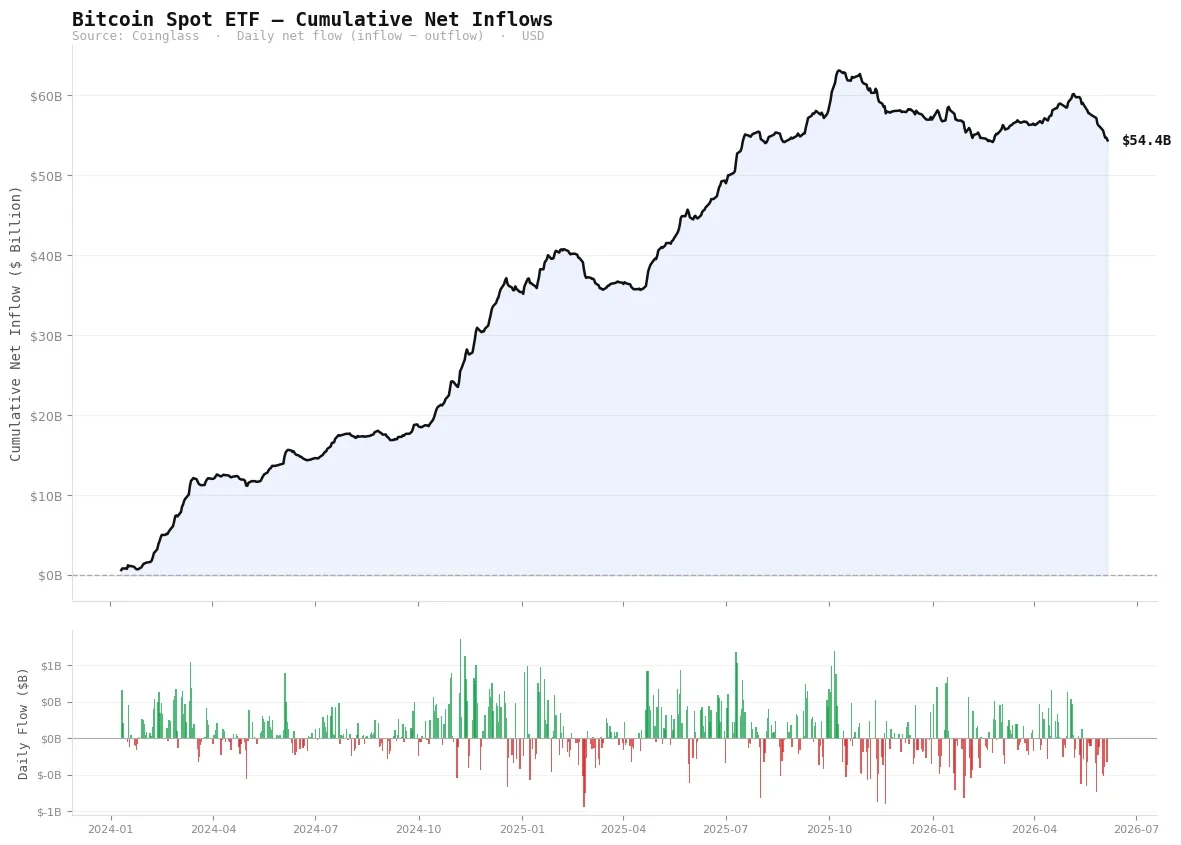
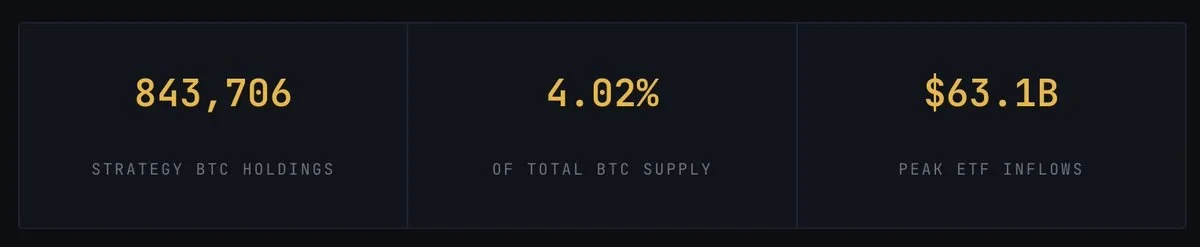
Cumulative net inflows into Bitcoin spot ETFs peaked at $63.1 billion in October 2025 and currently stand at $54.4 billion (Source: Coinglass).
From January 2024 to October 2025, spot Bitcoin ETFs accumulated $63 billion in net inflows. At their peak, daily inflows averaged over $350 million, 8 to 9 times the value of the new Bitcoin mined by miners each day. On the largest single-day inflow, over $1 billion poured in within one trading session.
These were not retail investors. They were pension funds, Registered Investment Advisors (RIAs), family offices, endowments, and hedge funds making asset allocation decisions on a quarterly basis. They don't check Bitcoin's price in the middle of the night. They don't FOMO on a green candlestick on X (Twitter). They receive an asset allocation mandate and execute it systematically over weeks or months.
When this type of buyer becomes the dominant market force, price action looks entirely different from a retail-dominated market. Instead of long periods of sideways consolidation followed by explosive vertical pumps, you get a slow, persistent grind higher. No parabolic weekly candles, just a stable uptrend that feels unexciting but delivers massive gains over time.
Bitcoin went from $40,000 in January 2024 to $126,000 in October 2025, a 215% increase. In any previous cycle, an advance of this magnitude would have included several weeks with 30% or 40% gains. But in this cycle, weekly gains were modest by historical standards. The total advance was massive, but its arrival felt procedural, almost boring, rather than explosive.
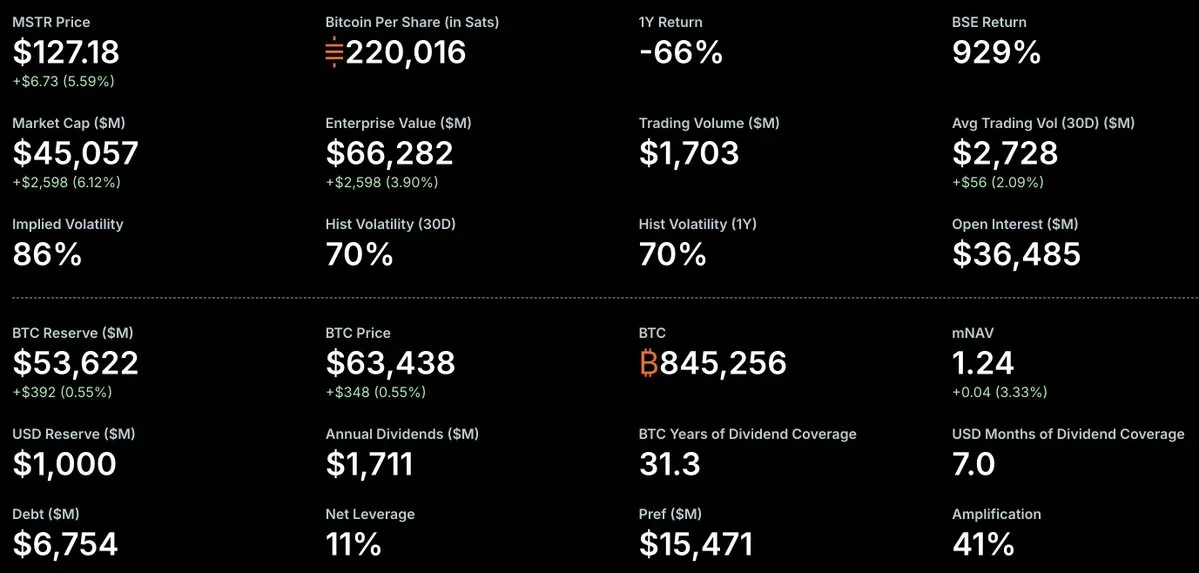
Strategy holds 845,256 BTC, representing 4.02% of Bitcoin's total supply, accumulated through consistent corporate treasury purchases.
And then there's Strategy. Their model is the most extreme version of the institutional buying that defined this cycle. They turned their entire corporate treasury management strategy into a Bitcoin accumulation machine, raising capital through stock and preferred share offerings and directly deploying it into Bitcoin purchases. As of June 2026, they held 843,706 Bitcoin, representing 4.02% of the future total supply.
In 2025 alone, they raised $25.3 billion through capital markets to buy Bitcoin. They don't sell, they don't hedge. Regardless of price, they accumulate weekly. This is a structural buy-side pressure that simply didn't exist in previous cycles.
The key thing to understand about this institutional structure is its impact on on-chain data. When BlackRock buys Bitcoin for its IBIT, those tokens are moved to Coinbase Prime for custody. They become nearly invisible in on-chain analysis, impossible to track like retail activity. ETF purchases don't show up as tokens changing hands on-chain like retail trades. Strategy's Bitcoin accumulation via stock offerings appears in SEC filings, not on-chain. Every dollar of demand generated less on-chain activity than in any previous cycle.
This is the core technical reason every top indicator failed. These indicators measure on-chain activity, token movement, and realized profit behavior – metrics that are valid when retail is the dominant buyer. When the dominant buyer operates through off-chain custodians and registered financial products, these indicators remain eerily calm, even as hundreds of billions of dollars flow into the asset. The metrics' math wasn't wrong; they were measuring the wrong thing.
Why Did the Eight Major Top Indicators Fail One by One?
These indicators had a near-perfect track record. In 2013, 2017, and 2021, they signaled tops within days or weeks of the actual peak. Analysts obsessively watched them throughout 2025, waiting for signals. Bitcoin broke $126,000 and then started declining. Yet all these indicators remained calmly in neutral or accumulation zones.
It wasn't that the indicators were