Avenir Group 下注 WasabiCard:为什么 U 卡退潮,稳定币支付反而更香了?


Li Lin is placing another bet.
On June 3, 2026, WasabiCard, a global stablecoin payment infrastructure platform, completed its Pre-A round of funding. Including earlier seed rounds, its cumulative financing has approached nearly $10 million. Investors include Vernal Capital, Avenir Group, Vision Plus Capital, and 01VC—among which, Avenir Group is Li Lin's family office.
Interestingly, almost simultaneously, another piece of news flooded social media: Fiat24 suspended new account applications in Mainland China. Meanwhile, several crypto payment card services familiar to Chinese-speaking users, such as SafePal and Bitget Wallet, all have partnerships relying on Fiat24's card issuance capabilities.
On one hand, capital is betting on an "invisible" payment infrastructure company; on the other, a fundamental service provider's policy adjustment directly impacts certain front-end card products. Viewed together at this point in time, it provides a fresh perspective for re-examining the stablecoin payment track.
And behind this perspective lies a rapidly expanding real demand.
1. The Ebb of U-Cards: What's Receding Isn't Demand, But the Model
According to Fireblocks' "State of Stablecoins 2025" report, 49% of surveyed institutions already use stablecoins for payment purposes, while another 41% are in the testing or planning phase. This means nearly 90% of institutions are engaging with stablecoin payments in some form.
Demand is rising, but the way it is being met is changing.
As is well known, the most discussed form of stablecoin payments in the Chinese-speaking market over the past few years has been the "U-card": users transfer stablecoins like USDT and USDC into a card product, then use it for online subscriptions, consumption, or offline payments. This is also the easiest model for users to understand and adopt.
But a U-card is merely the front-end that users see.
Behind a single card lies a complex web of card issuance qualifications, card network partnerships, KYC/AML, risk control systems, stablecoin-to-fiat conversion, clearing and settlement networks, merchant channels, and cross-border payment capabilities. Yet, users often only remember front-end brands like RedotPay, KAST, or Crypto.com, while institutions like WasabiCard remain relatively unknown.
In fact, thanks precisely to infrastructure companies like WasabiCard, today, issuing a "single card" is no longer a difficult task.
Project teams can entirely outsource stablecoin acceptance, credit allocation, card issuance, and consumption channels to third-party service providers, simply branding and launching the front-end themselves. In a sense, this is a key reason for the rapid proliferation of U-card products in recent years.
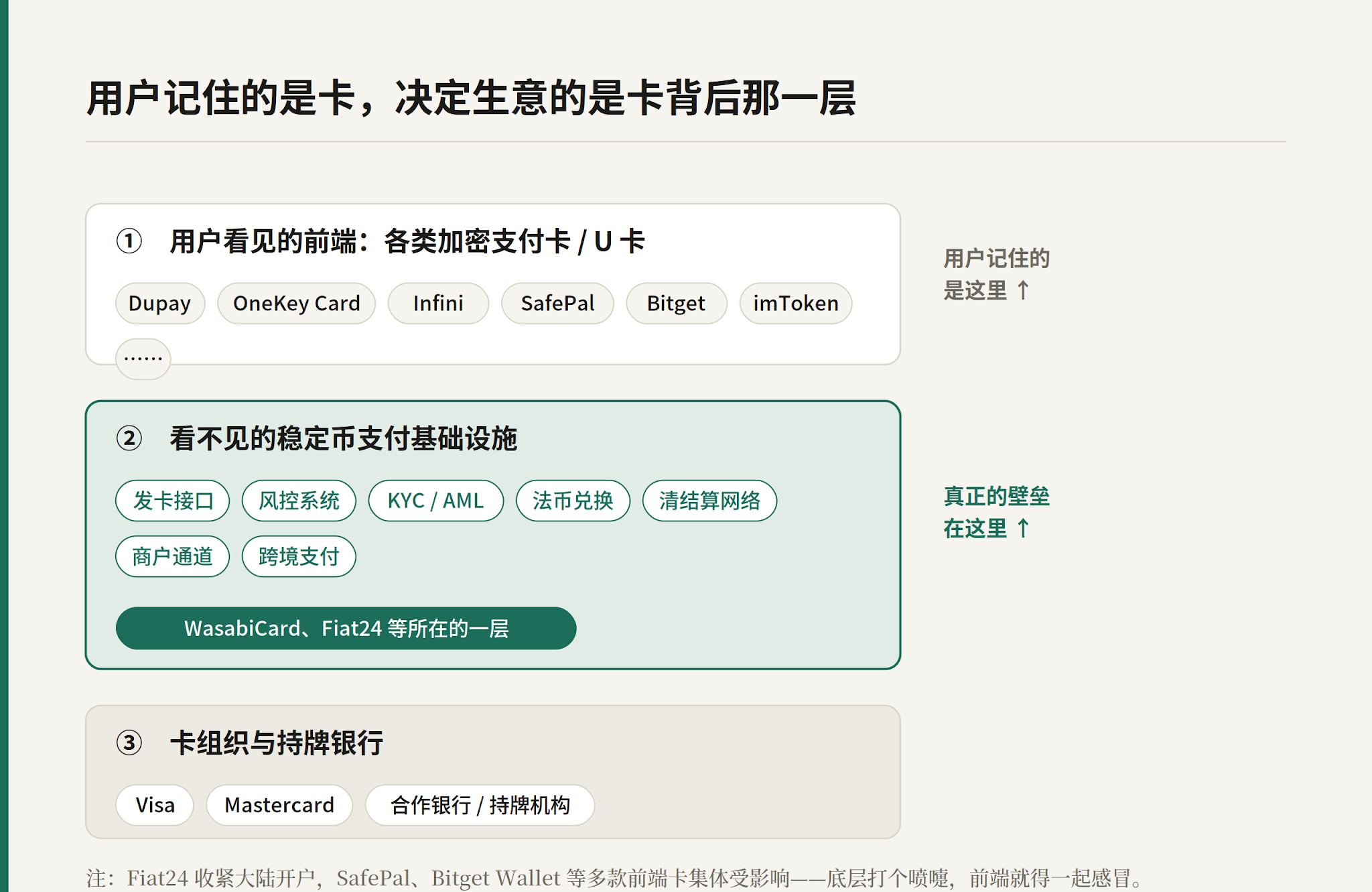
So, Fiat24 tightening account openings is just the trigger.
The real issue is that the rapidly spreading consumer U-cards of the past few years are essentially a "light front-end, heavy external dependency" model. They outsourced the hardest parts, leaving themselves mainly with branding, user acquisition, and the user interface. While this solved the problem of "how to spend U," it did not solve the problem of "how to run this business sustainably, stably, and compliantly in the long run."
Over the past year, the contraction or even exit of multiple front-end card products has repeatedly demonstrated that relying solely on front-end experience cannot sustain a payment business capable of weathering market cycles.
This point is crucial.

U-card products can be replicated, subsidies can be matched, and users can quickly migrate based on fees, risk management, and usability. What is truly difficult to replicate is back-end capability:
- Ability to maintain stable card issuance and acquiring partnerships across multiple markets.
- Ability to handle identity verification and anti-money laundering requirements across different jurisdictions.
- Ability to maintain consistency in fund flow and information flow between stablecoin top-ups, fiat conversion, card consumption, and merchant settlement.
- Ability to develop a mature risk control system for handling abnormal transactions, high-risk addresses, chargebacks, refunds, freezes, and compliance reviews.
This is the logical starting point for institutions like Avenir Group betting on WasabiCard—what institutions are eyeing is perhaps not another crypto card product, but a stablecoin payment business transitioning from "cards" to "infrastructure."
2. Why Avenir Group is Betting on WasabiCard
In recent years, the crypto market hasn't lacked grand narratives.
From DeFi, NFTs, GameFi, to public chains, L2s, Restaking, and AI + Crypto, industry cycles are often driven by asset prices, token expectations, and liquidity expansion. However, payments have always been a somewhat different business. It's less glamorous, harder to generate extreme valuation narratives quickly, but much closer to real-world transaction needs.
Because whenever a transaction occurs, every specific step—payment, currency exchange, card issuance, settlement, acquiring, and cross-border transfers—presents an opportunity to generate revenue.
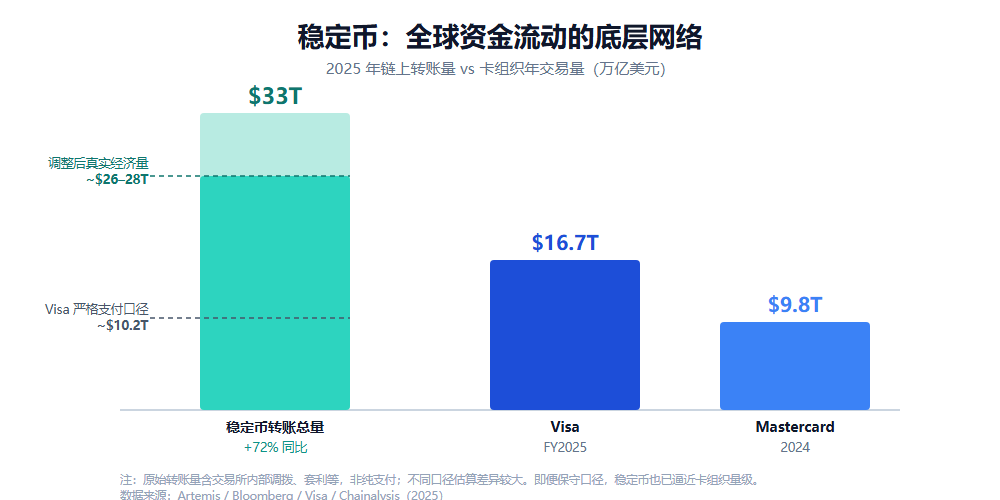
And the scale of this business can no longer be ignored. Artemis data shows that in 2025, global stablecoin on-chain transfer volume reached $33 trillion, a 72% year-over-year increase, surpassing the combined volume of Visa and Mastercard. Even excluding non-payment uses like exchange internal transfers and arbitrage, its real economic volume is approaching the scale of traditional card networks.
Whether these fund flows ultimately correspond to trading, transfers, or settlements, it means stablecoins have become a crucial underlying network for global capital movement. But precisely because of this, for an on-chain USDT/USDC transfer to truly become usable payments for businesses, salaries for employees, acceptable settlements for merchants, or card balances for users to spend, a complete set of off-chain financial infrastructure is required.
This is precisely the opportunity for companies like WasabiCard.
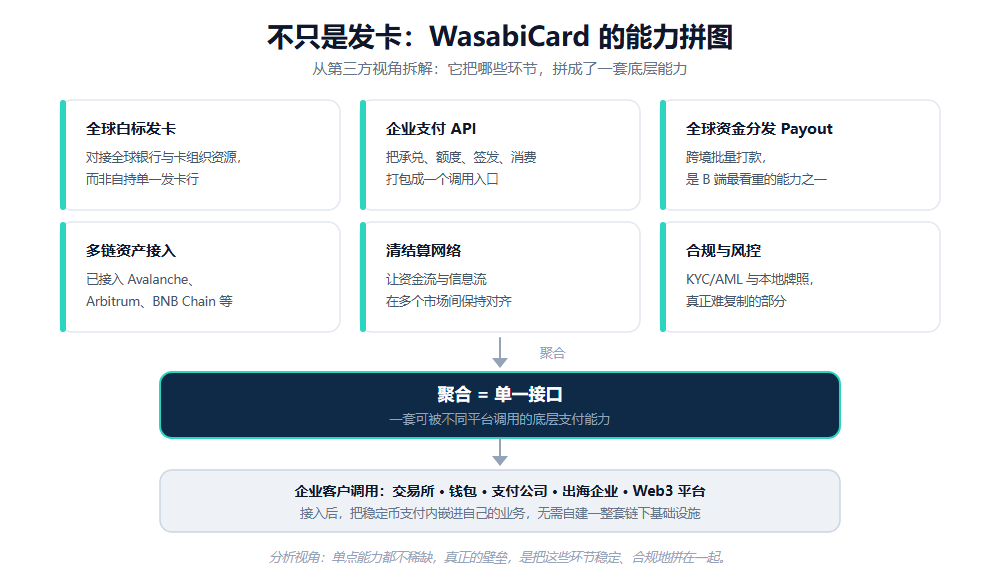
They focus on the "heavy lifting" – connecting with card networks and issuing resources, building enterprise APIs, handling fund settlement, managing risk and compliance, and enabling business clients to embed stablecoin payment capabilities into their own workflows. These tasks don't attract market attention quickly like issuing a token, but once capabilities are validated, they can form stronger reusability.

Because from a business model perspective, B2B infrastructure and C-end card products are inherently two different businesses.
C-end card products require continuous user acquisition, subsidies, and education, while constantly facing user comparisons on fees, usability, and brand trust. In contrast, once a B2B payment infrastructure is integrated by exchanges/wallets, payment companies, or global businesses, it can benefit from the client's own transaction volume growth. The former gets stuck in a cycle of user acquisition, while the latter is more likely to generate compounding returns.
More importantly, once a project integrates a specific payment API into its business, the switching cost becomes high, and the partnership is more likely to deepen around transaction volume, settlement volume, and business scale. This is the beauty of underlying infrastructure: it doesn't have to outrun everyone itself; as long as any of its clients succeeds or scales up, it can share in the growth dividends.
Breaking this down explains why capital is more interested in the underlying layer:
- Payments are one of the easiest scenarios for stablecoins to generate real cash flow. Compared to Web3 narratives still relying on token cycles and liquidity expectations, it's closer to real transaction demand. It's a business model driven less by market sentiment and more by transaction volume and network scale.
- Service providers like WasabiCard already have a business and compliance foundation, having accumulated reusable capabilities in B2B client relationships and highly compliant systems. For investors, "already integrated" is far more valuable than "planning to integrate."
- Capital is buying not a single-point product, but a scalable infrastructure. Its growth can "piggyback" on the growth of its clients, rather than requiring new customer acquisition for every single transaction.
For an investment institution, the ceiling of a single-point U-card product depends on how many C-end users it can acquire and their active consumption frequency. However, the potential of a stablecoin payment infrastructure depends on how many enterprise clients it can serve, how many payment scenarios it covers, and whether it can become the universal capability layer behind more front-end products.
From this perspective, Avenir Group's investment in WasabiCard seems less like some form of "authoritative endorsement" and more like a directional bet on stablecoin payment infrastructure by a savvy veteran in the crypto space.
What it points to is perhaps more important than the investment itself.
3. Comparing Not Size, But Position: Where is the B2B Moat?
Of course, this doesn't mean the infrastructure model is inherently easier to succeed in. In stablecoin payments, C-end cards and B2B infrastructure are simply different tracks. Comparing absolute scale is meaningless; the key is market positioning.
Look at RedotPay, a benchmark on the C-end track. It boasts over 6 million users, coverage in 100+ countries, annualized transaction volume of ~$10 billion, annual revenue exceeding $150 million, cumulative funding of $194 million in 2025, and a valuation exceeding $1 billion.
This is almost the ceiling a U-card can reach. Yet intriguingly, even this champion relied on licensed entities like Reap for its card BIN, Fireblocks and Sumsub for compliance, and Circle's network for cross-border payouts.
In other words, even the leading card itself stands on a layer of underlying infrastructure.
Now consider BVNK, a "graduate" of the B2B track. Processing over $30 billion in annual payment volume, covering 130+ countries, holding licenses like MiCA, it was ultimately acquired by Mastercard for up to $1.8 billion, becoming the largest stablecoin infrastructure acquisition to date.
It offers another endgame for this track: not chasing C-end users, but building deep enough underlying capabilities and continuously refining compliance, eventually being integrated into a global network by a major player.
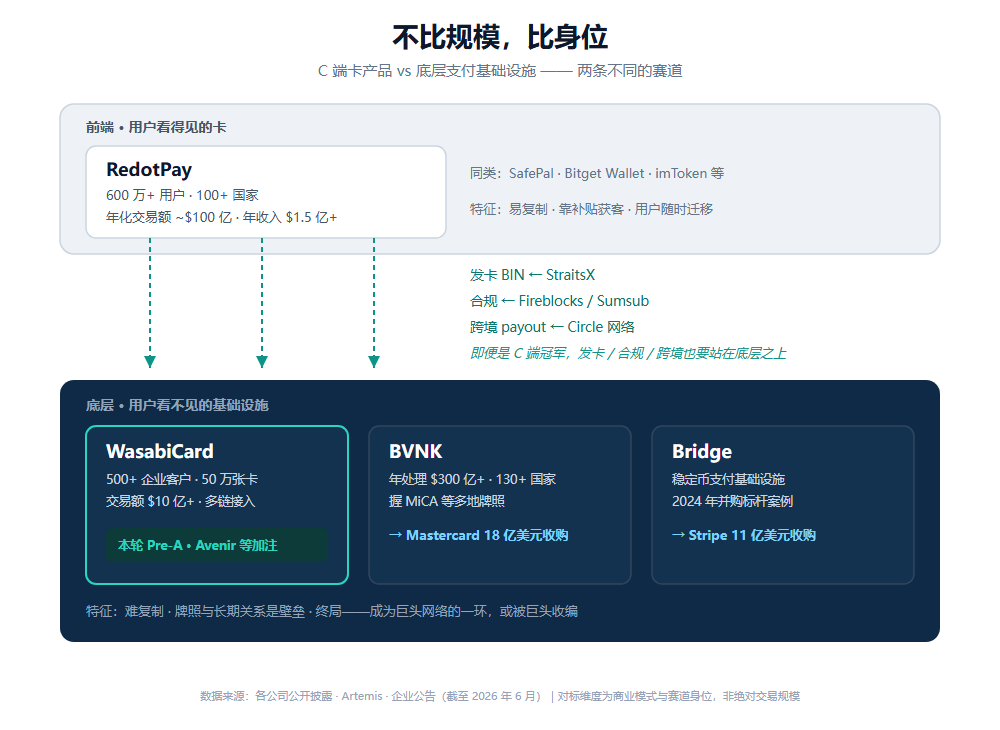
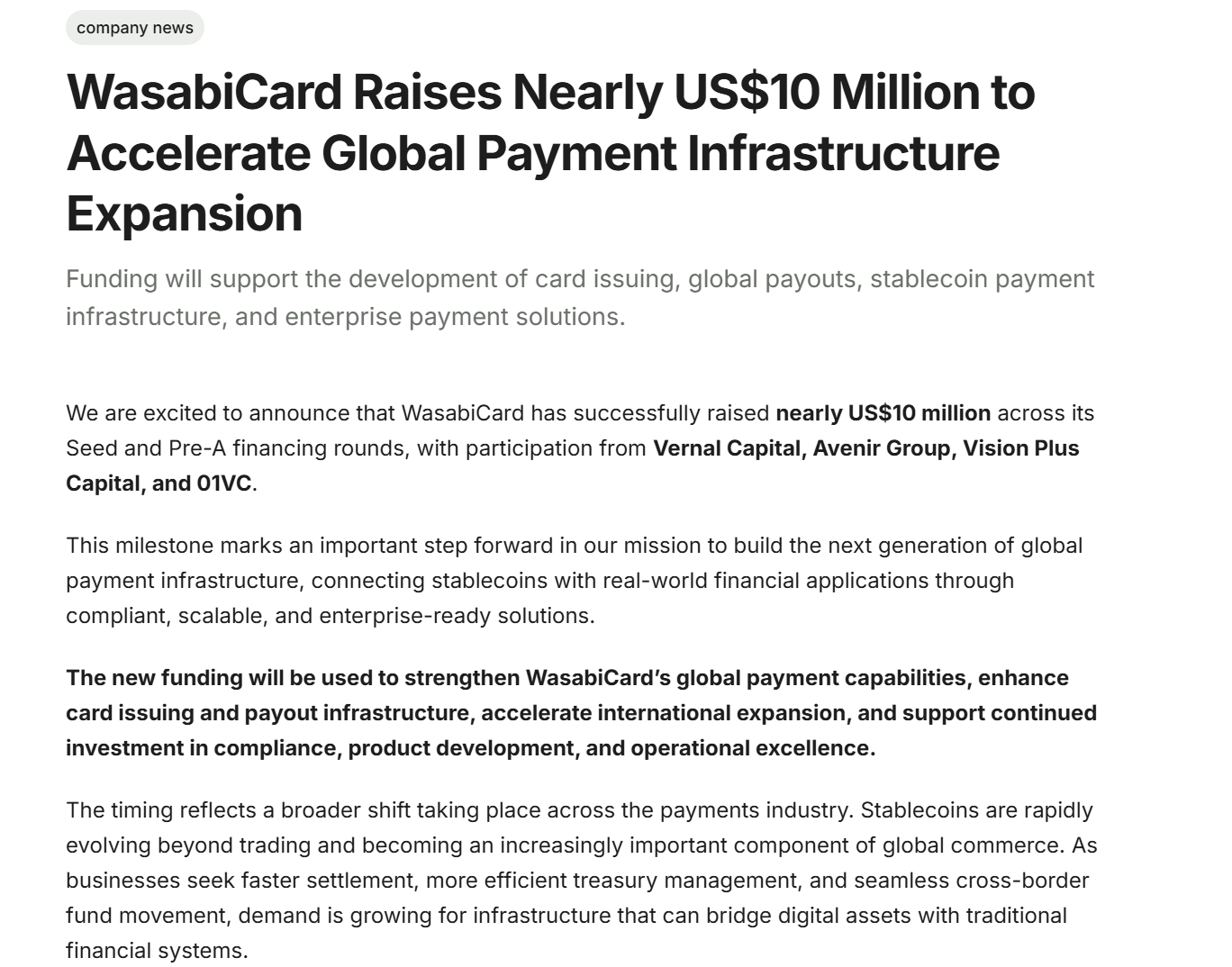
WasabiCard stands on this same track. As of this funding round, it officially disclosed serving over 500 enterprise clients globally, issuing over 500,000 cards, processing over $1 billion in transaction volume, integrating multiple chains like Avalanche, Arbitrum, and BNB Chain, and recently joining Circle's partner program.
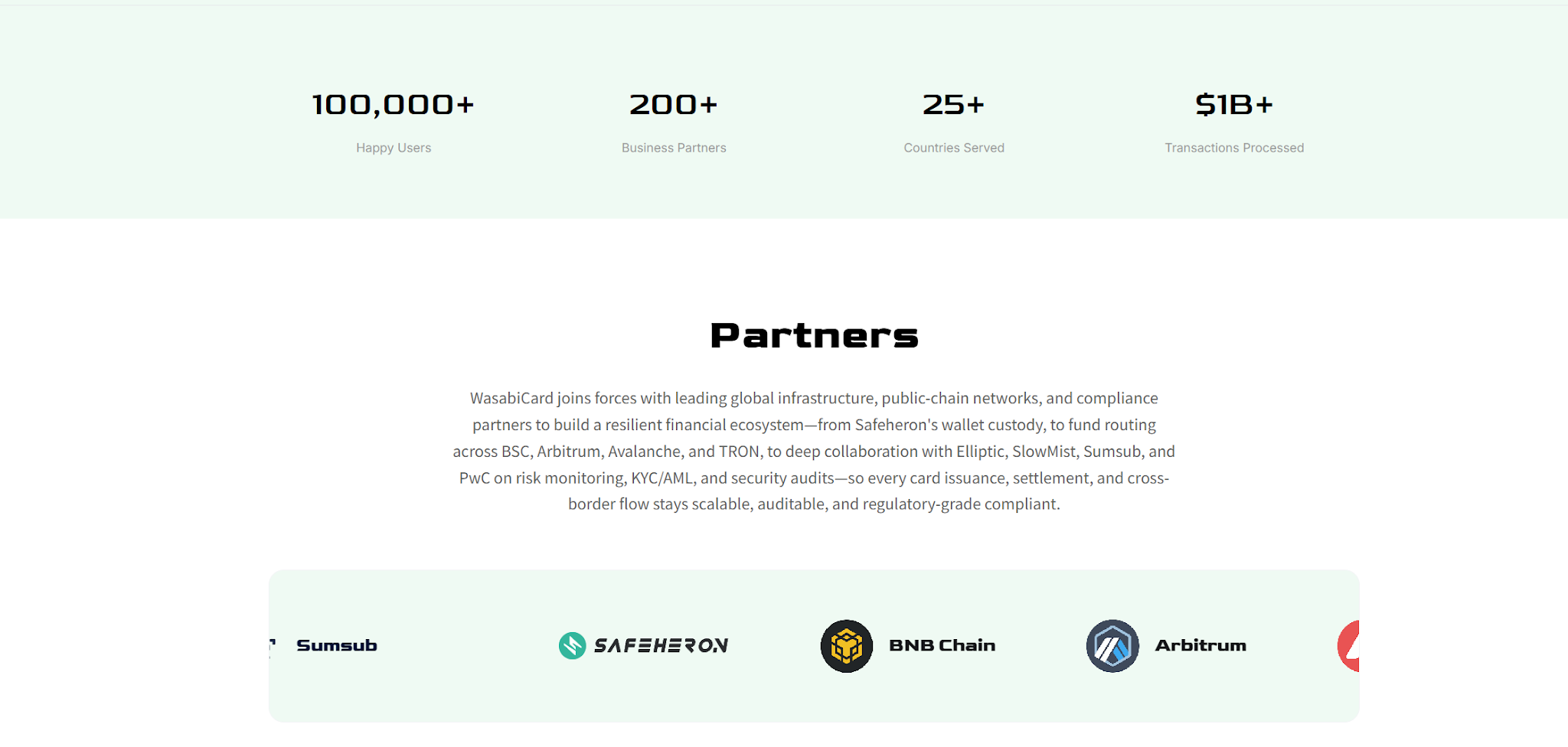
It aggregates card issuance, API, settlement, and payment capabilities into a single interface, focusing on a localization strategy partnering with banks in major global markets. It positions itself as an infrastructure company capable of exporting global white-label card issuance, APIs, clearing/settlement, and payment capabilities with a "one-click" approach. This localization allows WasabiCard to leverage local banking capabilities in various regions to compliantly issue cards to local users. Meanwhile, its enterprise clients need only integrate its API once to achieve global card issuance with a single click.
More critically, based on public information, WasabiCard's focus isn't just on consumer card issuance. It continuously expands global card issuing resources, enterprise payment APIs, global fund distribution (payouts), multi-chain asset access, and compliance system building. This means it provides not a single payment product, but a set of underlying payment capabilities that can be invoked by different platforms and business scenarios.
So, where exactly is the moat for this capability layer?
The Fireblocks report provides evidence: when banks and payment institutions select stablecoin infrastructure providers, 41% value "fast and reliable payouts" most, while 34% prioritize compliance. In short, payout and compliance are the two most critical factors for enterprise selection, and these are precisely what issuing a single card cannot replace.
For representative B2B players like WasabiCard, this means proving not just that they can issue cards, but that they can become the stablecoin payment operating system behind various enterprise clients, serving broader internet businesses and cross-border commerce scenarios.
4. PayFi: The Time for the "Underlying Layer" to be Seen Again?
If the most vibrant part of stablecoin payments in recent years was U-cards, the next phase worth watching might be PayFi infrastructure.
For a long time, PayFi was easily simplified to "card issuance" or "cashback rewards," making it look more like a user product track than a financial infrastructure track.
But in the past two years, the situation has been changing significantly.
Financial infrastructure related to stablecoin issuance, payments, and clearing/settlement has become one of the few assets in the crypto industry capable of generating stable cash flow. The associated PayFi track has attracted almost all types of players, from crypto-native projects and traditional payment giants to stablecoin issuers, exchanges, and specialized stablecoin public chains, all positioning themselves in their own ways.
The most illustrative evidence is the series of actions by traditional payment giants:
- October 2024: Stripe acquired stablecoin infrastructure company Bridge for approximately $1.1 billion, then considered one of the largest acquisitions in crypto.
- March 2026, a year and a half later: Mastercard announced plans to acquire stablecoin infrastructure provider BVNK for up to $1.8 billion, paying about $700 million more than Stripe did, setting a new record.
- Almost simultaneously: Visa expanded its partnership with Bridge (now part of Stripe), planning to roll out stablecoin-linked cards from 18 countries to over 100.
- Earlier: PayPal had already launched its own stablecoin, PYUSD.
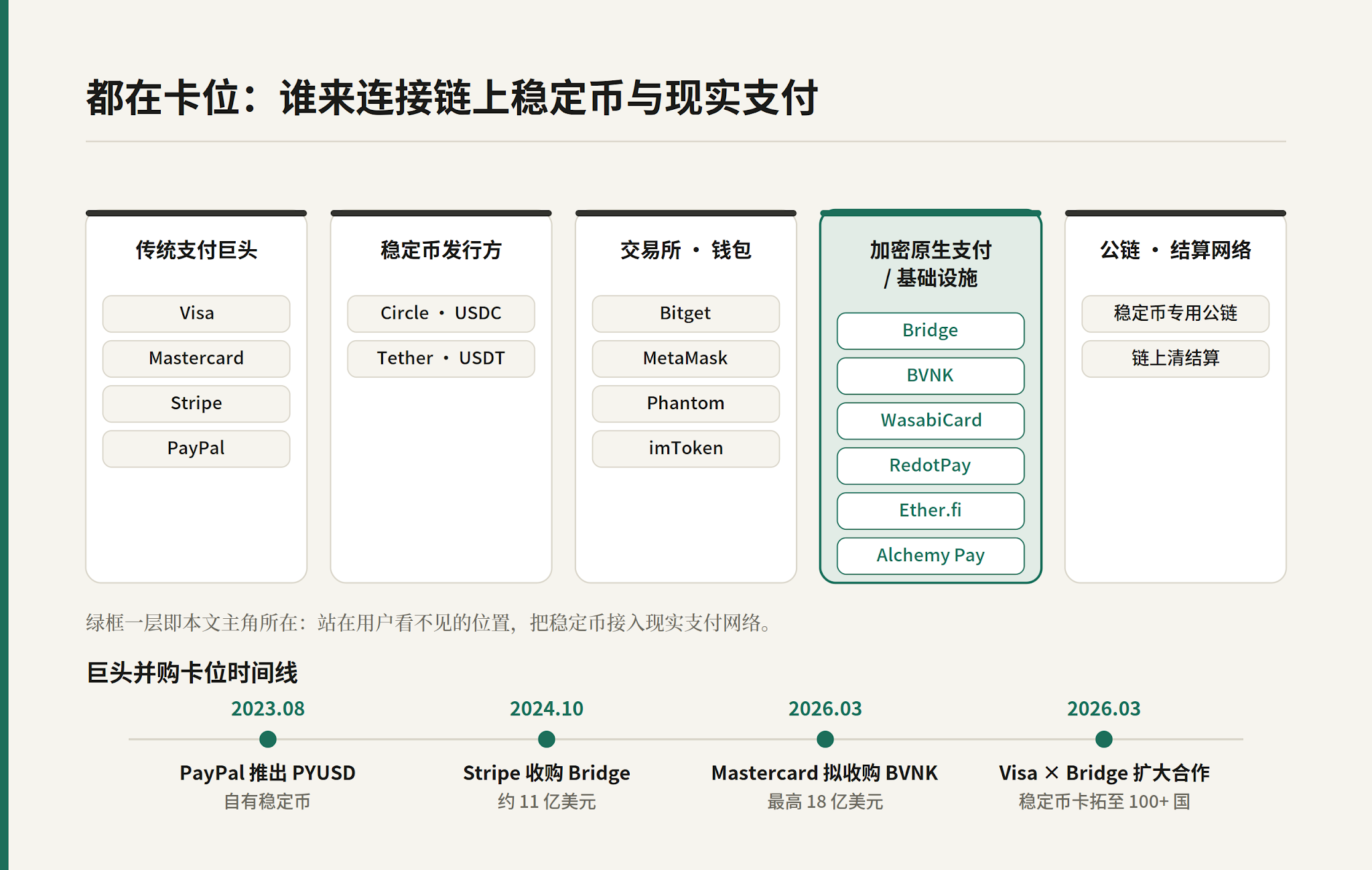
Plotting these actions from payment giants, card networks, and large fintech companies on the same map reveals not just isolated bets on crypto payments by a single firm, but a preemptive positioning by the entire payment industry around the stablecoin gateway.
Because stablecoins impact not just the payment experience, but also the deeper profit and power structures within the traditional financial system. They directly involve who controls accounts, cross-border channels, and even clearing and settlement in the new era. From this perspective, the proactive move by giants to connect on-chain accounts, stablecoin assets, and merchant receiving ends is less about embracing innovation and more about not wanting to be bypassed and left behind in the next restructuring of payment clearing.
However, when giants start fighting for the underlying layer themselves, the window for independent infrastructure players becomes starkly clear: either become an irreplaceable part of the giant's network, or grow into the network yourself. After all, regulation and licenses, KYC/AML, card network partnerships, and localized compliance are precisely the parts that C-end U-card products, built on traffic and subsidies, find hardest to sustain long-term.
This explains why companies like WasabiCard intend to use this funding round primarily for global compliance system building, multi-banking network connections, and core clearing/settlement system upgrades. These directions aren't glamorous, but they are the foundational capabilities that must be strengthened when stablecoin payments evolve from user products to financial infrastructure.
Looking further ahead, PayFi's imagination could extend to AI Agent payments. If AI Agents truly begin to execute automated transactions on behalf of users in the future, payment infrastructure can no longer be designed solely around "humans." Machines will also need callable accounts, verifiable authorizations, controllable limits, auditable transaction records, and the ability to handle high-frequency, low-value micropayments automatically within compliance boundaries.
This will make the endgame for stablecoin payment infrastructure more complex. Of course, this is still a longer-term vision.
But it at least shows that the value boundary of stablecoin payments is far larger than a single U-card.
Final Thoughts
Crypto payment cards are certainly a good business.
They connect stablecoins with real-world spending, giving users their first tangible experience that "U can be spent." This is precisely why U-cards rapidly broke into the Chinese-speaking market, becoming the most easily understood entry point for PayFi.
But the biggest reward may not lie on the card itself.
In the past, the market was more likely to remember a card, an app, a cashback campaign, or a low-fee gateway. However, as stablecoins enter larger-scale real-world business scenarios, what ultimately determines the long-term landscape of the industry might be deeper, more foundational capabilities.
Players like WasabiCard, operating relatively behind the scenes, may