






Kelp DAO는 4억 달러의 부실채권을 막았지만, Aave는 120억 달러의 대가를 치렀다


- 핵심 의견: Aave는 rsETH 사태 이후 자산을 되메꿨지만, 120억 달러 이상의 TVL 이탈, 뉴욕 법원의 소송 리스크, 그리고 거버넌스 내부 갈등이라는 세 가지 도전에 직면해 있습니다. 미래 성장은 V4의 이기종(heterogeneous) 시나리오 개방성과 Horizon의 RWA 기관 노선에 달려 있지만, 두 경로 모두 외부 속도와 내부 정치에 제약을 받아 단기간에 시장 신뢰를 회복하기는 어렵습니다.
- 핵심 요소:
- rsETH 사태 이후, Aave의 TVL은 4월 18일 263억 9600만 달러에서 5월 25일 141억 8100만 달러로 하락하며 120억 달러 이상의 손실을 입었습니다.
- 뉴욕 남부 연방지방법원은 6월 5일 Arbitrum 보안위원회가 동결한 30,766개의 ETH 귀속 문제에 대한 재판을 진행할 예정이며, Aave는 법적 위험과 브랜드 손상을 겪고 있습니다.
- DeFi United가 한꺼번에 여러 방면에서 Aave에 자금을 지원했지만, 커뮤니티의 비상 대응 능력이 소진되어 동일한 규모의 손실 방어 메커니즘을 재현할 수 없습니다.
- 저스틴 선(Justin Sun) 등 고래(whale) 사용자들은 Aave에서 약 1억 7400만 달러를 인출하여 Spark로 옮겼으며, 자금 이동 추세가 뚜렷해 프로토콜이 큰 손님의 신뢰를 잃었습니다.
- V4 출시 이후 예금 증가세는 더디며(5월 26일 기준 8613만 달러), 거버넌스 레이어가 번들 투표 제안으로 인한 내부 갈등을 겪으면서 개방성 실현 속도에 영향을 미치고 있습니다.
- Horizon은 허가형(Permissioned) V3 인스턴스로 기관 RWA에 특화되어 있으며, 5월 26일 기준 누적 순 예금이 5억 달러를 넘었고, BlackRock 등을 협력사로 두고 있지만, 성장은 전통 금융의 접근 속도에 의해 제약받고 있습니다.
- 경쟁사인 Morpho와 Spark는 rsETH 사태 이후 TVL을 회복하며 Aave에서 이탈한 대출 유동성을 흡수하여 장기적인 경쟁 구도를 형성하고 있습니다.
Original author: Sanqing, Foresight News
On May 26, Kelp DAO transferred the final batch of 20,373.72 rsETH to the LayerZero OFT Adapter. Aave simultaneously announced that rsETH and all affected markets had returned to normal. In 37 days, all 116,500 rsETH were backfilled.
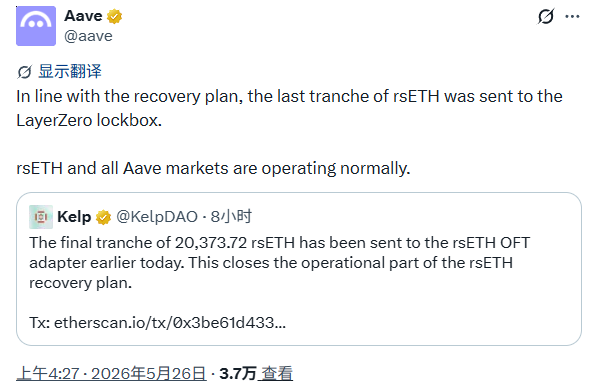
However, this only means rsETH has re-established a 1:1 backing; it does not imply that Aave's books have been fully cleared. The 30,766 ETH frozen by the Arbitrum Security Council remain tied up in the U.S. District Court for the Southern District of New York, with ownership still undetermined. Aave's lost TVL cannot simply return alongside the rsETH.
The Bill Extends Beyond the TVL Column
According to DefiLlama data, on the day of the incident, April 18, Aave's TVL was $26.396 billion; on May 25, it was $14.181 billion. Over $12 billion in value had not returned after one month.

What's more difficult to handle lies ahead. The U.S. District Court for the Southern District of New York will hold a hearing on June 5 regarding the ownership of the 30,766 ETH frozen by the Arbitrum Security Council. Both Aave LLC and Gerstein Harrow submitted supplemental briefs before May 22. The judge previously modified the restraining notice on May 8 to allow fund transfers, but a substantive judgment is still pending the June 5 determination.
Gerstein Harrow represents the families of victims of North Korean terrorism and holds an unenforced judgment of $877 million. Regardless of the outcome, this lawsuit is a drain on Aave's brand.
DeFi United came together this time because multiple parties were willing to backstop the situation: Stani Kulechov personally contributed 5,000 ETH, Consensys and Joseph Lubin pledged up to 30,000 ETH, the Aave treasury allocated up to 25,000 ETH, plus a credit line of up to 30,000 ETH from Mantle, along with support from Lido, Ether.fi, and others.
The scale of community mobilization was unprecedented, but Aave has used this one-time card. Should another upstream contamination event occur, it may not be possible to assemble the same list of backers again.
For example, after the incident, Justin Sun withdrew approximately $174 million (including 65,854 ETH and some stablecoins) from Aave to Spark, bringing his total deposits on Spark to over $1.3 billion. Whales are voting with their feet; capital has already migrated.
V4's Openness Is Being Slowed by Governance
Aave's counterattack isn't limited to just V4, but V4 is the most critical piece.
V4 launched on the Ethereum mainnet on March 30, featuring a Hub-and-Spoke architecture with three initial Liquidity Hubs. Aave Labs committed to "security-first growth," with deposit limits increasing gradually. It surpassed $10 million in deposits on April 8, crossed $50 million on May 9, and reached a total deposit of $86.13 million on May 26, with active lending positions at $27.77 million.
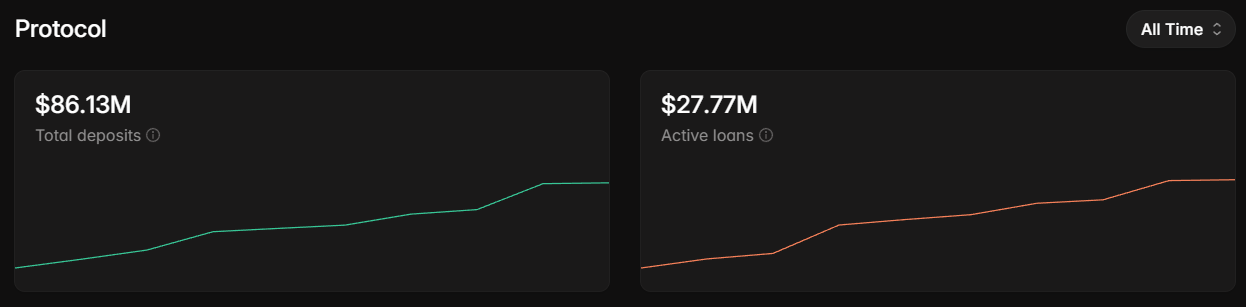
Before the rsETH incident, this pacing was a responsible design choice. After it, it turned into a stress test. Aave is simultaneously managing a $200 million bad debt on V3 while slowly expanding limits on V4.
More棘手 is that V4 also faces internal friction within its own governance layer. In February 2026, Aave Labs submitted a strategic proposal bundling product revenue, service provider incentives, V4 growth engines, and brand legal custody, requiring delegates to vote on four different risk dimensions in a single ballot.
Marc Zeller, founder of Aave Chan Initiative, publicly questioned the appropriateness of bundling a massive funding request with strategic approvals. This governance dispute has festered around V4's launch, with each delay allowing competitors to eat away at Aave's market share.
V4's strength lies in the openness of its Spoke design; anyone can build a Spoke, and if it meets conditions, connect it to a Liquidity Hub as a credit line. This is why Babylon Labs chose to integrate its Trustless Bitcoin Vaults into V4 over alternatives. However, the speed of realizing this openness depends on whether the governance layer can keep pace.
Beyond V4, Aave is Fighting Three Battles
Aave V3 remains the cash cow, generating over $100 million in annualized revenue, with the bulk of its $14.1 billion TVL residing on V3. The "Aave will win" proposal positions V3 in a "stable maintenance" phase, with Stani publicly committing to no forced migration and no deadline.
V4 and V3 will run in parallel for at least 24 to 36 months. V4 serves as an additive supplementary layer, handling heterogeneous use cases that V3 cannot accommodate. Horizon is a separate permissioned fork of V3, specifically designed for institutional RWA.
Each of the three layers targets different incremental growth. V4 aims for new scenarios beyond V3's risk framework; post-rsETH, it also has the task of giving capital that migrated to Morpho or Spark a reason to return to Aave. Horizon targets RWA traffic from traditional finance, operating in a completely separate pool from V3 and V4.
The Horizon Market officially launched in August 2025. It's a permissioned V3 instance deployed by Aave, specifically allowing institutions to use tokenized Treasuries, corporate bonds, and money market funds as collateral to borrow stablecoins like USDC, GHO, and RLUSD.
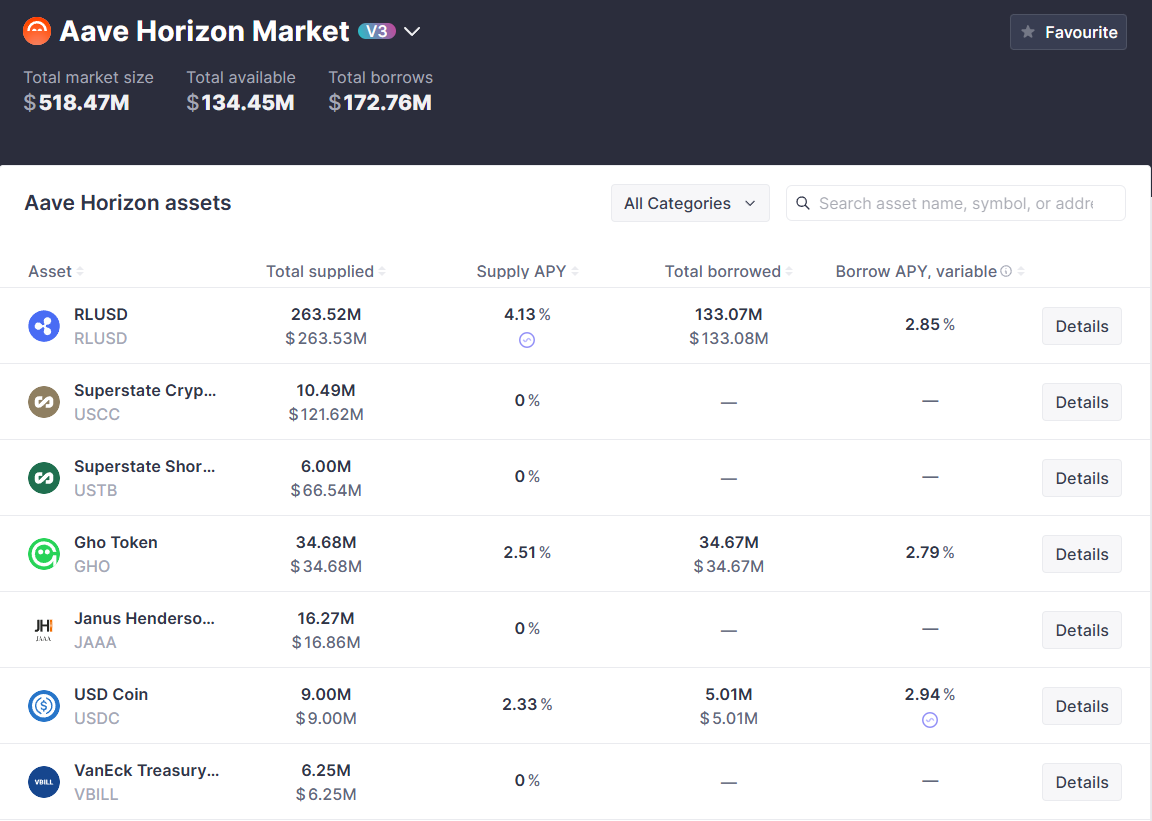
As of May 26, it has accumulated over $500 million in net deposits, aiming to surpass $1 billion by the end of 2026, with partners including BlackRock, Franklin Templeton, Circle, Ripple, and VanEck.
This strategy diverges from Morpho's vault management model. Morpho uses third-party curators like Steakhouse and Gauntlet to manage vaults that capture lending flows from retail institutions like Coinbase. Aave, via Horizon, directly connects with asset managers from traditional finance for RWA.
The two paths target different institutional client profiles. Morpho serves fintech companies using on-chain lending as a tool, while Aave serves asset managers using the chain as a place of issuance.
The capital migration following the rsETH event mainly affected the first type of client. The second type faces higher migration costs and reacts more slowly. The compliance framework, KYC processes, and asset access audits Aave has built with Horizon are barriers Morpho cannot quickly replicate.
This is the only incremental line for Aave not directly hit by the rsETH event, but its growth depends on the pace at which traditional finance integrates with DeFi.
There Will Be No Second DeFi United
Aave remains the largest protocol in the lending market. Its $14.1 billion TVL is still nearly double that of Morpho, and its years of deployment depth are unmatched in the short term.
However, the bill from rsETH isn't on the balance sheet; it's in the column of institutional default preference for lending protocols. Spark's TVL grew from $3.727 billion to $5.3 billion in a month. Morpho's TVL bottomed out on April 21 and slowly crawled back to pre-incident levels. These figures won't automatically reverse course just because Aave's market has technically recovered.
The speed of V4's execution in heterogeneous scenarios, combined with Horizon's progress in institutional RWA, will determine whether Aave can reclaim its lost market share. However, the former is bottlenecked by governance friction, and the latter by the access pace of traditional finance itself. And on both counts, Aave can only wait.
DeFi United was not a permanent institution; it was a one-time mobilization.


