






First-day trading volume crushes Polymarket, Hyperliquid enters the prediction market with BTC binary options


- Key Takeaway: Through HIP-4, Hyperliquid launched BTC intraday binary outcome contracts, integrating prediction markets directly into its on-chain trading system. On its first day, trading volume surpassed similar markets on Polymarket and Kalshi, aiming to transform event contracts into risk management tools for traders while strengthening the value capture mechanism of its HYPE token.
- Key Elements:
- Impressive First-Day Data for HIP-4: BTC price event contracts achieved a trading volume of $6.15 million, with over 54,000 trades and more than 3,000 unique traders, far exceeding the cold-start performance of comparable markets.
- Innovative Settlement Mechanism: As a primitive for standalone outcome markets, HIP-4 is specifically designed for binary outcomes (0/1), featuring dedicated processes for settlement, dispute resolution, and oracle confirmation to avoid mispricing and arbitrage risks, distinct from the continuous pricing model of perpetual contracts.
- Differentiated Positioning: Unlike Polymarket (focusing on event diversity) and Kalshi (emphasizing compliance pathways), Hyperliquid leverages its L1, on-chain order book, and processing capacity of 200k transactions per second to enhance trading experience and capital efficiency.
- Token Staking Threshold: Future permissionless deployment of outcome markets will require staking 1 million HYPE (higher than HIP-3's 500,000), used as a safeguard against risks like oracle manipulation, thereby increasing on-chain staking demand for HYPE.
- Value Capture Flywheel: Protocol fees will be used to buy back HYPE. If HIP-4 generates incremental trading volume, it will directly drive demand for and the scale of HYPE buybacks, creating a growth flywheel.
- Development Stage: Currently focusing solely on the BTC intraday market, this is still in its early stages. Future success will depend on the ability to expand into categories like sports and politics, as well as the reliability of the oracle settlement mechanism.
Original | Odaily (@OdailyChina)
Author | Asher (@Asher_0210)

On May 2, Hyperliquid launched HIP-4 Outcome Markets on mainnet, formally introducing outcome markets to its on-chain trading system. The first markets to go live were BTC daily binary outcome contracts, allowing users to trade based on whether the BTC price will be above a specified price at a certain point in time. Contract prices float between 0.001 and 0.999, reflecting the market's pricing of the probability of an event occurring; they settle at 1 if the event occurs and 0 if it does not. Contracts are fully collateralized in USDH, with no fees for opening positions.
This is not a simple product expansion. In the past, Polymarket has functioned more like an information market centered around events, where users enter specific markets for elections, sports, geopolitical conflicts, or crypto trends, using prices to express their judgment on outcomes. Kalshi, on the other hand, has tried to place event contracts within a clearer compliance framework.
Hyperliquid's approach is different. It doesn't first build a standalone prediction market to attract users and their capital. Instead, it starts directly from the trading environment it knows best – bringing outcome contracts into the same ecosystem as perpetuals and spot trading. For Hyperliquid, prediction markets are not just about betting on an outcome, but a new tool traders can use to express direction, manage risk, and construct strategies.
BTC Daily Market Sees Strong Start, First-Day Data Exceeds Expectations
The first market under HIP-4 is a daily settlement BTC price performance market. This choice itself is very "Hyperliquid" – starting not from politics, sports, or entertainment, but from the BTC price volatility that crypto traders know best.
On its first day, HIP-4 delivered impressive data. According to Predictefy, Hyperliquid's event contracts recorded a trading volume of $6.15 million on day one for BTC price-related contracts, significantly surpassing similar markets on Kalshi, Polymarket, and other prediction platforms. This means within the specific niche of BTC price-related event contracts, Hyperliquid has already moved to the forefront on its first day.
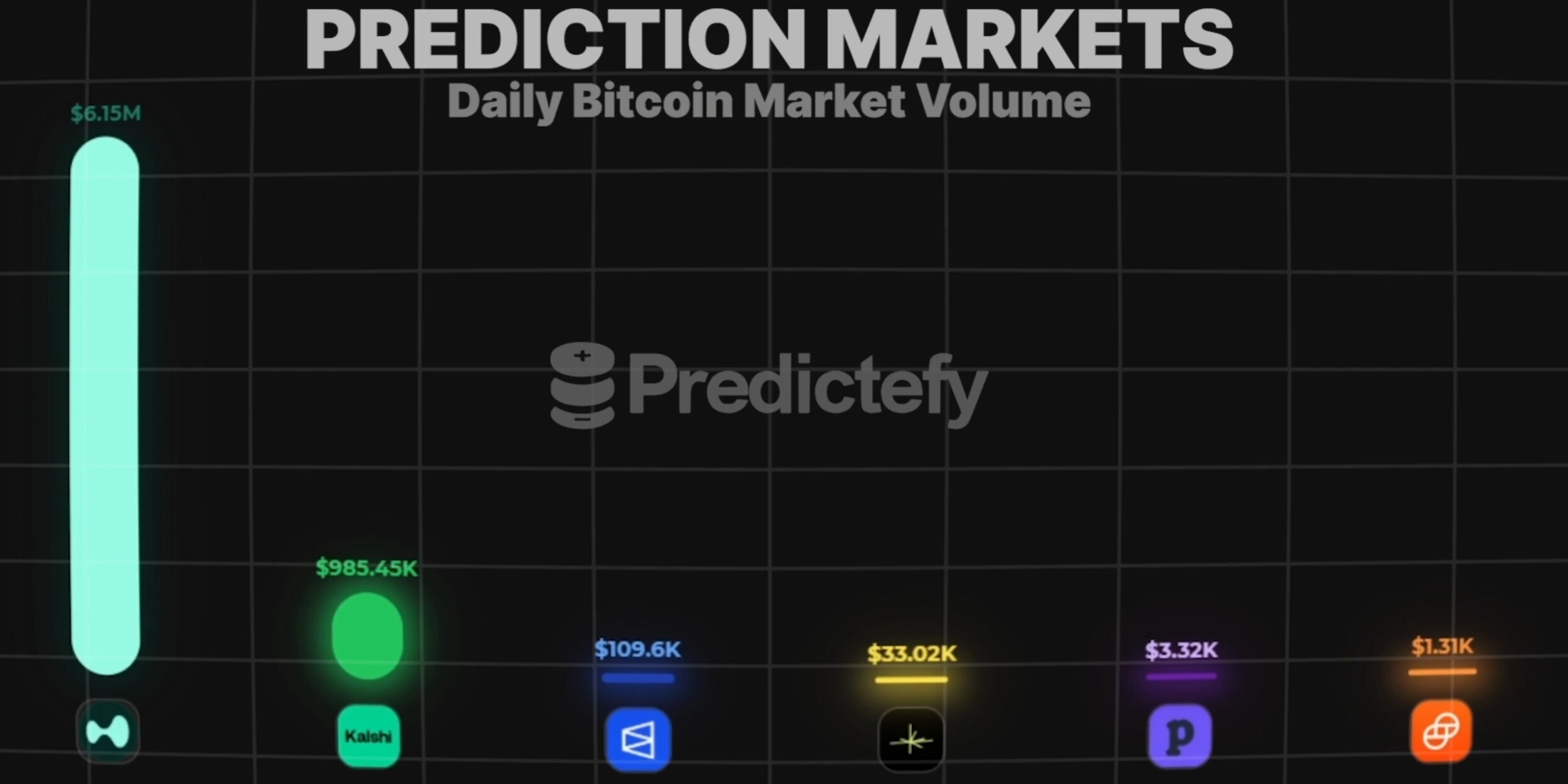
Source: Predictefy
Additionally, on its launch day, HIP-4 generated over $12,000 in total trading fees, recorded more than 54,000 transactions, and attracted over 3,000 traders. For a newly launched prediction market-related feature like HIP-4, these figures are already impressive. This was not achieved by launching a wide array of event categories, but by achieving a cold start within a single BTC daily market, making HIP-4's first step particularly significant.
Why HIP-4 Isn't Simply a Modified HIP-3
Hyperliquid previously supported Builder-deployed perpetual markets through HIP-3. The question arises: since perpetual markets can already be deployed, why was a separate HIP-4 needed? The answer lies in the fundamentally different settlement logic of outcome contracts.
Perpetual contracts require continuous pricing, allowing for gradual price adjustments via oracles. However, binary outcome contracts only settle at 0 or 1. Applying an oracle mechanism not designed for binary contracts could leave a prolonged window for mispricing after an event's outcome is already determined, creating near-risk-free arbitrage opportunities.
Therefore, HIP-4 was designed as a separate outcome market primitive. It is not a reskinned perpetual but a contract type specifically designed for expiration, settlement, dispute resolution, and oracle result confirmation. For an average user, prediction markets might just seem like buying Yes or No. But for a real trading system, the true challenge lies in how events are defined, who confirms them, when they settle, how disputes are handled, and how erroneous outcomes are corrected and penalized. The core of a prediction market is not just the front-end interface and trading entry point, but the settlement mechanism itself.
Hyperliquid, Polymarket, and Kalshi - Each with Their Own Battlefield
Looking at Hyperliquid's HIP-4, Polymarket, and Kalshi together, they represent three different directions for prediction markets:
- Polymarket's core advantage is event richness and mindshare: Its strength lies in converting complex events into tradable questions, blending public attention, media dissemination, and market probabilities. Political elections, geopolitical conflicts, celebrity events, sports, and crypto project milestones can all be quickly transformed into markets.
- Kalshi's advantage lies in its compliance path: It operates closer to the context of traditional financial event contracts, with a target user base and regulatory framework distinct from Polymarket and Hyperliquid. Recent escalating debates over prediction market regulation in the U.S., and conflicts between the CFTC and state-level regulators, indicate that event contracts are no longer a niche product but have entered the core discussion of financial regulation.
- Hyperliquid's advantage is trading experience and capital efficiency: Hyperliquid has its own L1, HyperCore matching engine, on-chain order book, and spot and perpetual infrastructure. Official documentation states that HyperCore includes a fully on-chain order book for perpetuals and spot, with orders, cancellations, trades, and liquidations executed transparently, capable of processing 200k orders/second.
Therefore, Hyperliquid is unlikely to take all of Polymarket's users in the short term. A lightweight user interested in the US election, sports, or entertainment gossip might not enter Hyperliquid's trading interface just to buy an event contract. However, a trader already trading BTC, ETH, gold, oil, or equity perpetuals on Hyperliquid might naturally incorporate BTC daily outcome contracts as part of their portfolio.
HYPE Could Become the Value Capture Engine in this Competition
HIP-4's significance for Hyperliquid is not just adding a new trading scenario; it further integrates prediction markets with HYPE's staking, fee, and buyback mechanisms. According to the HIP-4 design, Phase 1 involves validators deploying standardized markets, while Phase 2 will open up permissionless deployment. In the future, market creators wishing to create their own prediction markets will need to stake 1 million HYPE. Each staking seat can support rolling and periodic markets, which can be reused after settlement. In case of oracle manipulation, anomalous market states, or prolonged downtime, staked assets may be slashed.
This threshold is significantly higher than HIP-3's 500,000 HYPE. The reason is clear: outcome markets depend more on event definition and oracle settlement than perpetuals. Perpetual prices can adjust continuously, but outcome markets only have 0 and 1. A settlement error doesn't just harm the trading experience of one market, but the credibility of the entire prediction market system.
For HYPE, HIP-4 brings two layers of incremental demand. First is staking demand. More Builders wanting to deploy outcome markets will need to lock up more HYPE. Especially as categories like sports, macro, politics, crypto events, and entertainment gradually open up, the right to create quality markets could become a high-barrier business license. Second is the fee and buyback logic. Hyperliquid already has a strong capacity for capturing trading volume and fees, with a significant portion of protocol fees used to buy back HYPE. If HIP-4 can generate new trading volume, outcome markets become not just a new feature, but a part of the fee growth and HYPE buyback flywheel.
This is also a key difference between Hyperliquid and Polymarket or Kalshi. The growth of Polymarket and Kalshi is reflected more in platform volume, market share, and brand influence. Hyperliquid's growth, however, maps more directly onto the demand for and value capture of HYPE.
Market Sentiment is Optimistic, but HIP-4 Still Needs to Prove Itself
Market feedback on HIP-4 leans optimistic, for understandable reasons. Hyperliquid already possesses mature trading infrastructure, active trading users, and a clear HYPE value capture mechanism. Entering the prediction market, it doesn't need to build a matching system from scratch or find its first batch of traders from zero.
However, HIP-4 is still in a very early stage. Current markets are limited to BTC price outcomes. Whether it can successfully expand to sports, politics, macro, crypto events, entertainment, and other categories depends on the smooth progression of Phase 2's permissionless deployment. Simultaneously, outcome markets demand higher standards for oracles and settlement mechanisms. Event definition, data source selection, dispute handling, and erroneous settlements will all directly impact market trust.
Therefore, HIP-4's significance is not that Hyperliquid has already won the prediction market, but that it has introduced a new competitive direction to the sector. Polymarket proved events can become an information market, Kalshi represents a compliant path for event contracts, and Hyperliquid aims to prove that event contracts can also be an integral part of an on-chain trading system.
If the past competition in prediction markets was about who could capture the most hot events and attract more users to bet, then post-HIP-4, a new competitive axis has emerged: who can truly integrate event outcomes into traders' capital, positions, and strategies.
This also means Polymarket's competitor is no longer just Kalshi. With Hyperliquid entering the fray, the next phase of prediction markets might not just be a competition between event markets, but a competition between trading systems, liquidity, and asset pricing capabilities.


