






SPCXの先物価格が上場価格の150ドルを下回るも、焦って買う必要はない


- 核心的な見解:SpaceXのスターシップ試験爆破と200億ドルの社債発行開始に加え、世界的なAI関連株の調整が重なり、株価は3日連続で急落。時価総額は約4000億ドル減少し、IPO初日の終値を下回り、市場の信頼感は損なわれた。
- 重要な要素:
- 6月18日のスターシップの静的燃焼試験の爆発は、地上で最も深刻な事故と見なされ、市場にパニックを引き起こした。
- 6月22日、SpaceXはxAI買収のブリッジローン返済のため、少なくとも200億ドルの社債発行を発表。投資家の間でキャッシュフローと設備投資に対する懸念が生じた。
- SPCXは1日で16.43%以上急落し、時価総額は約4000億ドル減少。これは世界の企業史上2番目に大きい1日の時価総額減少記録となった。
- 世界的なAI関連株の調整が広がり、韓国のKOSPI指数は9%超下落、香港のMINIMAXは15%下落し、SpaceXの株価にさらなる圧力をかけた。
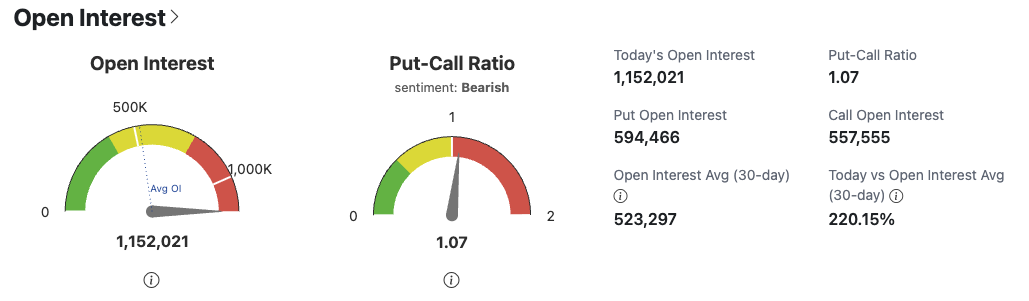
- 個人投資家の買い注文は枯渇し、プット/コール比率は1.07に上昇。市場センチメントは中立からやや弱気に転じ、IPO時の流通株式はわずか5%であり、株式ロックアップ解除の見通しがさらなる下押し圧力となっている。
- ARK Investは暴落日に逆張りで約21万株を購入し、SpaceXの長期的な破壊的イノベーションに強気の見方を示したが、MorningstarやKeyBancなどの多くの機関は、現在の評価額は将来の成長を既に十分に織り込んでいると考えている。
Original: Odaily Planet Daily (@OdailyChina)
Author: Golem (@web3_golem)
On the evening of June 18, SpaceX's Starship, serial number 36, exploded during its 10th static fire test, creating a massive fireball at the site. Fortunately, there were no casualties. This was SpaceX's most serious ground accident in recent times, with all test facilities damaged, and Western media described it as a "catastrophic failure."
The "ripple effect" of this explosion quickly spread to the capital markets. Since June 18, SpaceX has fallen for three consecutive trading days, with a decline of over 16.43% on June 22 alone. Its single-day market value evaporated by approximately $400 billion, setting the record for the second-largest single-day market value loss in global corporate history.
Worse still, SPCX has fallen below its IPO first-day closing price ($160.95). According to Hyperliquid data, SPCX once dipped below its listing opening price ($150) in after-hours trading. If the stock truly breaks below $150 when the U.S. market opens on June 23, it would mean that all investors who bought and held SPCX in the secondary market are now underwater.
Is this continuous decline due to a loss of investor confidence in SpaceX, or is it just a short-term market sentiment correction? Where will the SpaceX stock price head next? Odaily Planet Daily will provide a brief analysis in this article.
The $20 Billion Bond Financing May Just Be the Trigger
On June 22, the direct trigger for SPCX's drop of over 16% was SpaceX's announcement that day to initiate its first senior unsecured note issuance. Although the 8-K filing submitted to the SEC did not disclose the specific offering size, Bloomberg reported last week that SpaceX was planning a bond issuance of at least $20 billion. SpaceX confirmed that the proceeds from this fundraising would be used to repay bridge loans, pay related fees, and for general corporate purposes. These bridge loans arose from SpaceX's acquisition of Musk's own company, xAI, in February of this year.
However, conducting bond financing less than two weeks after listing is not good news for investors. While the additional interest expense from the bond issuance is a minor issue, the fact that SpaceX still needs extra financing now brings significant negative implications.
SpaceX had already raised $85.7 billion in its IPO, and according to disclosures, it also has approximately $100.8 billion in cash and cash equivalents on its books. This has become the latest point of attack for short sellers. A company that has just gone public with over $100 billion in cash on its balance sheet is now borrowing from the market again. This implies that SpaceX has not yet achieved positive free cash flow, and that the capital burn rate for Starship and AI infrastructure is far exceeding market expectations.
CFRA Research, an independent investment research firm that had previously given SpaceX a sell rating, also questioned the necessity of such massive financing, commenting, "With Elon Musk, you never know what he's thinking."
Renowned tech hedge fund manager Dan Niles also posted on Platform X, stating that SpaceX's bond issuance and its computing power agreement with Reflection AI may remind investors that the market has another hyperscale AI competitor requiring massive financing. He has previously expressed concerns about its high valuation.
Affected by the Global Decline in AI Concept Stocks
The announcement of the bond financing may just be the trigger for SpaceX's decline. Its share price pressure is also attributed to the broader pullback in global AI concept stocks.
On June 23, not only did AI concept stocks generally fall at the close of the U.S. stock market, but the AI sectors in other global markets were also in correction. On June 23, South Korea's KOSPI index became the worst-performing major index in Asia, falling over 9%. The South Korean stock market triggered a circuit breaker in the morning and continued to fall in the afternoon, with SK Hynix and Samsung Electronics both falling over 12%. At the same time, the two giants of Hong Kong's AI sector also plummeted, with MINIMAX falling 15% and Zhipu falling over 9%. The four major A-share indices also fell collectively in early trading.
The global correction in AI concept stocks is mainly due to investor concerns that the investment in AI infrastructure is too large, while the cycle for commercial returns is too long. There are doubts about whether the capital expenditure will ultimately yield corresponding returns. SpaceX is seen as one of the representative companies following this logic. Its investment scale far exceeds the speed of commercial returns, so its stock price naturally suffers significant setbacks.
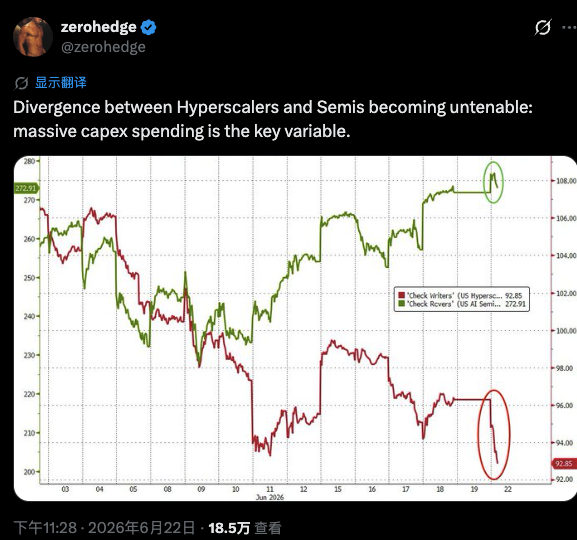
On June 22, U.S. financial media outlet zerohedge posted on Platform X, stating that the divergence between hyperscale cloud vendors and semiconductors is intensifying, and massive capital expenditure has become the key issue.
Retail Buying Dries Up, Equity Unlock Negative News Lands Early
SpaceX has been one of the most sought-after stocks by retail investors in the U.S. market since its listing. Because initially only less than 5% of the float was tradable, the SPCX stock price was essentially driven up by retail investors. According to Vanda Track statistics, retail investors net bought $405 million worth of SPCX in the first five trading days. Their buying volume for SPCX exceeded their combined purchases of all other stocks in the "Magnificent Seven," where the total buying volume for NVDA, MSFT, AMZN, META, GOOGL, and GOOG during the same period was only $278 million.
However, retail buying cannot serve as long-term support for the SPCX stock price. On the contrary, the more aggressive the initial retail buying, the faster the retail momentum will dissipate once the real buyers have finished buying and sentiment cools down.
Options trading for SpaceX began on June 16, with bullish sentiment dominating the early trading period. However, according to OptionCharts data, the current put/call ratio for SPCX is 1.07. From a sentiment perspective, investors are leaning towards a neutral-bearish stance. While it is not yet a case of universal bearishness, it at least proves that retail investors are beginning to show trepidation.
This sharp decline in SPCX has only occurred with only 5% of the float being tradable. How will SPCX hold up when the equity unlock date arrives? In a sense, the current stock decline in SPCX is also the early materialization of negative news regarding the equity unlock. Investors may be waiting for the first round of SpaceX equity unlock before re-establishing their positions.
According to regulations, after SpaceX releases its Q2 earnings report in mid-August, 20% of the shares will be unlocked. If the stock price at that time is 30% higher than the IPO price and meets this standard for 5 out of 10 trading days, an additional 10% could be unlocked.
Jeff Jacobson, strategist at 22V Research, stated that insiders could sell 44% of SpaceX shares by early September, which would increase the current float by approximately 900%.
The next positive catalyst for SpaceX is its potential inclusion in the Nasdaq 100 Index in July. However, due to the three consecutive days of price decline, investor panic regarding SpaceX has outweighed the anticipation of this potential positive development.
Bull and Bear Arguments
Unlike the first week of listing, bearish sentiment on SpaceX now dominates the market. The main bull and bear arguments are as follows.
Shorting Tools Completed, Correction, Valuation Reflects Future Growth
On June 18, after SpaceX announced the acquisition of Cursor through a $60 billion equity deal, Morningstar, a well-known independent investment research firm, not only refrained from raising its expectations for SpaceX's AI business but further lowered its fair value estimate from the previous $63 to $62. They believe that without substantial quarterly earnings reports to support it, the current stock price is entirely driven by narrative.
Gary Black, co-founder of Future Fund, previously pointed out that before SPCX options trading began, SpaceX's trading logic was completely detached from fundamentals. "Its trading performance is more like a meme stock than a company driven by fundamentals." Therefore, the current crash is an inevitable correction after the shorting tools have been put in place.
On June 22, KeyBanc Capital Markets (KBCM), a major U.S. investment bank, gave SPCX a neutral rating. Although it did not provide a target price, its analysts stated that SpaceX's current valuation already fully reflects future growth, and the stock price could be cut in half. While there are long-term growth drivers, much of the positive news has already been "priced in."
Cathie Wood Becomes a Staunch SPCX Bull
Twilight reveals the faithful. Cathie Wood-led ARK Invest is not only a Bitcoin bull but is also one of the staunchest bulls on SpaceX. On the day of SpaceX's IPO, ARK Invest made a substantial purchase of approximately 3.3 million shares, valued at over $500 million at the time. On June 22, the day of SPCX's significant drop, ARK purchased approximately 210,000 SPCX shares (worth about $38.9 million) through several of its ETFs (including ARKK, ARKQ, etc.).
Previously, in 2024, ARK's model estimated SpaceX's enterprise value in 2030 to reach $2.5 trillion, with an optimistic scenario approaching $3.1 trillion. At that time, ARK was referring to a company that was not yet listed and valued at approximately $180-350 billion. Now, SpaceX has successfully gone public, and its market value once approached ARK's model estimate from back then. ARK's decision to increase its stake at this point likely reflects a long-term positive view of SpaceX's disruptive innovations, such as reusable rockets, Starlink, and the space economy.


