






USDC反攻USDT、真の戦場はHyperliquid


- 核心見解:ステーブルコインの競争は、コンプライアンスから流通チャネルの獲得へとシフトしている。CoinbaseとHyperliquidの取引の核心は、短期的な利益分配ではなく、USDCを無期限先物という高頻度取引の場に組み込み、USDTのネットワーク効果に対抗するグローバルな流通チャネルを獲得することにある。
- 重要要素:
- 2026年5月、USDCの取引量は3550億ドルで初めてUSDTを上回ったが、市場シェアは27.6%から28.1%への微増に留まり、成長の大部分が米国国内市場によるものであることを示している。
- Hyperliquidは、チェーン上の無期限先物市場の30%のシェアと46%の建玉を占め、その取引量は一部の中央集権型取引所に匹敵し、グローバルなリーチを有している。
- 取引後、Hyperliquidは従来のモデルの約2倍の収益分配を得るとともに、ユーザーからの信頼が高いUSDCを再び統合する。Coinbaseは、無期限先物という中核的なユースケースにおけるUSDCの構造的な流通チャネルを獲得する。
- Coinbaseは規制上の制約により、サービス提供国が約100カ国とBinanceに遠く及ばず、Hyperliquidのようなグローバルなリーチを独自に再現することは不可能である。
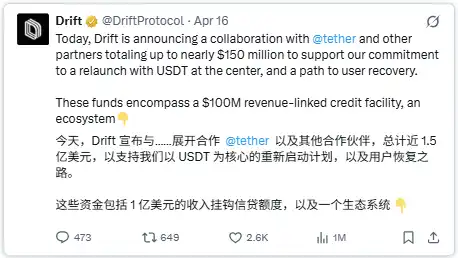
- Tetherもこの戦略を模倣しており、Driftへの攻撃後、1億4750万ドルを投じてUSDTをその決済資産とし、Solanaエコシステムにおける無期限先物市場を争っている。
Original title: How USDC Wins the Hyperliquid Deal
Original author: David Christopher
Original translation: Peggy
Editor's note: The stablecoin competition is shifting from "who is more compliant" to "who can secure more trading gateways."
Following the passage of the GENIUS Act, USDC has indeed gained new growth momentum. Circle's US-based background and compliance advantages have allowed USDC to catch up and even periodically surpass USDT in trading volume. However, from a market share perspective, the landscape has not changed significantly: USDT still holds the majority of the stablecoin market and maintains a strong position outside the US.
This is also the core significance of the deal between Coinbase, Circle, and Hyperliquid. On the surface, it's a stablecoin asset swap: USDC regains its position as Hyperliquid's primary quote asset, and Hyperliquid gets a higher revenue share. But at a deeper level, it's a battle over distribution channels.
Hyperliquid is a core platform in the on-chain perpetual contracts market, which inherently relies on stablecoins as quote and settlement assets. Whoever becomes the main quote asset for these markets gains long-term use cases from increased trading volume, margin, deposits, withdrawals, and on-chain activity. Tether has already proven this path through Binance; USDT's strength comes not just from its issuance size, but also from being deeply embedded in the global trading system.
For Coinbase and Circle, Hyperliquid offers a global reach that they themselves can hardly replicate. Coinbase is constrained by regulations and cannot cover as broad a market as Binance or Hyperliquid. Therefore, embedding USDC into Hyperliquid's transaction infrastructure might be a realistic path for them to counter USDT's network effect.
What's most noteworthy in this article isn't whether Coinbase made concessions or how much revenue share Hyperliquid received, but that USDC is trying to evolve from a "US-compliant stablecoin" into a broader "on-chain base currency for trading." As perpetual contracts continue to grow, the main battleground for stablecoin wars may increasingly concentrate on these high-frequency trading scenarios.
The following is the original text:
Tether still dominates Binance, but Coinbase has just re-loaded USDC onto Hyperliquid. The battle for stablecoin distribution channels is becoming increasingly fierce.
Hyperliquid is becoming one of the most contested assets in the crypto industry. Last week, spot HYPE ETFs launched by 21Shares and Bitwise went live on US trading platforms, followed by Grayscale and VanEck. Behind the rush of institutional capital is a longer-running competition: who can claim a piece of this trading platform's economic returns.
Last fall, Hyperliquid issued a public RFP seeking proposals for its native stablecoin USDH, aiming to reclaim the revenue that had previously flowed to Coinbase and Circle. At that time, approximately $5.6 billion in USDC was held in Hyperliquid's cross-chain bridge, generating about $200 million in annual interest income, but this revenue went to its centralized competitors. The platform that actually created the demand didn't benefit from it. Ultimately, Native Markets defeated bidders like Paxos and Ethena in the community vote, and USDH was subsequently launched.
Bankless previously reported on Hyperliquid's bidding war over USDH.
But just last week, Native Markets sold USDH to Coinbase and agreed to gradually phase out this stablecoin tied to Hyperliquid's interests, reinstating USDC as the trading platform's primary quote asset. In exchange, 90% of the related revenue will flow back to Hyperliquid, though the specific revenue capture mechanism remains unclear. The deal is widely interpreted as a victory for Hyperliquid, with the cost borne by Coinbase and Circle. That interpretation is understandable but not entirely accurate.
What Hyperliquid gained from this deal is clear: a significantly improved revenue share, roughly double that of the USDH model; stronger regulatory resources through alignment with one of the most influential voices in the US crypto industry in Washington; and a return to the stablecoin experience that the platform was originally built around and that users highly trust. Particularly in the HIP-3 market, which has drawn significant attention to Hyperliquid over the past six months or so, USDC remains the primary asset used.
From Coinbase and Circle's perspective, the deal is largely seen externally as a reputational boost: it aligns them more closely with one of the most crypto-native and successful projects of the last cycle. But if you look at USDC's current market position alongside the growth trajectory of the perpetual contracts market, another beneficiary emerges.
What Coinbase and Circle truly gained is a distribution channel for USDC. And this scaled distribution may be more important than any other part of the deal.

How Is It Performing on Home Turf?
Since the passage of the GENIUS Act, USDC has indeed shown strong growth momentum. Circle was well-prepared for the new environment shaped by this regulatory framework: USDC is headquartered in the US and has always been compliance-oriented. This positioning has translated into real trading volume.
Allium data shows that in May 2026, USDC trading volume reached $355 billion, surpassing USDT for the first time in recent months. This also reflects accelerated growth since the GENIUS Act was passed last July.
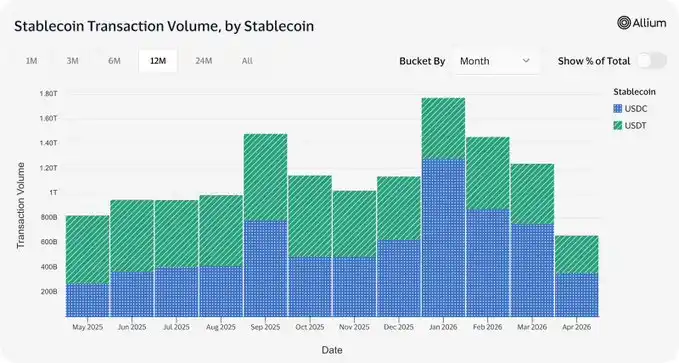
But the structural landscape of the stablecoin market hasn't changed.
In April 2025, just before the GENIUS Act's passage, USDT held 67% of the stablecoin market share and USDC 27.6%. One year later, USDT's share was 67.3% and USDC's 28.1%. The change was barely half a percentage point. In other words, although USDC's trading volume is accelerating, its supply share has hardly budged.
A report by Artemis last October showed that the US is USDC's strongest market. Given the correlation between USDC's post-GENIUS Act growth and the US regulatory environment, it's reasonably safe to conclude that the US is also the primary source of USDC's growth.
But the problem is precisely that the US is also the market where new competitors are converging most intensely. Stripe has clearly entered the stablecoin business through Tempo and other acquisitions; major financial institutions are also launching their own domestic stablecoins compliant with the GENIUS Act. They are all encroaching on USDC's core market.
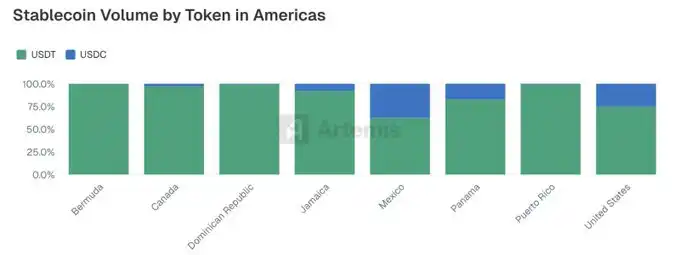
If the squeeze in the domestic US market intensifies further, USDC doesn't have a sufficiently solid base overseas to fall back on. In almost all markets outside the US, USDT remains the default dollar stablecoin, widely used for savings, investment, and trading, and it continues to expand aggressively. Over the past year, several new chains have been launched specifically to expand USDT distribution; meanwhile, Tether has also launched USAT, attempting to enter the boundaries of US regulation under the GENIUS Act framework and directly challenge USDC's home market.
Coinbase and Circle now have the momentum to continue expanding, but the window to lock in distribution channels before competition fully heats up is narrow. Trading venues, especially the perpetual contracts market, are the most suitable place to compete for this distribution gateway.
Bankless previously reported on Tether's launch of the US-regulated USA₮ stablecoin.
Perpetual Contracts Are the Real Battlefield
Like stablecoins, perpetual contracts are one of the fastest-growing categories in the crypto industry, consistently maintaining double-digit or even triple-digit year-over-year growth.
Perpetual contracts and stablecoins are structurally highly intertwined, as stablecoins are typically the primary quote asset in perpetual contract markets. USDT has already established a significant foothold here: on Binance, the world's largest perpetual contract trading platform, most trading markets use USDT as the primary quote asset. Any user trading in Binance's core markets primarily transacts via USDT. This further solidifies USDT's supply within the platform and naturally creates downstream pull effects on deposits, withdrawals, and on-chain activities surrounding the platform.
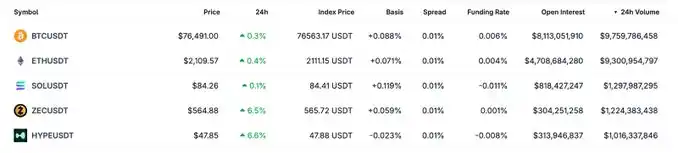
Although Hyperliquid's trading volume is much lower than Binance's, it is already the largest on-chain perpetual contract trading platform, holding a 30% share of the entire on-chain perpetual contract market and 46% of open interest. This position has remained resilient despite repeated competitive challenges.
Meanwhile, although Hyperliquid is not a centralized exchange, it has clearly demonstrated the ability to compete with them. As of April 30, its trading volume was about 50% of Bybit's, 30% of OKX's, and 79% of Coinbase International's. Taken together, this amounts to only about 13% of Binance's trading volume. But the key is that this number is still growing, and the growth curve points in only one direction.
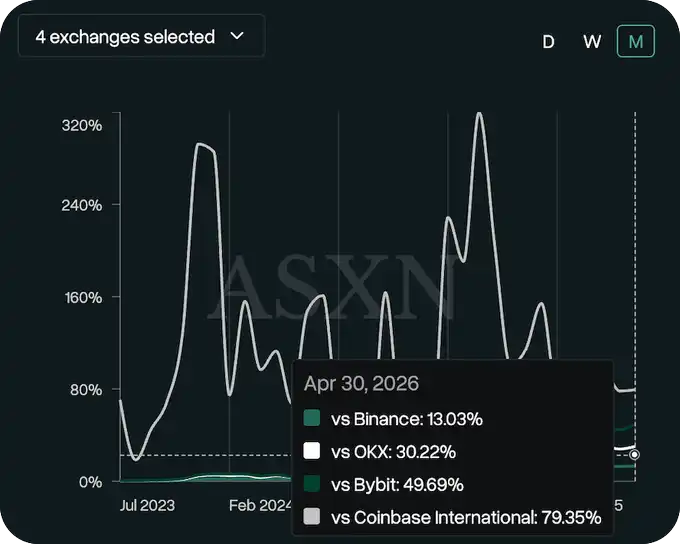
Although still in its early stages, Hyperliquid's dominance in the on-chain perpetual contract market, coupled with its ability to match or even sometimes exceed the trading volume of centralized exchanges, gives it a global reach comparable to Binance's coverage outside the US. This opens a new channel for Coinbase and Circle: they can leverage Hyperliquid to compete with Tether and turn it into a structural distribution channel for USDC.
Coinbase Chose Its Battlefield
However, this raises the question: why didn't Coinbase simply develop its own perpetual contract business further and build this distribution channel itself?
The reason is that Coinbase is constrained by its regulatory framework, limiting the range of customers it can serve and the number of markets it can list. Currently, Coinbase covers about 100 countries, slightly more than half of Binance's 180. Hyperliquid, benefiting from a "looser" operating environment, can reach a wider market, giving it an edge over both Binance and Coinbase—an advantage that Coinbase itself can hardly replicate.
Therefore, Coinbase and Circle have chosen to let Hyperliquid play the role of global reach, with USDC following as the underlying asset into these markets. This deal allows them to share in the upside through USDC supply growth and the resulting revenue, without having to engage in a jurisdiction battle they would be hard-pressed to win. They only get a portion of the economic benefits, but it's a scale that Coinbase alone could not achieve.
Tether Is Replicating the Same Playbook
Tether is also doing its own version, albeit on a much smaller scale. After the Drift attack in April, Tether committed up to $147.5 million to support its recovery. This deal established USDT as Drift's settlement asset, created USDT credit lines for designated market makers backed by Tether, and funded the trading incentive layer.
In other words, Tether used Drift's crisis to change the base currency of a major Solana perpetual contract DEX. Before this deal, USDC's stablecoin presence on Solana was more than double that of USDT, a pattern common across the entire Solana chain.
Both sides of the stablecoin war have realized the same thing: the perpetual contracts market is a key battleground in the stablecoin competition.
Overall, to capitalize on the growth momentum from the GENIUS Act, Coinbase and Circle need more distribution channels, and the Hyperliquid deal may be just such a gateway: allowing USDC to spread into core on-chain trading scenarios, enter one of the fastest-growing categories in crypto, and gain the possibility of competing at scale with USDT and Binance.
It may also be a bet on further opening of US regulatory boundaries. CFTC Chairman Selig has clearly stated his desire to allow perpetual contracts to trade in the US, and the passage of the CLARITY Act could ensure this. Reports this week show that the SEC is preparing to introduce an "innovation exemption" under its Project Crypto initiative, allowing crypto-native platforms to offer on-chain trading of tokenized US stocks under lighter registration requirements.
Combined with the CFTC's stance under Selig's leadership and the SEC's direction under Atkins' push, Coinbase appears to be positioning in advance: enabling Hyperliquid to gain distribution capabilities in the US market, with USDC already installed as the core asset.
Bankless has previously reported that perpetual contract trading is entering its window of opportunity.
Of course, the above remains speculative. But it does align with how Wall Street and institutional players might view Hyperliquid: as their gateway into the future institutional framework for perpetual contracts. For an asset, this is almost one of the most attractive tailwinds possible.


