Aaveは自らの愚かさによって、DeFi融資の王座を明け渡そうとしている


- 核心的見解:Aaveは、Kelp DAOへのハッキング事件後、積極的な危機対応と保証を示さなかったため、172億ドル以上の資金が流出。融資分野における自らの安全性の強みを競合のSparkに明け渡し、王座の座が揺らぐリスクに直面している。
- 重要要素:
- Kelp DAOから2億9200万ドル相当のrsETHが盗まれ、Aaveに1億2370万ドルから2億3010万ドルの不良債権が発生する可能性がある。
- Aaveには不良債権をカバーする能力があるものの、Kelp DAOやLayerZeroとの責任の押し付け合いにより、ユーザーへの約束が遅れ、パニックと取り付け騒ぎを引き起こした。
- 資金の継続的な流出により、Aaveの複数のプールの利用率が最大限に達し、流動性が枯渇。信用危機がさらに悪化した。
- 競合のSpark(Aaveのコードをフォークしたもの)は、事前にrsETHのサポートを削除していたため無傷で、TVLは約200億ドル増加。孫正義(ジャスティン・サン)が13億ドルを預け入れた。
- Aaveの創設者Staniは、多額の資金流出が起きてからようやく救済計画を発表したが、Aaveはすでに「最も安全なDeFi」としてのユーザーの認識と市場シェアを失ってしまった。
Original: Odaily Planet Daily (@OdailyChina)
Author: Azuma (@azuma_eth)

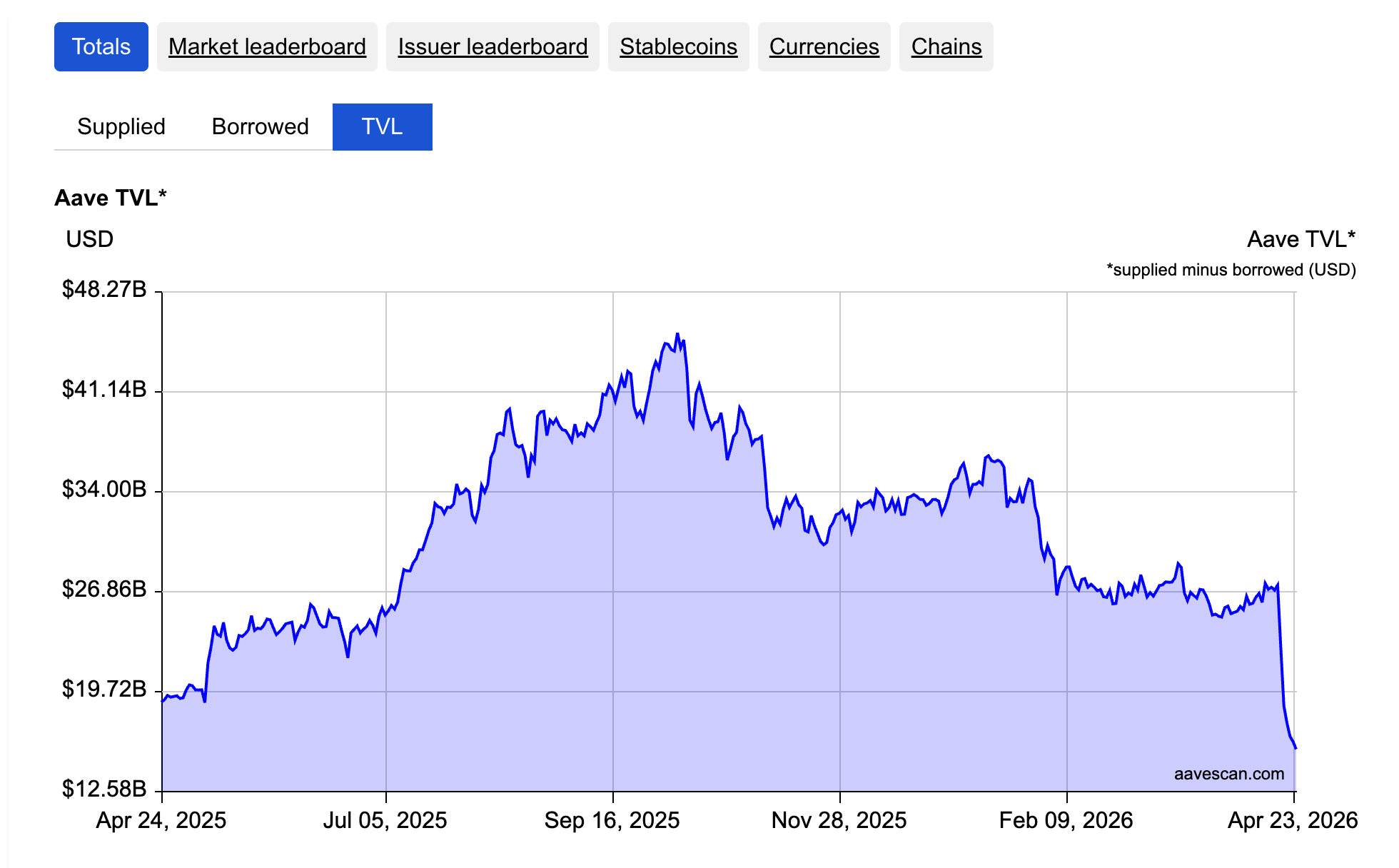
2.92 billion dollars – that's the total amount of rsETH stolen from Kelp DAO; 17.2 billion dollars – that's the scale of funds flowing out of Aave since the incident.
Aave, through its incredibly misguided crisis management strategy, is allowing community panic to fester for days, thereby losing its greatest advantage in the lending赛道: hundreds of billions of dollars in locked capital and the user mindshare as the "safest DeFi" protocol.
- Odaily Note: For background, please refer to "DeFi Hacked Again for $292M – Is Even Aave No Longer Safe?" and "The Three-Way Game Under the $290M Hole: Who Pays – Aave, L0, or Kelp?".
What Did Aave Do Wrong?
The details of the Kelp DAO hack need no further elaboration. It's pointless to blame Aave for granting rsETH such a high LTV. The focus here is on Aave's response strategy from the perspective of a long-term AAVE user.
First, the scale of bad debt. Aave itself calculated the potential scenarios based on different treatments of rsETH: If the stolen loss is deducted from all circulating rsETH, it's estimated to create $123.7 million in bad debt. If the mainnet rsETH value is protected, with the loss fully attributed to the bridged rsETH on Layer 2, it's estimated to create $230.1 million in bad debt.
In either scenario, Aave has the financial strength to cover it with its Umbrella, DAO treasury, and team funds. I understand that Aave is unwilling to foot the entire bill and wants the primary responsible party, Kelp DAO, and the secondary responsible party, LayerZero, to contribute as much as possible. However, the problem is that the other parties are thinking the same: "Aave is so wealthy and the situation is so awkward; they should shoulder more of the burden." Therefore, reaching a consensus among these three parties in the short term is difficult, meaning a universally satisfying solution is unlikely for now.
But users cannot wait that long. – Aave's yield rates have never been particularly competitive. Users who deposit with Aave do so for its reputation, security, and liquidity. Yet, during the most critical days after the incident, Aave failed to offer users any kind of guarantee or backstop. Instead, it focused on deflecting blame, repeatedly stating, "Our code isn't the problem," and "Aave cannot control how rsETH is accounted for."
Consequently, panic continued to ferment within the community. Users scrambled to find ways to withdraw and seek safety. Those who could withdraw directly did so; those who couldn't tried to borrow from other pools first, causing the impact to spread. So now, Aave finds itself in a situation where it is simultaneously facing continuous capital outflows and liquidity freezes in multiple pools due to utilization rates being maxed out.
This awkward situation could have been avoided (or at least been less severe). Since Aave has the financial capacity, why didn't it provide a stabilizing statement to the community from the outset to prevent a bank run? The maximum bad debt is $230 million (likely less). It's not as if Aave would have to pay it all alone; it could have continued negotiating with LayerZero and Kelp DAO afterwards.
Now, look at the result. To avoid committing to a maximum of $230 million in relief, Aave watched $17.2 billion in locked capital drain away (and this number may still grow), without even accounting for the recent decline in the AAVE token price. By any measure, this is a disastrously bad deal.
What's more troubling for Aave is that the worse its position becomes, the more comfortable its counterparts, like LayerZero and Kelp DAO, become. They will calculate that Aave is more motivated to resolve the issue quickly, which only puts Aave at a further disadvantage in negotiations.
Having reached this point, Aave has only itself to blame.
Behind Aave, Spark is Poised to Strike
While Aave is grappling with its headache, its competitor Spark is experiencing a period of remarkable success. What's more ironic is that Spark is a competitor Aave "nurtured" itself.
Spark is a lending protocol originally forked by Sky (formerly MakerDAO) from Aave V3's open-source codebase. Both protocols essentially run on the same underlying code logic. In return, Spark had a profit-sharing agreement with Aave. However, Aave later accused Spark of breaching this agreement, and coupled with diverging roadmaps, the two are now purely competitive.
Three months before the Kelp DAO hack, Spark had already removed support for rsETH (see details in "Same Day, Different Fate: Aave Embraces rsETH and Loses Nearly $200M, Spark Exits Unscathed"). Whether this is called strategic conservatism, rigorous risk control, or even just plain luck, the result is that Spark was completely unaffected by this incident. On this very point, Spark can freely attack Aave's former 'safest DeFi' label.
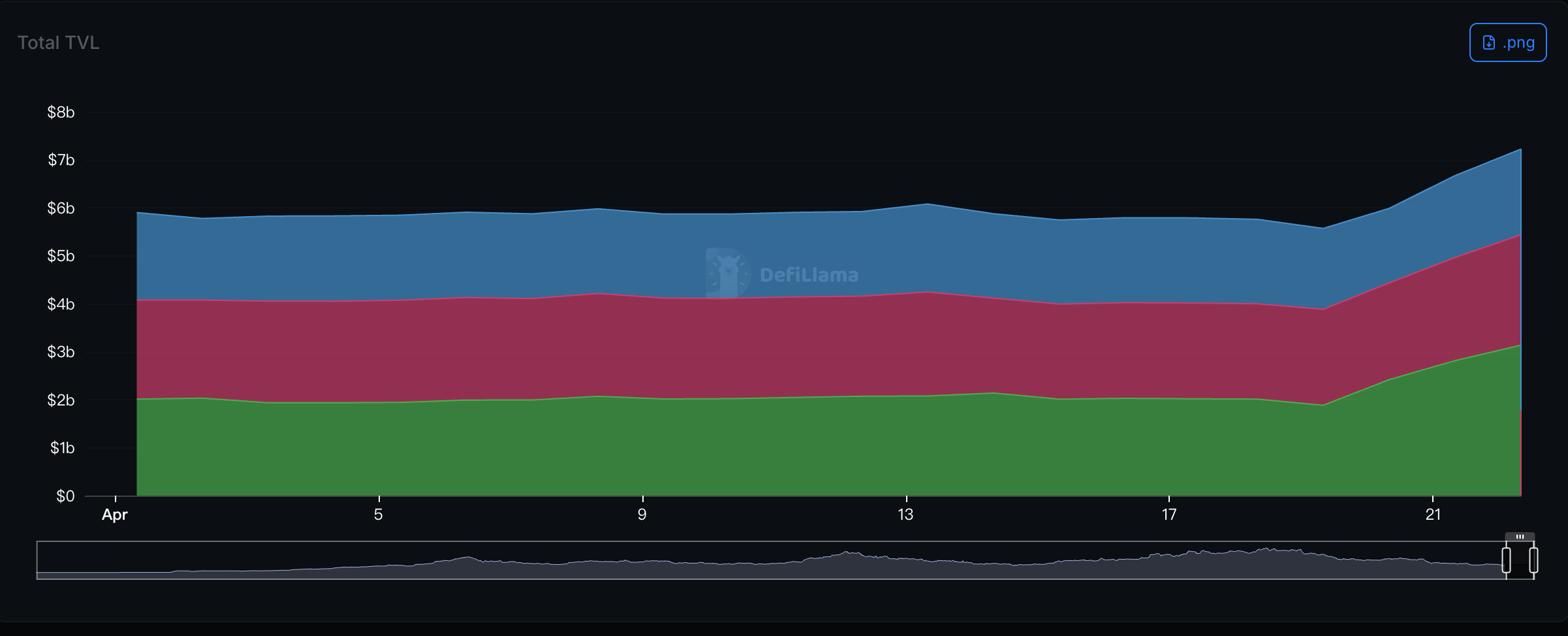
Consequently, Spark became one of the safe havens for funds fleeing Aave. Since the incident, Spark's TVL has grown by nearly $2 billion (green section in the image below). Justin Sun withdrew 53,665 ETH (worth $124 million) from Aave on the day of the incident and deposited it into Spark. After accumulating more in the following days, his total deposit has reached $1.3 billion. – In the world of DeFi, you really should learn from Sun Ge's moves.
On April 23rd, Upbit officially listed Spark (SPK) on its Korean Won trading market. Boosted by this news, SPK surged over 80% in a single day, significantly narrowing its market cap gap with AAVE.
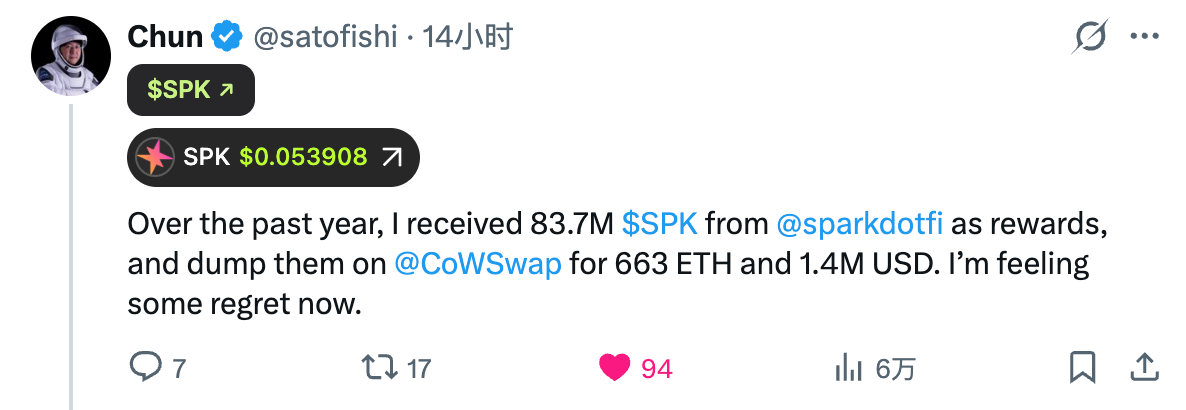
Even FishPool founder Wang Chun lamented on X: "In the past year, I received 83.7 million SPK in rewards from Spark and sold them on CoWSwap for 663 ETH and $1.4 million. I regret it a bit now."
Spark clearly recognized this as the perfect opportunity to seize market share from Aave. Since the incident, Spark's strategy lead, MonetSupply, has arguably become the most vocal KOL on this matter, posting dozens of times a day. While his statements may have helped the public understand the situation objectively, they have also undeniably fueled the panic surrounding Aave.
But this is simply pure business competition. MonetSupply made the most optimal choice.
Aave is Losing its Throne in DeFi Lending
In the early hours of April 24th, perhaps recognizing the severity of the situation, Aave founder Stani announced on X the launch of a relief plan called DeFi United. Partnering participants include LayerZero, Ethena, ether.fi, the Ink Foundation, the Golem Foundation, Trydo, and others. Stani himself will donate 5000 ETH to address the current issue.
But the capital has already fled, and user trust has been severely damaged. With this belated statement alone, Aave will find it extremely difficult to recover its locked capital and user confidence anytime soon.
The DeFi lending track has long been characterized by a "one superpower, multiple strong players" structure, with Aave seemingly holding a very stable leading advantage. But now, Aave has voluntarily relinquished its throne. Behind it, challengers are advancing aggressively. Besides the surging Spark, other competitors like Morpho and Jupiter Lend are also looking to take a bite out of Aave's market share.
Last year, Stani spent roughly $30 million to buy a five-story mansion in London, one of the most expensive transactions in the UK's sluggish luxury real estate market that year. I don't know if there's something like a "jinx," but precedents like Su Zhu suggest that flamboyant spenders in the crypto circle often seem to run into bad luck.
I can't guess what Stani is thinking right now in his five-story mansion.