




From Visa's Experiment to KYA Governance: Who Defines the Financial Boundaries of Agents?


- Core Viewpoint: Visa has launched an experimental AI Agent wallet called Visa CLI, enabling Agents to complete API payments and generate task-based income through stablecoins. This marks a formal move by a mainstream financial giant into the payment rails of the Agent economy, while the KYA (Know Your Agent) identity verification system is becoming a more urgent industry bottleneck than the battle over payment rails.
- Key Elements:
- Visa's stablecoin settlement annualized volume has surpassed $25 billion, a tenfold increase from approximately $2.5 billion a year ago and far exceeding the $7 billion recorded in March.
- Visa CLI adopts a dual-layer architecture: the identity layer is based on the TAP protocol and Agent Directory for registering public keys, while the funding layer settles on the Tempo chain in OUSD through the MPP protocol developed by Stripe and Tempo.
- After integrating with Taskmarket, Agents have for the first time achieved a two-way closed loop of "taking orders to generate income — paying per use," with rewards flowing directly into users' on-chain wallets in OUSD.
- Three days before Visa CLI's debut, the Monetary Authority of Singapore (MAS) announced it would push the industry to jointly develop a KYA protocol, requiring that Agent identity ownership, authorization limits, task scope, and trusted endorsements be clearly defined before transactions.
- Visa CLI is currently available only to individual cardholders in the United States on an invitation-only basis, with a maximum of 25 Agents linked per card, indicating clear boundaries for enterprise-level multi-Agent scenarios.
- Enterprise-grade solutions such as Cobo Agentic Wallet embed permission boundaries into cryptography and risk control engines rather than Prompts, through MPC dual-path signing and the Pact task contract framework.
Last week, we just discussed "ChatGPT Wallet Joins Forces with Visa: Does the Agent Economy Still Need Stablecoins?," and Visa has now stepped in personally to offer a thought-provoking answer.
On November 22, Cuy Sheffield, Head of Visa Crypto Labs, announced the launch of an experimental AI Agent wallet called Visa CLI. Unlike previous consumer-facing entry points focused on "helping humans swipe cards to shop," Visa CLI lets cardholders complete identity verification with their bank cards and connect their own AI Agents. The Agent can then use stablecoins to pay per-call API fees, and can also enter task marketplaces like Taskmarket to take on paid work such as research and content creation, earning USD stablecoin Open USD (OUSD) directly upon delivery and acceptance.
If we look at another set of figures Visa disclosed during its Q4 fiscal year 2026 earnings call, this step is clearly not a spur-of-the-moment decision: as of late October, Visa's stablecoin settlement business had surpassed $25 billion in annualized run rate, ten times the roughly $2.5 billion a year earlier, and far ahead of the $7 billion recorded in March this year.
As AI Agents gradually cross the two-way income-and-expense loop of "taking orders, receiving payment, and then paying outward," the industry is no longer just facing a route debate between bank cards and stablecoins:
A system of identity verification, authorization boundaries, and fund control built around non-human economic entities is being forced onto the stage ahead of schedule.
1. What Is Visa CLI Trying to Do?
Breaking down the design of Visa CLI reveals a very pragmatic approach.
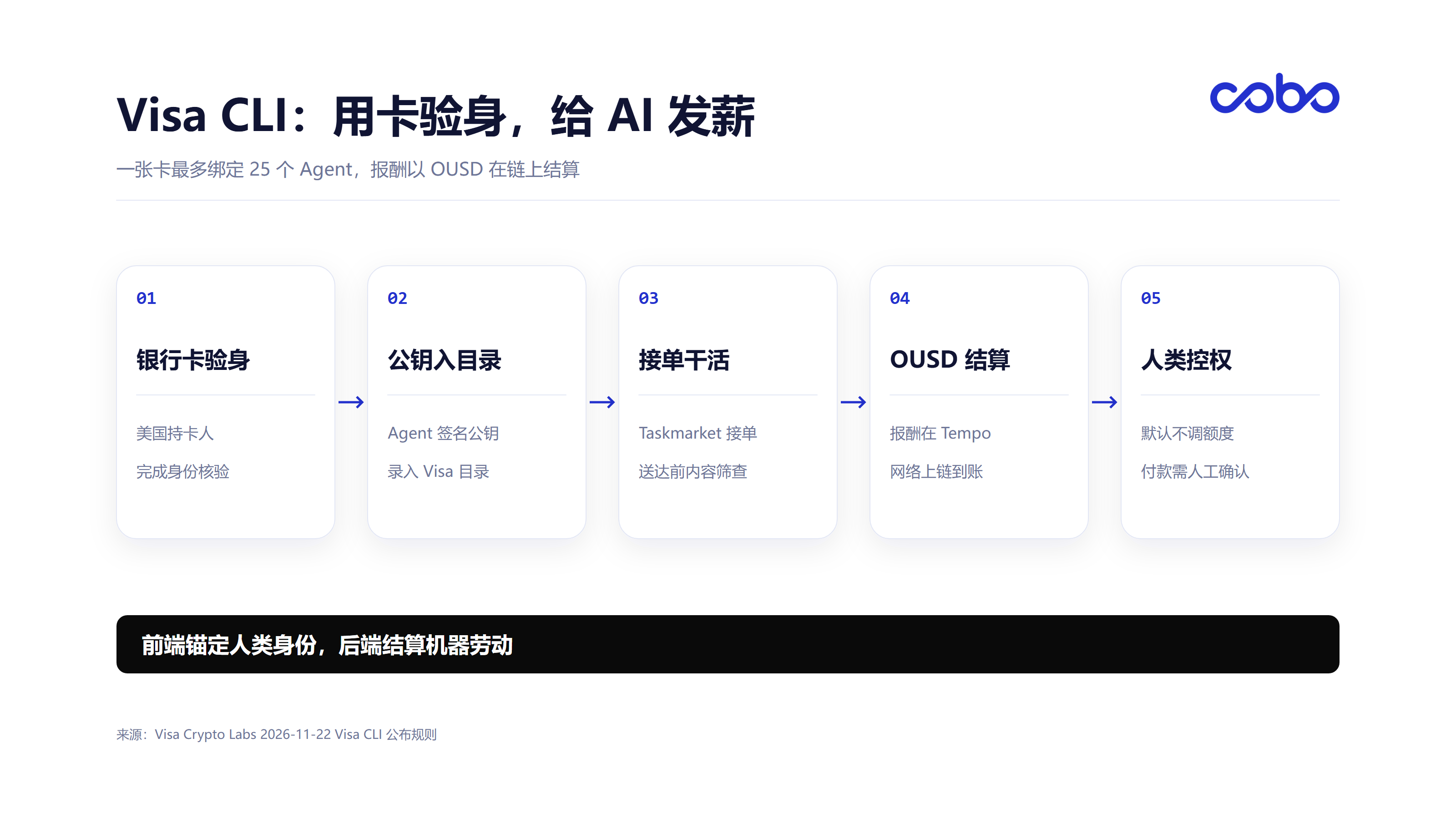
The product is currently in an invitation-only experimental phase, open to eligible U.S. Visa cardholders. Users complete card verification through a one-time passcode from their issuing bank, after which they can connect Agent applications such as Claude Code and Codex to Visa CLI.
The Agent then receives an independent signing identity, with its public key registered in the Visa Agent Directory for subsequent payment requests, task acceptance, or self-identification to service providers.
Notably, when funds actually move, Visa CLI uses OUSD held in the user's wallet rather than debiting directly from the linked bank card.
In other words, this design effectively separates two concerns: identity verification and request authentication on one side, and fund payment and settlement on the other.
The identity layer runs on the Trusted Agent Protocol (TAP) jointly promoted by Visa and Cloudflare. When an Agent sends an HTTP request, it must sign the request content with its own private key, and the recipient verifies, using the public key registered in the Visa Agent Directory, which registered Agent the request came from and whether the request content was tampered with during transmission.
The fund payment layer connects to the Machine Payments Protocol (MPP) jointly launched by Stripe and Tempo. When an Agent calls an external API or digital service on a per-use basis, the server returns a payment requirement, and the Agent completes settlement in OUSD on the Tempo network within a preset limit before receiving the corresponding service.
The most imaginative change in Visa CLI this time lies in its integration with the Taskmarket task marketplace.
In the past, an Agent calling external APIs was typically just the payer; now it can search for paid tasks on the marketplace, autonomously pick up work, and after completing research or content delivery and passing acceptance, the reward goes directly into the user's on-chain wallet in OUSD. This also means that for the first time, the Agent economy has run out a prototype of "income—spending" on rails built by a mainstream financial giant.
Objectively speaking, this architecture was not developed by Visa from scratch. What Visa controls itself is the identity protocol, the Agent Directory, and the product entry point, while underneath it integrates infrastructure from various players including VGS (card credential custody), Turnkey (key enclaves and wallet policies), Bridge (OUSD issuance), and Tempo (payment settlement chain).
But it is precisely this "assembly-style approach" that has brought considerable pressure to the crypto-native camp. Visa already holds billions of bank card credentials, a mature merchant network, and a vast developer ecosystem, and now with the combination of TAP + MPP + OUSD + Tempo, it has rapidly filled in low-cost on-chain payment rails.
From this perspective, for crypto-native public chains like Arc that focus on stablecoin payments, if they cannot open up differentiated thinking within the crypto ecosystem—such as more open multi-chain liquidity, DeFi composability, and neutral network effects—and instead only stare at existing commercial payment scenarios and confront giants head-on, the traditional market will likely be directly eaten up by giants like Visa and Stripe.
2. A Bottleneck Arriving Earlier Than the Rails Debate: From KYC to KYA
Stepping outside the rail contest between public chains and giants, when Agents begin receiving and making payments at high frequency, a more immediate real-world bottleneck is emerging: from the perspective of counterparties and financial institutions, how do you confirm who this program on the other side actually is and whether it can be trusted?
After all, the foundation of the modern financial system is KYC (Know Your Customer). No matter how many hands the money passes through, tracing it down will always find a specific natural person or registered legal entity to bear legal responsibility. But autonomously operating Agents break this premise.
For an API service provider, it needs to know which Agent the request comes from; for a task marketplace, it needs to know whether the party submitting results is the same Agent that previously committed; and for a bank or payment institution, it needs to figure out on whose behalf this Agent is acting and whether it has actually received the corresponding authorization.
This is also the direct reason why KYA (Know Your Agent) is beginning to enter the regulatory spotlight.
Just three days before Visa CLI debuted, Ravi Menon, Managing Director of the Monetary Authority of Singapore (MAS), delivered a speech at the 2026 Singapore FinTech Festival, explicitly proposing to promote industry-wide development of a KYA protocol in the next phase of SAFR (Safeguards for Agentic Finance at Runtime) work.
What regulators worry about is very specific: when AI Agents move funds at high frequency, and some users even hand their financial account login credentials directly to personal Agents, financial institutions will face three blind spots at once: they do not know whether the Agent is operating under the customer's full authorization, whether its operations have deviated from the original instructions, and who should bear responsibility if a mistaken operation or unauthorized transaction occurs.
According to the framework outlined by MAS, a qualified KYA protocol must, before a transaction occurs, clarify at least four things to financial institutions:
Identity and attribution: who this Agent is and which real customer or corporate entity stands behind it; authorization limits: how much funds it is allowed to use and which operations it can invoke; task scope: under what business instructions and constraints the current transaction is occurring; trusted endorsement: whether its code source, operational compliance, and historical records have verifiable credentials.
Looking back at Visa CLI, it becomes clear that it is actually conducting a lightweight KYA experiment on the consumer side—using a real-name-verified bank card as the anchor, issuing directory public keys to personal Agents, and rebinding "software behavior" back to "human identity." As long as a service provider's verification finds that the corresponding TAP public key is unregistered, suspended, or revoked, the request will be directly rejected before settlement, with no charge incurred.
Regardless of whether funds run on traditional card networks or public chains in the future, Agents without clear identities and verifiable authorization will not be able to truly connect to mainstream financial networks.
3. Beyond the Personal Sandbox: How to Manage Money for Enterprise-Level Multi-Agent Systems?
But if we shift the scenario from "an individual letting AI take on some odd jobs to earn OUSD" to real enterprise-level business, the current boundaries of Visa CLI immediately become apparent.
This is because Visa CLI's current design is entirely centered on individual users—for example, verification is completed with an eligible U.S. personal Visa card (prepaid and corporate cards are not currently supported), and a single card can be linked to at most 25 Agents; users set spending limits separately for each Agent, and by default every payment requires manual confirmation, with small automatic transactions allowed only under specific conditions.
For individuals trying it out, this mechanism is sufficiently prudent, but in an enterprise production environment, the problems are far more complex.
An enterprise backend may simultaneously run dozens or hundreds of Agents across procurement, finance, marketing, development, and supply chain. They face different counterparties, belong to different budget pools, and have completely different approval chains. Obviously, it is impossible to rely on a single personal bank card for unified backing, nor is it possible to require the finance lead to click confirm every time.
Large models may misunderstand tasks, external web pages may contain malicious prompts, and the runtime environment may be compromised. If permissions are written only in prompts, whether an Agent follows the rules ultimately still depends on how the model interprets those instructions.
Therefore, the enterprise-level Agent economy cannot stop at identity declarations at the protocol layer; it must write the permissions and boundaries required by KYA directly into the cryptography and risk-control engine of the underlying wallet.
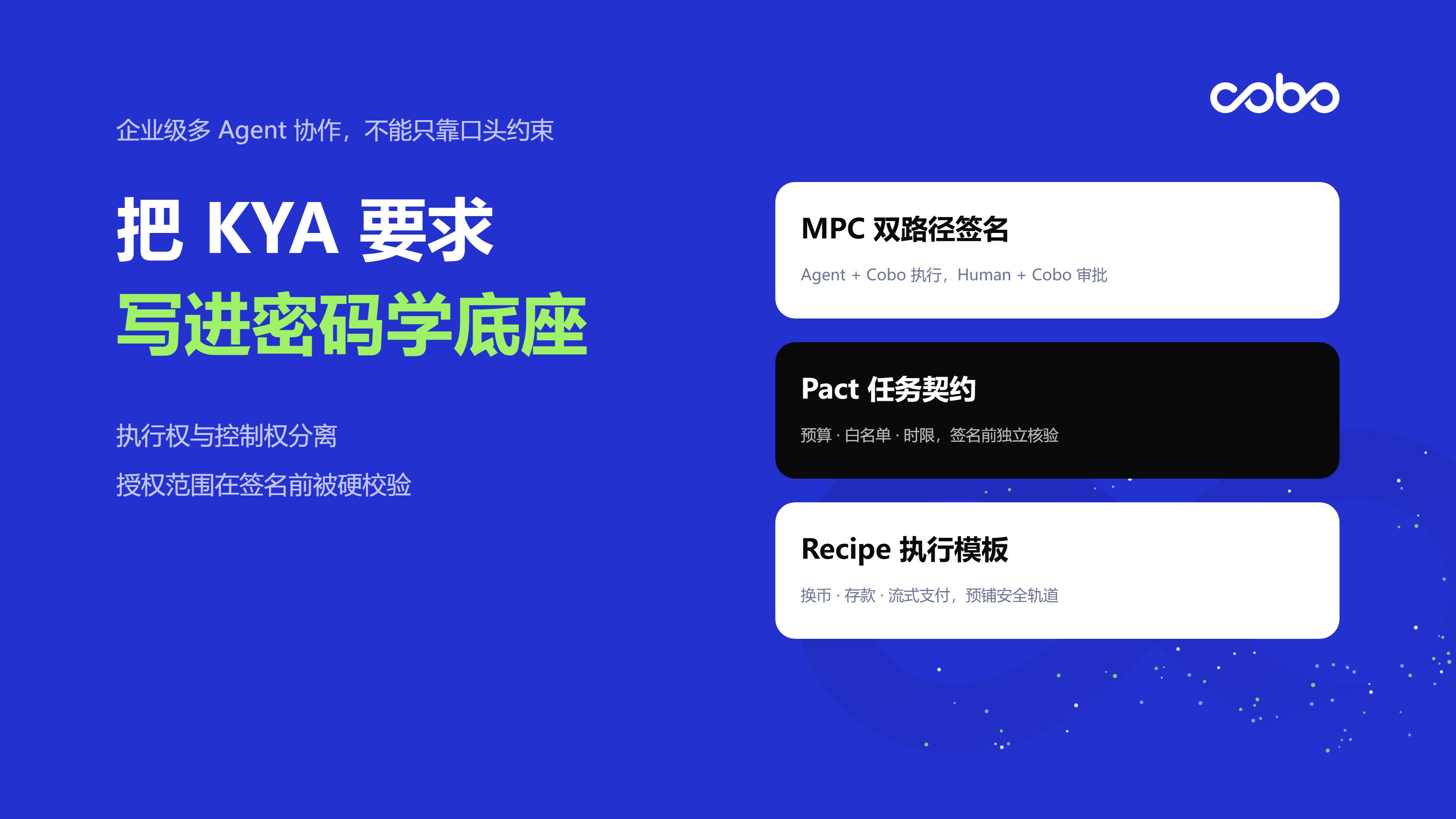
Taking the engineering approach of Cobo Agentic Wallet as an example, the core method is to completely separate the Agent's "execution power" from the enterprise's "fund control power."
At the underlying key level, it uses MPC dual-path signing to avoid single-point loss of control. The Agent's runtime environment does not store the complete private key; daily receipts and payments within the authorized scope are completed through system coordination, and once large transfers or core changes are triggered, it forcibly switches back to the manual approval path. Even if the sandbox is compromised or subjected to malicious inducement, a single node cannot move the funds away.
At the next layer up, through the Pact task contract framework, natural language instructions are turned into rules that machines can enforce rigidly, writing budget caps, whitelists, allowed contracts for interaction, and invalidation conditions directly into the risk-control engine. Every transaction must undergo independent verification before signing, which in essence turns the "authorization limits" and "task scope" emphasized by KYA into code gates that cannot be bypassed.
When business goes beyond simple transfers and involves on-chain swaps or complex contract calls, predefined templates (Recipe) are used to narrow the parameter space, reducing the probability that an Agent, when assembling transactions on its own, mistakenly touches high-risk contracts due to hallucination. Combined with pre-transaction on-chain compliance screening, multi-Agent fund flows can safely connect to an enterprise's existing treasury system.
Final Thoughts
The single Visa CLI experiment alone is not enough to prove that Agents have already become independent commercial entities.
But connecting several recent events into a line—from ChatGPT Wallet integrating traditional bank cards, to Visa CLI connecting TAP and MPP and settling in OUSD on the Tempo chain, to MAS beginning to draft a KYA protocol—the pace of evolution in Agent payments is faster than many expected.
In the future, when an Agent consumes by swiping a tokenized credit card, and settles with stablecoins during machine collaboration, it is essentially just routing choices under different scenarios. Ultimately, there can be many payment rails, and settlement assets will vary by scenario.
But in a commercial network operated automatically by large numbers of Agents, only by building infrastructure as quickly as possible that embeds identity verification, permission boundaries, and risk-control execution into the underlying architecture can we catch the next wave of large-scale institutional capital.
This is a proposition the entire industry needs to think about.