Will XRP Replace SWIFT? A Deep Dive into Ripple's 14% Bet Against the Banking Giants


- Core Thesis: XRP is not replacing SWIFT; rather, it targets SWIFT's expensive Nostro account liquidity layer, offering faster and cheaper settlement on specific remittance corridors. How far it can go depends on the liquidity depth of the markets at both ends, not on technology.
- Key Elements:
- SWIFT is a messaging network connecting over 11,500 institutions—not a bank. Its bottleneck lies in banks needing to pre-fund idle Nostro balances across dozens of countries; 90% of payments can already be delivered within an hour.
- The XRP Ledger settles in 3–5 seconds at a cost of less than one cent, and in 2017 demonstrated a throughput of 1,500 transactions per second; ODL uses XRP as a bridge currency to eliminate pre-funding.
- RippleNet and XRP must be distinguished: hundreds of institutions are connected to the messaging network, but very few actually use the XRP token; Santander's One Pay FX does not involve XRP.
- The clearest case is Japan's SBI Remit, which launched an XRP-based remittance service to the Philippines in July 2021.
- Ripple CEO Garlinghouse aims to capture 14% of SWIFT's liquidity transaction volume within five years, betting on the liquidity layer rather than fully replacing the messaging network.
- In 2025, SWIFT announced a partnership with over 30 institutions to develop a blockchain-based shared ledger; the intersection between the two sides lies in the ISO 20022 messaging standard, not XRP settlement.
- In August 2025, both parties in the SEC case withdrew their appeals, and the RLUSD stablecoin was launched—structural signals are more worth tracking than price signals.
Whenever XRP makes headlines, the same debate resurfaces: can cryptocurrency really challenge the backbone of the global banking system?
For decades, SWIFT has moved trillions of dollars across borders globally, but its operating model is costly, and it is coming under increasing pressure from blockchain-based solutions like XRP.
Setting hype aside, this article presents the actual facts: who is really using XRP for cross-border payments today, where XRP has the upper hand, and the one key factor that will determine how far it can go.
Key Takeaways
- No. XRP has not replaced SWIFT, nor does SWIFT use XRP; XRP is competing for a slice of SWIFT's liquidity layer, one remittance corridor at a time.
- SWIFT is a messaging network connecting more than 11,500 institutions and is not itself a bank; its idle "Nostro" funds are the real weakness XRP is targeting.
- XRP can settle in just 3–5 seconds at a cost of less than one cent; SWIFT today can also deliver most payments to receiving banks within an hour.
- The most well-documented real-world example of XRP in payments is Japan's SBI Remit, which launched an XRP-based remittance service to the Philippines in 2021.
- Using Ripple's network does not equal using XRP: Santander partnered with Ripple to build the One Pay FX app, but Ripple's own description of it does not mention XRP.
- Ripple's CEO says the company aims to capture 14% of SWIFT's liquidity volume within five years—a bet on the liquidity layer, not a full-scale replacement.
What Is SWIFT and How Does It Handle Cross-Border Payments?
SWIFT, the Society for Worldwide Interbank Financial Telecommunication, is not a bank and does not actually move money itself: it is a messaging network connecting more than 11,500 financial institutions across over 200 countries, responsible for telling banks how and where to send funds.
The real bottleneck lies behind the scenes.
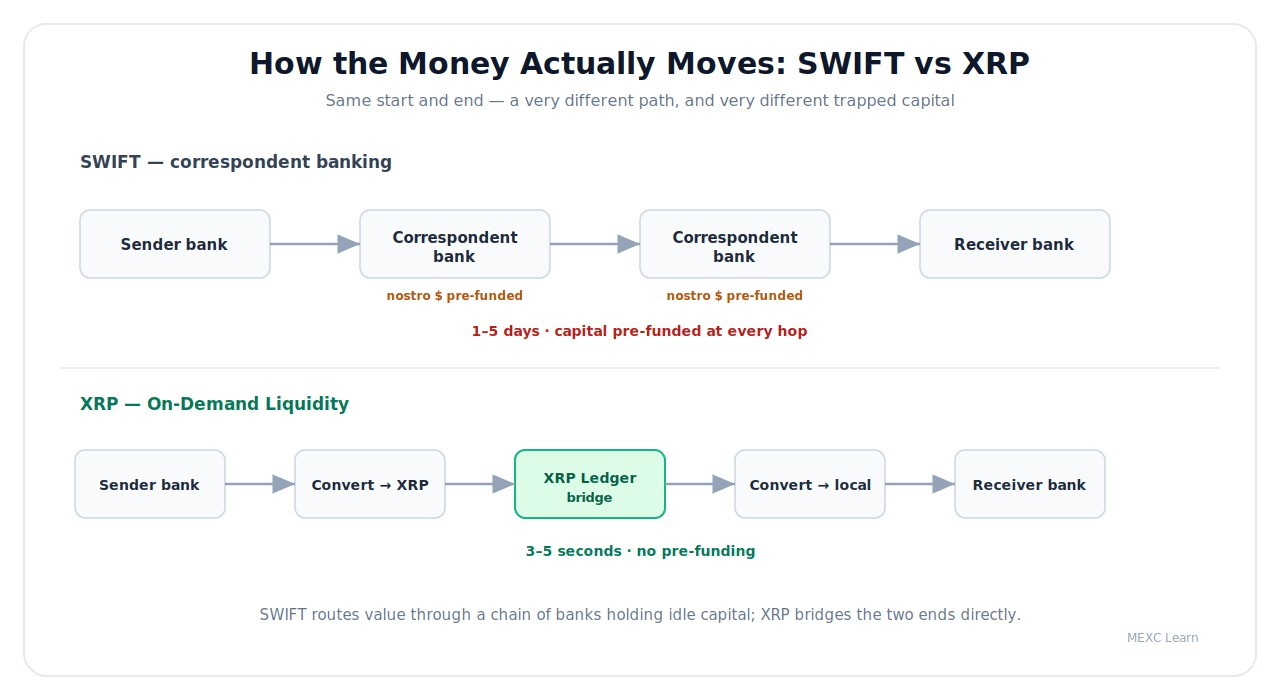
To keep the system running, banks must pre-fund Nostro accounts (accounts held with correspondent banks) and leave that money idle across dozens of countries.
Traditionally, an international wire transfer could take several days to settle, with fees and FX markups tacked on along the way; for people sending money home to family overseas, that cost feels especially real.
To be fair, SWIFT has not been standing still either.
SWIFT now says that 90% of payments on its network reach the receiving bank within an hour, far ahead of the industry's 2027 target.
The delays people still experience mostly occur at the final step—when the receiving bank credits the funds to the customer's account—rather than in SWIFT's messaging itself.
So the more objective framing is not that SWIFT is slow, but that SWIFT's architecture forces banks to lock funds in idle Nostro accounts, and that trapped liquidity is precisely the high-cost link XRP is targeting.
Who Is Actually Using XRP for Cross-Border Payments Today?
Before naming names, clarifying one key distinction clears up most of the confusion around this question.
Ripple actually sells two things: first, RippleNet, a messaging and settlement network that competes with SWIFT but does not require XRP; second, On-Demand Liquidity (ODL), which is where XRP is actually used as a bridge between two currencies.
Hundreds of institutions are connected to the messaging network, but far fewer actually use the XRP token—which is why "over 300 banks use Ripple" and "banks are using XRP" are two entirely different things.
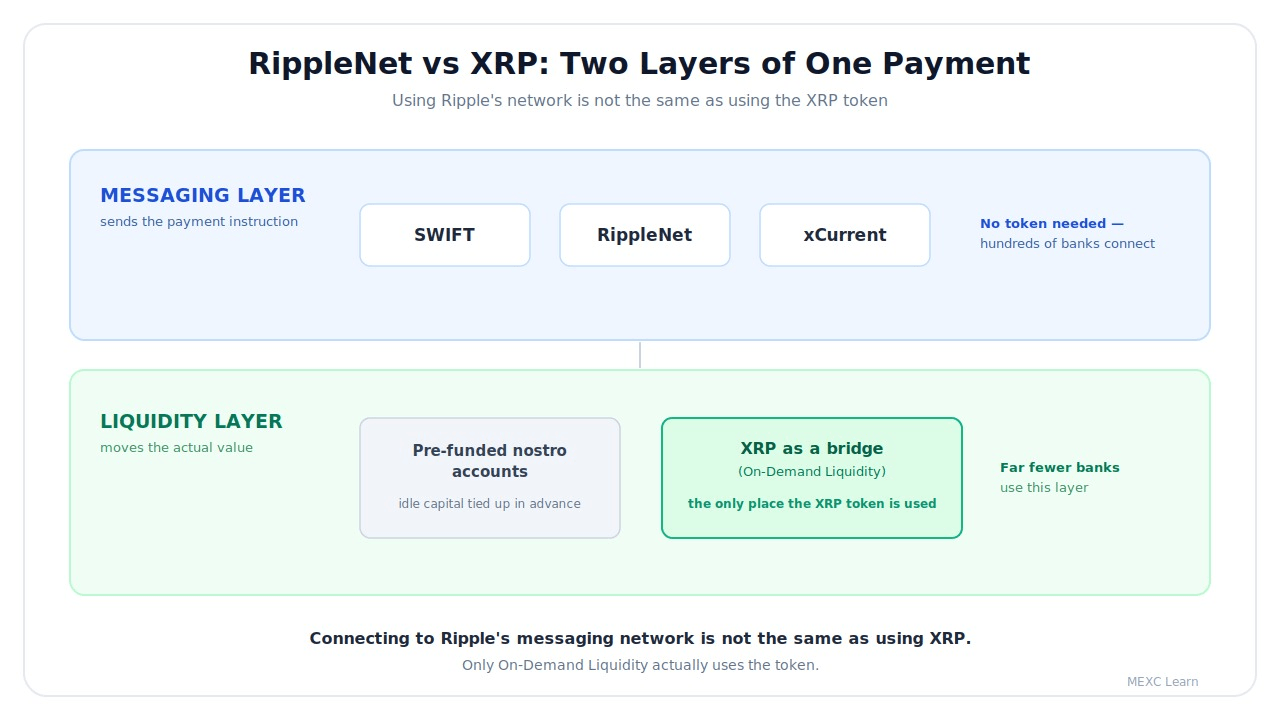
The "over 300" figure dates back to 2019, when it already appeared in a Ripple article introducing Vietnam's TPBank.
Below is a breakdown, based on companies' own announcements or Ripple's, of who is actually doing what.
Data as of November 2026
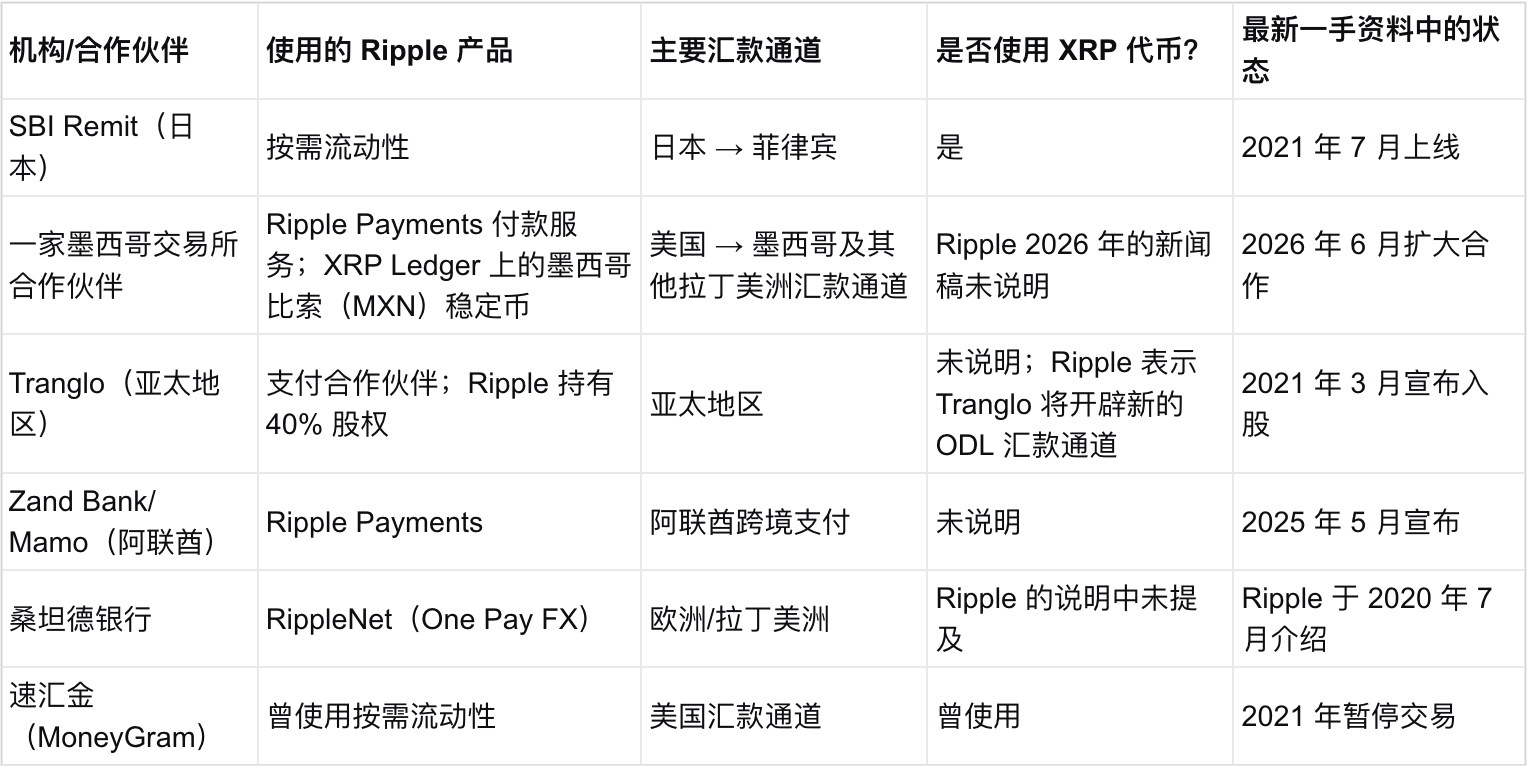
SBI Remit announced in July 2021 that an XRP-based remittance service via the Ripple ODL platform had launched for the Philippines, with plans to expand to more Southeast Asian countries.
In a June 2026 press release about its Mexican exchange partner, Ripple discussed stablecoin and payments collaboration but did not mention that the partner uses XRP.
Ripple's March 2021 announcement about Tranglo stated that Tranglo would help open new ODL remittance corridors.
Ripple's May 2025 press release about Zand Bank and Mamo covered Ripple Payments and did not mention XRP.
According to Ripple's July 2020 description, Santander partnered with Ripple as a member of RippleNet to build One Pay FX, and the text does not mention XRP.
MoneyGram said in February 2021 that, due to uncertainty surrounding Ripple's lawsuit with the U.S. Securities and Exchange Commission (SEC), it had suspended transactions on the Ripple platform.
For a full list of institutions associated with Ripple, see our complete list of banks using Ripple.
How XRP Settles Faster and Cheaper Than SWIFT
Ripple's original intent was not to build a better messaging tool, but to solve the liquidity problem that makes SWIFT so expensive.
XRP Ledger's Speed and Cost
The XRP Ledger settles transactions in roughly three to five seconds and demonstrated the ability to process 1,500 transactions per second in 2017.
Its minimum transaction cost is 0.00001 XRP, far below one cent.
Compared with SWIFT's traditionally multi-day settlement times, the technical gap is obvious.
On-Demand Liquidity: No More Pre-Funded Accounts
Ripple's on-demand liquidity service uses XRP as a bridge currency between two fiat currencies, completing the exchange instantly so banks no longer need to pre-fund accounts.
A bank converts dollars into XRP, sends it over the XRP Ledger in seconds, and the receiving institution converts it back into local currency on the other end.
This eliminates the capital efficiency problem that has been entrenched in the correspondent banking model for decades.
The Real Ceiling: Liquidity Depth at Both Ends
This next part is rarely explained clearly, but it is what truly determines how far XRP can go.
XRP already wins on speed and cost—that debate is over.
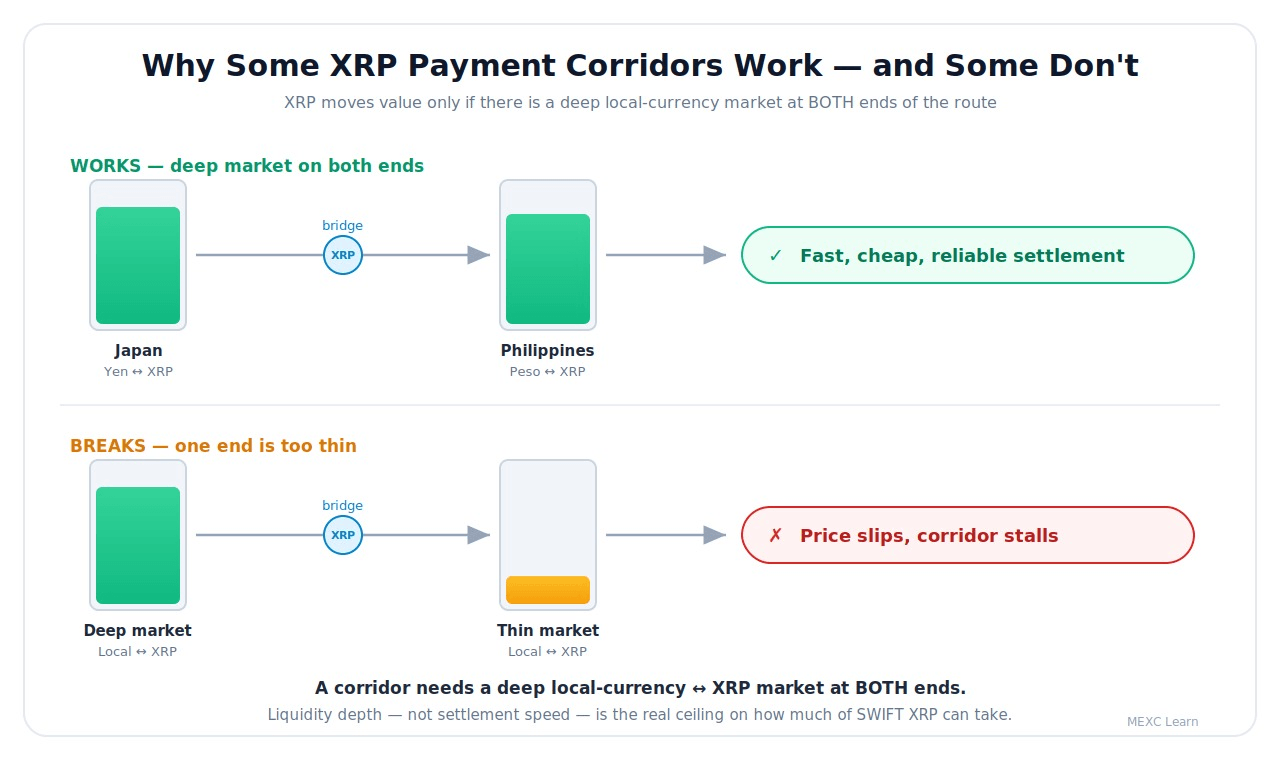
For a cross-border payment via XRP to work, there must be, at the moment of transfer, a market deep enough at one end to convert local currency into XRP, and a market deep enough at the other end to convert XRP back into local currency.
This is exactly where the exchange perspective adds value, and where MEXC can speak directly, because we can see how deep the order books actually are for various local currencies against XRP.
Where liquidity is sufficient at both ends—for example, Japanese yen against XRP, and Philippine peso exchange through established partners—remittance corridors can be fast, cheap, and reliable.
If either end has thin liquidity, there is not enough depth to absorb large transactions without pushing the price against you, and no matter how fast the ledger is, that corridor will stall.
This is why XRP's adoption map reflects where liquidity is deep enough, not where the technology is available.
It is also the most objective way to interpret Ripple CEO Garlinghouse's stated goal: he talks about 14% of SWIFT's liquidity layer, not its messaging, because what truly caps how much XRP can take from SWIFT's business is liquidity depth, not settlement speed.
So, Will XRP Replace SWIFT?
The question sparks both anticipation and skepticism, and as of 2026, the objective answer is clear: "No, but…"
At Ripple Apex 2025 in June 2025, Garlinghouse said Ripple aims to capture a portion of SWIFT's liquidity layer, estimating 14% of that volume within five years.
That is a claim about liquidity, not a bid to replace SWIFT's messaging network—two entirely different things.
On the other hand, SWIFT is modernizing at its own pace, having announced in 2025 that it would build a blockchain-based shared ledger with more than 30 financial institutions.
For large, compliance-heavy institutional transfers, SWIFT's regulatory relationships and global network remain advantages XRP cannot replicate in the near term.
So the emerging outcome is not winner-take-all but a division of labor: XRP captures liquidity-based remittance corridors like SBI Remit's service to the Philippines, while SWIFT retains the messaging layer and the largest institutional money flows.
Will XRP fully replace SWIFT? As of 2026, the answer is no, and there is no credible timeline suggesting otherwise.
Is XRP capturing a real, verifiable slice of the liquidity layer SWIFT once monopolized? On specific remittance corridors, the answer is yes—and that is the part worth watching.
The technical standard these systems use to exchange payment messages is