A week of cascading outages! Microsoft, FAA, NSA, and Apple fall one after another—is America's aging infrastructure facing a devastating blow from AI?


- Key Takeaways: Within a single week, five major technical failures struck critical systems including the U.S. NSA, Apple, Microsoft, the FAA, and JPMorgan Chase, exposing the structural fragility of aging digital infrastructure in the AI era and triggering widespread market and public concern over the resilience of core systems.
- Key Elements:
- The NSA's classified network NSANet was disrupted due to software patch maintenance and was classified as a "Yellow Code" Level 2 alert; core mission capabilities were unaffected.
- Apple suffered widespread outages across AppleWeb, AppleConnect, VPN, and retail store operations due to an internal update; the company denied it was a cyberattack.
- The FAA's nationwide ground stop stemmed from a 25-year-old aging router that became overloaded during copper cable replacement, with cascading failures lasting over four hours and disrupting tens of thousands of flights.
- JPMorgan Chase experienced trading delays due to a local hardware and software vulnerability, while United Airlines suffered a system outage of approximately one hour the same day.
- Senator Mark Warner noted that AI is identifying vulnerabilities at an unprecedented pace, placing enormous patching pressure on systems not designed for rapid iteration.
- The FBI issued a FLASH-level alert warning that hackers using the AI penetration framework ARTEX can compress the entire attack lifecycle to within three hours.
- Market reaction was sharp, with the Nasdaq falling and the S&P 500 dropping below its 200-day moving average; Costco saw a surge in emergency supply sales.
Original author: Bao Yilong
Original source: Wallstreetcn
In the span of just one week, multiple critical systems in the United States have failed in succession—from Microsoft's productivity software, nationwide flight groundings, and JPMorgan trading disruptions, to the National Security Agency's classified network outage and widespread disruptions to Apple services. This string of technical failures is shaking public confidence in core digital infrastructure and pushing the question of "whether legacy systems can withstand the rapid iteration pressure of the AI era" to the forefront.
On Tuesday, the National Security Agency (NSA) confirmed that NSANet, its network for internal classified communications, was briefly disrupted due to routine software maintenance, with some employees unable to access work systems. The agency subsequently implemented staggered arrival schedules for personnel.
Meanwhile, Apple experienced a widespread service outage triggered by an internal update, affecting employee portals, internal login systems, and remote-work VPN channels, while sales, repair, and customer service operations at retail stores were also forced to halt. Apple said the issue did not stem from a cyberattack and that most systems have now been restored.
The FBI issued a FLASH (rapid action) level security alert the same day, warning that cybercriminals and state-linked hackers are exploiting the AI-powered penetration framework ARTEX—a warning that further intensified market concerns over the vulnerability of technical infrastructure.
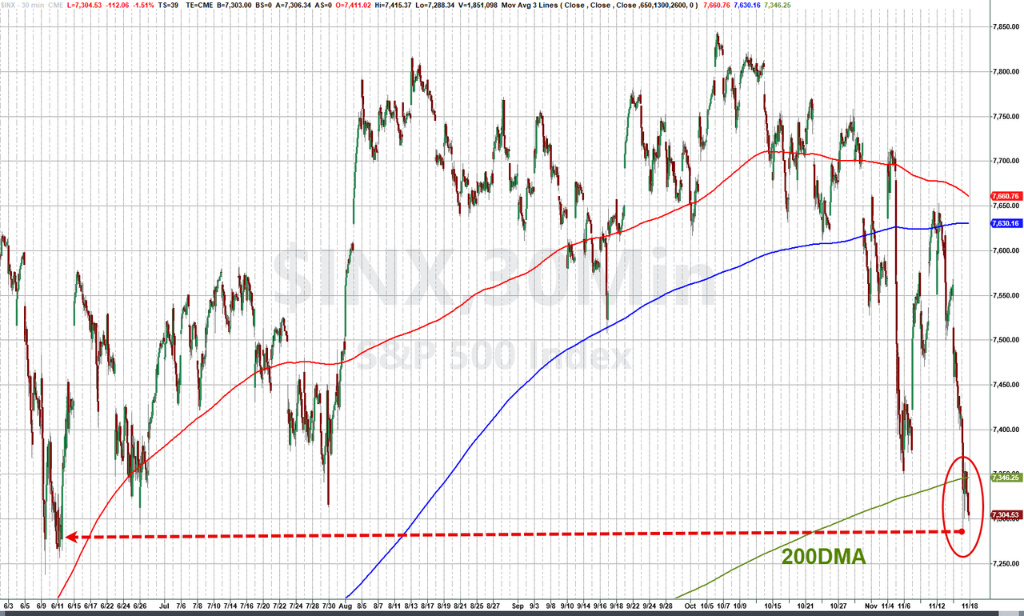
Markets reacted sensitively, with the Nasdaq index falling in response and the S&P 500 breaching its 200-day moving average.
NSA Classified Network Outage Rated "Level 2 Alert"
On Tuesday, the disruption of NSANet, the NSA's classified internal communications network, drew intense outside attention.
According to Mike Nelson, a researcher at the National Security Institute, speaking to Nexstar's NewsNation, the disruption may have stemmed from malicious attack activity. However, according to The Wall Street Journal, the cause pointed to a software patch update.
NSA officials subsequently confirmed to The New York Times that the incident was classified as a "yellow code" event, the second-highest level in a three-tier alert system. An NSA spokesperson said in a statement:
The National Security Agency experienced a brief degradation during routine scheduled maintenance. Some internal systems were affected, but core mission capabilities remained fully operational, and the ability to defend national security was not impacted.
Former senior U.S. intelligence official Beth Sanner assessed that a cyberattack is the least likely scenario.
The system has firewalls and is protected by the most capable cyber agency in the world. Were it not for the current extraordinary circumstances, this would likely never have made the news.
Apple Internal Update Triggers Cross-Platform Mass Outage
Apple confirmed on Tuesday that an internal update caused widespread disruptions to multiple services and systems.
Affected internal systems included the employee portal AppleWeb, the internal login system AppleConnect, and VPN channels used by remote employees.
According to reports citing people familiar with the matter, employees also faced issues downloading internal software builds, accessing company calendars, and booking meeting rooms—even the internal website tracking outage status itself went down.
Consumers were affected as well, with anomalies in iCloud access and the ability to register AppleCare directly on devices, and services for schools and enterprises were also impacted. Sales, repair, and customer service operations at multiple Apple retail stores worldwide were disrupted as a result.
Apple said in a statement:
An internal update this morning caused disruptions to some systems. Many systems have now been restored, and we are working to bring the remaining systems back online as quickly as possible.
Apple also emphasized that the outage was not caused by a cyberattack.
Dense Cluster of Failures: Five Major Outages in One Week
The Apple and NSA incidents are the latest two in a series of U.S. technology accidents over the past week.
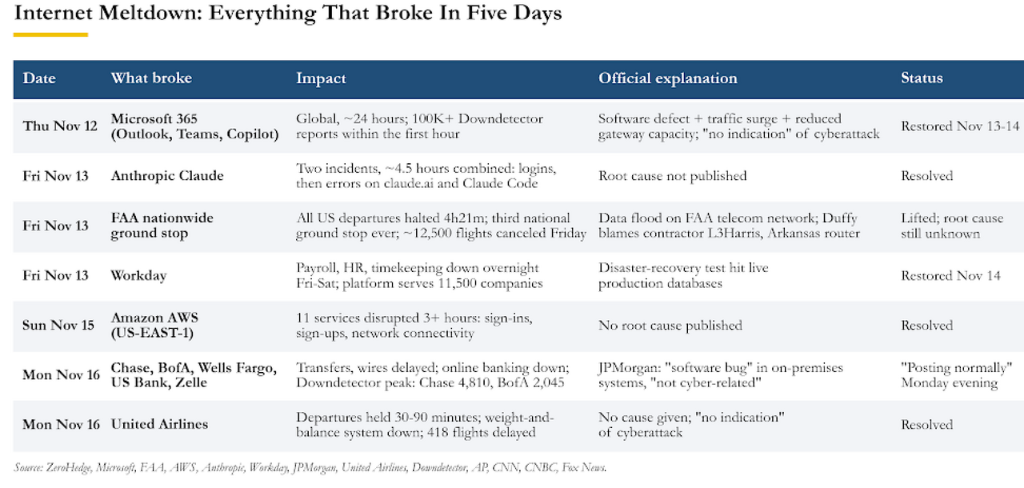
Last Thursday, Microsoft 365 experienced a widespread outage affecting Outlook, Teams, and the Copilot assistant, with the disruption lasting until Saturday before being resolved. Microsoft attributed the cause to a "technical glitch" during routine rerouting of user traffic and denied any connection to cyberattacks or AI systems.
Last Friday, the Federal Aviation Administration (FAA) issued a rare nationwide ground stop order, disrupting tens of thousands of flights for more than four hours. Investigations showed the incident was triggered when a contractor replacing aging copper cabling at a remote facility in Arkansas overloaded a network router roughly 25 years old, causing a cascading failure.
U.S. Homeland Security Secretary Markwayne Mullin later said:
I can tell you with complete certainty that we were not attacked.
On Monday, JPMorgan experienced "technical issues" that delayed some trade processing, with institutional clients including Bank of America and U.S. Bancorp also reporting problems. JPMorgan later attributed the cause to a "software vulnerability in local hardware systems." The same day, United Airlines suffered a system outage lasting about an hour, grounding multiple flights.
Panic Spills into Consumer Markets as Officials and Conspiracy Theories Vie for Narrative
Unease triggered by the technical failures has spilled beyond professional circles and reached ordinary consumers.
Sales of non-perishable food, drinking water, and batteries at Costco surged sharply, with analysts raising their price target on the stock from $1,100 to $1,150; high-end generators on the company's website were nearly sold out as of Sunday.
In the absence of authoritative, timely explanations, conspiracy theories spread on social media, with some viral posts claiming the U.S. is under coordinated attack by foreign—or even "extraterrestrial"—governments, while others interpreted the technical turmoil as an omen of some catastrophe.
The Trump administration took a low-key stance. Asked about the JPMorgan and Microsoft outages during his Asia trip, Trump responded:
Everything will be under control. That's life. When you're huge and you have tremendous wealth, these things happen. Not a big deal.
AI Accelerates Vulnerability Discovery as Aging Infrastructure Buckles
The dense cluster of failures in a short period has focused attention on a deeper structural issue: AI is discovering system vulnerabilities at an unprecedented pace—can infrastructure built decades ago withstand the resulting pressure for rapid patching?
U.S. Senator Mark Warner, a Virginia Democrat, said in a statement on the outage that the series of incidents appeared to be "a consequence of AI rapidly changing the cybersecurity landscape." He explained:
AI makes it possible to identify large numbers of system vulnerabilities at unprecedented speed, putting enormous pressure on companies and government agencies to patch immediately—often simultaneously—placing immense strain on systems that were never designed to withstand this pace of change.
Joe Slowik, director of threat research and cyber engineering at risk intelligence firm Dataminr, said it is rare and concerning for so many high-profile incidents to occur in such a short period. He said:
We are overly dependent on infrastructure whose stability was already questionable, and we have underinvested in redundancy—whether it's errors, failed updates, or cyber incidents, any of them can trigger a worst-case scenario.
Christiaan Beek of cybersecurity firm Rapid7 cautioned that there is no indication in public records that the outage was caused by an emergency security update.He noted that the more general concern is the systemic risk of organizations relying on outdated processes to cope with the wave of AI-assisted vulnerability discovery. Christiaan Beek said:
Complex systems fail for mundane reasons, not adversary attacks. And such mundane reasons are not harmless—what is worrying is that it means the systems we depend on are so fragile that we can bring them down ourselves without any attacker.
The FBI's warning on Tuesday highlighted another side of the issue that cannot be ignored. The FBI said in a social media post that it had issued a FLASH-level alert warning that cybercriminals and state-sponsored hackers are using the AI-driven penetration testing framework ARTEX to launch automated attacks against companies and institutions worldwide.
The FBI noted that ARTEX can compress the entire process from initial targeting to obtaining privileged access to under 3 hours, and was previously used in the October supply chain attack against ConnectWise.