


The history of RUGs in the crypto world has just added a bold new chapter


- Core Viewpoint: The long-dormant DePIN project Puffpaw precisely manipulated token FDV through a surprise token launch, heavy supply control, and extremely thin liquidity to profit from the Polymarket prediction market, rather than genuinely giving back to the community, sparking settlement disputes in the prediction market.
- Key Elements:
- Puffpaw had previously raised a $6 million seed round led by Lemniscap, centered on the "quit smoking to earn tokens" concept, but went silent for six months after the sector fell out of favor.
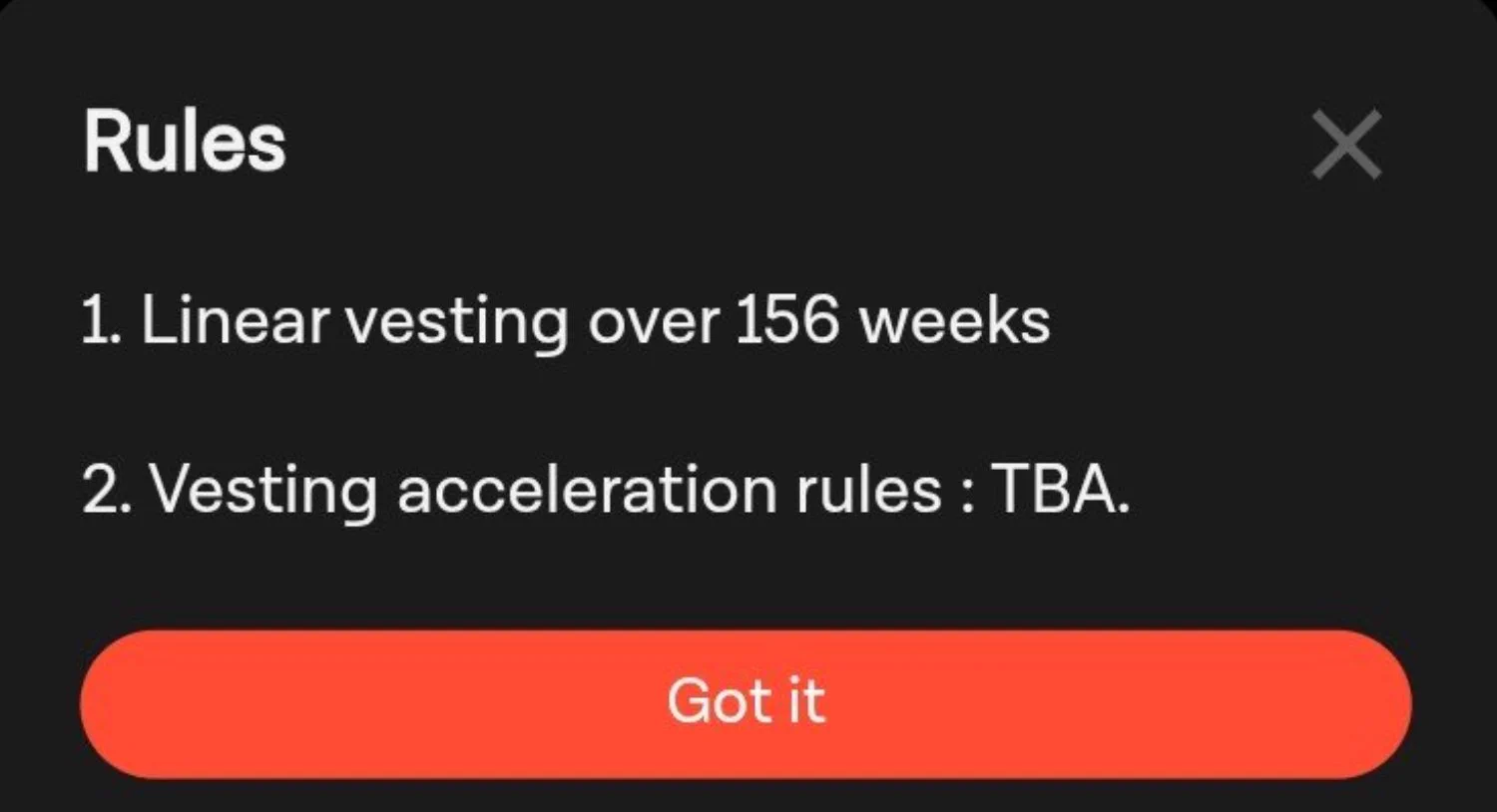
- The VAPE token had no CEX support and deployed only tens of thousands of dollars in liquidity pools; early users who invested hundreds of dollars received only tens of dollars in airdrops, subject to a 156-week linear vesting schedule.
- On-chain data shows that team-associated addresses controlled 97% to 99.88% of the token's circulating supply.
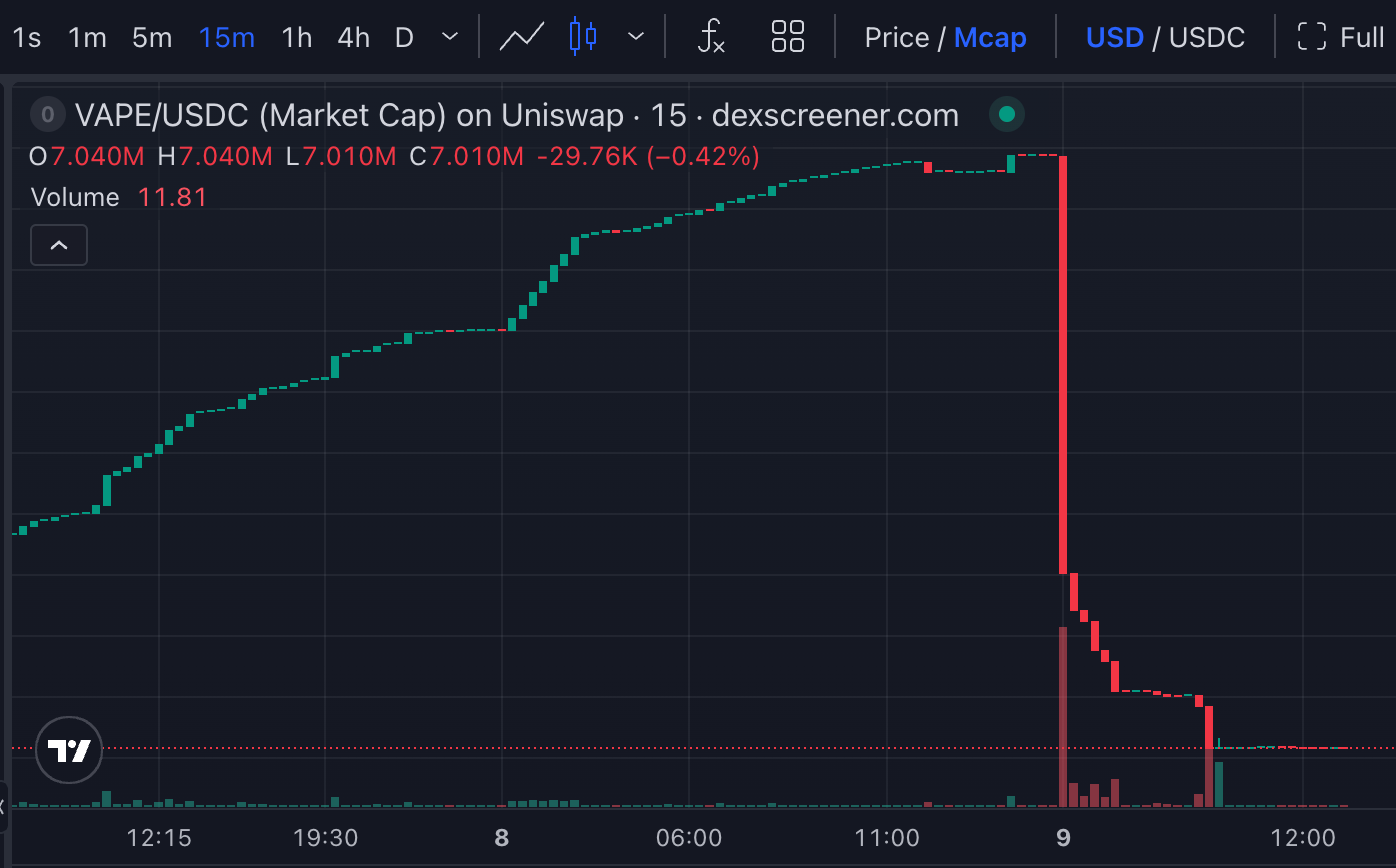
- On its first trading day, VAPE exhibited a "staircase" style of controlled price action, with FDV precisely maintained just below $400 million; after triggering Polymarket prediction conditions, the price was immediately dumped, with FDV plummeting to $7 million.
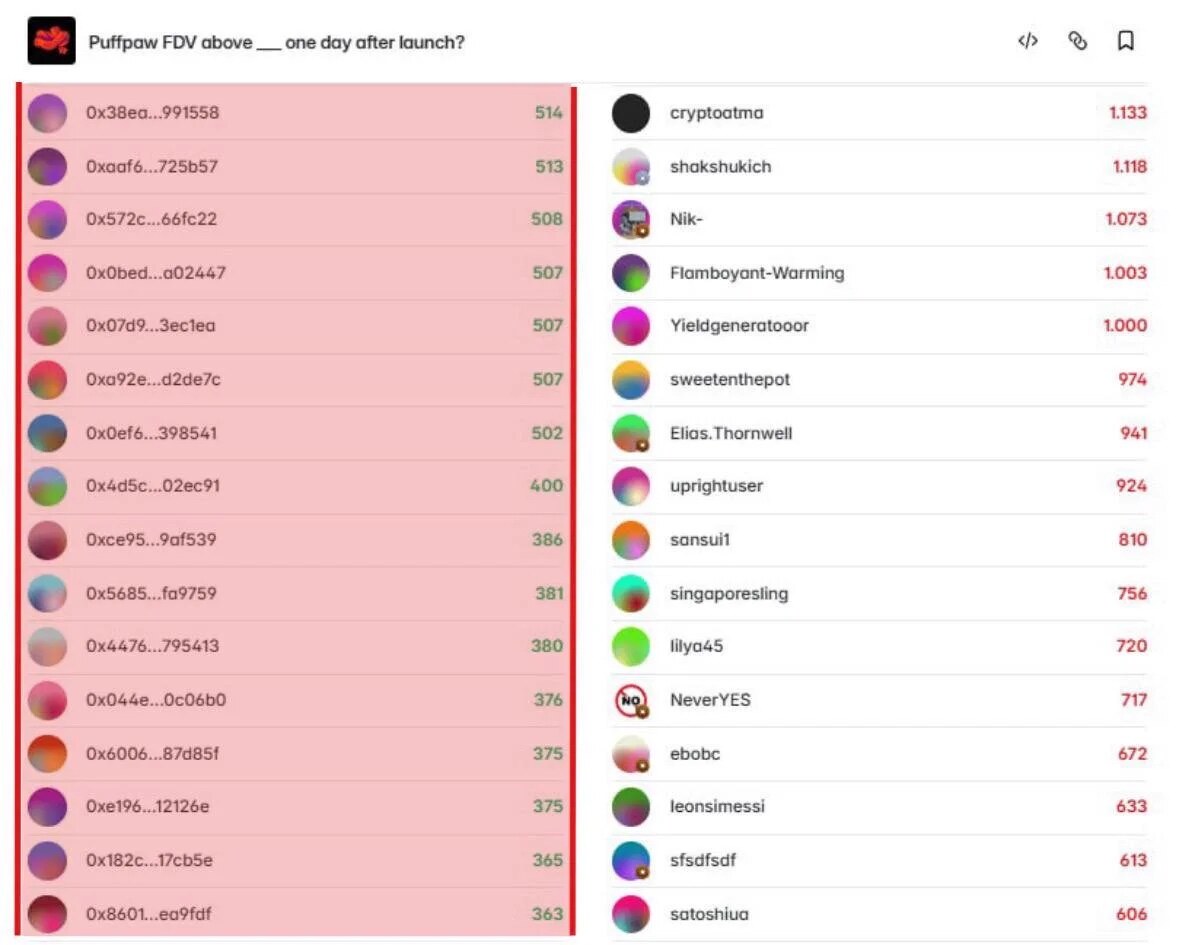
- Of the 1,285 holding wallets in the related Polymarket prediction market, 1,259 (approximately 98%) were new accounts that only traded that market, showing clear signs of manipulation.
- The event's settlement faced two disputed challenges and has entered the UMA holder voting arbitration stage, expected to conclude on November 11, with the community engaged in heated debate over "procedural justice" versus "outcome justice."
Original | Odaily (@OdailyChina)
Author | Azuma (@azuma_eth)
"I've seen projects get rug-pulled, but I've never seen a project this shameless."
This is the community's genuine assessment of Puffpaw, a DePIN project that has just launched its token.
Just last week, this project—which once raised $6 million but had gone silent for a long time due to cooling ecosystem and narrative headwinds—suddenly announced a token launch and airdrop. But this wasn't the team's genuine desire to "give back to the community." Every move was designed to harvest profits on another front (prediction markets).
A Former "Star" Project
Although its current conduct is utterly unsightly, Puffpaw was once a legitimate, funded project. As a decentralized physical infrastructure network (DePIN) built on Berachain, Puffpaw championed the "Vape-to-Earn" concept, attempting to record users' smoking data through smart vape hardware and provide token incentives.
Riding the consumer hardware narrative that had its moment in the spotlight, along with the early buzz of the Berachain ecosystem, Puffpaw successfully completed a $6 million seed round in 2024 led by Lemniscap with participation from well-known institutions such as Folius Ventures and Spartan Group, and subsequently raised substantial community funds through its smart vape node pre-sale and genesis NFT sale.
However, as the Berachain ecosystem cooled and the DePIN narrative faded, Puffpaw gradually drifted out of public view, with project progress nearly stalling and community maintenance falling into prolonged silence.
Token Launch Ambush and Outrageous Airdrop Vesting
Just when the community had almost accepted that the project was dead, Puffpaw suddenly came back from the grave last week (over half a year since its last update), announcing the launch and airdrop of the VAPE token.
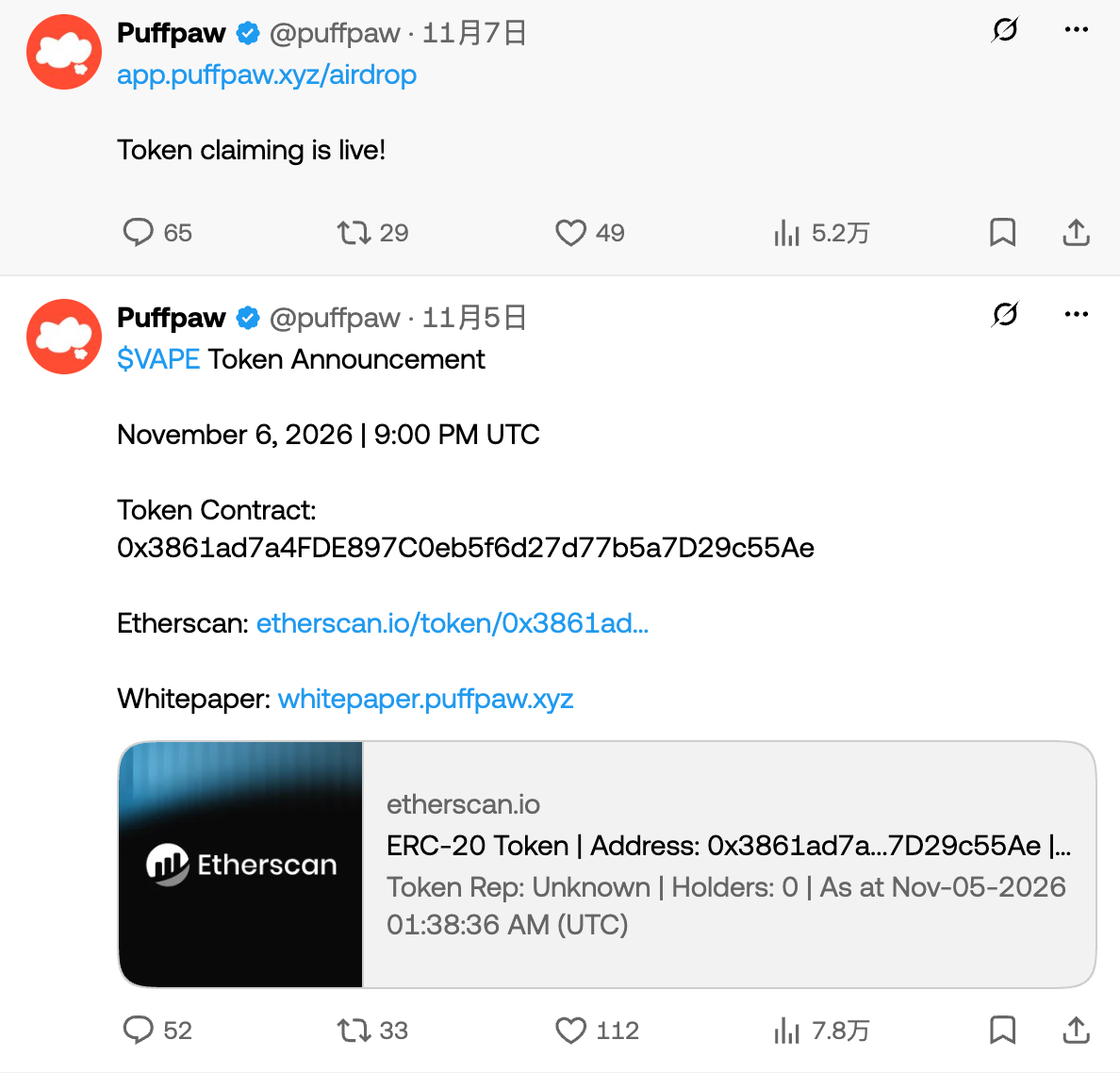
However, what awaited early supporters was not a pleasant surprise, but outright humiliation.
For a project that raised $6 million, VAPE launched with no centralized exchange (CEX) support, with only an extremely thin liquidity pool (roughly tens of thousands of dollars) deployed on an on-chain DEX.
The airdrop design was even more shameless. Many early users who had been interacting since 2024 spent two to three hundred dollars to purchase genesis NFTs or devices, only to receive airdrops worth just a few dozen dollars. Even more absurdly, the meager airdrop came with a linear vesting period of 156 weeks (approximately 3 years).
This means the real selling pressure at launch was deliberately isolated, with tokens almost entirely held by the project team itself — on-chain data shows that team-associated addresses controlled 97% to 99.88% of the token's circulating supply.
Why Do This? The Trick Is All in Prediction Markets
Since they weren't planning to list on exchanges, nor to cultivate liquidity on the secondary market for gradual selling, why did Puffpaw go through all this trouble to launch a token and airdrop? The answer isn't in the DEX—it's in another market: Polymarket.
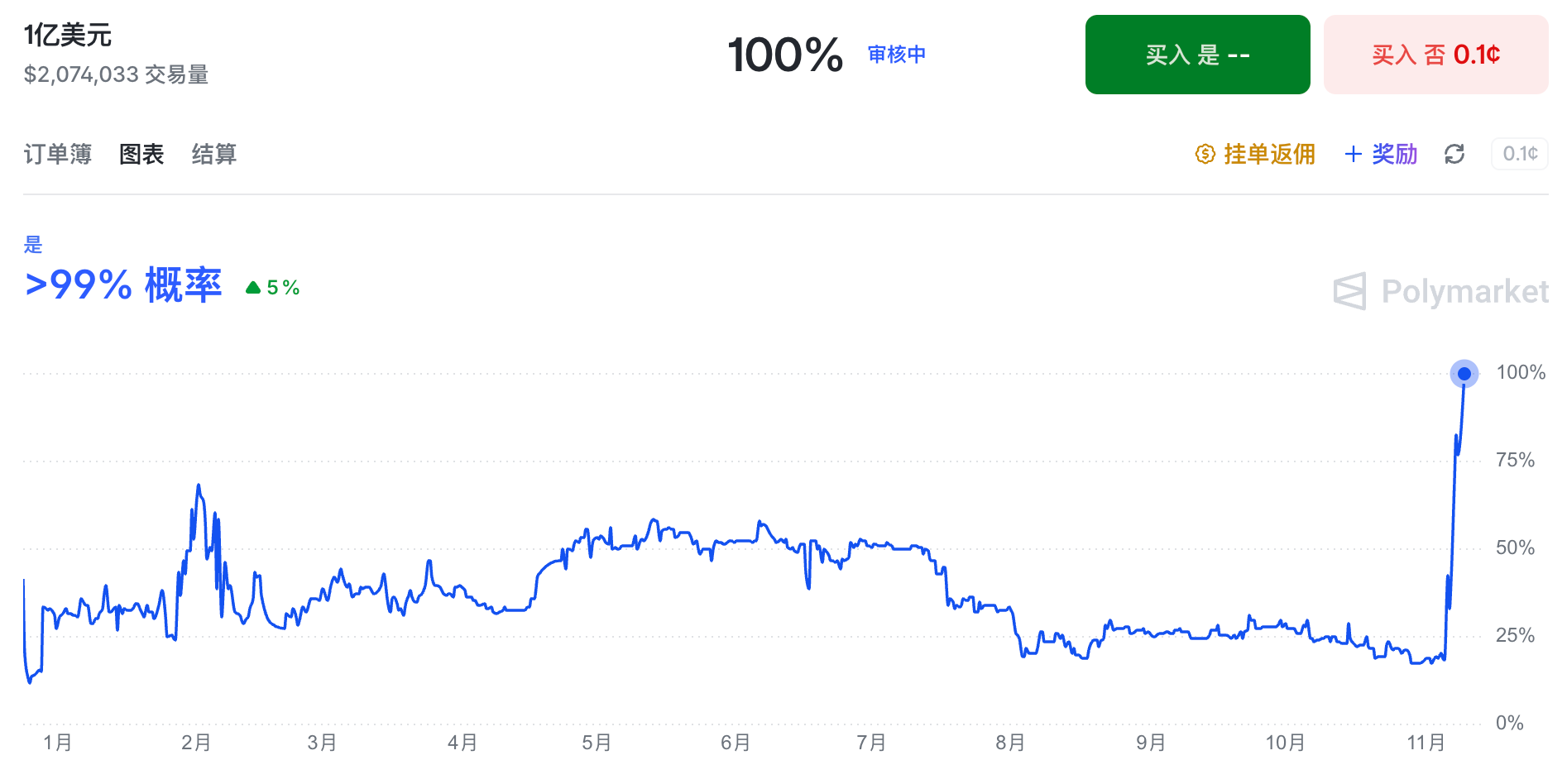
Polymarket had previously listed an event about "what FDV Puffpaw will exceed one day after launch ($50M / $100M / $200M / $300M / $400M)," and Puffpaw team's goal in controlling the token was precisely to manipulate the token's market cap to profit from bets on this event.
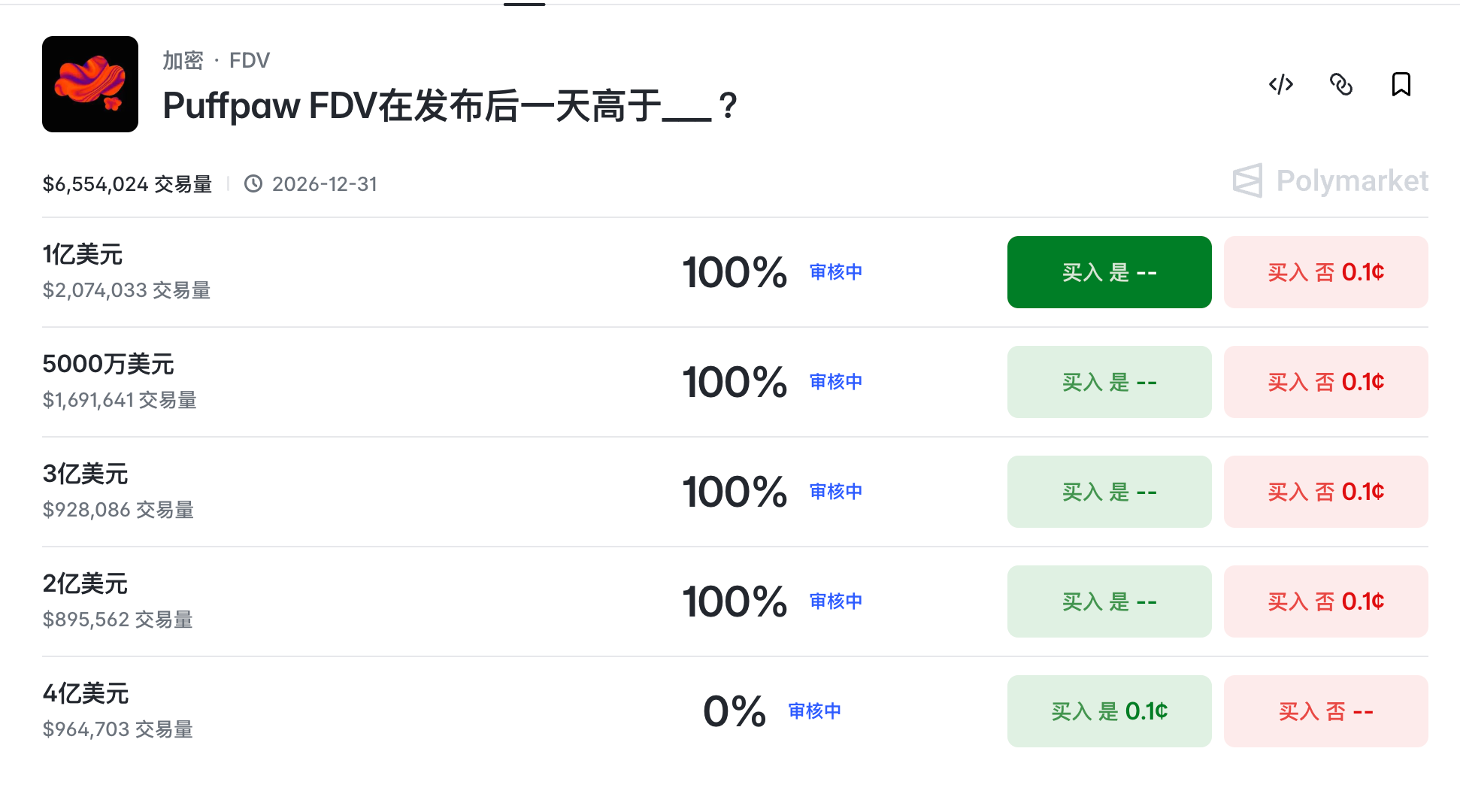
Previously, since Puffpaw had been dormant for so long with no token launch in sight, the probability of the YES option at each tier on Polymarket was very low (the event expires at the end of 2026, and if no token is launched it would be resolved as NO). This gave the Puffpaw team an opportunity to accumulate YES positions at each tier at extremely low cost, then use tokens they fully controlled to precisely "draw the line."
VAPE's price action after launch confirmed this. On the first day after the token went live, VAPE brazenly traced a "staircase" pattern (almost every candle had no upper or lower wicks—purely manipulated upward), with FDV precisely controlled at just below $400 million.
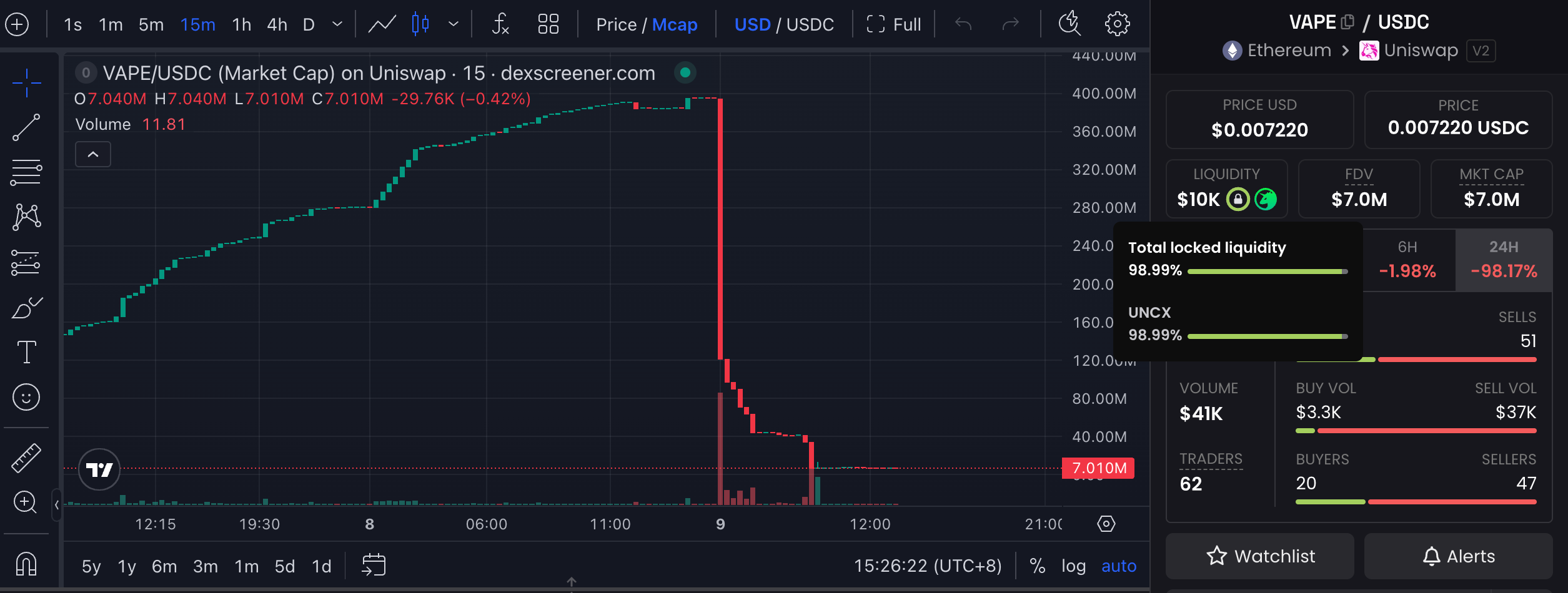
And after the price was sustained long enough to trigger the prediction market's resolution conditions, VAPE completed its historic mission. What followed was an unabashed dump. Due to the extremely shallow pool, a small amount of token selling instantly broke through the bottom of the pool, and VAPE's FDV plummeted from nearly $400 million—now down to just $7 million.
In this process, since the on-chain pool had no depth for retail buyers to absorb selling, the project team didn't actually make much from the token dump itself. But the token price collapse was irrelevant to them—the main harvest was already completed in the prediction market.
This isn't the community deliberately smearing the Puffpaw team. On-chain data analyst Atlantis liquidity uncovered even more damning anomalous data—in Polymarket's Puffpaw FDV prediction market, a total of 1,285 wallets held positions, of which 1,259 wallets (nearly 98%) had never traded any other market on Polymarket—they were brand-new accounts created purely to bet on Puffpaw's FDV, and it's not hard to guess who was behind them.
Polymarket Still Unresolved, Community Continues to Raise Objections
As of publication, in the related event on Polymarket, the probabilities for the $50M, $100M, $200M, and $300M tiers have all risen to 100%, while the $400M tier has dropped to 0. It appears Puffpaw's harvesting operation has come full circle, but because the conduct was simply too egregious, the final fund settlement is stuck halfway.
Faced with such blatant manipulation, the counterparties on Polymarket (traders betting NO) and the community chose to fight back jointly, continuously challenging the resolution proposals.
The Polymarket page shows that the results for each tier of the related event have already been subject to two "Disputed" challenges. According to Polymarket's oracle mechanism, after a market result encounters two consecutive disputes, all five sub-markets have entered the final review phase, with the results to be decided by a vote of UMA token holders. This round of voting is expected to conclude on November 11.
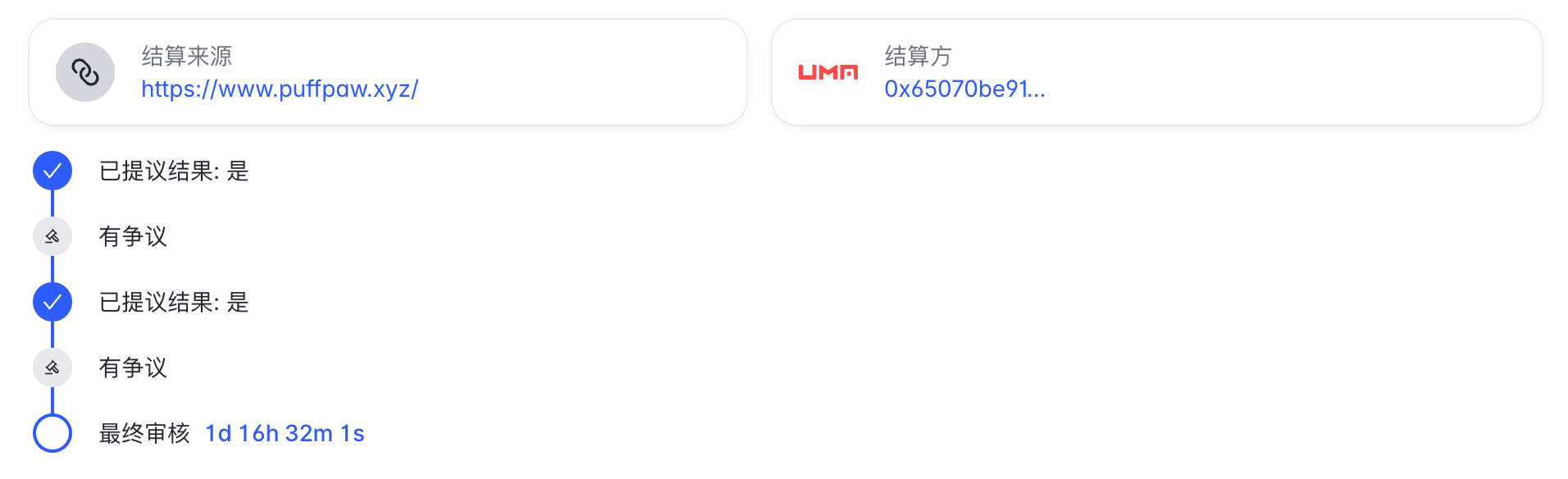
Around this ruling, the community is currently embroiled in a fierce debate between "procedural justice" and "outcome justice."
Those opposing payout (supporting NO) argue that for such obvious malicious manipulation and fraud, if it can still be settled smoothly, it would be tantamount to encouraging wrongdoing—and could even incentivize more similar projects to choose this profitable path. Those supporting payout (supporting YES) argue that although Puffpaw's actions are utterly disgraceful, as long as VAPE literally satisfied Polymarket's set conditions for the "launch and FDV threshold," it should be settled as YES. If rules are overturned after the fact and changed to NO simply because it "looks like a scam," then the contractual certainty of prediction markets would cease to exist.
Regardless of how UMA ultimately rules, this farce has already been absurd enough. Whether Puffpaw's carefully orchestrated "empty-handed profiteering" scheme can successfully put money in their pockets will soon have an answer.





