One-Day Giveback of Post-Election Gains: AI Tech Stocks and Crypto Market Hammered After Democrats Sweep Congress


- Key Takeaways: After Democrats won a landslide victory in the U.S. midterm elections, market logic reversed from "uncertainty subsiding" to "rising expectations of AI regulation," triggering a synchronized selloff in tech stocks and the crypto market, with the AI industry's expansion environment facing policy variables.
- Key Elements:
- Democrats secured both the Senate and the House and flipped seats in multiple states, prompting investors to reassess the outlook for data center construction and computing power expansion.
- Democratic Congresswoman Ansari publicly called for a pause on advanced AI development, and Musk shared a sarcastic post, amplifying market concerns.
- Semiconductor stocks led the decline: AMD fell 17.55%, Micron dropped 16.8%, and Nvidia has shed approximately $1.4 trillion in market value from its peak.
- Crypto-related stocks fell more than coin prices themselves: Coinbase dropped about 10%, mining company stocks fell 15% to 20%, and Bitcoin briefly broke below $76,000.
- About $1.12 billion in liquidations occurred within 24 hours, including $990 million in long positions, with over 210,000 traders forcibly liquidated.
- AI/tech stocks and crypto assets show highly correlated risk appetite, the Nasdaq fell below its 200-day moving average, and short-term direction depends on whether tech stocks can stabilize.
Original | Odaily (@OdailyChina)
Author | jk
On Thursday, November 5 (US Eastern Time), US stocks suffered a broad selloff, with AI and semiconductor sectors hit hardest, completely erasing Wednesday's rally driven by the midterm election results. By late trading, the Dow was down about 3%, over 1,600 points; the S&P 500 fell nearly 4%; the Nasdaq dropped over 5%, moving toward a technical correction; the Philadelphia Semiconductor Index fell nearly 10%.
From "Uncertainty Resolved" to "Regulatory Expectations Heating Up"
On Wednesday, Democrats won both the Senate and the House, and Trump said he accepted the results. The market initially rallied on "political uncertainty dissipating," with the Dow surging over 1,500 points in a single day. But one day later, the logic reversed.
After the midterms, Democrats won both the Senate and the House, and made sweeping gains at the governor and state legislature levels; Republicans did not flip a single Democratic seat at any level. Before the election, Republicans held 53 Senate seats and roughly 218 to 213–214 House seats.
In the Senate, Democrats currently hold 54 seats to Republicans' 44, flipping 7 seats, with Alaska and Mississippi yet to be called. In the House, vote counts as of the afternoon of November 4 showed Democrats with 251 seats and Republicans with 155, far exceeding the 218 needed for a majority. At the state level, Democrats flipped 5 governorships, including defeating three-term Governor Abbott in Texas; up to 12 state legislative chambers changed hands, with the Pennsylvania Senate flipping for the first time since 1994, and preliminary results in both chambers of Arizona also indicating a flip. Senate seats flipped include Texas, North Carolina, Iowa, South Carolina, Ohio, and Maine.
The new question raised by the election is the policy environment for the AI industry: investors are beginning to reassess the pace of data center construction and computing power expansion, and whether these investments can generate sufficient returns.
Wednesday's rally reflected the dissipation of political uncertainty: after Trump acknowledged the results, the market no longer needed to price in election disputes. Thursday's decline reflected a different concern: the new Congress could change the environment on which the AI industry depends for expansion, especially data center construction. TipRanks listed this as one of the reasons for Thursday's selloff, alongside the semiconductor stock rout and uncertain interest rate outlook.
These concerns were amplified because some Democrats have already drafted concrete legislation to restrict AI.
One Post Became an Emotion Amplifier
On November 4, Arizona Democratic Representative Yassamin Ansari posted that Democrats need to put a pause on advanced AI development at the top of their agenda on day one, regulate runaway industries, and ban artificial superintelligence. In the early hours of the next day, Musk reposted and responded: "It's a Brave New World," borrowing the title of Huxley's dystopian novel, with obvious sarcasm. He had previously posted that "space data centers are looking attractive now." According to reports, Musk invested approximately $474 million in Republican-affiliated political groups during this election cycle.
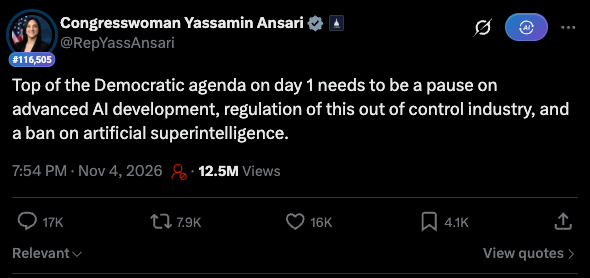
Ansari's original post, Source: X
It should be noted that Ansari's statement is only a personal expression, not the official position of the Democratic Party. Senator Sanders and Representative Khanna introduced the "Banning Artificial Superintelligence Act" in September of this year, advocating a permanent ban on superintelligence and a pause on advanced AI development, but the bill has not yet become law, and "superintelligence" has no universally accepted technical definition, making enforcement very difficult.
US Stocks Hit Hardest
According to msx.com data, AMD fell 17.55%, Micron dropped 16.8%, Intel fell 11%, TSMC's US depositary receipts declined 10%, Marvell dropped 16.3%, and SanDisk fell 22%. Nvidia's intraday decline ranged between 6% and 9%, at one point marking its largest intraday drop since April 2025; according to Yahoo Finance, Nvidia has shed nearly $1.4 trillion in market value since hitting a record high in October.
Data center and neocloud companies, most sensitive to incremental computing power and financing, led the declines. CoreWeave fell about 11%, Nebius dropped about 14% to 15%, IREN declined about 15%, Vertiv, which provides power supply and liquid cooling equipment for data centers, fell about 14%, and Oracle dropped about 7%. Oracle had recently priced approximately $20 billion in combined equity and debt financing, and its funding needs are also a market focus. By contrast, major cloud providers such as Amazon, Google, and Microsoft saw much smaller declines overall, with Amazon down about 3% intraday.
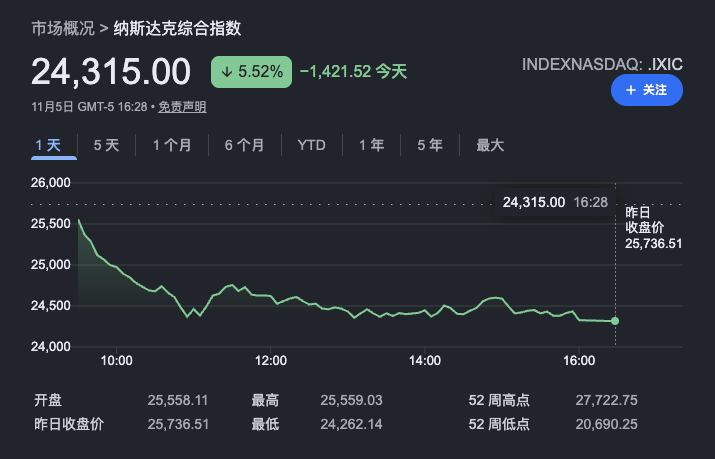
Source: Google
Musk's companies also came under pressure, with Tesla falling about 11% and SpaceX dropping about 9%. CNBC linked this pressure to his approximately $474 million in election spending coming to naught.
Among crypto-related stocks, Coinbase fell about 10%, Circle dropped about 8% to 12%, Strategy declined about 10%, and crypto mining stocks fell 15% to 20%. The declines in major cryptocurrencies themselves (Bitcoin about 5%) were smaller than those of related stocks.
Risk Assets Fall in Tandem
The crypto market came under simultaneous pressure. Bitcoin briefly dropped below $76,000, then stabilized above that level, touching a roughly three-month low; altcoins largely gave back their weekly gains. FXStreet called it "one of the most synchronized risk-off moves of the year."
Bitcoin earlier on Thursday, driven by ETF inflows and short liquidations, briefly rose above $80,000, then fell from $78,767 to $75,986 within an hour. Ethereum dropped about 7% to around $2,248; XRP and Solana fell between 4% and 7%. Total cryptocurrency market capitalization shrank about 5% to approximately $2.6 trillion. According to CoinGlass data, 24-hour liquidations totaled approximately $1.12 billion, of which about $990 million were longs, with over 210,000 traders forcibly liquidated. Spot Bitcoin ETFs still recorded approximately $148 million in net inflows on Thursday, while Coinbase and mining stocks fell in line with tech stocks.
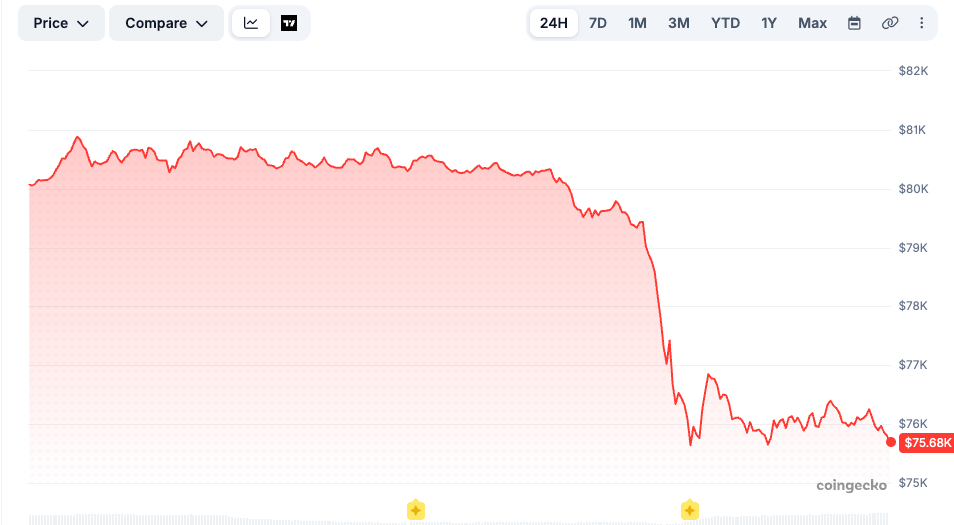
Bitcoin price trend, Source: Coingecko
The dollar index stood at about 101.4, further declining from Wednesday's 101.51 and near a one-month low. The 10-year Treasury yield was about 4.9%, down to 4.894% on Wednesday (from 4.952% the previous day), having returned below 5%. The market is pricing in about a 67% probability of a Fed rate hike in December, with Friday's nonfarm payrolls report being the next key data point.
Crude oil plunged over 8% on Wednesday and recovered somewhat on Thursday.
What to Watch Going Forward?
On the policy signal front, the key question is whether the new Democratic Congress will actually place an AI pause or superintelligence ban on its early agenda, or whether it will remain at the level of individual statements. On the technical front, after the Nasdaq broke below its 200-day moving average, strategists expect volatility to intensify. Regarding the crypto correlation, AI/tech stocks and crypto assets are highly linked in terms of risk appetite; whether US tech stocks can stabilize will directly affect Bitcoin's short-term trajectory.