Another circuit breaker! US midterms spark market storm—why is the Korean stock market hit first?


- Key Takeaways: The Democratic sweep of both chambers of Congress and key governorships in the US midterm elections has triggered fears of tighter regulation on AI data centers, with shockwaves spreading to the Korean stock market. Semiconductor and power equipment sectors took heavy hits, and both major indices triggered circuit breaker mechanisms on the same day.
- Key Elements:
- The KOSPI fell 5.50% intraday to 5,371.41 points, while the KOSDAQ dropped 5.11%. The two indices rarely trigger sell-side circuit breakers on the same day; Samsung Electronics and SK Hynix plunged 7.8% and 9.81%, respectively.
- The trigger was the Democratic Party winning governorships in data center hub states including Texas, Ohio, and Georgia. Texas's governor-elect has pledged to pause all new data center approvals; among 74 gubernatorial candidates, 43% support pausing or banning new data center construction.
- US semiconductor stocks also weakened in tandem, with the Philadelphia Semiconductor Index falling 3.1% to a near six-month low. Nvidia and Micron dropped 3% to 8%, while CoreWeave plunged 9.9%.
- Korean power equipment stocks came under pressure simultaneously, with Hyosung Heavy Industries, HD Hyundai Electric, and Samil Electric falling 10.10%, 7.53%, and 12.84%, respectively, as markets worry that delays in data center construction will compress demand for transformers.
- Some analysts believe the impact may be limited: Democrats are unlikely to secure the two-thirds majority needed to override a presidential veto, constraining their policy agenda; renewable energy stocks, by contrast, benefited from rising policy expectations.
Democrats swept both chambers in the US midterm elections, and the resulting worries about tighter AI data center regulation hit the calm surface like a stone dropped into still water, with the shockwave quickly transmitting to the Seoul stock market. South Korea's two benchmark indices triggered sell-side circuit breakers on the same day, semiconductor bellwethers suffered steep losses, and this "blue tsunami" is now testing the export engine at the very core of South Korea's economy.
On November 5, the KOSPI opened down 1.82% and continued to extend its losses, triggering the Sell-Sidecar mechanism before noon that day, temporarily halting programmatic selling. As of 2:25 p.m. that day, the KOSPI was down 5.50% from the previous session at 5,371.41 points, while the KOSDAQ fell 5.11% over the same period to 678.4 points, a rare instance of both indices triggering market stabilization mechanisms on the same trading day. Samsung Electronics and SK Hynix shares plunged 7.8% and 9.81%, respectively.
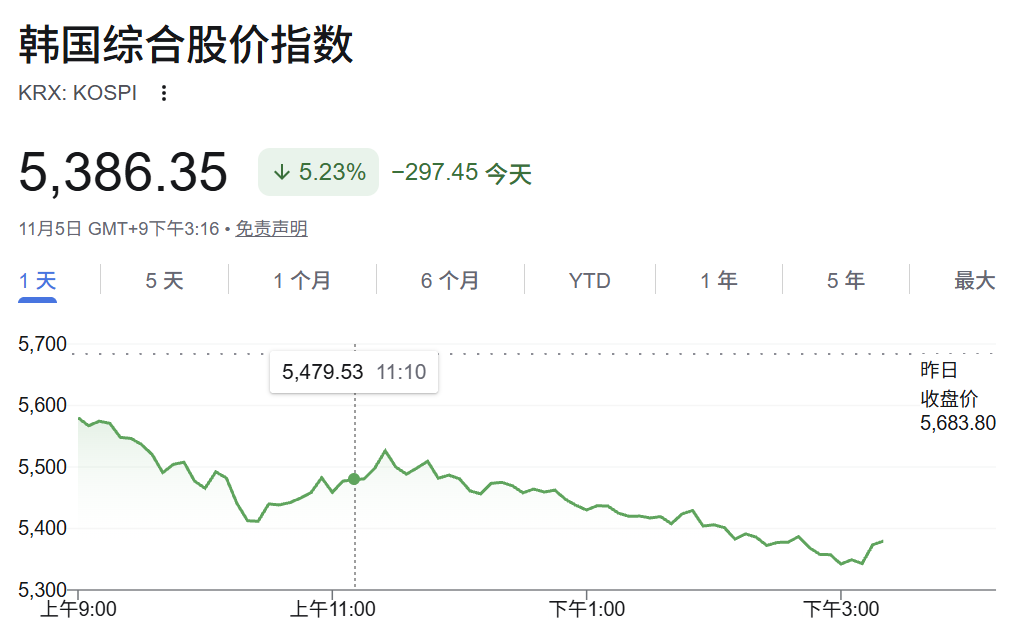
The direct trigger for this selloff was the sharp rise in market fears that approvals for new data centers would be blocked after Democrats won governorships in data center strongholds such as Texas, Ohio, and Georgia. Because Samsung Electronics and SK Hynix together account for more than half of KOSPI market capitalization, any shift in semiconductor sector sentiment is amplified across South Korea's benchmark index.
Democratic Sweep Sends Data Center Regulatory Fears Soaring
Democrats achieved a historic "blue sweep" in this midterm election, winning control of both the Senate and the House while also securing governorships in several states with high concentrations of data centers.
Among them, Texas governor-elect Gina Hinojosa pledged during her campaign that she would immediately pause all approvals for new data centers once elected. According to the Texas Tribune, a regional Texas newspaper citing DataCenterWatch analysis, among 74 gubernatorial candidates across 36 states, 43% expressed support for pausing or banning new data center construction.
The market reaction was also directly transmitted from the previous trading day's US stock moves. Although major US indices rose overall on the 4th—the S&P 500 gained 1.58%, the Dow Jones surged 3.03%, and the Nasdaq rose 1.44%—the internal structure was sharply divided.
Large tech stocks such as Apple, Microsoft, and Amazon all rose more than 5% on the day, while semiconductor stocks including Nvidia, Micron, SanDisk, and Intel generally fell, with declines ranging from 3% to 8%. AI compute leasing newcomers CoreWeave and Nebius plunged 9.9% and 6.7%, respectively, while the Philadelphia Semiconductor Index fell 3.1% to a near six-month low.
Korean Semiconductor and Power Equipment Stocks Under Broad Pressure
The decline in the Korean market was concentrated in semiconductors and the power equipment sector closely tied to AI infrastructure. Samsung Electronics fell 5.39%; SK Square dropped 6.56%; Samsung Electro-Mechanics plunged as much as 10.31%. Semiconductor equipment companies on the KOSDAQ market also suffered steep losses, with Jusung Engineering down 10.23%, Simmtech down 13.90%, and EO Technics down 11.72%.
Power equipment companies such as transformer makers were not spared either. The market fears that delays in data center construction will directly squeeze demand for transformers. Hyosung Heavy Industries, HD Hyundai Electric, and Sanil Electric fell 10.10%, 7.53%, and 12.84%, respectively.
Mirae Asset Securities analyst Seo Sang-young said, "Democrats also won elections in key data center locations such as Texas and Georgia, sharply raising market concerns over tighter regulation of grid connections, approval processes, and power costs. Companies that have taken on heavy debt to build new data centers will face higher financing costs and greater earnings pressure once project timelines are delayed."
Kim Seok-hwan, a senior researcher at Mirae Asset Securities, noted, "Tighter AI regulation could disrupt the capital expenditure plans of large tech companies. These companies need to build data centers to deliver the compute capacity they have promised to customers such as OpenAI and Anthropic, and ultimately convert those commitments into cloud revenue. Delays in data center construction will postpone the window for realizing revenue, prompting hyperscalers to reassess the pace of subsequent investment, and demand expectations for high-bandwidth memory and other advanced chips will come under pressure accordingly."
Policy Path Has Limits; Some Analysts See Shock as Short-Lived
The Bank of Korea's New York representative office said in a report that the election results are unlikely to drive a major shift in the overall policy direction of the Trump administration, but "may have a limited impact on AI regulation and the pace of related investment."
Yang Jun-seok, an economics professor at the Catholic University of Korea, said that even if Democrats control both the Senate and the House, they would struggle to obtain the two-thirds majority needed to override a presidential veto, which fundamentally limits their room to advance actual policy, making it difficult to expect a direct, substantive shock to AI investment from the election results alone.
But he also noted that if Democrats further clarify a policy stance of tightening AI development and investment, combined with other pressures the industry already faces—including public concerns that AI is displacing jobs, driving up energy bills, and consuming large amounts of water, as well as the debt burden on large tech companies from heavy borrowing to invest in AI—this could evolve into a "meaningful additional suppressing factor."
Jo Yeon-ju, a researcher at NH Investment & Securities, took a more optimistic view, saying: "Democrats also understand the strategic importance of AI leadership and will not rashly impose large-scale delays, but will instead favor compensating local residents to push data center construction forward. The real impact on large tech companies may be little more than a storm in a teacup."
Researchers at iM Securities also noted that while concerns over AI data center approval regulation are weighing on semiconductor investment sentiment, expectations of cost savings from falling crude oil prices are spreading to sectors such as aviation and transportation, which are worth continued attention.
Renewable Energy Sector Benefits Against the Tide
Even as the broader market came under pressure, some sectors were seen as potential beneficiaries of the "blue tsunami." After Democrats consolidated their majority, expectations grew for a restart of supportive renewable energy policies, with solar, wind, nuclear, and energy storage system (ESS)-related stocks widely cited as beneficiaries.
Ahn Joo-won, a researcher at DS Investment & Securities, said, "As Democrats gain stronger bargaining power in future legislation thanks to their overwhelming election advantage, demands in renewable energy areas such as solar and wind will be fully reflected, and wind power and fuel cell-related stocks will benefit."
Lee Jae-won, a researcher at Yuanta Securities, cautioned, "After Democrats took control of Congress and won governorships in key states, the probability of stricter regulation for AI data centers has risen. Approval restrictions and grid cost pressures in major data center construction areas such as Texas could delay the pace of AI capital investment, thereby weighing on memory semiconductor demand and dragging down prices."