


Musk May Have a Headache Coming? Texas Flips "Blue" Overnight, Compute Infrastructure Could Hit the Brakes


- Key Takeaways: After the U.S. midterm elections, Texas's political landscape has flipped, with Democratic candidates winning the governor's seat and a federal Senate seat respectively. They advocate tightening data center approvals and tax incentives, bringing policy uncertainty to the region's rapidly expanding AI infrastructure industry.
- Key Elements:
- Inojosa defeated Republican Governor Abbott, ending more than three decades of Republican control of the Texas governorship; Talarico became the first Democrat to win a Texas federal Senate election since 1988.
- Texas is a key location for AI data centers owned by Microsoft, Amazon, Nvidia and other companies, and electricity consumption, power bills, water resources and environmental impact have become core issues in local elections.
- Inojosa advocates pausing approval of new data center projects and eliminating tax incentives, criticizing Abbott's partial pause measures in September as insufficient; Talarico likewise advocates stronger regulation.
- Musk spent nearly $450 million in this midterm election cycle supporting Republican candidates. He has established Tesla, SpaceX and the Terafab semiconductor project in Texas, but his political investment did not produce the expected results.
- According to statistics, of the 36 states holding gubernatorial elections this year, 21 have at least one major party candidate supporting a pause on some data center construction, showing that the restrictive trend crosses party lines.
- The election results do not mean existing data centers will immediately halt construction; the specific impact will depend on policy formulation and the scope of implementation after the new government takes office.
Source: Jin10 Data
The results of the U.S. midterm elections are reshaping Texas's political landscape and bringing new policy uncertainty to the state's rapidly expanding artificial intelligence (AI) infrastructure industry.
Democratic candidate Gina Hinojosa defeated incumbent Republican Governor Greg Abbott, while Democrat James Talarico defeated Republican candidate Ken Paxton in the federal Senate race.
This result ends more than three decades of Republican control of the Texas governorship. Talarico also becomes the first Democrat to win a Texas federal Senate seat since 1988.
The victory results have been confirmed by media outlets including The New York Times and CBS, but the official election results still require official certification.
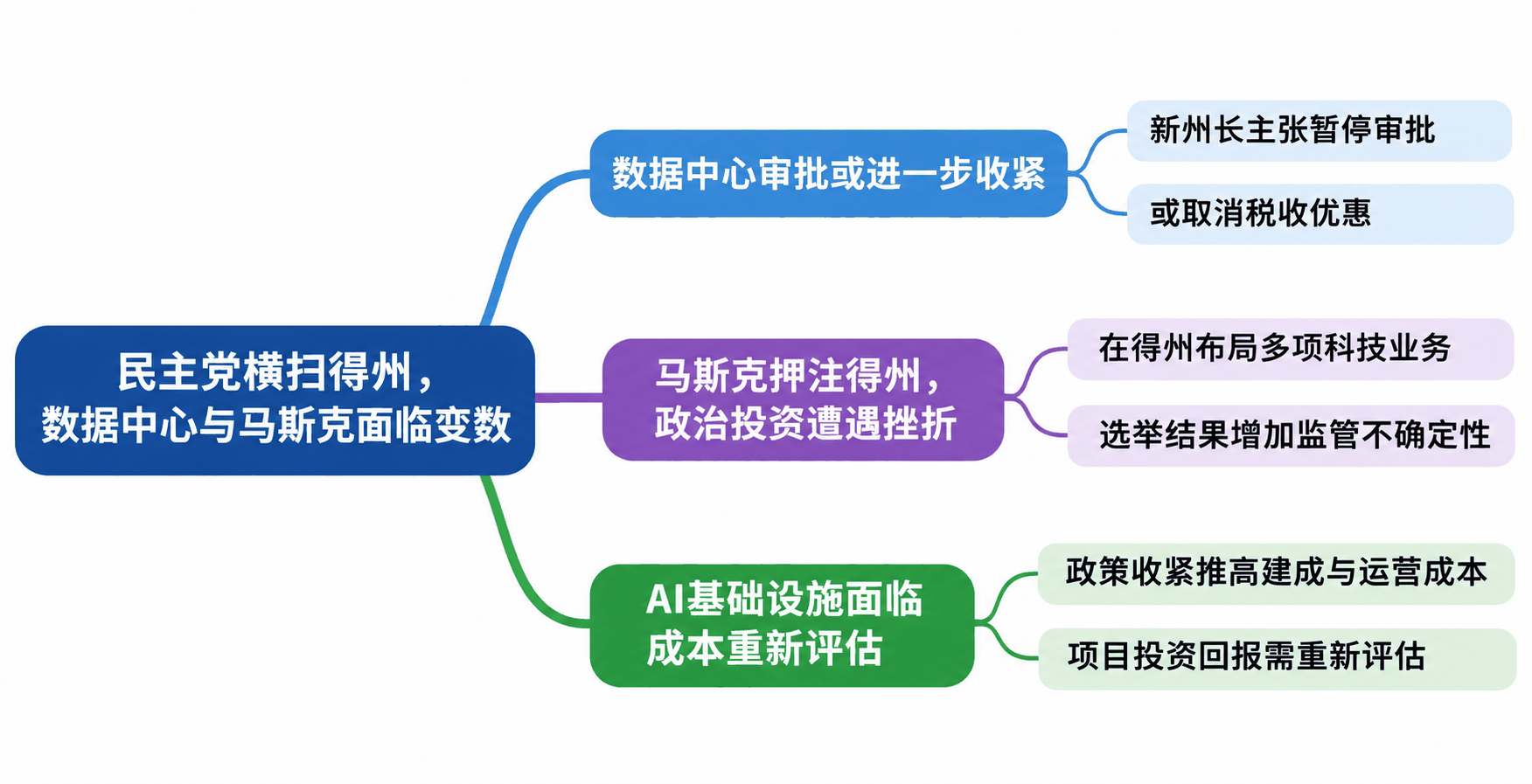
Data Center Approvals May Tighten Further
Texas is a key region for U.S. AI infrastructure development, with tech companies such as Microsoft (MSFT.O), Amazon (AMZN.O), and Nvidia (NVDA.O) all establishing data center projects in the state.
However, as the electricity demand of data centers grows rapidly, the impact of related projects on the power grid, residential electricity bills, water resources, and the local environment has become a major issue in local elections.
During her campaign, Hinojosa advocated pausing approval of new data center projects and canceling the tax incentives enjoyed by related facilities. She also criticized Abbott's previously announced partial moratorium on data center construction as insufficient.
In fact, Abbott announced in September of this year a pause on approvals and grid connection arrangements for some data center projects, but Hinojosa wants broader restrictions to buy time for measures addressing residential electricity costs and environmental protection.
Meanwhile, newly elected federal Senator Talarico also advocates strengthening data center regulation.
This policy shift means that future AI projects in Texas may face stricter conditions for power access, environmental review, and tax incentives.
The current election results do not mean that existing data centers will halt construction immediately; the specific impact will still depend on the policy formulation and scope of implementation after the new government takes office.
Musk Bets on Texas, Political Investment Suffers Setback
The change in Texas's political landscape is of particular significance to Tesla and SpaceX CEO Musk.
In recent years, Musk has moved the headquarters of Tesla and SpaceX to Texas and continued to expand the companies' local operations.
SpaceX has a major launch base for its Starship rocket in southern Texas.
In addition, Musk previously announced plans to build a large semiconductor manufacturing base called Terafab in Grimes County, Texas, with participation from both Tesla and SpaceX.
The project is one of Musk's key plans to expand chip manufacturing capacity.
Musk invested nearly $450 million in this round of midterm elections to support Republican candidates. Among these, the Texas Senate race was one of his key political battlegrounds.
Musk has repeatedly criticized Talarico on social platform X, calling him a "far-left extremist" and accusing his political stance of harming Texas's interests.
However, Talarico ultimately defeated Trump-backed Paxton, meaning Musk's local political investment failed to translate into the expected election outcome.
AI Infrastructure Faces Cost Reassessment
The Texas election results also reflect a changing attitude in American society toward large-scale data center construction.
Previously, large tech companies typically viewed data center projects as important investments capable of creating jobs, expanding local tax revenue, and promoting economic growth.
But as construction scale expands, residents are beginning to pay more attention to the impact of data centers on electricity prices, water resources, and public infrastructure.
According to prior statistics from The Information, among the 36 states holding gubernatorial elections this year, at least one major-party candidate in 21 states supported pausing some data center construction.
This trend does not divide entirely along party lines; some Republican candidates also advocate strengthening related restrictions.
Brad Gerstner, CEO of investment firm Altimeter Capital, said on election night that Democratic victories could lead to a slowdown in data center construction, but he believes concerns about the policy impact may be somewhat exaggerated.
For tech companies, Texas still offers advantages such as industrial clusters, energy resources, and existing infrastructure, but the new government may reassess the economic benefits and social costs of data centers.
What is worth watching going forward is whether Hinojosa fulfills her promise of a broader approval moratorium, and whether new electricity and tax policies will change tech companies' investment plans in Texas.
This election has introduced new policy variables for U.S. AI infrastructure expansion, but it is not yet sufficient to conclude that Musk's companies or local large-scale data center projects will face direct restrictions.





