


US midterm elections: final 36 hours—a golden buying opportunity for US stocks and Bitcoin?


- Core View: The probability of Democrats sweeping both chambers in the 2026 US midterm elections has risen to 72%, which may hinder the advancement of crypto-friendly regulation in the short term, but election uncertainty has already been priced in ahead of time. Historical data shows that US stocks and crypto assets generally rebound after elections.
- Key Elements:
- Prediction markets show Democrats have a 95% chance of controlling the House and a 73% chance of controlling the Senate. If they win, it will affect the advancement of crypto bills and regulatory policies at the SEC and CFTC.
- Morgan Stanley expects the S&P 500 may see a short-term pullback of about 9% to 7,100 points, but views it as a buy-the-dip opportunity, with a subsequent rise toward 8,000 points.
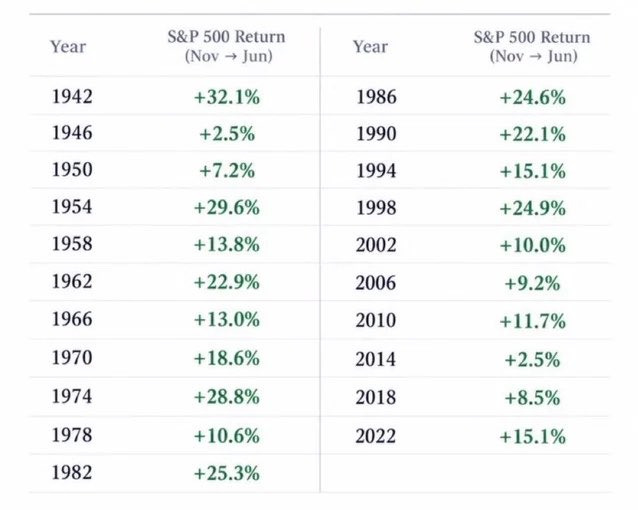
- Historical data shows that since 1950, US stocks have risen in both the 6 months and 12 months after midterm elections, with the S&P 500 averaging a 16.6% gain across the past 21 cycles.
- Excluding AI stocks, the S&P 500 rose 8% in October and hit a new high, but 58% of constituents fell at least 20% from their respective highs, with selling pressure concentrated in tech stocks.
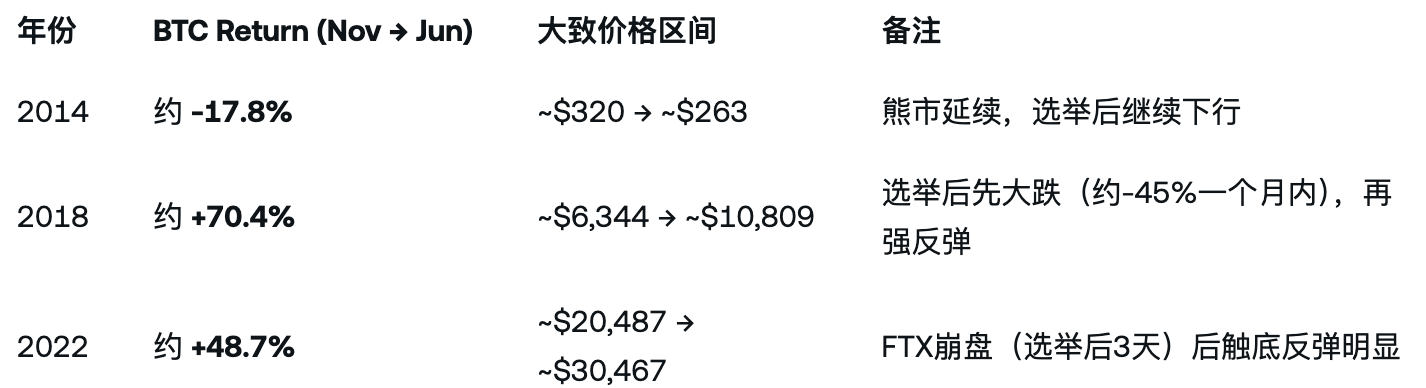
- The bottoms of the past three Bitcoin cycles all occurred after midterm elections (71 days in 2014, 39 days in 2018, and 13 days in 2022), potentially pointing to a bottom window from late 2026 to early 2027.
- After the 2018 and 2022 midterm elections, BTC posted gains of 50% to 70%, and crypto-related stocks outperformed the broader market over the same period, reflecting their high-beta nature.
Original | Odaily@OdailyChina)
Author | Wenser (@wenser 2010 )

The results of the 2026 U.S. midterm elections will be announced on the evening of November 3 local time (the morning of November 4 Beijing time), with Democrats and Republicans contesting all 435 seats in the House of Representatives and 35 of the 100 seats in the Senate.
Based on previous polling results and prediction market data, Democrats are currently poised to sweep both chambers, with the probability of securing majority seats in both the House and Senate having risen to 72%. Among these, the probability of Democrats controlling the House has reached 95%, while the probability of controlling the Senate stands at 73%.
This forward-looking situation had previously caused the U.S. stock market's recovery and rebound momentum to stall once again.
The bad news is that after Democrats win majority seats in both chambers, they will in the short term affect the advancement of crypto legislation and the SEC and CFTC's push for crypto-friendly regulatory policies, as well as increase tax pressure on industries such as AI data centers. The good news is that before the midterm elections, relevant information has already been priced in and digested in advance. After the elections conclude, regardless of the outcome, the U.S. stock market may see a short-term rebound and rally, while the performance of crypto-related stocks will still be highly dependent on Trump and regulators' statements of support.

The Deciding Factor of the Midterms: Trump's Future Legislative Agenda at Stake, Republicans May Fall into a Passive Position
The reason the midterm elections are so important is that if Democrats win control of the House or Senate, Trump will find it difficult to push related bills through Congress going forward. Although he has previously found ways to exercise power directly without relying on overall Republican support, domestic governance being obstructed is almost certain.
In terms of specific methods, if Democrats control one of the chambers, they can investigate the Trump administration's governance through congressional committees. Corruption allegations, the new White House ballroom, and the enforcement methods of U.S. Immigration and Customs Enforcement (ICE) could all come under scrutiny; Democrats are also internally discussing whether to impeach Trump (i.e., Congress bringing charges against the president as a basis for political trial rather than criminal proceedings).
Conversely, if Republicans continue to control Congress, Trump can continue to advance his policy agenda during the remaining approximately 2 years of his term.
After the Midterms, Where Will U.S. Stocks Go: Buy the Dip and Wait for a Rebound
Currently, institutions are quite optimistic about capital market performance after the midterm elections.
CITIC Securities: Bullish on the Possibility of U.S. Tech Stock Rebound After the Midterms
CITIC Securities stated in a research report that entering the second half of 2026, U.S. tech stocks continue to oscillate around high-frequency AI narrative changes, while the transmission from bond CDS to stock prices has correspondingly pushed up short-term market volatility. The decline in U.S. semiconductor hardware since early October still largely conforms to the market trading logic since mid-June, but the suppression brought by macro liquidity pressure and midterm election uncertainty outweighs the phased pessimistic turn in the AI narrative.
With the clearing of major macro and industry disturbance events over the past 1-2 weeks, as well as the phased return of optimistic AI narratives, we are bullish on the possibility of a U.S. tech stock rebound after the midterm elections, and recommend semiconductor hardware as the primary direction.
Morgan Stanley: Regardless of U.S. Midterm Election Results, Investors Should Buy the Dip in U.S. Stocks
Morgan Stanley's Chief U.S. Equity Strategist Mike Wilson stated that U.S. stocks may face several short-term correction risks in the future, including the U.S. midterm elections, market concerns triggered by AI spending, and liquidity constraints, which could push the S&P 500 down about 9% from its recent historical high to 7,100 points.
However, he believes these corrections will create opportunities to buy the dip, and expects that after related risks are released, the S&P 500 is expected to rise further to 8,000 points. Historically, since 1950, U.S. stocks have risen in both the 6-month and 12-month periods following every midterm election.
Macro Analysis Firm: Tech Stocks Weigh on U.S. Market Performance; S&P 500 Up 8% in October Excluding AI
The Kobeissi Letter posted that the Nasdaq 100 Index lost approximately $4 trillion in market value within 25 days, with AI stocks falling over 13% in October, while the S&P 500 excluding AI stocks rose 8% over the same period and hit a record high on Friday. Currently, the S&P 500 is only 3.5% away from its historical high, but about 58% of its constituents have fallen at least 20% from their respective highs, and 75% of tech stocks have entered bear market territory.
The Kobeissi Letter believes that current selling pressure is mainly concentrated in tech-related stocks, and most investors, due to heavy tech stock holdings, actually feel market pressure far higher than what major indices reflect. It also noted that companies investing record-scale capital expenditure in the AI technology revolution, as well as normal market corrections, may lay the foundation for the next rally, and expects the market to remain highly volatile in November.
Historical Experience Shows: U.S. Stocks Rise After Midterms, BTC Hits Historical Lows
Previously, "White-Haired Stock God" Serenity posted that historical data shows during the period from November of U.S. midterm election years to June of the following year, the S&P 500 has recorded positive returns in all of the past 21 related cycles, with an average gain of 16.6%.
But compared to previous years, a major variable in the 2026 midterm elections is the still-tense U.S.-Iran situation. A U.S. official previously publicly stated that if Republicans suffer a crushing defeat in the midterms, Trump may be more inclined to order large-scale military action; the U.S. military previously stated it could launch a new round of large-scale attacks on Iran within 96 hours of receiving orders.
Additionally, Trump has repeatedly mentioned the "Trump Dividend", namely that if Republicans win the midterm elections, the Trump administration would distribute $5,000 to every American adult citizen. Calculated based on approximately 240 million American adult citizens, the plan is estimated to cost about $1.2 trillion.
The cloud of war and the red envelope stimulus can be described as "half seawater, half flame," making the market situation after the midterm elections increasingly unpredictable.
Looking back at historical data, the capital market overall remains in a rebound and rally state:
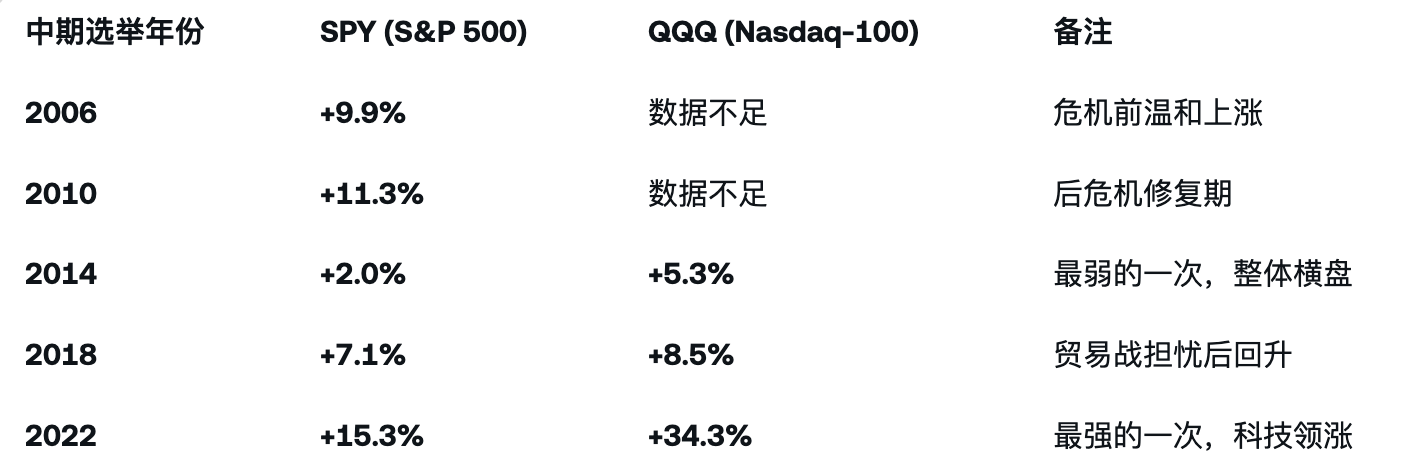
First, taking the S&P 500 Index and Nasdaq 100 Index as examples, in the past 5 midterm elections (November to January of the following year), both showed upward trends, with 2022 seeing the highest gains led by tech stocks.
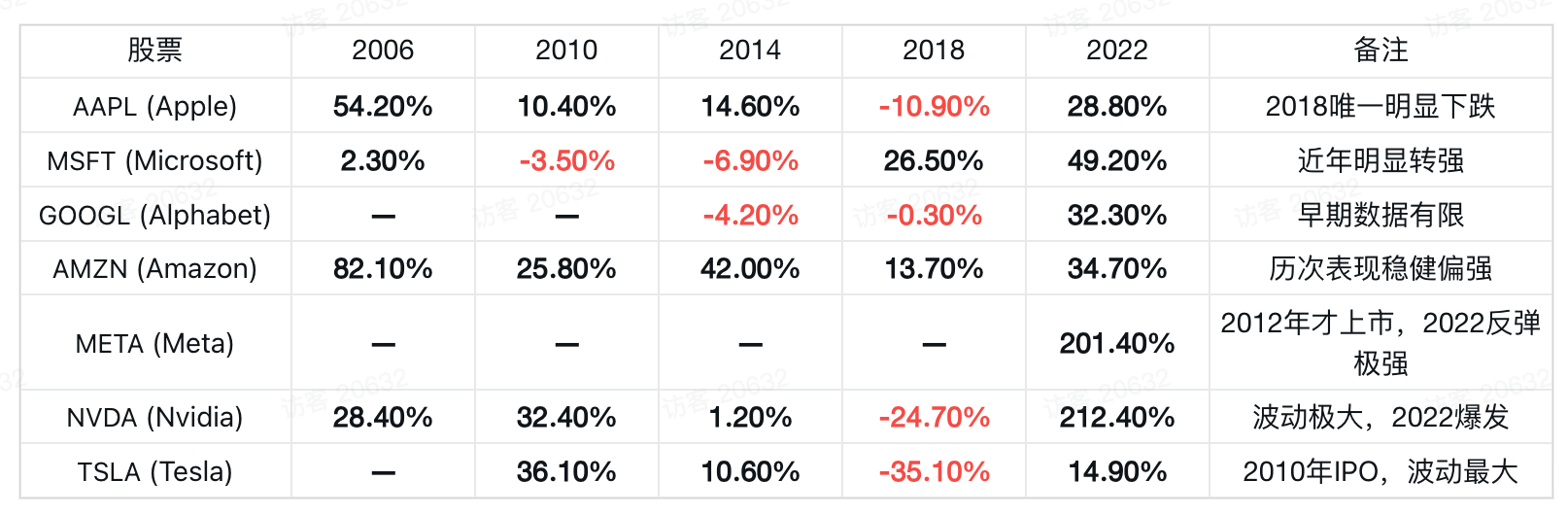
Second, looking at the stock price performance of the Magnificent Seven in the past 5 midterm elections, after the past 5 midterms (November to January of the following year), most individual stocks showed upward trends (only 2018 performed worst, with Apple, Nvidia, and Tesla all falling over 10%).
 Finally, looking at cryptocurrency performance, the past three Bitcoin cycle bottoms all appeared after U.S. midterm elections: 71 days after the election in 2014, 39 days in 2018, and 13 days in 2022. Some analysts say that if this pattern repeats, late 2026 to early 2027 may be the time window for Bitcoin's next cycle bottom. Looking solely at BTC price, after the 2018 and 2022 midterms (November to January of the following year), it recorded gains of 50%~70%.
Crypto-related stocks performed stronger than the broader market in the window period after the most recent midterm elections, rebounding in sync with BTC, belonging to high-beta assets:
- Strategy (MSTR) stock price rebounded from about $25 in early November of that year to about $34 by the end of June the following year, a gain of about 30%;
- Coinbase (COIN) rose from about $63 in early November to about $71.5 by the end of June the following year. Although it halved to the $30+ range at its lowest point in between, it ultimately still had a gain of about 13%;
- Crypto mining companies such as RIOT closely followed BTC's gains during the same period, showing significant rebounds in the first half of 2023 as BTC and risk appetite recovered, with enormous full-year gains as the market warmed up.
Overall, despite facing a complex market environment including Fed rate hikes, U.S.-Iran conflicts, and AI financing risks, asset performance after the midterm elections is still worth anticipating. Investors can choose timing to buy the dip or play the rebound based on their own circumstances.





