Why has on-chain options never taken off? What can Perp DEX bring to it?


- Core view: On-chain options have long lagged in development, with the core bottleneck being that sellers lack cheap hedging tools and capital efficiency; the depth of the perpetual contract market happens to provide a hedging venue for options sellers, and options are expected to follow perps on-chain and usher in growth.
- Key elements:
- Options allow traders to choose "how long they can be wrong," while perps cannot; however, on-chain options volume is still less than 1% of perp DEX volume, while options volume in traditional markets is about three times that of futures.
- Backtests show that a 10x BTC perp has a 47% probability of liquidation within 180 days, while call options over the same period will not be liquidated, confirming that the time dimension is the core value of options.
- Historical failures stem from a trilemma: liquidity is scattered across hundreds of order books, seller hedging costs are high, and margin requirements are too large; portfolio margin can reduce the collateral required to sell a call from $100,000 to about $15,000.
- Perp platforms such as Hyperliquid, with the deepest order books, unified accounts, and user base, have become ideal hedging venues for options sellers, and Hypercall is the first options platform built on this.
- In September 2026, on-chain options notional amount was about $5 billion, only about 7% of Deribit over the same period; by premium, Derive's share exceeds 90%, making it the main venue for real options exposure.
- Metric pools can tokenize options and distribute them through aggregators, but capital efficiency is low; issuers such as Derive can balance margin efficiency and distribution.
- The options version of Papertrade has the house vault sell options and uses token incentives for losing buyers; simulations show a net profit over eight years, but tokens need to be minted based on net losses and dynamically hedged to control tail risk.
The original article comes from Saurabh Deshpande
Compiled by Express@Odaily

I keep coming back to one question: if perpetual futures (perps) already work so well, why does the crypto market still need options? And I keep landing on the same answer — time. You might think Bitcoin will be higher in three months, but a leveraged perp can get liquidated tomorrow. Buying a call gives your thesis more room to breathe. You can still lose everything you put in, but one bad afternoon won't kick you out of the position.
That leads us to ask: why are on-chain options still so small? We tried buying them a few times, checked the liquidity, and looked at why so many previous attempts failed. Most of the reasons come down to the same thing — whether selling options is even worth the trouble. Perp exchanges may change that, because they can give sellers a place to hedge and bring them traders who are already there. This article is about why this could work, what's still unsolved, and who benefits. We'll also explore a few designs that could incentivize sellers.
Over the past few weeks, I've been playing with Papertrade. The platform has the house take the other side of every trade, and for every $1 you lose, you mint a corresponding amount of PAPER — a token that earns a share of the house's fee revenue. Compensating losses with a token made me wonder: what would this look like applied to options, a category that still hasn't produced a breakout success story?
A perp lets you choose how far price can move against you. It never lets you choose how long you can be wrong. Options can. In July 2025, we argued in an article that options would follow perps on-chain and could grow a hundredfold over three years. Fifteen months later, options are still less than 1% of perp DEX volume. In traditional markets, options volume is roughly three times that of futures.
This is another piece in a series on the state of crypto options.
In this one, I quantify the cost a perp imposes on a trader who is right but early; explain why the next wave of on-chain options will grow next to perp markets like Hyperliquid; take stock of who is doing what; and identify which protocols benefit most once volume actually arrives. The short answer: whoever controls the hedge benefits. The three positions worth holding are — Hyperliquid as the landlord of the hedging market, Derive as the engine others build on, and Paradex as the desk for block trades. Then we sketch two projects that could bring in the missing sellers.
One puts options into Metric's LP pools, the other is an options version of Papertrade.
Right Direction, Wrong Route
How often does a perp kill a trade that should have been profitable? We took BTC's daily closing prices from January 2018 to October 2026, treating every day as a possible long entry. We kept only those trades that closed above the entry price 7 to 180 days later — the ones where the trader was right — and then checked whether BTC fell far enough during the holding period to liquidate a 5x, 10x, or 20x perp.
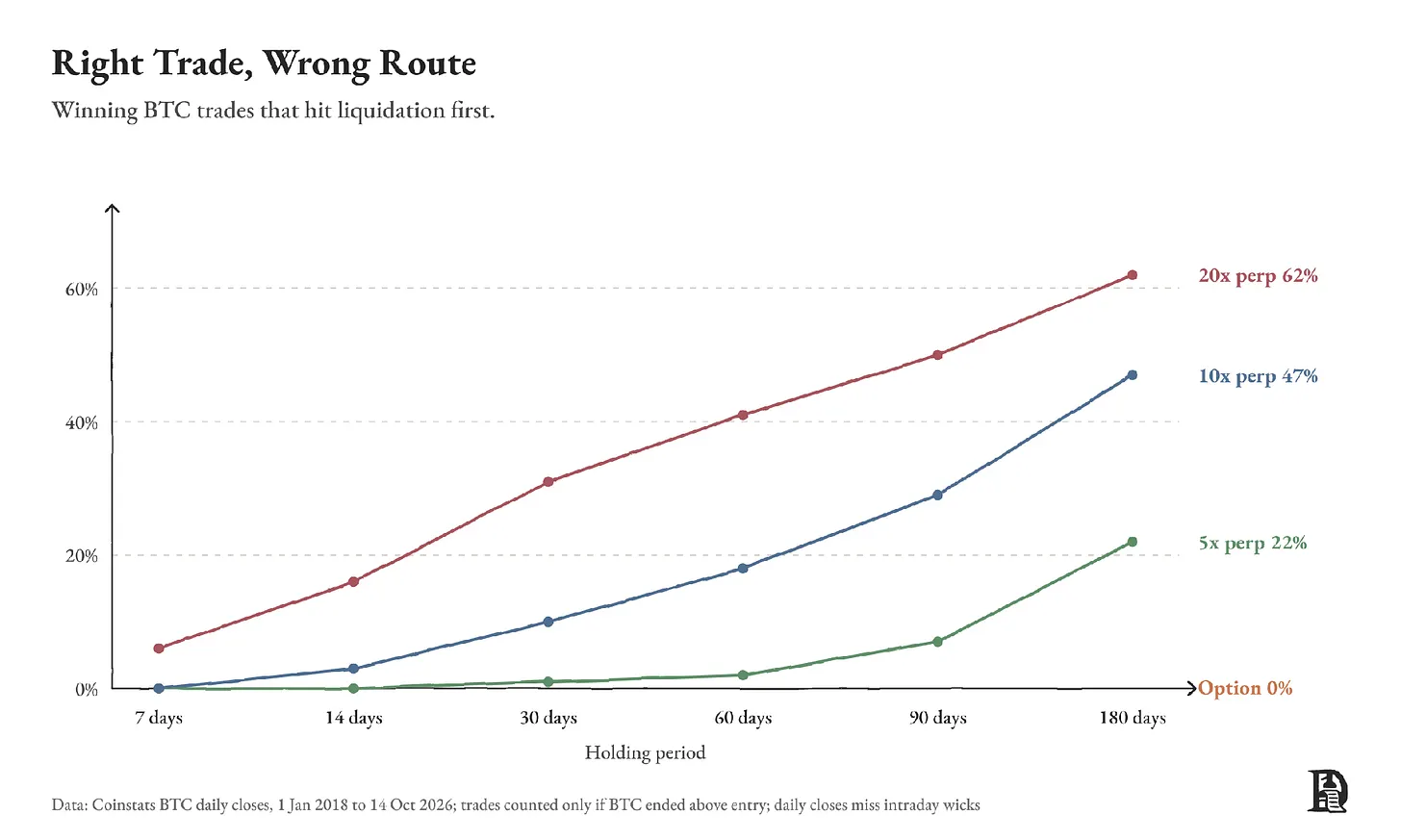
A 10x perp has a 47% chance of being liquidated over 180 days, 29% over 90 days, and 18% over 60 days. Buying an option covering the same window won't get liquidated before expiry. Daily closes also miss intraday wicks, so the real probabilities may be higher. In March of this year, we wrote in Bringing the World On-Chain that directional flow overwhelmingly chose perps. That's still true for hour-by-hour trading. But the longer a thesis takes to play out, the more likely a perp gets stopped out or liquidated.
We revisited October 10, 2025. At 12:00 UTC, we opened three $1,000 BTC longs. The first was a 10x perp; the second was a 30-day call bought with the same $1,000; the third was the same 10x perp, but paired with a 7-day put struck 5% below the entry price, with the premium paid out of that $1,000.
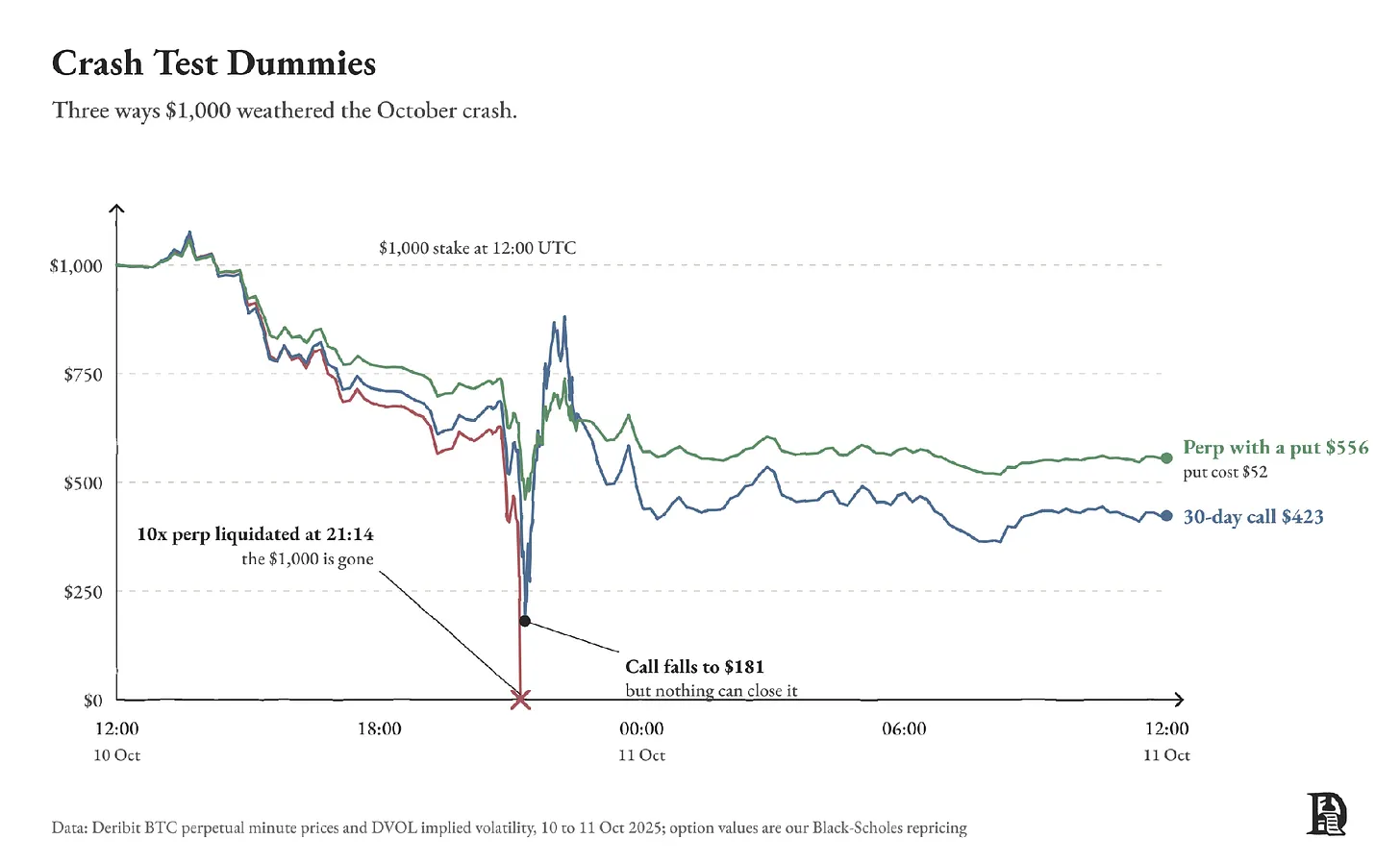
The perp position was liquidated at 21:14. The call fell to $181 at the low but was back above $800 within an hour. The put cost $52 and kept the 10x long alive through the crash. We repeated the test across eight assets using Deribit prices, and the results were consistent.
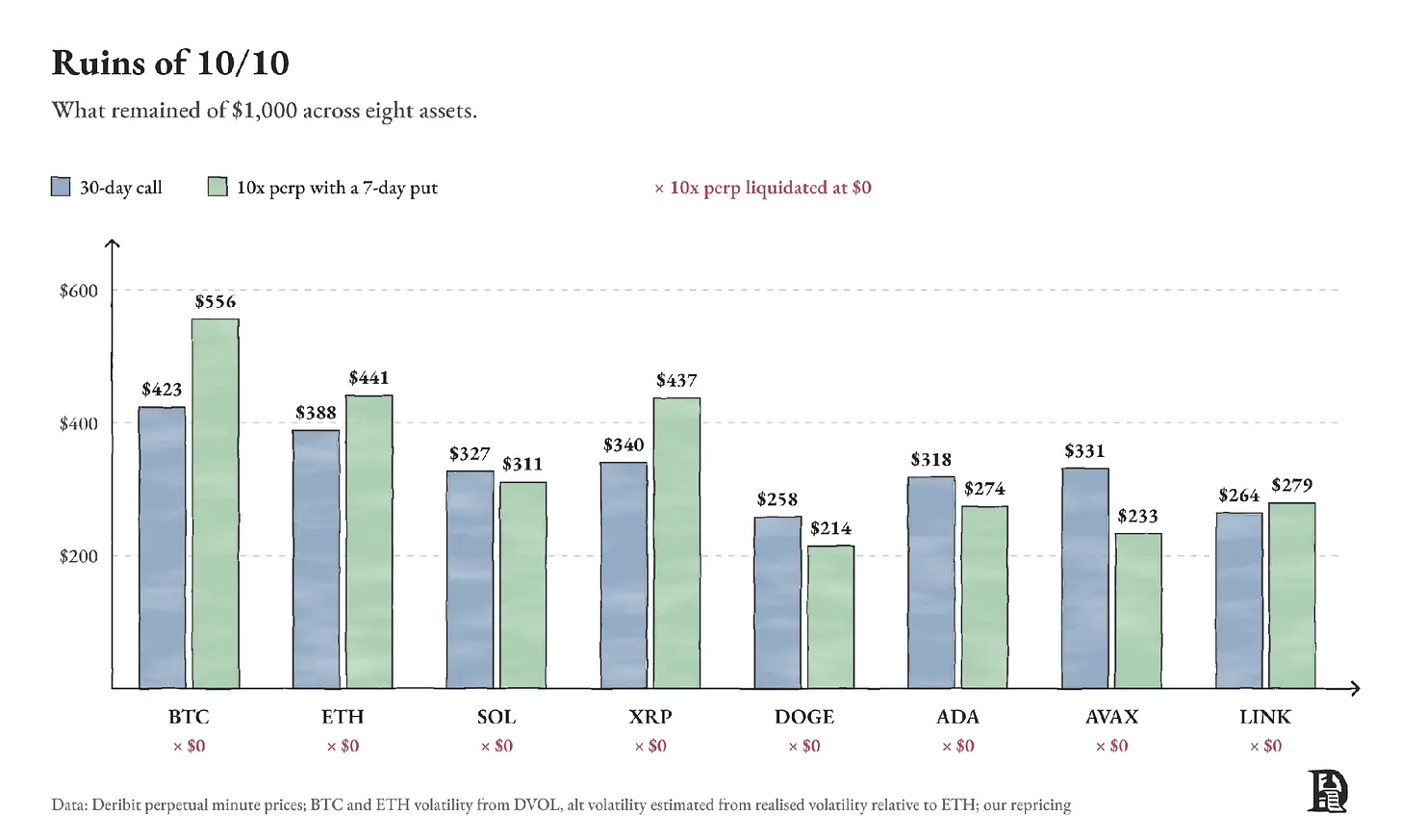
On small caps, this protection costs $250 to $340 out of the $1,000, because their options pricing carries much higher volatility.
Everything's on the Menu
TradFi and crypto are borrowing from each other in three ways.
First, TradFi is importing crypto tools. CME now trades crypto futures and options around the clock. Hyperliquid's perp prices appear on the Bloomberg Terminal, and Hyperliquid's policy team and trade.xyz have filed with the SEC for rules on pre-IPO perps. Polymarket launched perps for non-US users in September.
Second, crypto is importing TradFi assets. On Hyperliquid, you can trade the S&P 500, Nvidia, gold, and crude oil as perps at any time of day. In Everything is a market, we said that Treasuries, equities, compute, and attention would all trade on-chain. Anyone in the industry can see that every important asset will eventually come on-chain. And perps are exactly how that's happening. On March 23, trade[XYZ]'s WTI and Brent crude perps combined for $2.3 billion in single-day volume. There's now a perp tied to the hourly rental rate of Nvidia H100 GPUs, and another tied to a Pokémon card index. CME and ICE are awaiting CFTC approval to list compute futures.
As more prices become tradable, people will want different ways to trade them. Someone might use a GPU perp to bet on a compute shortage. An AI startup with exposure to the same price might just want to buy protection against higher bills next quarter.
Buying an option lets that startup buy this protection for a known amount. If rental rates rise above the agreed level, the option pays out. If rates fall, the startup enjoys cheaper compute and only loses the premium. And the perp gives whoever sold that option a tool to hedge with. Every new perp market creates room for an options market alongside it.
Third, TradFi tools now serve crypto's own assets. In April, open interest in BlackRock's Bitcoin ETF options climbed to $27.6 billion, surpassing BTC options open interest on Deribit. In the same period, Coinbase acquired Deribit for $2.9 billion.
The same venue could eventually offer spot, perps, options, and binaries, with underlyings ranging from Bitcoin to equities and commodities. Whoever gets there first will capture most of the flow. We think crypto has a head start, for two reasons.
Listing is a software decision. IBIT launched in January 2024, but its options didn't start trading until November of that year, waiting on sign-offs from exchanges, clearinghouses, and the SEC one by one. Hypercall listed SpaceX options on June 3, 2026, nine days before SpaceX listed on Nasdaq, using Hyperliquid's pre-IPO perp as the reference price.
This market never closes. Hypercall lets you trade Nvidia and SpaceX options on Sundays, because the perps used to hedge them also trade on Sundays. Spreads outside US market hours widen by 1.5 to 2x. But traditional venues don't offer Nvidia options at all during that window.
The rise of perps is the best thing that could happen to on-chain options, because perps are exactly where options sellers hedge. The deeper the perp market, the cheaper it is to sell options on top of it. Every new perp market is a potential options market.
Why On-Chain Options Never Took Off
Since 2019, dozens of protocols have tried to bring options on-chain. Nearly all have shut down, pivoted, or barely traded. We walked through the generations in Trading Optionality; here's the short version. Options are much harder to list than perps, for three reasons.
Liquidity is fragmented across hundreds of order books per asset. BTC has one perp order book. Deribit lists 884 BTC options across 11 expiries, each of which must be quoted around the clock.
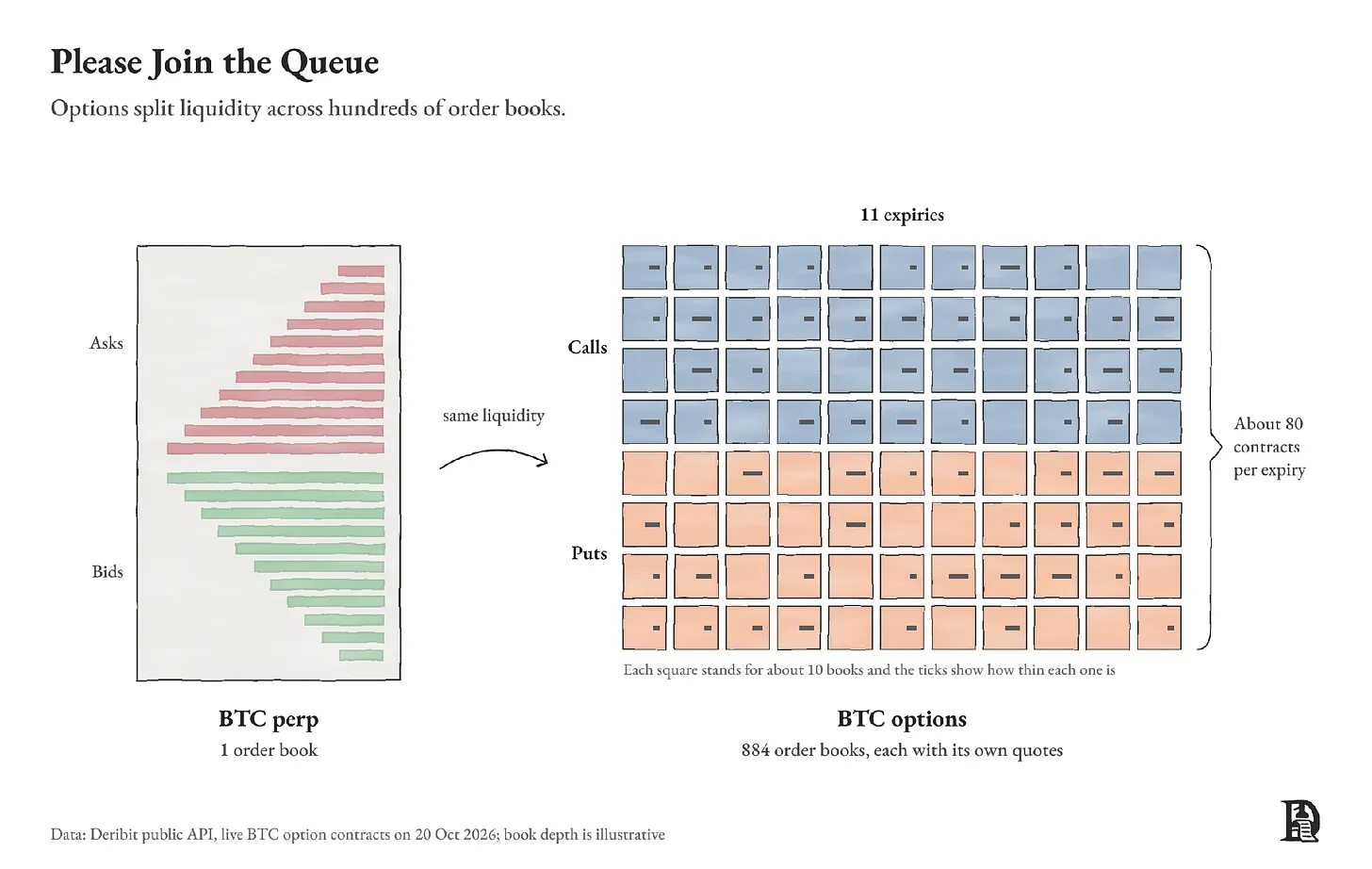 Sellers can't hedge cheaply. Sellers must continuously trade the underlying to stay neutral, which requires a sufficiently deep market right next door.
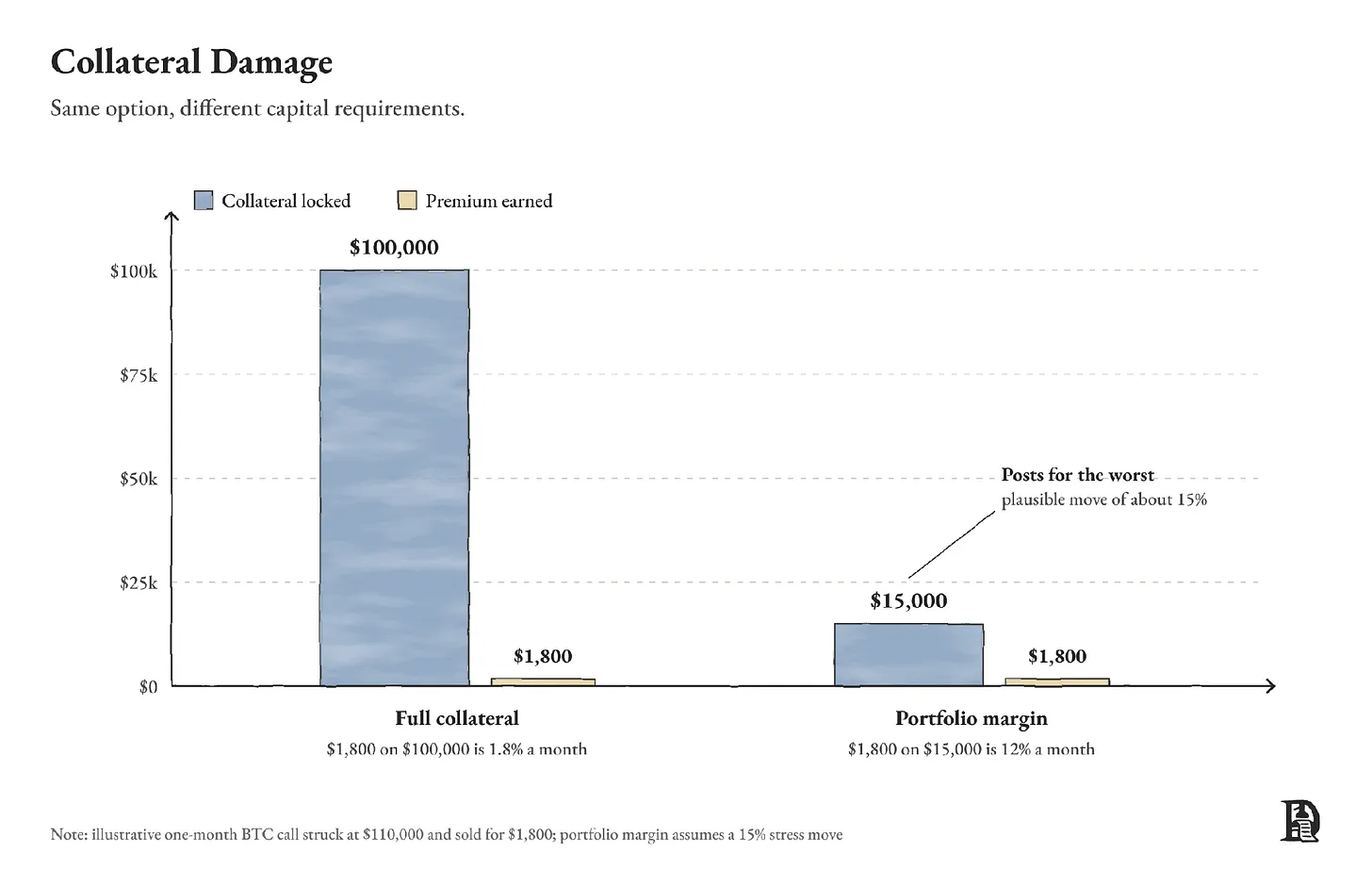
Selling ties up capital. Early protocols required sellers to lock up the maximum amount they could theoretically owe. Selling a $1,800 call on $110,000 of BTC meant locking up $100,000 to earn 1.8% a month. No professional market maker would take that trade.
 Each generation solved one of these and stumbled on another. In May 2021, Hegic depositors lost most of roughly $80 million; Lyra depositors lost 4.9% in the BTC pool and 17.6% in the ETH pool over seven months; PsyOptions shut down its product in June 2024.
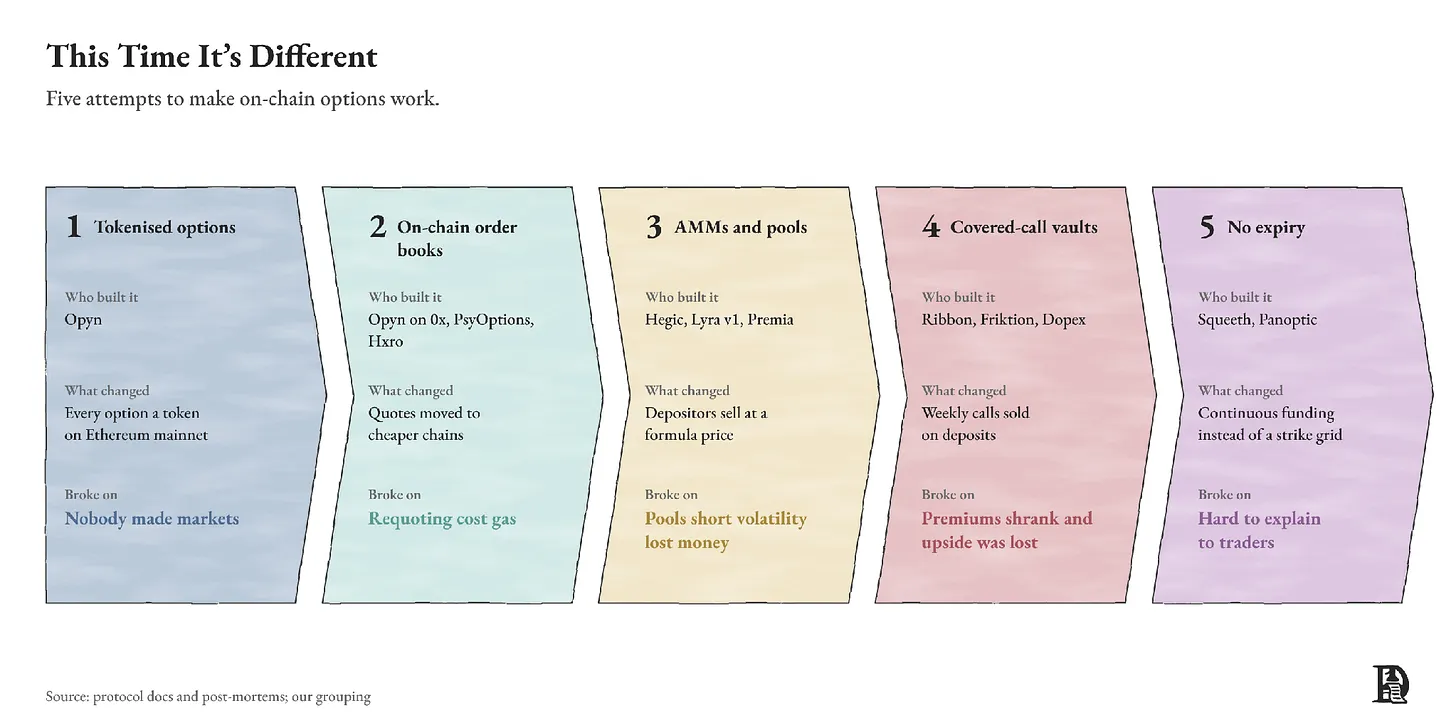 So why do market makers avoid it? Before retail arrives, most of the flow that hits a new venue's quotes comes from traders arbitraging its prices against Deribit. They only act when the new venue's quotes go stale, so even if the platform runs perfectly, market makers lose money on nearly every fill. A platform has only two paths: pay the first market makers to absorb these losses, or bring them retail flow that doesn't exist yet.
How Today's Platforms Solve It
The platforms that work today share the same foundational design. Orders are matched off-chain, so updating quotes is free. Collateral, margin, and settlement stay on-chain, so you always retain control of your funds.
But a better design still has to give a reason to sell. The strongest reason is a cheap hedge in the same account. Remember the seller who needed to lock $100,000 to sell a $1,800 BTC call?
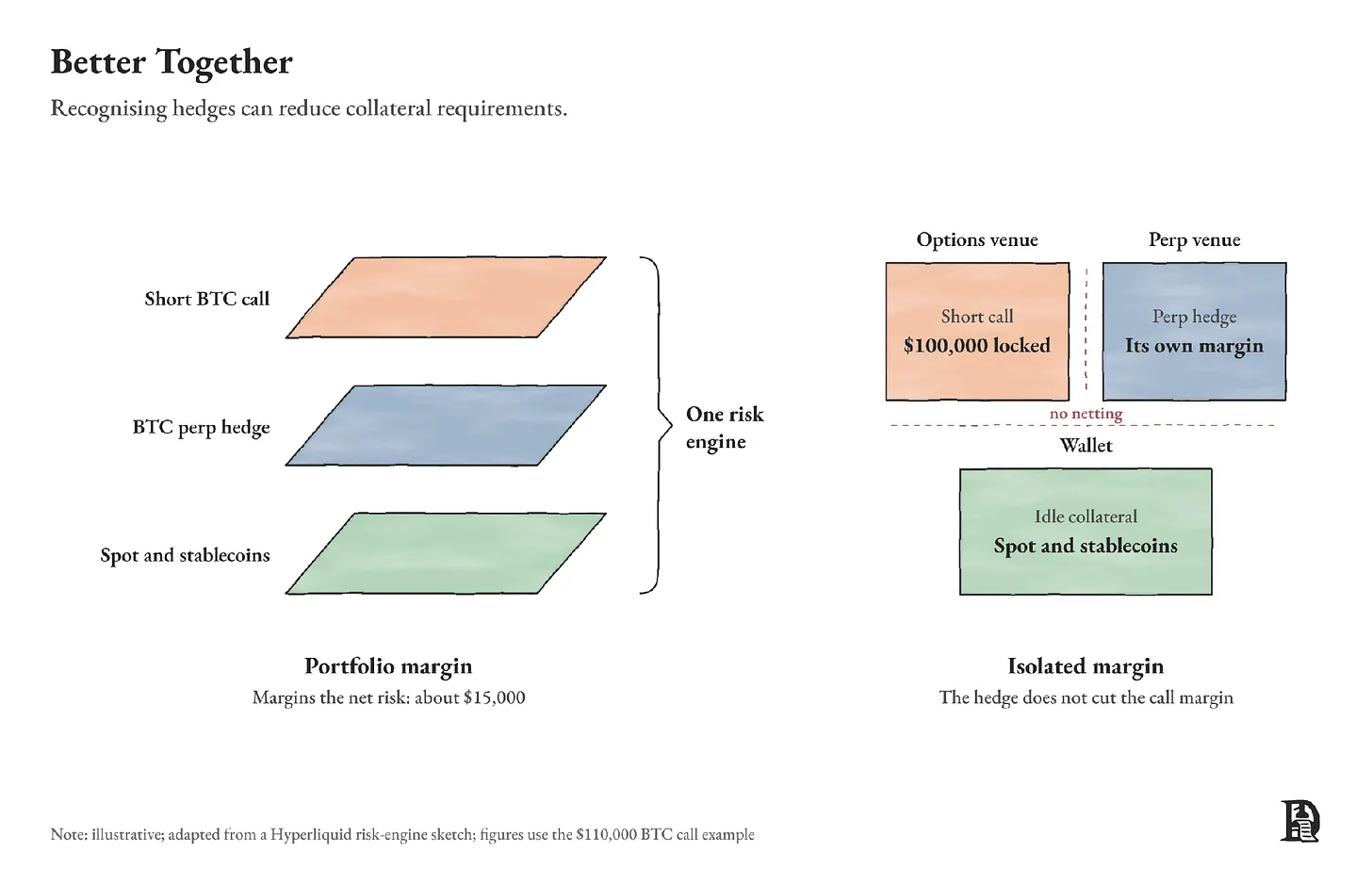
A portfolio margin engine calculates the maximum possible loss across all positions and derives the required collateral from that. If the worst reasonable move is 15%, the seller only needs to post about $15,000 instead of $100,000. The premium is still $1,800, so the return on locked capital jumps from 1.8% a month to about 12%.
That's why we think options will take off where perp liquidity already exists, and today that's platforms like Hyperliquid and Lighter. An options seller on Hyperliquid gets three things at once that other on-chain venues can't assemble.
The first is depth. Hyperliquid has the deepest perp order book on-chain, and builder codes let any app plug in.
The second is one account. A trader selling a put can reuse collateral to open a perp long, with spot, perps, and event contracts sharing the same risk engine. This is the most critical improvement over predecessors. The third is users, and platforms that hold liquidity, users, and distribution at the same time tend to retain the value they create.
Hypercall is the first options platform built on this foundation. A market maker selling you an Nvidia call can buy the Nvidia perp on Hyperliquid in the same account, and that hedge lowers the margin required for the option. Its founder estimates that 10 to 100 times as many market makers quote perps as quote options. Hypercall gives this cohort of perp market makers a reason to quote options too.
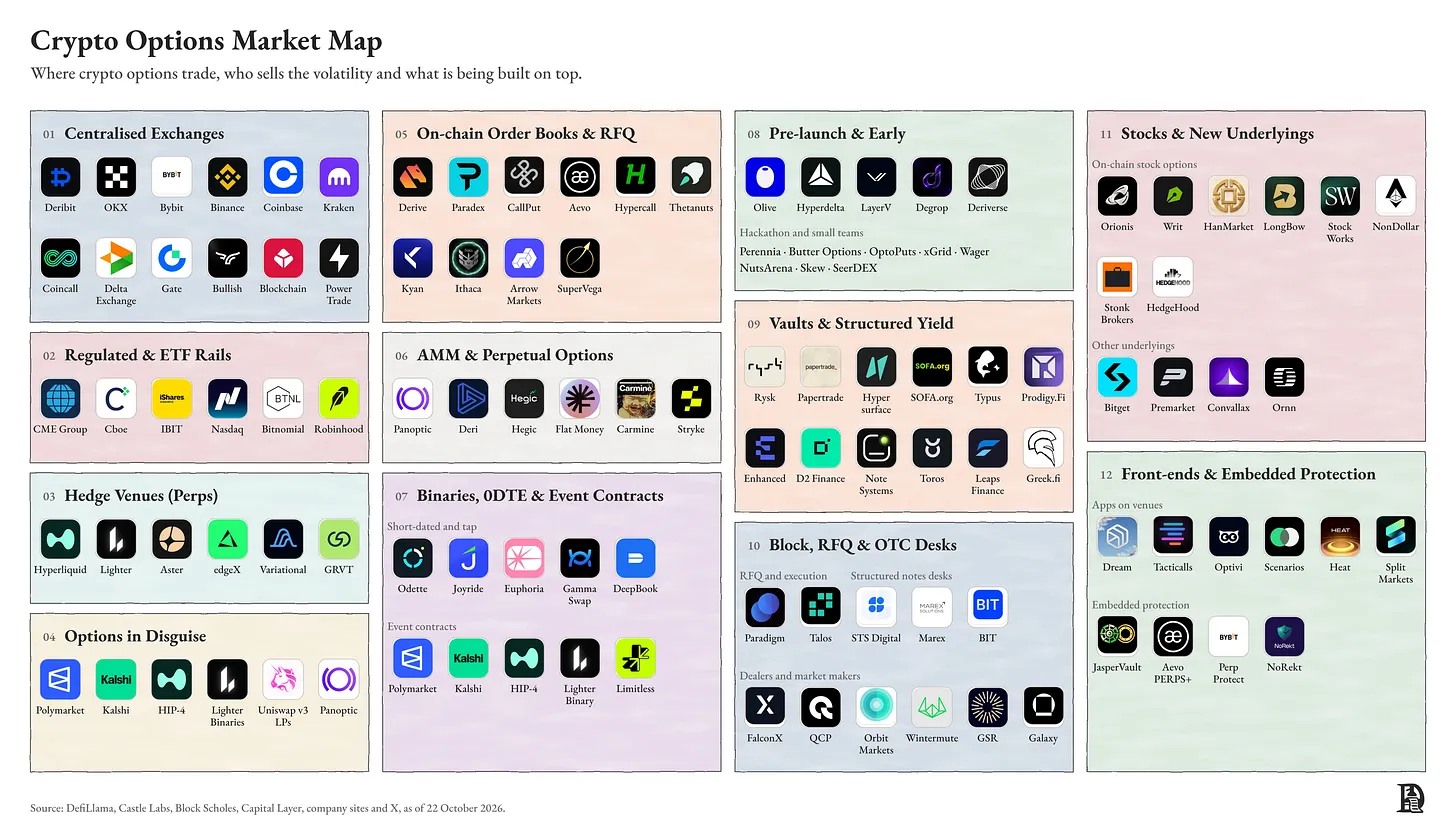
Other platforms have each found different sellers.
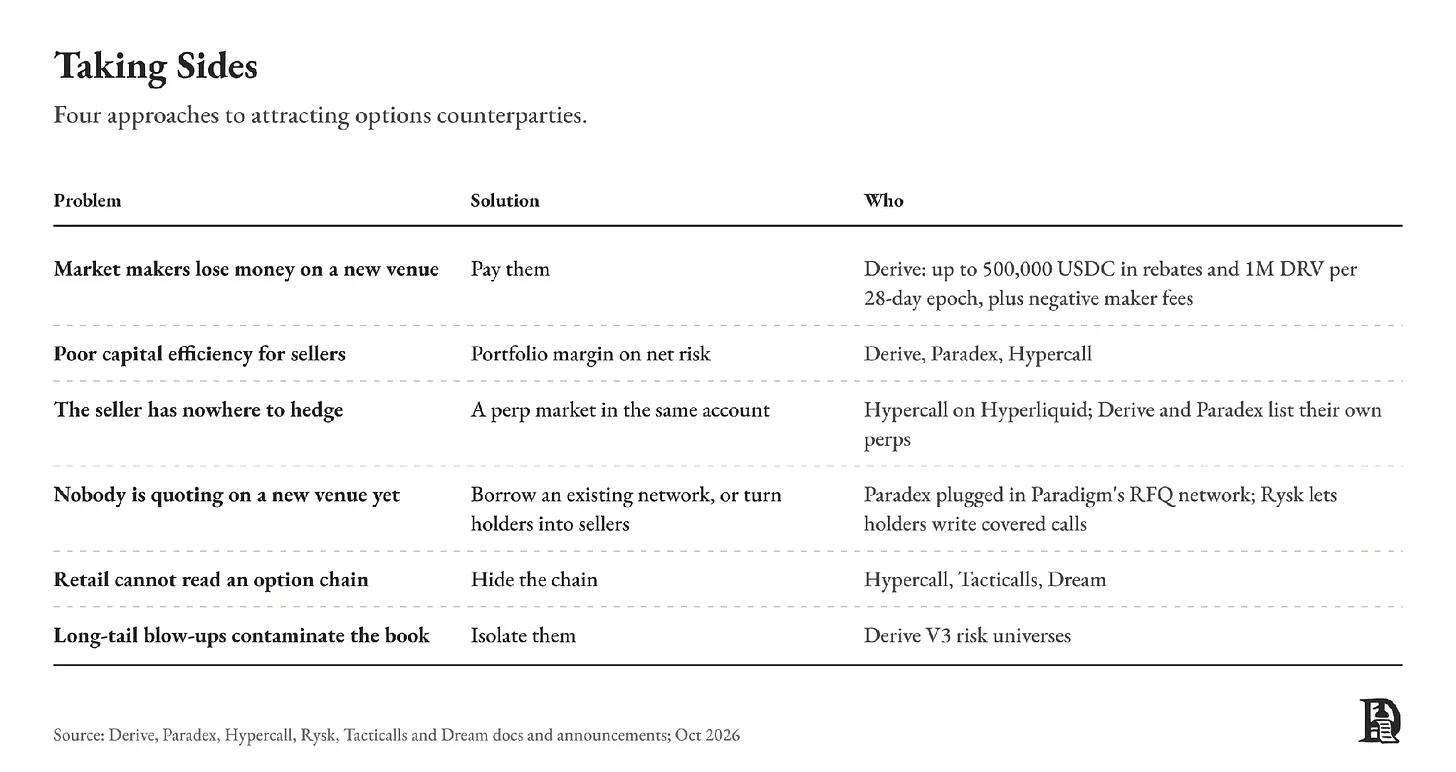 Derive (formerly Lyra) pays for its sellers. In the year through October 19, it cleared roughly $18 billion in options notional, with FalconX as its only publicly named market maker. FalconX's funds stay with its custodian, and Derive represents that balance as a tradable token, so institutions can quote on-chain without moving collateral on-chain.
Paradex borrows its sellers. On September 15, it connected to Paradigm's network, which handles about a quarter of Deribit's block trades. Its daily options volume jumped from under $3 million to $58.7 million within a week, but open interest fell from over $250 million to about $96 million by October 14. Block traders come for one trade and then leave.
Rysk turns holders into sellers. You deposit HYPE, BTC, or ETH, sell covered calls to whitelisted market makers, and receive the premium upfront. In the 30 days through October 14, it did $148 million in notional, but volume stalled once buyers of these calls capped their HYPE exposure.
The frontends layered on top of these platforms hide the strike tables entirely. Dream lets you top up with Apple Pay, pick a direction and position size, and it buys the option for you. Tacticalls, built on Derive, offers three-tap betting and copy trading. Simpler wrappers can pull users in. But when the underlying order book is empty, they can't manufacture a seller.
Listed, but How Much Liquidity?
September 2026 was the best month ever for on-chain options. Notional roughly doubled to $5 billion, premium grew by a third to $85 million, and open interest peaked near $2.5 billion. That's still only about 7% of Deribit's volume that month. Most of it went through Derive.
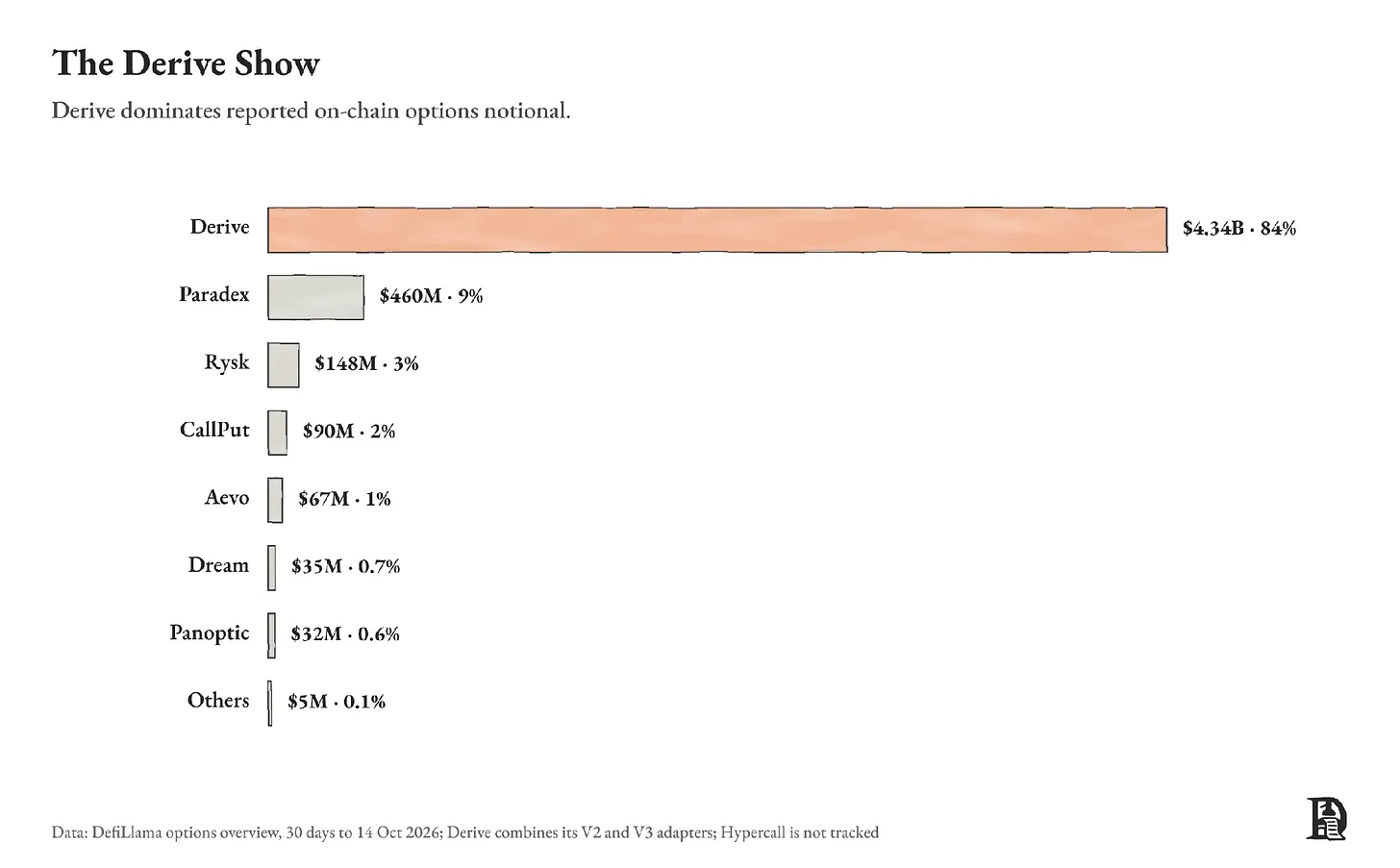 A platform that only sells cheap, deep out-of-the-money contracts can rack up high face value on very little capital turnover. Premium — the cash a buyer actually pays for an option — is the more reliable gauge. By premium, Derive's share is even higher, over 90%.
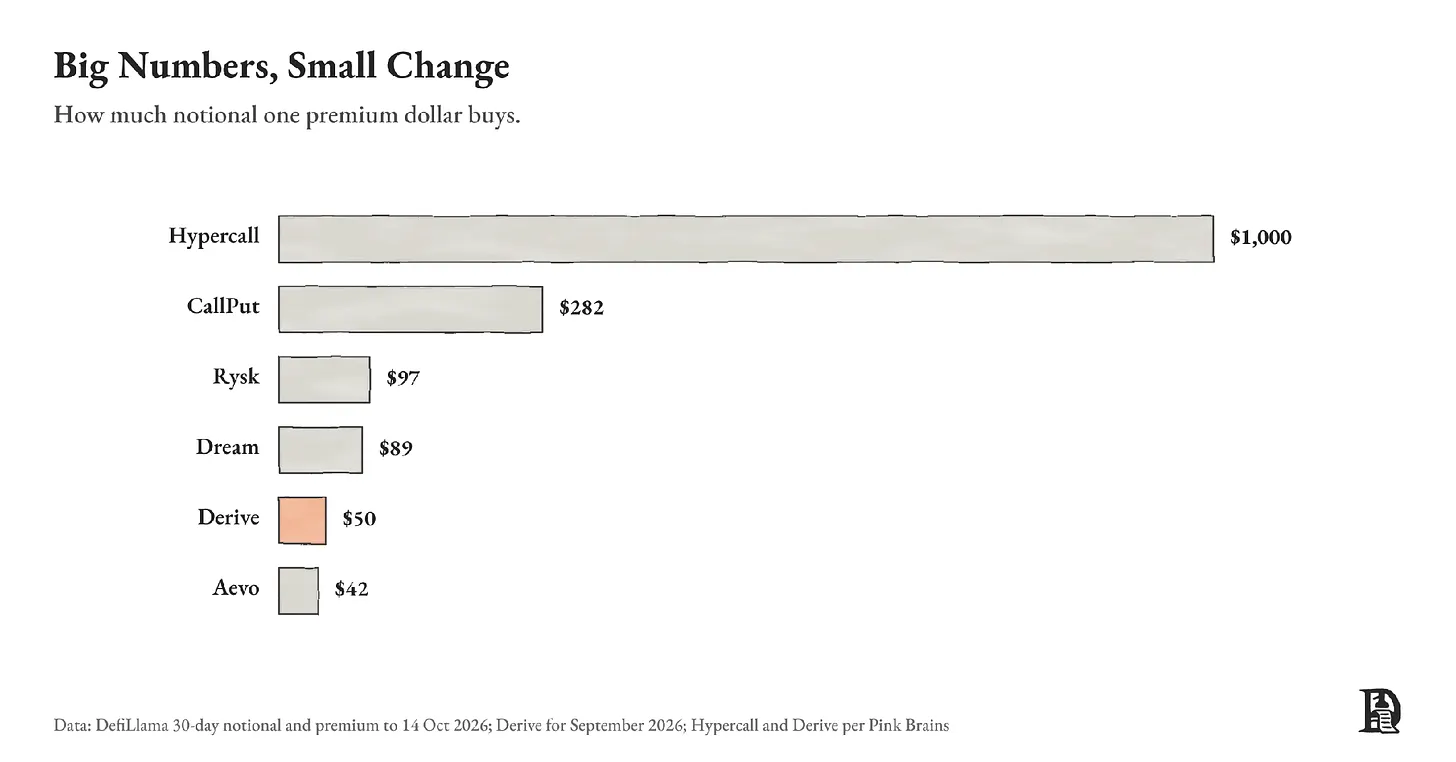 Most of Hypercall's notional comes from cheap, deep out-of-the-money options on the S&P 500, bought as lottery tickets. Pink Brains found that $1 of premium on Hypercall buys about $1,000 of face value, versus about $50 on Derive. Three reasons could explain the gap.
First, volatility. The S&P 500 moves about 16% a year versus 43% for BTC, so its options are much cheaper.
Second, the contract itself. Short-dated calls far from spot cost only a fraction of a percent of face value.
Third, rewards. When Hypercall distributed $1,000 of HYPE a day, notional rose 50x while premium barely moved, suggesting traders were buying the cheapest contracts to farm rewards. Derive is where traders pay for real options exposure.
Is Derive's book good enough? On the evening of October 19, we pulled every BTC and ETH option listed on Derive and Deribit, excluding deep out-of-the-money contracts and those expiring within three days. Deribit had both bids and asks on all 346 strikes included in the count. Derive had two-sided quotes on 206. Where Derive did quote, its asks were within 0.2% of Deribit's, with a bid-ask spread of about 3.8% of the option price versus 2.6% on Deribit.
In Trading Optionality, published in July 2025, we found Derive's spreads were often 2 to 5 times Deribit's. The gap has narrowed significantly since.
Outside BTC and ETH, it's a different story. Derive lists options on 12 assets, and we pulled every December 25 expiry strike from its public API.