


Why Did Tesla (TSLA) Stock Fall After Its Q3 2026 Earnings? Operating Profit Plunged 56%


- Key Takeaways: Tesla's Q3 2026 revenue was $28.046 billion, essentially flat year-over-year, and non-GAAP EPS beat expectations at $0.48, but surging R&D spending caused operating profit to plunge 56% to $718 million. After the earnings call, the stock and the TSLAUSDT contract turned from gains to losses.
- Key Elements:
- Revenue structure diverged: automotive revenue fell 3% to $20.560 billion, energy revenue fell 16% to $2.881 billion, and services and other revenue rose 33% to $4.605 billion, setting a gross profit record of $734 million.
- Main reasons for profit pressure: operating expenses rose 39%, with R&D spending climbing from $1.63 billion to $2.76 billion; regulatory credit revenue fell about 73% year-over-year to $113 million.
- Gross margin improved 160 basis points to 19.6%, free cash flow was $1.531 billion, and total cash and investments reached $45.447 billion; the 2026 capital expenditure guidance was lowered to approximately $20 billion.
- Business progress: FSD subscriptions reached 1.74 million, Cybercab began carrying passengers in Austin on September 3, and unsupervised Robotaxi mileage approached 2 million miles; Optimus has started production, but the target of 20,000 units per week will take at least another year.
- MEXC market data: TSLAUSDT rose 0.5% in the first hour and then fell about 3.0% cumulatively over the next five hours to 375.25 USDT. First-hour trading volume was about 5.64 million USDT, six times the same period the previous day, while the funding rate remained at 0%.
According to Tesla's (Nasdaq: TSLA) Q3 2026 earnings update filed with the U.S. Securities and Exchange Commission (SEC), the company's third-quarter revenue reached $28.046 billion, essentially flat year-over-year.
Tesla's third-quarter non-GAAP earnings per share (EPS) came in at $0.48, above analysts' expectations of roughly $0.45, but operating income plunged 56% year-over-year to $718 million as R&D spending increased.
In early after-hours trading on October 21, Tesla's stock initially rose, but reversed course and fell as the earnings call began.
On the MEXC platform, the TSLAUSDT perpetual contract edged up in the first hour after the earnings release, but had fallen about 3.0% cumulatively five hours later.
Key Takeaways
- Revenue: Third-quarter revenue was $28.046 billion, down about 0.2% year-over-year; automotive revenue fell 3%, energy revenue fell 16%, while services and other revenue grew 33%.
- Profit: Operating income was $718 million, down 56% year-over-year; operating margin was 2.6%, GAAP EPS was $0.22, and non-GAAP EPS was $0.48.
- Margins: Overall gross margin improved 160 basis points to 19.6%, but regulatory credit revenue fell from $417 million to $113 million.
- Cash: Free cash flow was $1.531 billion, and total cash and investments reached $45.447 billion.
- Autonomous Driving and Robotics: Active FSD subscriptions reached 1.74 million, Cybercab began carrying passengers in Austin on September 3, and Optimus has also started production on a high-volume line in Fremont.
- MEXC Market Reaction: TSLAUSDT fell from 386.90 USDT to 375.25 USDT within five hours; trading volume in the first hour after the earnings release was about six times that of the same period the previous day, while the funding rate remained at 0%.
Revenue Roughly Flat, but Profit Slumps
Tesla's third-quarter automotive revenue fell 3% year-over-year to $20.560 billion. Deliveries during the period fell 2% to 486,532 vehicles, while production rose 4% to 464,391 vehicles.
Energy generation and storage revenue fell 16% to $2.881 billion, with energy storage deployments of 13.7 GWh, though the segment's gross margin improved to about 33%.
Services and other revenue grew 33% to $4.605 billion, with gross profit reaching a record $734 million.
Profit pressure came mainly from operating expenses below the gross profit line. Third-quarter operating expenses rose 39%, driven primarily by R&D spending, which climbed from $1.63 billion a year earlier to $2.76 billion.
In addition, regulatory credit revenue fell about 73% year-over-year, further weighing on the company's profitability.
GAAP net income attributable to common stockholders was $787 million, including a $142 million pre-tax unrealized loss on Tesla's equity investment in SpaceX and a $288 million pre-tax unrealized gain from digital assets.
Cash Flow and Capital Expenditure
Tesla's third-quarter operating cash flow was $6.263 billion, capital expenditure was $4.732 billion, and free cash flow reached $1.531 billion.
Cash, cash equivalents and investments increased by $1.9 billion during the quarter, bringing the total to $45.447 billion.
On the earnings call, CFO Vaibhav Taneja said Tesla now expects 2026 capital expenditure of about $20 billion, below its previous guidance of more than $25 billion.
He said the company plans to fund the related spending primarily through operating cash flow.
Robotaxi, Optimus and Future Development
Cybercab began carrying passengers in Austin on September 3. Tesla said cumulative miles driven by its unsupervised Robotaxi fleet grew eightfold quarter-over-quarter, approaching 2 million miles.
Optimus has started production on a high-volume line in Fremont, and a dedicated Optimus production facility in Texas is under construction.
CEO Elon Musk said on the earnings call that it will take at least another year, and possibly longer, for Optimus to reach a production rate of 20,000 units per week.
Tesla Semi has begun scaled production in Nevada, and the company also plans to boost AI training compute to 400 MW by the end of the year.
Tesla said it is currently focused on raising factory capacity utilization, but battery supply remains one of the factors limiting vehicle production.
How Did TSLA Contracts on MEXC React?
Data snapshot: MEXC TESLA_USDT hourly candlesticks, index price candlesticks and funding rate history, retrieved at 02:00 UTC on October 22, 2026. Data queried later may have changed.
Chart: MEXC TSLAUSDT hourly closing prices (top) and hourly trading volume (bottom) from 4:00 AM to 9:00 PM ET on October 21, 2026.
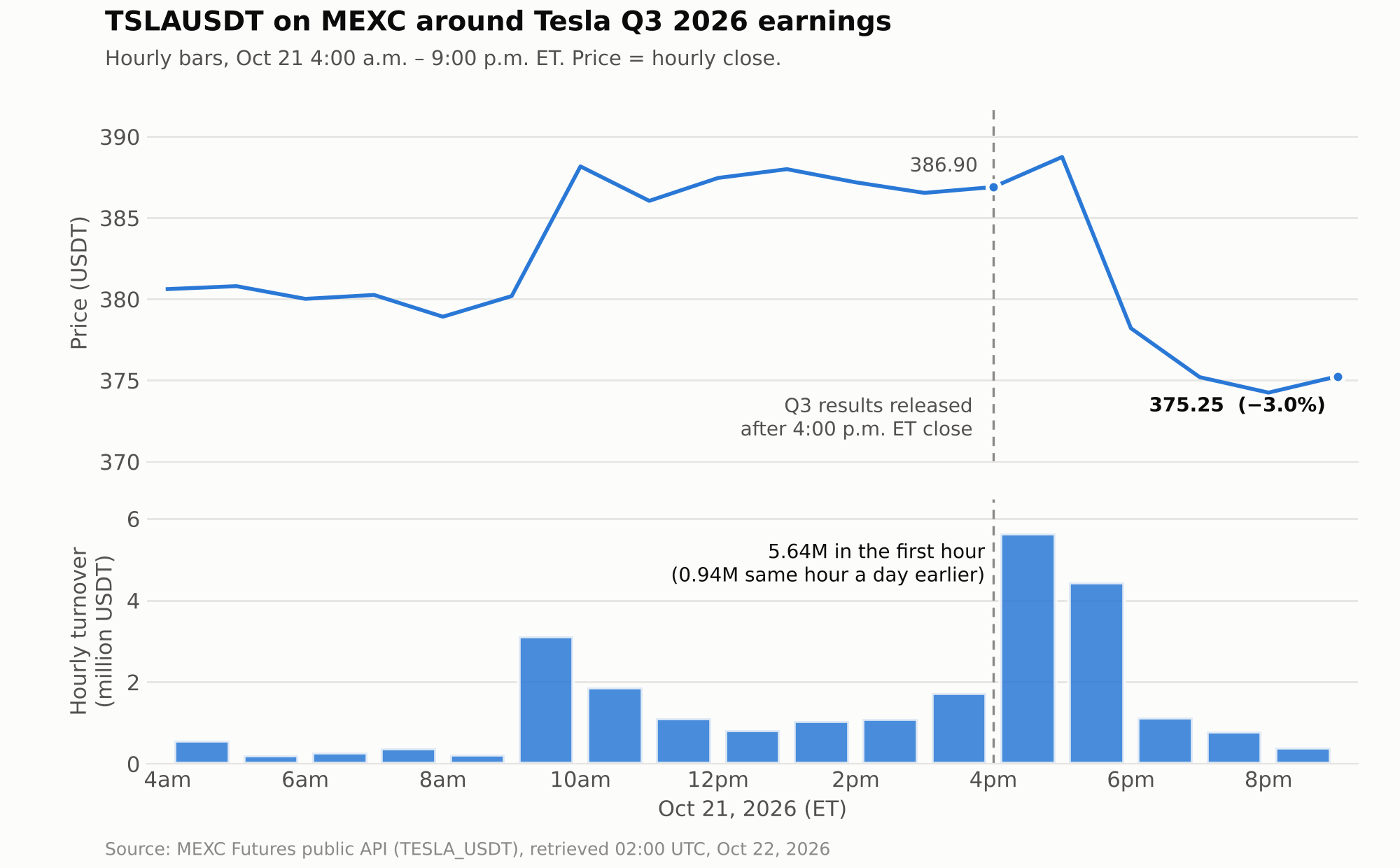
The analysis period begins with the hourly candle that opened at 4:00 PM ET (20:00 UTC) on October 21, which was also the window for the earnings release.
Price action: TSLAUSDT rose from 386.90 USDT at the U.S. market close to 388.75 USDT an hour later, a gain of about 0.5%. The contract price then turned lower, falling to 375.25 USDT by 9:00 PM ET, a cumulative decline of about 3.0%.
Most of the decline occurred in the second hour after the close, roughly around the start of the earnings call. The contract's index price also fell about 3.0% over the same period.
Trading activity: Trading volume in the first hour after the close was about 5.64 million USDT, up from about 940,000 USDT in the same period the previous day and well above the prior 24-hour average of about 700,000 USDT per hour.
Within five hours of the earnings release, cumulative trading volume was about 12.4 million USDT, even exceeding the roughly 10.83 million USDT traded between 9:00 AM and 4:00 PM ET that day.
Premium to index price: Before the earnings release, the contract price was about 1 to 2 basis points above the index price; after the release, the premium widened to about 2 to 15 basis points.
In other words, during this decline, the contract price fell slightly less than its reference index price.
Funding rate: TSLAUSDT settles funding every eight hours. The funding rate was 0% at all settlement times over the past two days, including the first settlement after the earnings release at 00:00 UTC on October 22.
Frequently Asked Questions (FAQ)
Why did Tesla's stock fall after it reported Q3 2026 earnings?
Tesla's third-quarter revenue was essentially flat, but operating income fell 56% year-over-year to $718 million due to higher R&D spending and lower regulatory credit revenue. The initial after-hours gain also reversed after the earnings call began.
Did Tesla's Q3 2026 earnings beat market expectations?
On earnings per share, yes. Non-GAAP EPS was $0.48, above market expectations of about $0.45, but revenue of $28.046 billion was slightly below forecasts.
What is Tesla's 2026 capital expenditure guidance?
Tesla said on its third-quarter earnings call that it expects 2026 capital expenditure of about $20 billion, below its previous expectation of more than $25 billion.
How did TSLA contracts on MEXC perform after the earnings release?
After the U.S. market close on October 21, TSLAUSDT rose about 0.5% in the first hour but had fallen about 3.0% cumulatively five hours later, broadly in line with its index price, while the funding rate remained at 0%.
Does the TSLAUSDT price represent Tesla's actual stock performance on Nasdaq?
No. TSLAUSDT is a perpetual derivative contract that tracks an index price, and Tesla's actual stock performance on Nasdaq must be checked separately.





