Dow hits new high, Korean stocks V-shaped reversal: Has the AI rally turned?


- Core View: The AI rally has not faded; rather, capital is repricing assets: shifting from assets that "rely on external financing to tell a story" to assets whose "revenue and cash flow have already materialized"; the test is whether AI-related revenue growth can outpace capital expenditure growth.
- Key Elements:
- The Dow hit a record high, with 3M up 5.78%; its partnership with Amazon is driving volume ramp-up of data center optical connectivity products, with warrants tied to $6 billion in cumulative sales over seven years—AI orders have already penetrated the "old economy."
- SpaceX posted Q3 revenue of $14.575 billion, up 161% year-over-year, with AI business revenue of $7.56 billion, up about 830% year-over-year; capital expenditures rose 185%, with revenue growth outpacing spending growth, and the stock rose nearly 8% after hours.
- Korean AI cloud service provider Elice fell 32% on its first trading day and rebounded 16% in early trading the next day; KOSPI fell 3.73% in one day and then rose 3.79%, with foreign investors switching from net selling 533.3 billion won to net buying 447.1 billion won—the main cause of volatility was positioning and the exit of buybacks rather than fundamentals.
- WTI touched $101.37 intraday before closing at $98.18, down 0.37%; the 10-year U.S. Treasury yield fell to 5.11%, but the 2-year rose to 4.78%, and the market has not priced in "the end of rate hikes."
- Meta's Q2 free cash flow fell to $1.75 billion (from $9.02 billion a year earlier), with 2026 capital expenditure guidance of $130 billion to $145 billion; the market is focused on whether its capital expenditures and cash flow can match.
From the close on October 20 to the morning of the 21st, global markets did not cast a unified directional vote. The Dow hit an all-time high, while the Nasdaq barely moved. South Korean stocks fell 3.73% the previous day, then rebounded 3.79% in the next morning session. Oil prices surged above $101, briefly fell back to $95, and closed down just 0.37%.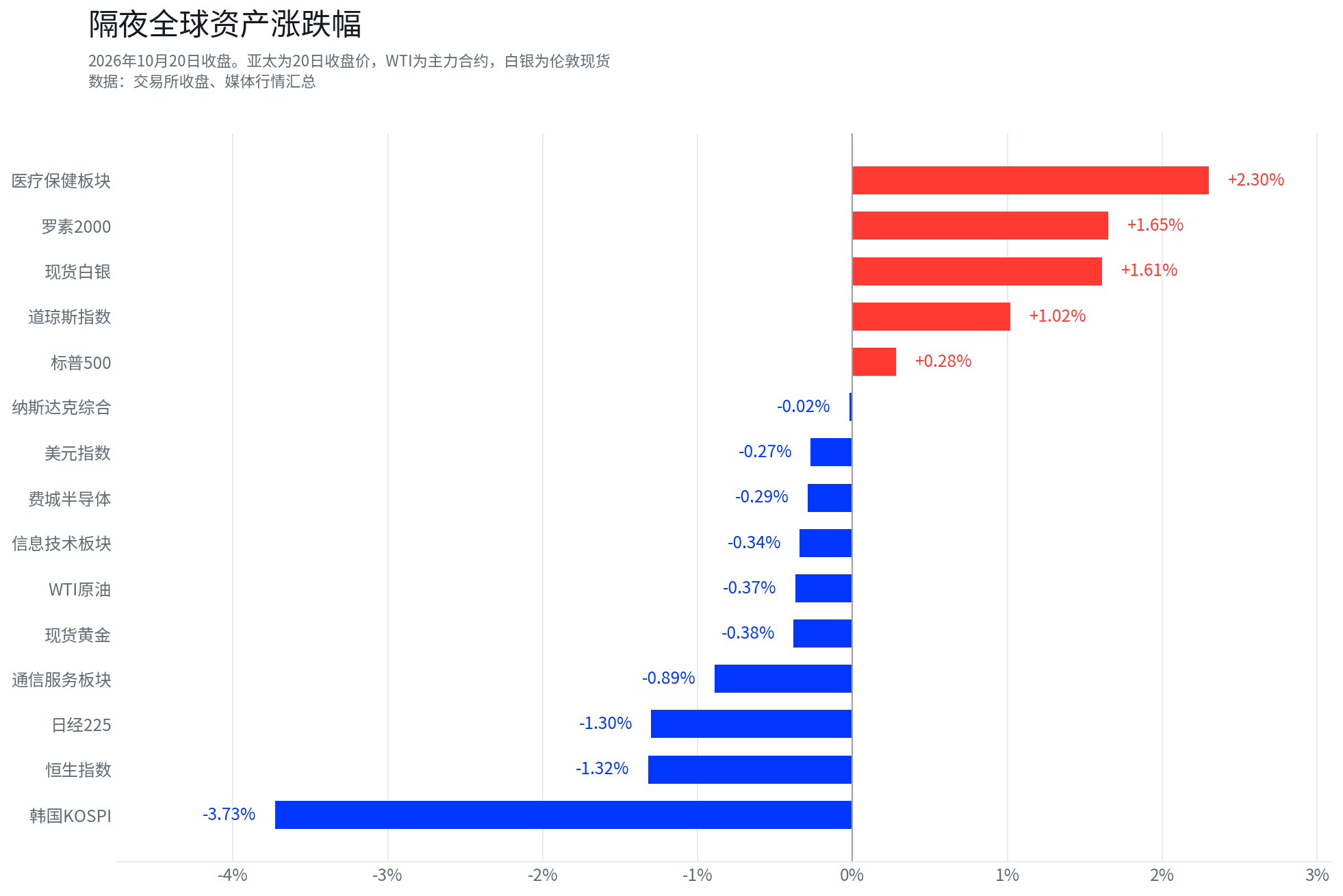
Put these prices together, and what emerges is not "AI has been sold off," but the same pool of money changing positions. What is being sold are assets that "need external financing to keep the story going"; what is being bought are assets whose "revenue and cash are already on the books." The two report cards from SpaceX and 3M happened to place this dividing line in the same evening.
1. Dow Hits Record High as Capital Shifts Toward Cash Flow Certainty
3M rose 5.78% that day, one of the main drivers of the Dow. The earnings report itself was not extravagant: third-quarter sales of $6.6 billion, up 1% year over year; adjusted earnings per share of $2.50, up 12% year over year; and full-year adjusted EPS guidance raised to $9.10 to $9.15.
What really made the stock jump was another item in the same announcement: 3M expanded its partnership with Amazon to drive volume growth in data center products such as optical connectivity, and issued warrants for up to 3.2 million common shares to Amazon, with exercise conditions tied to cumulative sales of $6 billion in related products over the next seven years.
This announcement shows that AI orders have already seeped into "old economy" companies. The difference lies in the payment method. 3M uses operating cash flow to build capacity and win orders, with Amazon as its customer. The price the market gives it corresponds to "orders signed, cash received."
The same evening, Eli Lilly rose 3.49% to a record high, Amgen rose 3.29%, the healthcare sector rose about 2.3% to a record high, and the Russell 2000 rose 1.65%. On the other side, communication services fell 0.89%, information technology fell 0.34%, Meta fell 1.59%, and Apple fell 1.00%.
The Dow's new high looks more like a classification than an "old economy revival." One category of orders is anchored to cash flow that has already been generated; the other is anchored to construction plans that still require continued financing. Capital bids up the former and leaves the latter in place.
2. SpaceX Delivers High-Growth Results, Korean Stock Elice Plunges, AI Rally Begins to Diverge
After the bell, SpaceX released its second earnings report since going public@. Third-quarter revenue was $14.575 billion, up 161% year over year, above market expectations of $12.8 billion. AI business revenue was $7.56 billion, up about 830% year over year, surpassing for the first time the combined revenue of Starlink and launch services. Net profit was $4.404 billion, compared with a net loss of $1.054 billion in the same period last year.
Capex was also surging, at $19.593 billion, up 185% year over year, mainly directed toward AI computing power. The market reacted positively, with the stock rising nearly 8% after hours to around $159.
The reason is not complicated. AI revenue growth was 830%, capex growth was 185%, and revenue is running ahead of spending. This is the structure the market is currently willing to pay a premium for.
The same night, South Korean AI cloud service provider Elice closed down 32% on its first day of trading in Seoul, then rose 16% in the morning session on the 21st. On the US stock side, Micron fell 0.98%, ASML fell 0.99%, Applied Materials fell 1.97%, KLA fell 2.80%, and Arm fell 3.07%.
AI has not been abandoned as a whole; what is being repriced is the tier where "spending has already occurred, but revenue has not yet been proven." This distinction can be tested with two growth rates: whether AI-related revenue growth is higher than capex growth. If Meta's capex continues to be revised upward tonight while revenue growth falls below 30%, this dividing line will move from marginal assets like Elice to hyperscalers.
3. Korean Stocks Plunge One Day and Rebound the Next as Foreign Investors Step Back In
On the 20th, the KOSPI closed down 3.73% at 5,552.74 points, having fallen as much as 4.76% intraday from the previous close to 5,493.24 points, the lowest close since April 7. That day, individuals net bought 898.2 billion won, foreigners net sold 533.3 billion, and institutions net sold 1.0048 trillion.
In the morning session on the 21st, the index reversed course. At 9:32 Korean time, the KOSPI rose 3.79% to 5,763.03 points, Samsung Electronics rose 6.15% to 224,500 won, and SK Hynix rose 7.44% to 1.314 million won. Foreigners net bought 447.1 billion won, institutions net bought 137.7 billion, and individuals net sold 676.3 billion.
Buyers and sellers swapped places overnight. On the 20th, retail investors were the ones taking the other side; on the 21st, it was foreigners and institutions.
There is another layer of detail: foreigners were net sellers overall on the 20th, yet net bought Samsung Electronics for a third consecutive trading day, with net purchases of 198.9 billion, 270.8 billion, and 383.5 billion won over the three days, while continuing to sell Hynix. According to South Korean media reports, JPMorgan believes Korean stock valuations are no longer high, but slowing share buybacks by listed companies are an important reason for the recent decline; Samsung's buyback has been completed, and Hynix's is nearing its end.
Looking at these two days together, the dominant variable looks more like positioning than the fundamentals of Korean AI. Since late August, the main buying support for the index has been buybacks; after buybacks exited, any slight disturbance was easily amplified. If foreign investors turn back to net selling after Meta's earnings tonight, the rebound in the morning of the 21st is more likely a short squeeze than a change in trend.
4. Oil Prices Return to the $100 Mark, Inflation Risk Remains
WTI front-month contracts hit an intraday high of $101.37 on the 20th, the highest in more than a month. Subsequently, reports said US-Iran negotiations could achieve a breakthrough as early as this week, and oil prices briefly fell to $95.2, a drop of more than 6%. After the reports were denied, prices returned to around $98 and closed at $98.18, down 0.37%. Brent closed at $109.16, down 0.36%.
The 10-year US Treasury yield fell 3 basis points to 5.11%, while the 2-year rose 1 basis point to 4.78%, and the dollar index fell 0.27% to 101.70. Spot gold fell 0.38% to $4,124.48, while spot silver rose 1.61% to $57.98. September housing starts released that day fell 5.2% month over month, the lowest since May.
Falling long-end yields do not equal cooling inflation. The two clues that day were the pullback in oil prices and safe-haven buying driven by fiscal concerns in France. The 2-year is still moving higher, indicating the market has not priced in "the end of rate hikes."
Gold falling and silver rising also shows that safe-haven demand has not risen across the board. Silver has a heavier industrial component, used in both solar power and data centers. Gold has a heavier monetary component and reacts more strongly to changes in real interest rates.
One testable reading is that the marginal pricing power for inflation now lies in the Strait of Hormuz, not in the Fed's meeting room. If WTI reclaims $100 and stays there for several trading days, the divergence of "the Dow rising while the Nasdaq does not" could reverse.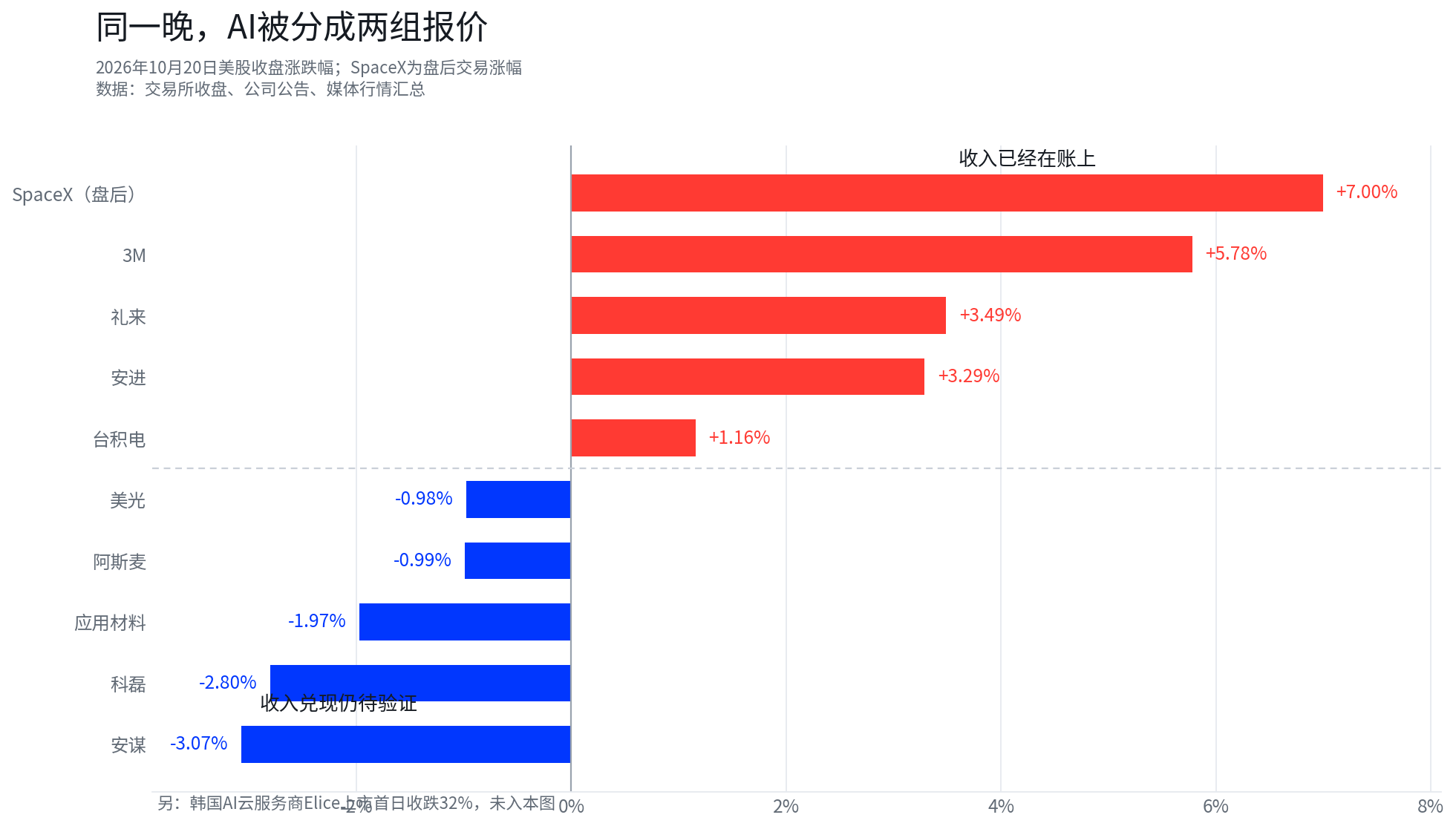
5. Meta and Tesla Earnings Ahead: Can AI Spending Translate Into Cash Flow?
Both Meta and Tesla will report third-quarter results after the US market close on the 21st.
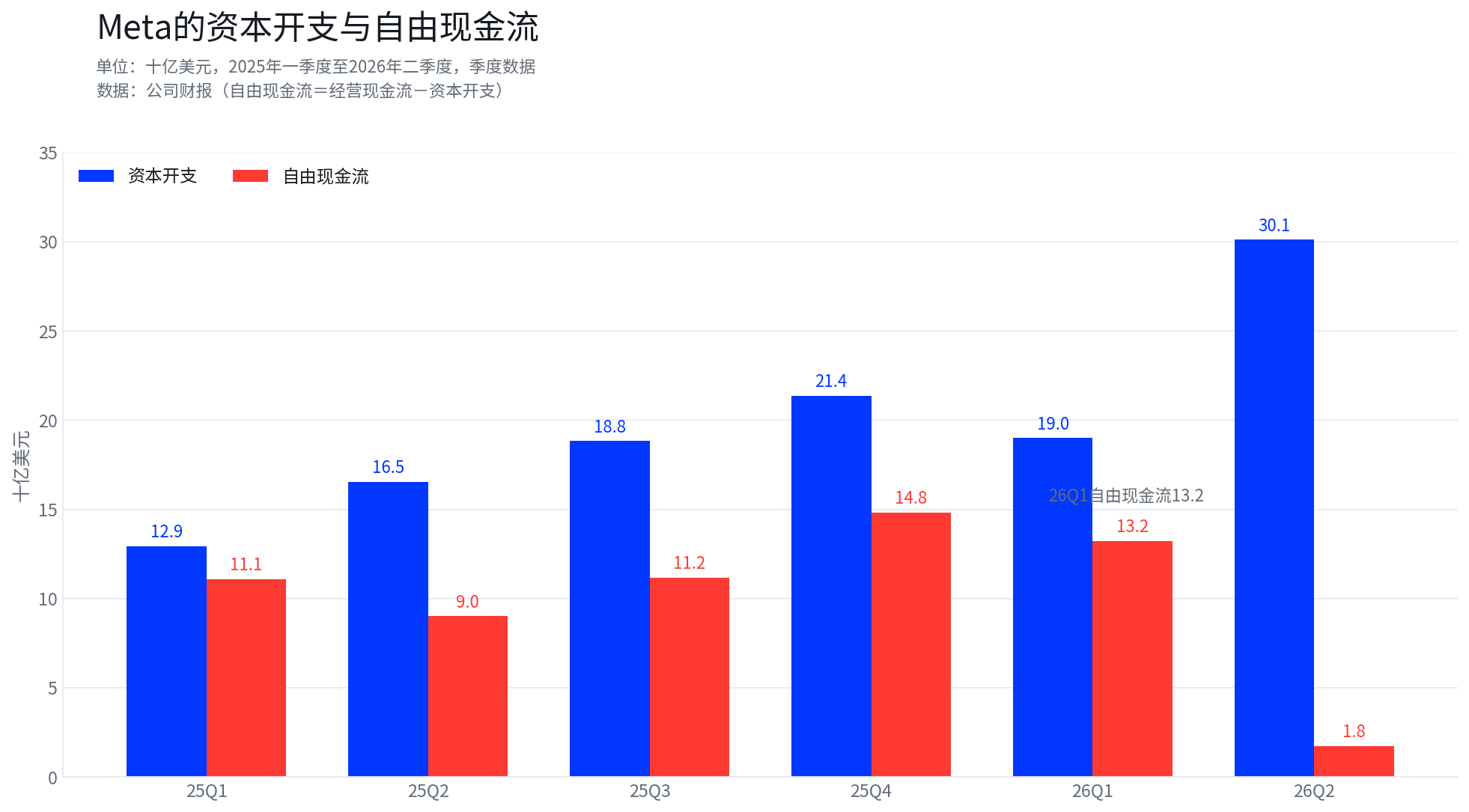
Meta's second-quarter revenue was $60.801 billion, up 28% year over year, capex was $30.12 billion, and free cash flow was $1.75 billion, compared with $9.02 billion in the same period last year. The company had previously guided 2026 capex to $130 billion to $145 billion. The market expects third-quarter revenue of about $63.2 billion, up about 23% year over year, and earnings per share of about $6.54, down about 10% year over year.
The most striking item is free cash flow. Second-quarter capex was already approaching operating cash flow for the quarter, leaving free cash flow at just $1.75 billion. If third-quarter capex steps up again, this number will be even thinner.
Tesla delivered 486,500 vehicles in the third quarter, down 2% year over year, and the market expects revenue of about $27.8 billion and earnings per share of about $0.43. The key point is not deliveries, but automotive gross margin and Robotaxi operating data.
Both companies are answering the same question: can revenue growth catch up with capex growth? SpaceX's answer last night was "yes," and the market responded. Meta needs to give its own version. If Meta raises capex while free cash flow continues to decline, that dividing line will move from marginal assets to the giants. If capex is not revised higher and advertising revenue holds steady, the divergence may narrow.
6. The AI Rally Has Not Receded; the Market Is Repricing
From last night to this morning, money has not left AI; it has simply changed the way it is priced: first look at the speed of revenue realization, then at the scale of capex.
The overnight reversal in Korean stocks shows that short-term volatility comes more from positioning and oil prices than from a final judgment on AI demand.
Whether this divergence can continue depends on two sets of numbers after tonight: Meta's capex and free cash flow, and whether oil prices can stay below $100.
Risk warning: This article is compiled based on public information, and the data involved are subject to company announcements and public reports. It does not constitute any investment advice.
Data Notes
- US stock indices, sectors, and individual stocks: exchange closes and media market summaries, 2026/10/20.
- Asia-Pacific stock markets and Korean capital flows: Korea Exchange and South Korean media reports, from the close on 2026/10/20 to 10/21 09:32 (intraday).
- SpaceX, 3M: company announcements, 2026/10/20.
- Commodities, the dollar, and US Treasuries: media market summaries, close on 2026/10/20, WTI front-month contracts.
- Meta, Tesla: company earnings and institutional consensus expectations, 2026/10/20.
Disclaimer:
This content is for general information and market commentary purposes only and is compiled based on public materials as of the time stated in the article. Relevant market data, expectations, and probabilities may change with market conditions. The views and investment strategies of third-party institutions, analysts, or other persons cited in this article represent only the views of the relevant third parties at a particular time and do not represent the views or recommendations of BIT. This article does not constitute investment advice, investment research, an offer, solicitation, or recommendation of any securities, investment products, or trading strategies, and should not be relied upon as the basis for any investment decision. Financial markets involve risk, securities prices and market performance may fluctuate, and historical performance and past market trends do not represent or guarantee future results. Investors should independently assess relevant risks based on their own circumstances and seek professional advice when needed. BIT's Hong Kong stock trading services are not provided to Hong Kong residents or users in other restricted jurisdictions.