


Tiger Research: South Korea's RWA and Stablecoin Market Forecast — How Big Will It Be by 2030?


- Core Viewpoint: South Korea's crypto market must move away from its sole reliance on retail trading fees and shift toward RWA tokenization and compliant stablecoins. It is projected to form an incremental market of 360 trillion Korean won by 2030, with traditional financial giants accelerating their positioning.
- Key Elements:
- South Korea's crypto accounts have reached 11.18 million (20% of the population), but by 2030 they are expected to grow to only 13.2 million households, with CAGR dropping to 3.3%, indicating that the trading-driven model has peaked.
- Based on global market × South Korea's GDP share of 1.58%, South Korea's tokenized assets are projected to reach 315 trillion Korean won and stablecoins 45 trillion Korean won by 2030, totaling 360 trillion Korean won (approximately $253 billion).
- In January 2026, amendments to the Electronic Securities Act and the Capital Markets Act achieved a breakthrough and are expected to be implemented in 2027, providing a legal foundation for STO.
- Shinhan, KB, Hana, Mirae Asset and other securities firms have already built technical sandboxes and completed internal testing, with cumulative investments of 2.35 trillion Korean won (approximately $1.7 billion) in strategic equity stakes in infrastructure.
- Asset targets are shifting from peripheral assets such as art to mainstream financial assets including government bonds, corporate bonds, and real estate trusts, as well as heavy assets such as shipping and infrastructure.
- Shinhan has partnered with Solana and Visa, KB with Securitize and Sui, Hana with Aptos and Fireblocks, and Mirae Asset with Polygon and Avalanche.
Key Takeaways
According to the latest in-depth research from Tiger Research, the current core development trajectory of South Korea's crypto market can be distilled into three major pillars:
• Moving beyond reliance on single-source trading: South Korea's crypto market must thoroughly break free from its one-dimensional dependence on trading fee revenue, and comprehensively reshape its underlying value structure around real-world asset tokenization (RWA) and compliant stablecoins. This transformation is regarded as the key engine determining South Korea's next stage of economic momentum.
• Targeting KRW 360 trillion by 2030: Based on projections from authoritative global institutions and scaled proportionally to South Korea's objective share of the global economy, by 2030, South Korea's domestic tokenized asset market is expected to reach KRW 315 trillion, with the stablecoin market reaching KRW 45 trillion. Together, the two will constitute a massive incremental market of up to KRW 360 trillion (approximately $253 billion).
• Traditional conglomerates mobilize in full force: Racing ahead of the official implementation of the Tokenized Securities Act (STO Act) in 2027, established South Korean financial giants such as Shinhan Financial, KB Financial, Hana Financial, and Kyobo Securities are sparing no expense in rapidly building out underlying infrastructure. Through large-scale strategic equity stakes and global cross-border alliances, they aim to seize the high ground before the regulatory dividend erupts.
The Dead End of Pure Trading-Driven Growth
The growth pace of South Korea's crypto market has slowed markedly, and the root cause lies in the country's ecosystem being highly distorted in its reliance on retail trading volume and exchange commission revenue, while mainstream global crypto markets have long since entered a mature, deep-water phase anchored by real assets and dominated by massive institutional capital.
As of the first half of 2026, the number of real-name verified accounts available for crypto asset trading across South Korea has reached 11.18 million, meaning more than one-fifth (20%) of the nation's citizens already hold crypto accounts. However, this extensive expansion model relying on retail demographic dividends has run its course. Rigorous demographic and account projection models show that even under the most optimistic super-bull-market scenario, by 2030 the total number of crypto accounts across South Korea will only inch up to approximately 13.2 million, with its compound annual growth rate (CAGR) plummeting to a mere 3.3%.
The traditional exchange model that relies solely on skimming fees from secondary-market flipping has its ceiling looming large. This is forcing South Korea's financial sector to seek a new second growth curve—tokenizing the trillions of high-quality assets lying dormant in the traditional financial system and bringing them on-chain.
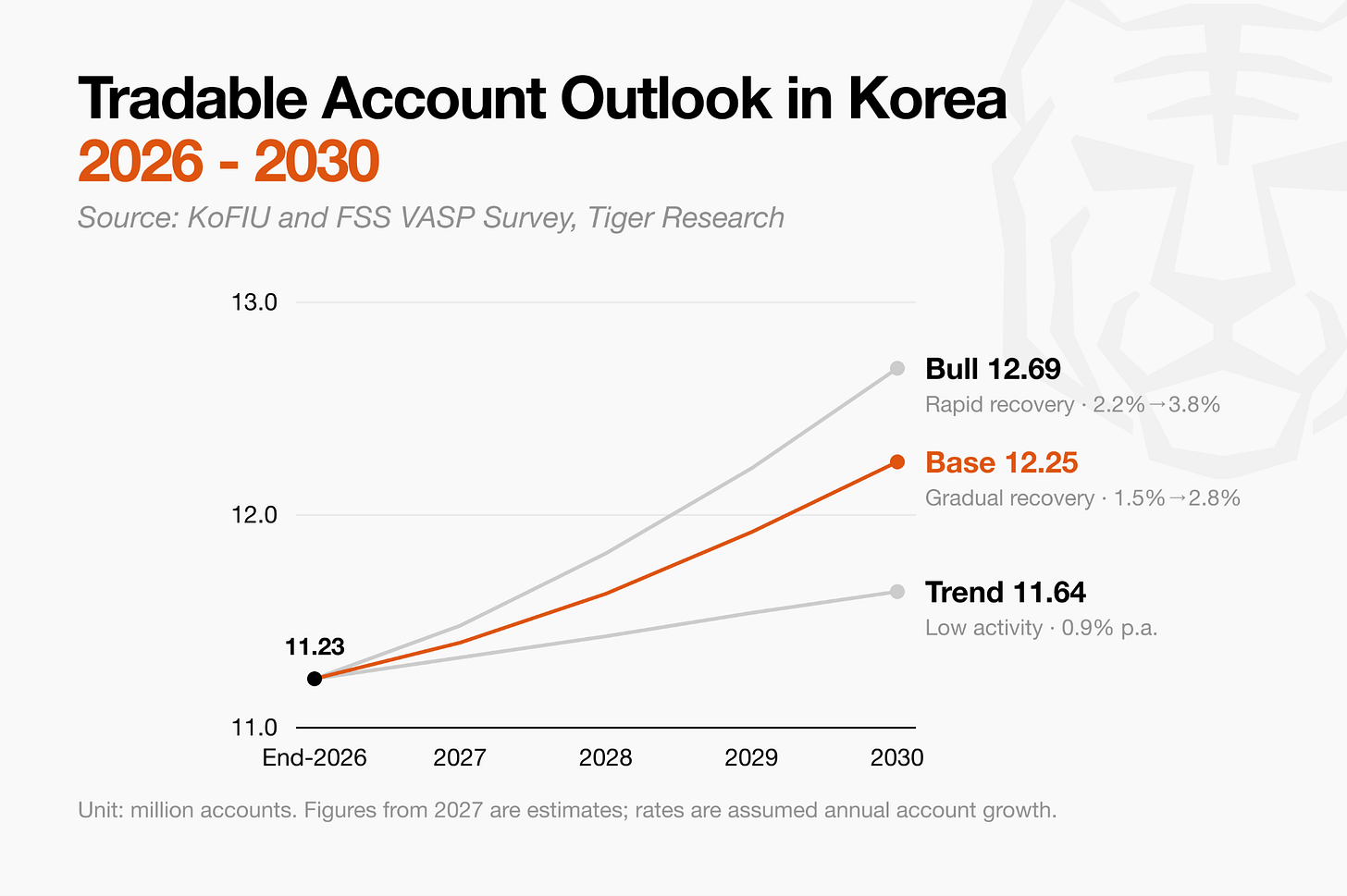
Figure 1: Scenario analysis of South Korea's crypto trading account growth from 2023 to 2030. Under the optimistic bull-market model, the number of accounts by 2030 will only inch up to approximately 13.2 million, and the growth model relying purely on retail trading turnover has already peaked.
Sizing the 2030 Market: A Grand KRW 360 Trillion Opportunity
As early as February 2023, the Hana Institute of Finance, in its special report "The Dawn of the Tokenized Securities Era," projected that South Korea's STO market would reach KRW 367 trillion by 2030. Tiger Research has now conduct a more rigorous recalculation of that model, incorporating the baseline scenario from Boston Consulting Group (BCG)'s latest "Global Asset Management Report" published in 2026 as well as the latest macroeconomic data.
The core authoritative parameters and underlying assumptions cited by the projection model are as follows:
• Global tokenized asset benchmark: According to BCG's latest 2026 estimates, by 2030, the total global tokenization of illiquid assets is expected to surge to approximately $16 trillion;
• Global stablecoin supply forecast: According to Standard Chartered's latest research report from October 2026, driven by cross-border clearing and the B2B payment wave, total global stablecoin supply is expected to surge from the current $230 billion to $2.0 trillion by 2030;
• South Korea's domestic share mapping formula: South Korea's domestic market capacity = projected global market total × South Korea's share of global nominal GDP (1.58%) × the current KRW/USD exchange rate (approximately KRW 1,422 per USD).
Precise model calculations yield the following: by 2030, South Korea's domestic tokenized asset market will reach KRW 315.0 trillion (approximately $221.5 billion), and the compliant stablecoin market will reach KRW 45.0 trillion (approximately $31.5 billion), for a combined total of a staggering KRW 360 trillion (approximately $253 billion). This enormous figure eloquently proves that as long as South Korea's market share in the tokenization wave can match its fundamental position in the global real economy, this land harbors immeasurable regulatory dividends.
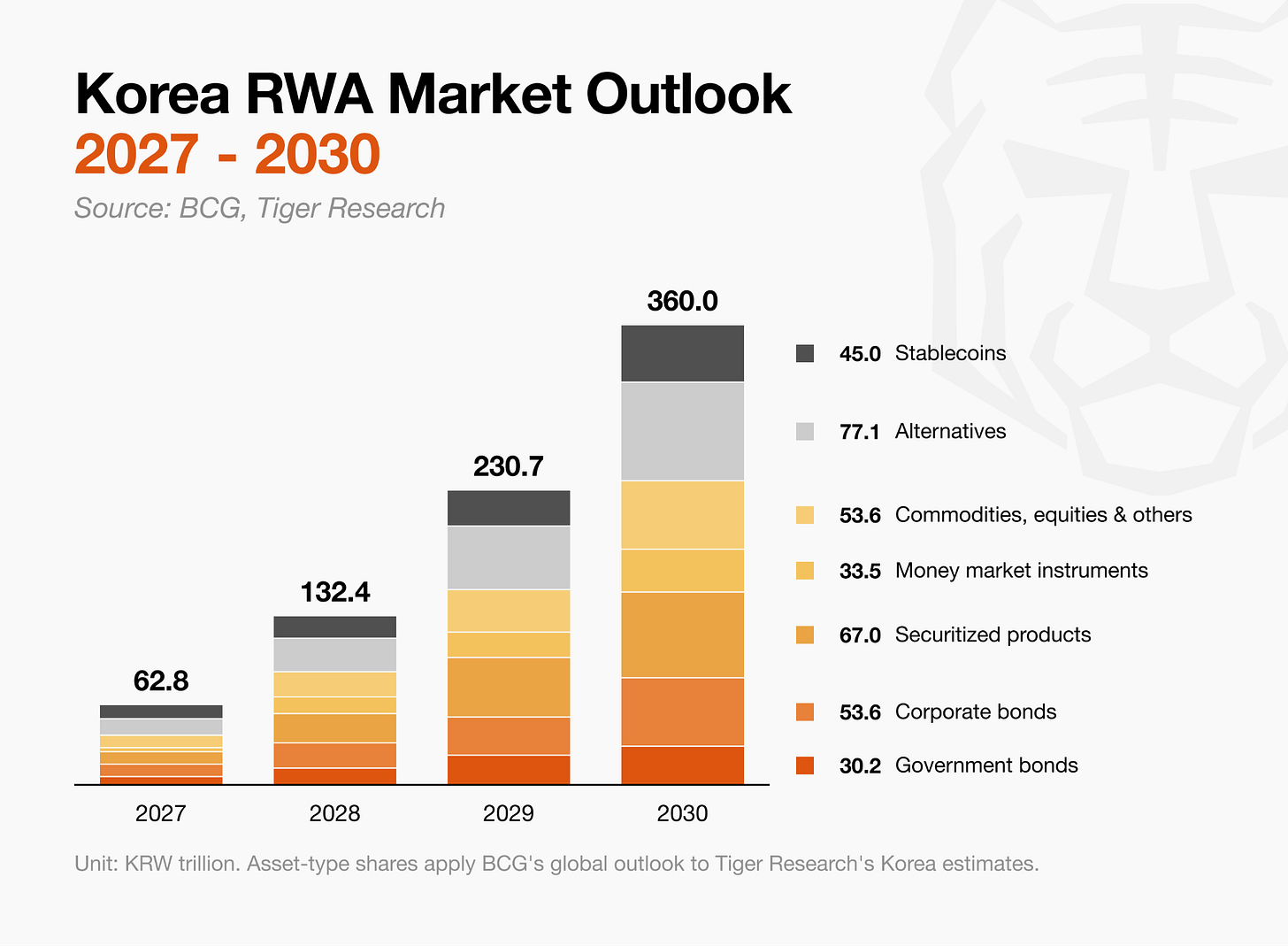
Figure 2: Estimated potential market size of South Korea's tokenized assets and stablecoins in 2030. Tokenized assets are projected to reach KRW 315 trillion, and stablecoins KRW 45 trillion, for a combined total of KRW 360 trillion (approximately $253 billion).
Full-Scale Preparations by South Korea's Traditional Financial Institutions: Technical Infrastructure and Strategic Positioning
As digital assets are accelerated into South Korea's formal national legal and regulatory framework, the financial system's transformation acuity is breathtaking. In January 2026, amendments to the Electronic Securities Act and the Capital Markets Act—covering the key legal status of tokenized securities—made major breakthroughs in the South Korean National Assembly and are expected to be fully implemented in 2027.
To meet this regulatory inflection point, South Korea's top traditional financial institutions are racing against the clock to roll out comprehensive strategic arrangements:
• Dedicated infrastructure buildout and pilots: Leading securities firms are devoting significant resources to building end-to-end tokenized securities issuance, distribution, and settlement systems. Industry leaders such as Shinhan Securities, KB Securities, Mirae Asset Securities, and Hana Securities have all established dedicated technical sandboxes and completed multiple rounds of internal testing;
• Massive strategic equity stakes in core tracks: South Korea's major financial conglomerates have injected a cumulative KRW 2.35 trillion (approximately $1.7 billion) in strategic venture capital into tokenization infrastructure providers, compliant custody platforms, and vertical issuance platforms, in order to secure controlling stakes in joint venture entities;
• Abandoning fragmented toys in favor of mainstream assets: Major financial institutions are decisively abandoning earlier small-scale, non-standardized experiments around marginal assets such as artwork and cattle farming, and are pivoting comprehensively toward mainstream financial-grade core underlying assets such as government bonds, corporate bonds, and commercial real estate mortgage trust certificates;
• Racing to secure standardization and high-net-worth physical collateral: Financial institutions are openly competing not only to bring standardized fixed-income securities on-chain, but also to reserve shipping and logistics trust certificates, revenue rights from large-scale infrastructure, and other multi-billion-dollar heavyweight assets as tokenization targets.
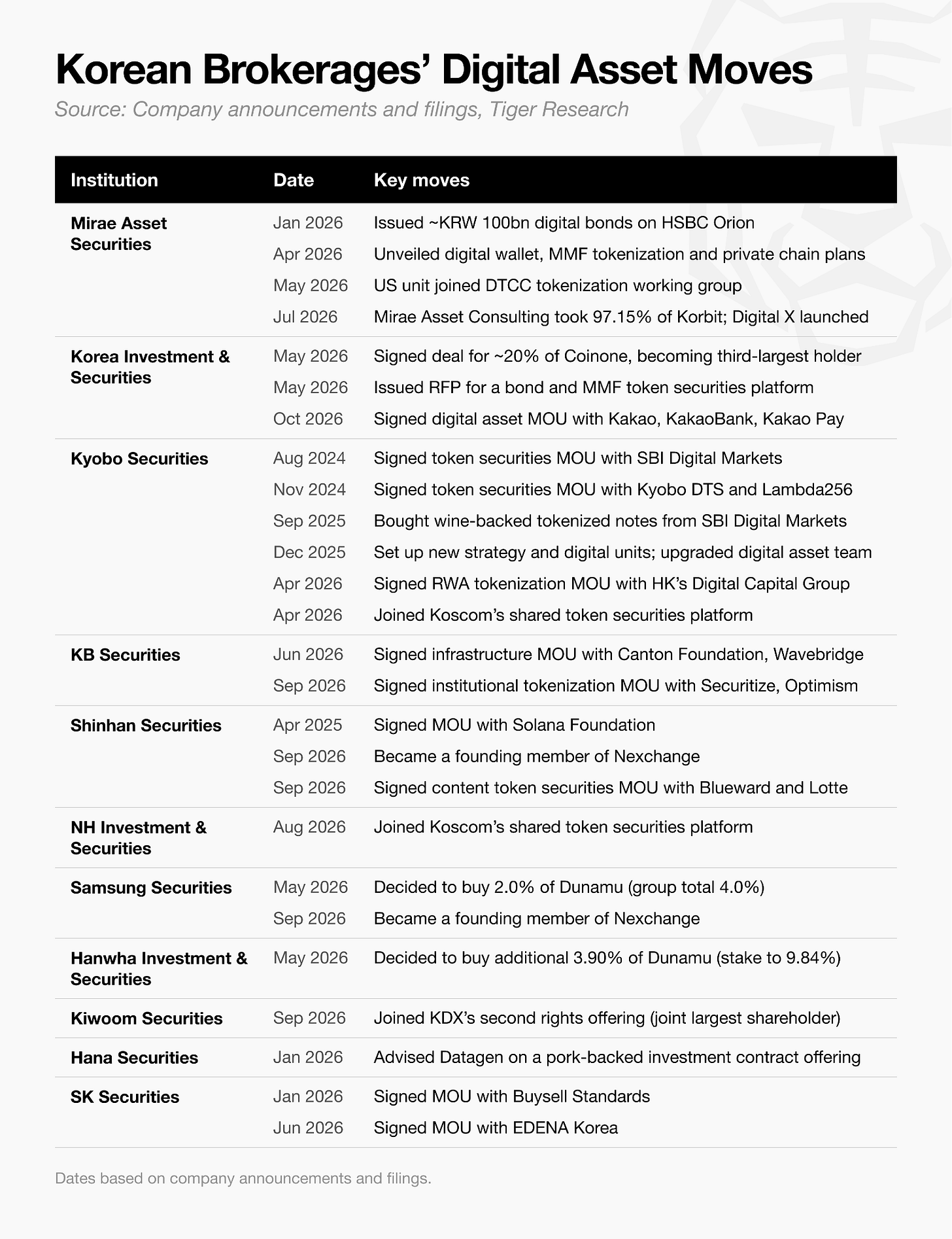
Figure 3: Panorama of investments and equity positions by major South Korean traditional financial institutions in tokenized securities infrastructure. Major securities firms have cumulatively invested approximately KRW 2.35 trillion (approximately $1.7 billion) in technical infrastructure and strategic shareholdings.
Cross-Border Alliances: Established Conglomerates Team Up with Solana and Visa to Go Global
South Korean financial institutions know full well that no single tree makes a forest, and are proactively forging deep alliances with leading global public chain foundations and technology giants to ensure their future systems possess robust cross-chain liquidity and international interoperability:
• Shinhan Financial Group has signed deep strategic partnerships with high-performance public chain Solana, payments giant Visa, and cross-border asset tokenization platform Etherfuse, committed to opening up channels between KRW tokens and global liquidity;
• KB Financial Group has partnered with Securitize, the world's largest tokenized asset issuance platform, and the privacy-focused consortium chain Canton Network, and has reached underlying technical collaboration with Mysten Labs, the core development team behind Sui;
• Hana Financial Group, leveraging Fireblocks' institutional-grade digital asset custody infrastructure, has formed deep partnerships with Move-language public chain Aptos and Crypto.com;
• Mirae Asset Securities and Korea Investment & Securities are likewise closely tied to mainstream ecosystems such as Polygon and Avalanche, actively promoting the seamless circulation of cross-border tokenized financial products.
These highly forward-looking cross-border strategic alliances will serve as the most core catalyst propelling South Korea's tokenization market toward its grand KRW 360 trillion goal by 2030. The vessel of South Korean crypto finance is resolutely bidding farewell to yesterday's shallows of retail speculation and steaming at full speed toward the trillion-dollar deep sea paved by institutional capital and digital real-world assets.
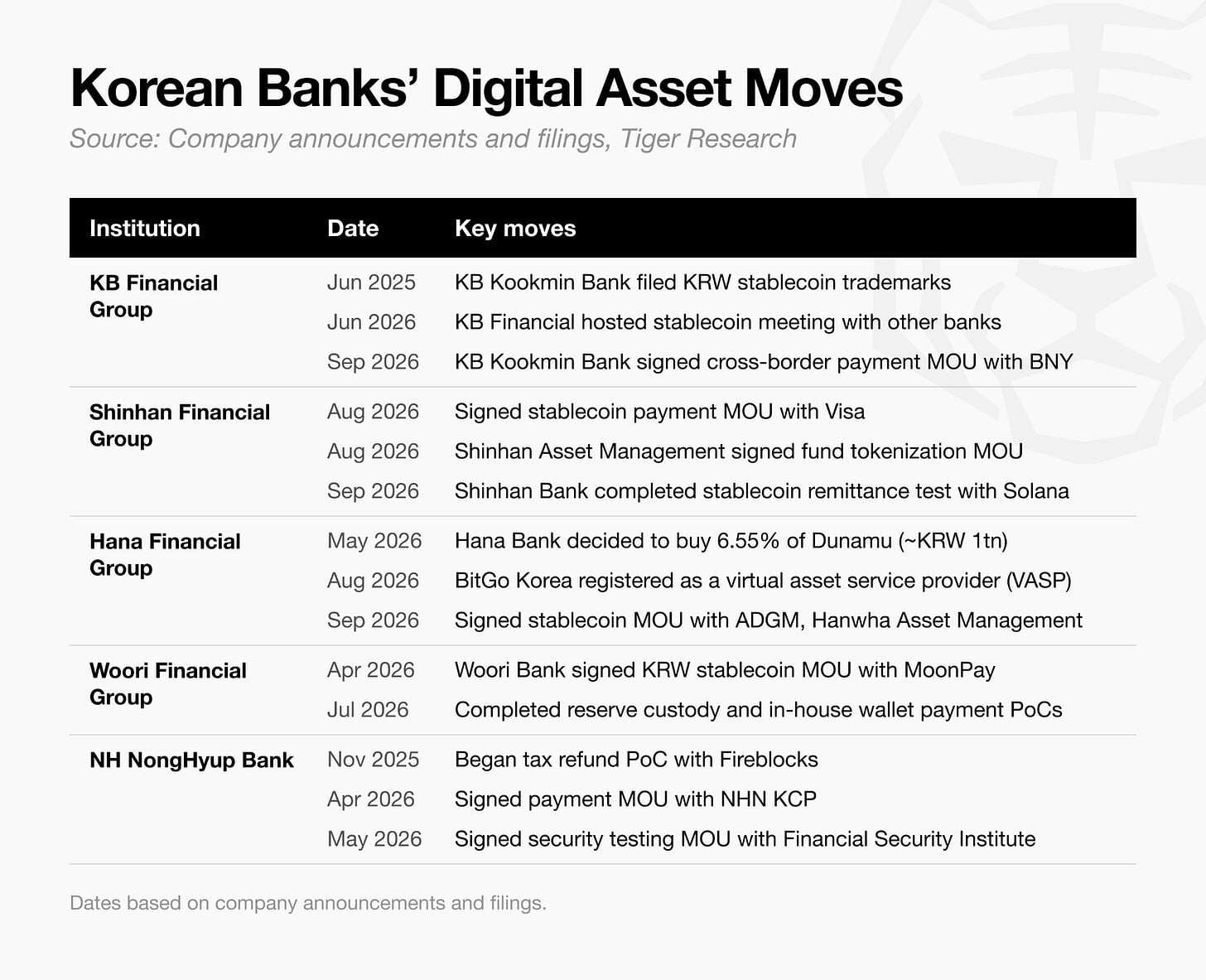
Figure 4: Strategic cooperation matrix between South Korea's top financial conglomerates and leading global Web3 institutions. Shinhan, KB, Hana, Mirae Asset, and others are fully connected to global liquidity networks such as Solana, Visa, and Securitize.





