Net profit expected to rise 65%, capex seen at $85 billion — three must-answer questions for TSMC's earnings call


- Core view: The key focus of TSMC's Q3 earnings report lies in capex guidance and the pace of CoWoS capacity expansion, rather than the profit data itself. The earnings report will test whether the market consensus that "AI infrastructure investment is still accelerating" holds, and whether the 2027 investment framework is provided ahead of schedule is the biggest suspense.
- Key elements:
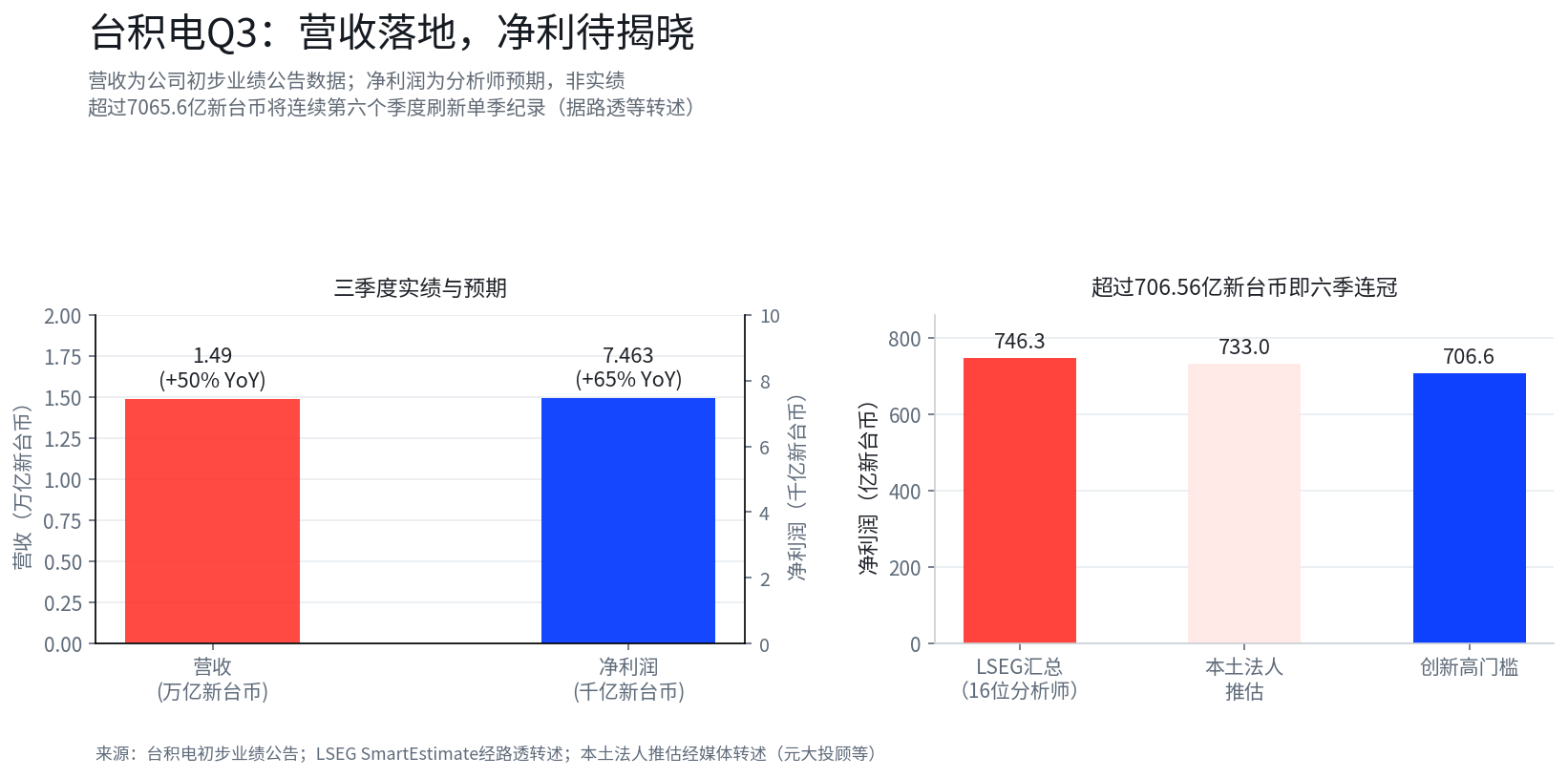
- Q3 revenue was NT$1.49 trillion, up about 50% year over year, exceeding the upper end of guidance; net profit is expected to rise about 65% year over year to NT$746.3 billion, potentially achieving 11 consecutive quarters of profit growth.
- 2026 capex has been raised to $60 billion to $64 billion. Goldman Sachs estimates it will reach $85 billion in 2027, while Citi estimates about $81 billion in 2027 and about $90 billion in 2028.
- CoWoS advanced packaging is the bottleneck for AI chip delivery. GlobalFoundries is expected to mass-produce silicon interposers in the first half of 2028, and Amkor's Arizona packaging plant is scheduled to begin production in early 2028.
- Arizona investment totals $265 billion. Reuters reported that the company is evaluating investment in Texas, and Musk's Terafab campus may involve TSMC leasing or a joint venture.
- Morgan Stanley expects the full-year revenue growth guidance may be raised from "slightly above 40%" to the mid-to-low 40% range; Bank of America raised its target price due to the 2nm capacity ramp-up.
- Broadcom's CEO warned that "capital is the biggest constraint on AI expansion," creating a directional divergence from TSMC's accelerating capex.
This Thursday, the world's main supplier of AI chip manufacturing will deliver its third-quarter report card. TSMC's capital expenditure directly affects the order expectations of equipment makers such as ASML and Applied Materials, and the pace of capacity expansion for advanced packaging such as CoWoS bears on the delivery capacity of AI chips for customers including Nvidia. For the entire AI infrastructure chain, this earnings report and conference call represent a concentrated progress check. On the market side, TSMC's U.S. shares closed Wednesday at $445.12, with a market capitalization of about $2.3 trillion (market data feed), roughly twice the market capitalization of Samsung Electronics (based on that day's close and exchange-rate conversion). Its Taiwan-listed shares fell 1.97% on Tuesday to NT$2,490. In the week before the earnings report, the Philadelphia Semiconductor Index had just suffered four consecutive declines, and Broadcom's CEO put the warning that "capital is the biggest constraint" back on the table, so this report card must be read with an extra layer this year. This article breaks the questions the earnings call needs to answer into three.

1. The market expects a sixth straight quarter of profit growth
Revenue has already landed first. The preliminary data the company released last week showed third-quarter revenue of NT$1.49 trillion, up about 50% year over year, exceeding the guidance range the company had previously given, with September revenue for the single month close to the all-time record set in August. Zero One founder Fernando's arithmetic is straightforward: the company had previously expected 2026 dollar revenue growth of "slightly above 40%," and if that wording is maintained, fourth-quarter growth would be only one-third of the third-quarter guidance level, below the business's actual operating level, so the possibility of further raising guidance does indeed exist (as relayed by Jin10 Data and Zhitong Finance).
Profit expectations are even more uniform. LSEG SmartEstimate, aggregating forecasts from 16 analysts, expects third-quarter net profit to rise about 65% year over year to NT$746.3 billion. If it exceeds NT$706.56 billion, it will once again set a single-quarter record and achieve 11 consecutive quarters of profit growth (as relayed by Reuters and others). Local institutional estimates are slightly below that figure: one report estimates third-quarter gross margin of 67.1%, operating margin of 58.1%, after-tax net profit of about NT$733 billion, and earnings per share of about NT$28.27. Yuanta Investment Consulting revised its third-quarter EPS upward to NT$29.03 and expects fourth-quarter revenue to grow 10% to 15% quarter over quarter, with EPS reaching NT$33.37, and 2026 and 2027 EPS reaching NT$111.72 and NT$157.29 respectively (as relayed by media). Morgan Stanley's Charlie Chan is directionally aligned, saying that driven by strong 3nm demand, the full-year revenue growth guidance may be raised from "slightly above 40%" to the mid-to-low 40% range. On the eve of the earnings report, Bank of America raised its TSMC target price on the grounds that the 2nm capacity ramp is lifting sales expectations and profit margins (as relayed by Futu; this view represents only the judgment of the institution concerned).
2. Capital expenditure, the real fork in the road this quarter
Revenue and EPS landing within the guidance range is merely "compliance"; the real fork in this earnings report is capital expenditure. In July, TSMC already raised its 2026 capital expenditure from $52 billion to $56 billion up to $60 billion to $64 billion, an increase of about 7% to 14%, mainly for advanced process and advanced packaging capacity. A Seeking Alpha review showed that second-quarter capital expenditure for the single quarter was about $15.59 billion, essentially in line with the annualized level of executing the full-year upper limit of $64 billion, with the allocation structure at about 70% for advanced processes, 10% to 20% for advanced packaging testing and photomasks, and 10% for specialty processes. The 2027 estimate is already being raised: Goldman Sachs lifted its 2027 and 2028 capital expenditure estimates to $85 billion, while Citi estimates about $81 billion for 2027 and about $90 billion for 2028 (as cited from research reports).
Why the capital expenditure guidance matters. Equipment makers' order expectations come from foundries' investment plans, and the pace of capacity expansion for advanced packaging such as CoWoS determines the delivery ceiling for AI chips. Last week the market just heard a voice from another direction, with Broadcom CEO Hock Tan saying capital is the biggest constraint on AI expansion. If TSMC maintains or raises its spending plans, it shows that supply-side investment is still accelerating. If the wording turns cautious, the impact of financing conditions on the pace of spending will enter the pricing of equipment makers and AI chips. There were also dissenting voices before the earnings report: a Seeking Alpha analysis downgraded TSMC to hold on the grounds that free cash flow is under pressure as capital expenditure accelerates, calculating that free cash flow for the first three quarters totaled about $37.8 billion, and that if the full year is executed at $64 billion, about $28.9 billion more would need to be spent in the last two quarters (this view represents only the article author's judgment).
The market is especially focused on the progress of CoWoS capacity expansion. As AI accelerators raise demands on computing performance and memory bandwidth, advanced packaging remains a bottleneck on the supply side. According to public reports, TSMC is expanding U.S. silicon interposer supply capacity through partner GlobalFoundries, which is expected to begin volume ramp-up in the first half of 2028. Amkor's advanced packaging plant in Arizona is scheduled to start production in early 2028. Industry estimates suggest TSMC's first advanced packaging plant in Arizona may begin operating as early as the first half of 2028.

3. After Arizona, is Texas the next stop?
Expansion layout is another focus of the earnings call. TSMC has already planned to invest $265 billion in building chip plants in Arizona, including the $100 billion newly announced in July. According to a Reuters report in September, the company is evaluating the possibility of investing in Texas. Musk said last week that his companies will build and operate an AI chip campus called Terafab, and TSMC may lease some of the facilities. Other reports say the two companies have discussed a joint venture to build a plant, which Musk confirmed on social media (an exclusive Culpium report and subsequent media citations); the form of participation is subject to the company's disclosures.
Two institutional judgments can be viewed side by side. Morgan Stanley believes that TSMC's customer demand is expected to continue growing over the next five years, that space at the Arizona site is limited, and that there is a relatively high necessity for laying out new production lines in Texas. Morningstar senior equity analyst Phelix Lee believes that some of TSMC's planned fabs in Arizona have not yet broken ground, so the urgency of entering Texas is not high, and that Texas, with its mature semiconductor industry cluster and talent pool, is more suitable as a long-term expansion plan for the 2030s to 2040s. This view represents only the judgment of the institution concerned.
4. Three variables to watch at the earnings call
First, whether capital expenditure will be further raised. Whether the $60 billion to $64 billion range given by the company in July is executed at the upper limit, and whether a new investment framework is given for 2027, directly determines the order visibility of equipment makers and materials suppliers.
Second, the specific timetable for CoWoS capacity expansion. The delivery bottleneck for AI chips lies in advanced packaging, and the pace of CoWoS expansion bears on the shipment rhythm of customers such as Nvidia, and also determines the growth slope of revenue in the advanced packaging segment.
Third, the full-year revenue growth guidance and the wording on 2027. Morgan Stanley expects the guidance to be raised to the mid-to-low 40% range. If management gives a more positive outlook, earnings expectations across the AI infrastructure chain will receive a concentrated confirmation. If the wording is conservative, the market needs to recheck the match between fourth-quarter growth and 2027 capital expenditure.
Taking the overall market picture and public information together, the market is focused on the delivery of profit records and relatively positive capital expenditure wording, and the real suspense is whether the 2027 framework will be given in advance. If the capital expenditure guidance lands at the lower end of the range and the CoWoS wording weakens, the reading that "AI infrastructure investment is still accelerating" will need to be revised.
Data notes
- Revenue and net profit: TSMC third-quarter preliminary results announcement, released in early October 2026. LSEG SmartEstimate (16 analysts) as relayed by Reuters and others.
- Capital expenditure: company guidance at the July earnings call ($60 billion to $64 billion, as reported by CNA and others). Goldman Sachs and Citi estimates are cited from research reports.
- Institutional estimates: reports from local institutions such as Yuanta Investment Consulting as relayed by media, October 11-13, 2026.
- U.S. expansion: the $265 billion in Arizona is company disclosure. Texas is from a September Reuters report. Terafab is cited from Musk's statement and an exclusive Culpium report.
- Market data: TSMC U.S. shares and Samsung Electronics market capitalization are market data feed figures as of the October 13, 2026 close, with exchange-rate conversion as described in the text.
Disclaimer:
This content is for general information and market commentary purposes only, based on public materials as of the time stated in the article, and the relevant market data, expectations, and probabilities may change with market conditions. The views and investment strategies of third-party institutions, analysts, or other persons cited in the article represent only the views of the relevant third parties at a specific time and do not represent or recommend the views of BIT. This article does not constitute investment advice, investment research, an offer, a solicitation, or a recommendation of any securities, investment products, or trading strategies, nor should it be relied upon as the basis for any investment decision. Financial markets involve risk, securities prices and market performance may fluctuate, and historical performance and past market trends do not represent or guarantee future results. Investors should independently assess the relevant risks based on their own circumstances and seek professional advice when necessary. BIT's Hong Kong stock trading services are not provided to residents of Hong Kong or users in other restricted jurisdictions.