$1.2 billion fine settled, stock trading looks at the second data point—Bank of America and Morgan Stanley take the baton tonight


- Core View: Bank of America and Morgan Stanley's earnings tonight will verify two key judgments—whether the rebound in provisions is an industry-wide trend, and whether strong equity trading revenue can continue. The answers will determine the direction of sector pricing as the big five banks' earnings week concludes.
- Key Elements:
- Bank of America was fined $1.2 billion by FinCEN (the third-largest in Treasury history), recorded as a non-tax-deductible expense in the third quarter, reducing earnings per share by approximately 17 cents.
- Bank of America maintained its net interest income guidance at the upper end of 6%-8%, while JPMorgan's net interest income reached $27.1 billion, up 13% year-over-year, with full-year guidance raised to $106.2 billion.
- Morgan Stanley's equity trading revenue is expected to be about $4.9 billion, ranking second among the big five banks, while Goldman Sachs reported actual revenue of $6.441 billion, up 72% year-over-year, serving as a key validating data point.
- JPMorgan's fixed income revenue fell 4% year-over-year (the first decline in more than two years), and the big five banks' combined third-quarter trading revenue is expected to be about $38 billion, a notable pullback from the record $47 billion in the second quarter.
- The three banks that have already reported showed year-over-year provision changes of -19%, +6%, and +51%, but the pace of net new provisions and charge-offs was moderate, reflecting proactive cushion-building rather than deteriorating bad loans.
- Analysts expect the big five banks' combined third-quarter profit to reach $44 billion, up nearly 9% year-over-year, but down about 20% from the second quarter, with the sequential cooling already anticipated.
After four banks reported last night, the market has already seen clear structural signals: Goldman Sachs' equities trading was hot, JPMorgan's fixed income struggled and dragged revenue below expectations, and Wells Fargo significantly increased its provisions. Bank of America and Morgan Stanley take over tonight, and two judgments need to be verified: whether the rise in provisions is an industry-wide trend or an individual difference, and whether the strength in equities trading revenue can extend to a second bank. The answers to these two questions will determine sector pricing as the big five banks' earnings week comes to a close.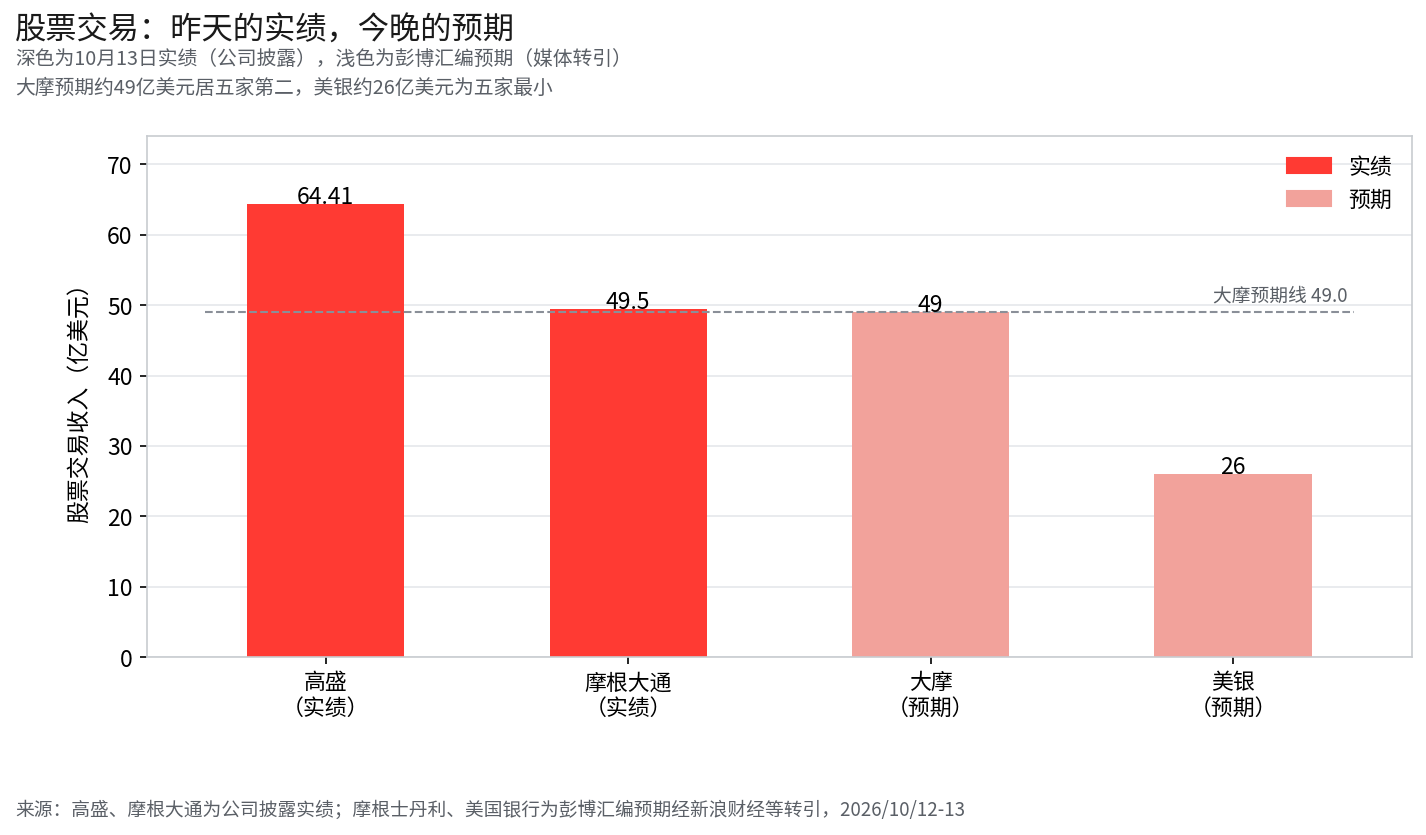
1. Bank of America: Operating Signals Beyond the Fine
Bank of America's earnings have a special variable. The U.S. Treasury Department's Financial Crimes Enforcement Network (FinCEN) announced a $1.2 billion fine against the bank, the third-largest penalty in the Treasury's history. Regulators said the bank failed for years to report more than $5 billion in suspicious transactions, of which over $1 billion involved high-priority risks such as national security. The Treasury separately announced a $11.6 million settlement over sanctions violations. As part of the settlement, Bank of America admitted to willfully violating the Bank Secrecy Act. The bank said it has invested billions of dollars in compliance, and the fine will result in a $1.2 billion non-tax-deductible charge in third-quarter results and reduce earnings per share by about 17 cents (Treasury announcement and media reports).
The fine itself is a one-time expense, and what really needs to be read is the operating data beyond the fine. Moynihan had previously expected third-quarter investment banking fees to fall at least 10% and sales and trading revenue to be roughly flat, a relatively conservative guidance that contrasts with last night's hot equities trading at Goldman Sachs. The market's core checkpoint for Bank of America is net interest income: management maintained its fiscal 2026 growth guidance at the upper end of the 6% to 8% range, while last night JPMorgan reported net interest income of $27.1 billion, up 13% year-over-year, and raised its full-year guidance to $106.2 billion. If Bank of America delivers in the same direction, the industry-wide conclusion of "record interest income" gains another piece of supporting evidence; if it diverges, the sector narrative will have to be written separately. According to Bloomberg compilation, Bank of America's equities trading revenue is expected at about $2.6 billion, the smallest among the big five banks, and if it falls short of expectations and is compounded by fixed-income pressure, trading could become a drag.
2. Morgan Stanley: The Verification Value of Equities Trading Revenue
Morgan Stanley's consensus earnings per share is about $2.94, with revenue of about $20 billion (compiled by Investing.com and others, with slight differences across media estimates ranging from $19.93 billion to $20.19 billion). According to Bloomberg compilation, analysts expect its equities trading revenue at about $4.9 billion, ranking second among the big five banks, behind only Goldman Sachs' actual $6.441 billion yesterday.
The verification value of this figure lies in whether Goldman Sachs' 72% year-over-year increase in equities trading revenue is industry-wide. If Morgan Stanley is similarly strong, the claim that "equities strong, fixed income weak" is an industry-wide trend gains a second data point. If it is weaker, and compounded by JPMorgan's 4% year-over-year decline in fixed income (its first in more than two years), the growth logic for trading revenue needs to be re-examined. Another background factor is the expectation gap: UBS cut its Morgan Stanley earnings per share forecast by 13% to $2.60 before the earnings release, leaving a gap of about 12% versus the market's $2.94 estimate, and which side the actual figure falls on will be clear tonight. Wealth management is Morgan Stanley's core business that distinguishes it from other big banks, and if its net interest income outlook is slightly lowered, that reflects the degree to which rising deposit costs are being transmitted to wealth management (according to media reports).

3. Three Things Already Confirmed in the First Half
Interest income is still setting records. JPMorgan, Citigroup, and Wells Fargo posted combined net interest income of $56.5 billion, a record for the fifth consecutive quarter, and JPMorgan raised its full-year 2026 guidance to $106.2 billion. Support for the interest side from high rates has not yet ended, and whether net interest margins can widen depends on the slope of deposit costs.
Trading is shifting gears. Goldman Sachs' equities trading revenue rose 72% year-over-year to $6.441 billion, while fixed income at $3.47 billion fell short of expectations. JPMorgan's fixed income fell 4% year-over-year, its first decline in more than two years, while equities trading revenue rose 49% year-over-year to $4.95 billion. According to Bloomberg compilation, the big five banks' combined third-quarter trading revenue is expected at about $38 billion, still up 13% year-over-year, but clearly down from the record of about $47 billion in the second quarter.
Credit is stable but provisions are picking up. The three banks' provisions changed by -19%, +6%, and +51% year-over-year respectively, but JPMorgan's net increase in provisions was only $540 million and Wells Fargo's net charge-offs rose by only about $29 million, both reflecting "building a bigger safety cushion" rather than deteriorating bad loans. If Bank of America and Morgan Stanley also increase provisions modestly while charge-offs remain stable, the reading that "the credit cycle has not turned" continues to hold. If both banks raise provisions significantly and delinquency rates rise in tandem, the market's judgment on credit costs will need to be re-examined.

First, whether the rise in provisions is industry-wide. If all five banks increase provisions in the same direction while charge-offs remain stable, that is proactive cushion-building. If provision increases and delinquencies rise together, that is a directional signal for the credit cycle.
Second, the volume-price structure of net interest income. Growth in both deposits and loans is still materializing, but Wells Fargo's net interest margin was 2.43%, flat versus the second quarter, and Bank of America's reading will verify the sustainability of "compensating for price with volume" under high rates.
Third, the sustainability of equities trading revenue. Morgan Stanley's expected figure of about $4.9 billion is the key second data point. The resilience or pullback in capital market activity directly determines the growth logic for trading revenue.
Fourth, signals of cooling in capital market activity. According to research note citations, Bank of America analyst Poonawala believes capital market activity in the second half of 2026 will be noticeably weaker than in the first half (this view represents only the judgment of the relevant institution). Analysts expect the big five banks' combined third-quarter profit to be $44 billion, up nearly 9% year-over-year, but down about 20% (about $10 billion) from the second quarter. A quarter-over-quarter cooling is already expected, and the disagreement is over the slope of that cooling.
Based on the overall picture and public information, one possible scenario is that Bank of America's operations remain stable after excluding the fine and Morgan Stanley's equities trading remains strong, fully confirming the big five banks' structural conclusions (record interest income, trading shifting gears, stable credit). If either bank diverges significantly on any item, both the cautious expectations priced into the sector since August and the room for recovery will need to be re-examined.
BIT supports real-time U.S. stock quotes and direct trading: during earnings season, you can track pre-market and intraday quotes for individual stocks and other instruments on BIT and trade them. Stablecoins can be deposited directly, with 7×24 second-level crediting, and one account covers both U.S. and Hong Kong stocks. Earnings-season volatility may increase, so please size positions and leverage according to your own risk tolerance.
Data Notes
- Bank of America fine: FinCEN announcement and Treasury press release (as relayed by Sina Finance and others), 2026/10/13-14. The $11.6 million sanctions settlement is part of the same announcement.
- Earnings results: disclosures from JPMorgan, Goldman Sachs, Citigroup, and Wells Fargo (as relayed by CNBC, Bloomberg, Yahoo Finance, and others), 2026/10/13.
- Trading and profit expectations: Bloomberg compilation as cited by Sina Finance and others, 2026/10/12-13. The big five banks' combined profit of $44 billion was relayed by Yahoo Finance.
- Morgan Stanley expectations: compiled by Investing.com and others (media estimates vary slightly). The UBS downgrade was cited from a research note.
- Market data: Bank of America's after-hours decline was relayed from public reports. The six major banks' closing prices are from market data interfaces.
Disclaimer:
This content is for general informational and market commentary purposes only, based on public materials as of the time stated in the article, and the relevant market data, expectations, and probabilities may change with market conditions. The views and investment strategies of third-party institutions, analysts, or other persons cited in this article represent only the views of the relevant third parties at a particular time and do not represent the views or recommendations of BIT. This article does not constitute investment advice, investment research, an offer, a solicitation, or a recommendation for any securities, investment products, or trading strategies, and should not be relied upon as the basis for any investment decision. Financial markets involve risk, securities prices and market performance may fluctuate, and historical performance and past market trends do not represent or guarantee future results. Investors should independently assess the relevant risks based on their own circumstances and seek professional advice when necessary. BIT's Hong Kong stock trading service is not provided to residents of Hong Kong or users in other restricted jurisdictions.