






TRON Industry Weekly: Stocks and Bonds at Highs, Crypto Rebound Hard to Sustain; A Deep Dive into Credible, the Global PayFi Payment Network Connecting Fiat and Stablecoins


- Core Viewpoint: This week's macro environment presented a coexistence of economic resilience and inflationary pressure. The crypto market weakened under the impact of high interest rates and ETH spot ETF outflows. Industry hotspots centered on stablecoins, RWA, and compliant trading infrastructure, with the U.S., EU, and South Korea all making phased progress on regulatory frameworks.
- Key Elements:
- The U.S. September ISM Services PMI came in at 54.9, with the prices index rising to 74.0. The 10-year Treasury yield closed at 5.243%, with elevated financing costs suppressing risk asset valuations.
- BTC fell from around $85,950 to $82,931 this week, while ETH dropped from $2,712 to $2,506. ETH underperformed BTC, with sustained ETF outflows posing pressure.
- The stablecoin market reached $313 billion in September, tokenized stocks totaled $4.87 billion with monthly trading volume of $15.6 billion, and the RWA sector continued to grow.
- The U.S. CFTC initiated pre-rulemaking consultation on crypto trading rules (Regulation CTX/CAM), and the SEC's crypto custody proposal entered the public comment period, ending December 7.
- The EU reached a political agreement on unified regulation of cross-border crypto service providers, proposing to bring the most significant service providers under direct ESMA supervision. South Korea's Digital Asset Basic Act second-phase legislation entered its final coordination stage.
- Next week, focus on U.S. September CPI on October 14 and PPI and retail sales data on October 15, which will test inflationary pressure and consumer resilience and could significantly impact interest rate expectations.
I. Outlook
1. Macro-Level Summary and Future Forecast
Macro Weekly Summary (October 5–11, 2026):
The core tension remains the coexistence of economic resilience and inflationary pressure. The U.S. September ISM Services PMI came in at 54.9, remaining in expansion territory, but the prices index rose to 74.0; initial jobless claims fell to 197,000, with layoffs still low, while the preliminary October consumer sentiment reading dropped to 46.3. The Federal Reserve meeting minutes released on October 7 emphasized inflation risks stemming from energy prices and AI investment; on October 9, the U.S. 10-year Treasury yield closed at 5.243%, financing costs remain elevated, and risk assets face valuation pressure.
Macro Forecast for Next Week (October 12–18):
Markets are expected to fluctuate primarily around inflation and interest rate expectations. U.S. September CPI will be released at 20:30 Beijing time on October 14, and PPI, retail sales, and initial jobless claims will be released at 20:30 on October 15. If core inflation exceeds expectations and consumption remains strong, expectations for further rate hikes may intensify, pushing up the dollar and Treasury yields; if inflation cools and consumption moderates appropriately, it would help ease tightening concerns. Energy prices remain an important variable, and a single decline is insufficient to confirm a reversal in the inflation trend.
2. Crypto Industry Market Movements and Alerts
Crypto Market Movements This Week (October 5–11):
Major coins generally weakened, with a slight recovery over the weekend, and ETH underperformed BTC. BTC fell from approximately $85,950 as reported on October 5 to approximately $82,123 on October 9; as of 09:30 Beijing time on October 11, it stood at $82,931.96. ETH declined from approximately $2,712 on October 5 to approximately $2,488 on October 9, recovering to $2,506.70 at the same time point. The above are price snapshots from different dates, not complete weekly highs and lows; the high interest rate environment and continued outflows from ETH spot ETFs are pressure factors worth monitoring this week.
Crypto Market Forecast for Next Week (October 12–18):
A data-driven range-bound market is likely, and whether the rebound can continue depends on U.S. inflation results and ETF fund flows. If CPI comes in below expectations, Treasury yields decline, and ETF flows improve, BTC and ETH may recover this week's losses; if inflation proves stronger and tightening expectations intensify, there remains risk of another pullback. BTC's $80,000 and ETH's $2,500 can be observed as short-term psychological thresholds, but cannot be regarded as confirmed support; at present, it is not sufficient to conclude that the market has resumed a sustained upward trend.
3. Industry and Sector Hotspots
This week's verifiable highlights centered on stablecoins, RWA, and compliant trading infrastructure. A CoinDesk report released on October 6 showed that the stablecoin market reached $313 billion in September, tokenized stocks reached $4.87 billion with monthly trading volume of $15.6 billion—these are last month's data released this week, reflecting business growth in the relevant sectors. Meanwhile, the U.S. CFTC initiated preliminary consultations on a crypto trading framework, and the EU advanced unified regulation of major cross-border crypto service providers, further highlighting the importance of trading, custody, and asset tokenization infrastructure; whether business growth can translate into returns for related tokens still needs to be assessed on a case-by-case basis.
II. Market Hot Sectors and Weekly Potential Projects
1. Potential Projects Overview
1.1. In-Depth: $4 Million Total Funding from Individual Investors — Building a Global PayFi Payment Network Connecting Fiat and Stablecoins: Credible
Introduction
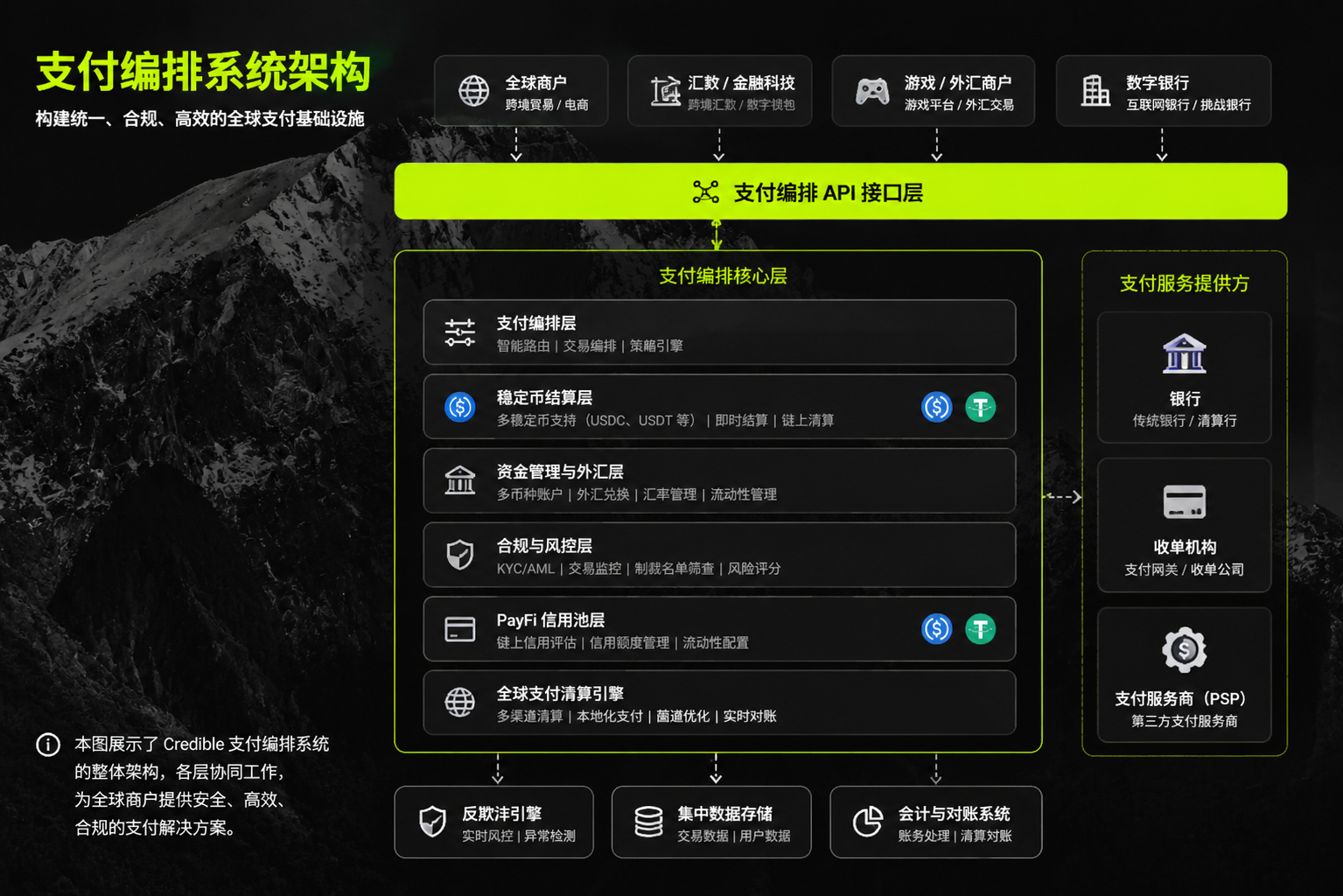
Credible is a Payment Orchestrator that combines Fiat Infrastructure with Stablecoin Liquidity to provide Same-day Settlement, seamless access to local payment methods, and competitive foreign exchange rates for global payments.
Credible's core is built around three pillars:
- Speed
- Accessibility
- Pricing
Core Functions
- Pay-In
Credible supports real-time T+0 pay-in. The platform receives fiat payments made by users through multiple payment methods via integrated Payment Gateways and Aggregators, while releasing stablecoin liquidity in advance through its PayFi Credit Layer.
Merchants can receive settlement funds immediately, even though the underlying fiat-to-stablecoin conversion process still needs to be completed asynchronously through local fiat payment networks. In this way, Credible combines the settlement delays of traditional fiat payments with on-chain stablecoin liquidity to deliver a faster merchant fund arrival experience.
- Pay-Out
Credible supports T+0 withdrawals and payment distribution. The platform provides local fiat funds in advance to Neobanks and Fintechs for cross-border remittances and merchant payments.
At the same time, the stablecoin-to-fiat conversion process continues to complete clearing asynchronously in the background. This model enables end recipients to receive funds instantly without waiting for traditional fiat settlement cycles, thereby improving cross-border payment and commercial payment efficiency.
- Yield
Credible provides short-term payment financing services with tenors of 1–7 days, collateralized by users' Pay-In / Pay-Out Receivables.
This financing layer effectively provides working capital support for payment operations, enabling merchants and payment service providers to achieve real-time settlement while generating yield from the payment fund flows within the financing. By combining payment liquidity, stablecoin funds, and short-term credit, Credible has built a PayFi infrastructure that both enhances payment efficiency and optimizes capital utilization.
Protocol Mechanism Overview
1. How Credible Works
Credible is a Payment Orchestration Layer designed to decouple payment settlement speed from traditional fiat clearing cycles, enabling real-time (T+0) Pay-In / Pay-Out globally.
This goal is achieved through three core capabilities:
- Stablecoin-based Payment Financing
- Regulated Fiat Rails
- Short-duration Receivable-backed Credit
Through these mechanisms, Credible enables users to complete payments and receive funds quickly, while the underlying fiat clearing process can still be completed asynchronously in accordance with the traditional financial system.
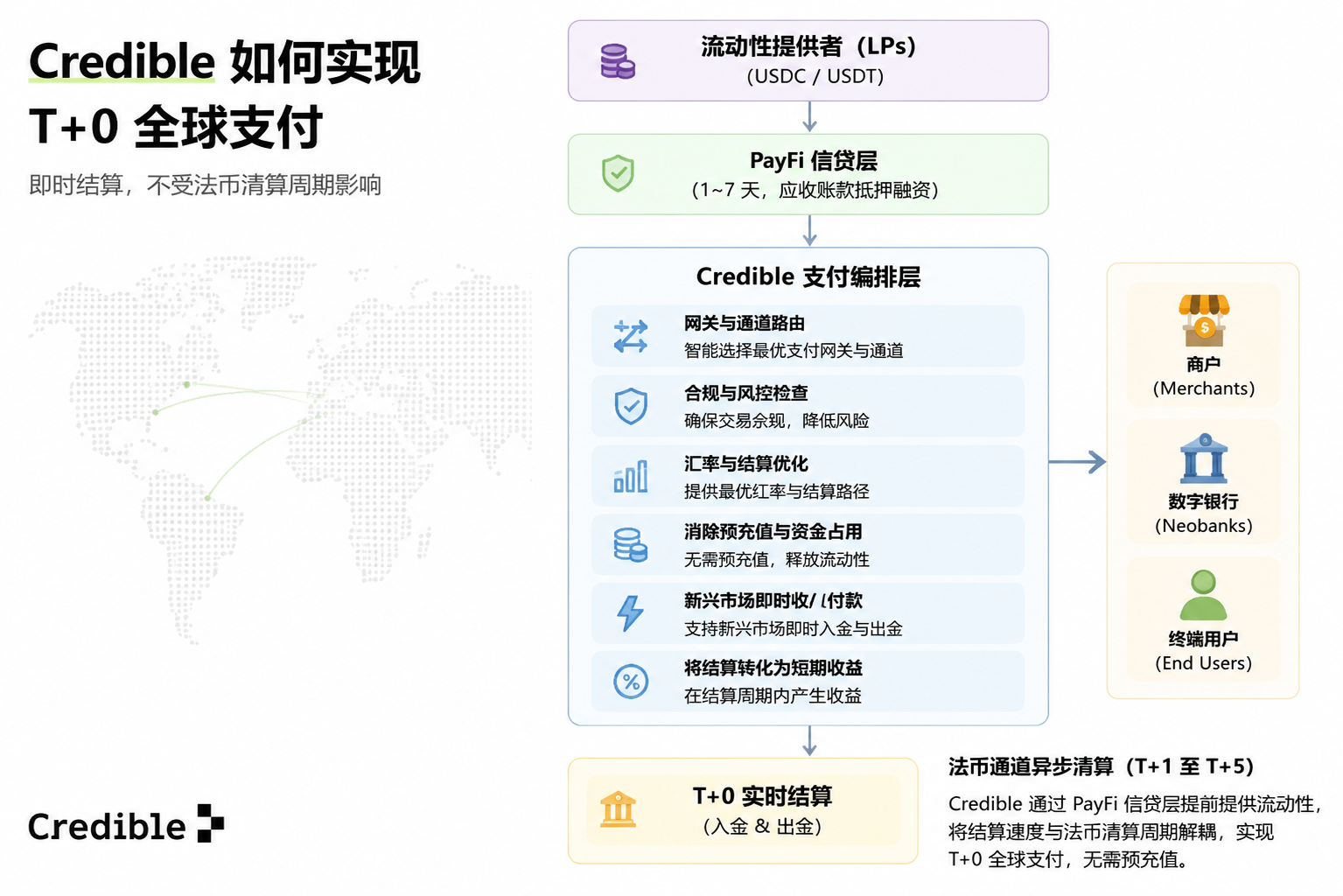
Three Types of Core Participants in the Credible Ecosystem
1. Liquidity Providers (LP)
Liquidity Providers supply stablecoin liquidity to Credible's PayFi Credit Layer, such as:
- USDC
- USDT
These funds are used to support short-cycle (1–7 day) payment financing, secured by receivables generated from real payment operations.
LPs can earn yield by providing liquidity for the payment process.
2. Payment Platforms
These include:
- Neobanks
- Fintechs
- Merchants
These platforms need to achieve instant pay-in and pay-out in global markets, but traditional payment systems typically involve:
- Pre-funding requirements
- Trapped Capital
- Slower fiat clearing speeds
Credible helps these platforms achieve instant settlement through its payment financing layer, without relying on the traditionally slow fiat clearing process.
3. Fiat & Payment Rail Partners
These include:
- Payment Gateways
- Aggregators
- Banks
- Local settlement partners
These institutions are responsible for completing fiat collection and payment distribution in different markets, but their operations typically depend on the traditional financial system, so clearing cycles may involve delays.
Credible bridges this time gap through stablecoin liquidity and its payment financing layer.
4. What Makes Credible Unique
Credible's core innovation lies in:
Separating payment execution speed from fiat clearing speed.
By providing stablecoin or local fiat liquidity in advance through the PayFi Credit Layer, Credible enables end users and recipients to achieve T+0 (real-time or same-day) settlement.
Even if the underlying processes:
- Fiat → stablecoin conversion;
- Stablecoin → fiat conversion;
are still completed asynchronously in accordance with the traditional financial system, users can still receive funds in advance.
Especially in emerging markets, where local fiat systems typically have longer settlement cycles, Credible solves the payment efficiency problem through advance financing.
This decoupling of settlement speed from clearing cycles is where Credible's core value lies.
The Credible Stack Is Built on Three Pillars
① PayFi Credit Layer — Financing
The PayFi Credit Layer is Credible's short-term payment financing module.
This layer provides:
- 1–7 day short-term financing;
- Secured by receivables generated from pay-in or pay-out;
- Working capital support for the payment process.
It primarily addresses:
- Funding gaps in the payment process;
- Advance funding needs of merchants and platforms;
- Capital occupation issues caused by settlement cycles.
Through this layer, payments can be executed in real time without pre-funded capital.
② Payment Orchestration — Execution
The payment orchestration layer is responsible for unified management and scheduling of different payment channels.
It connects:
- Payment gateways;
- Aggregators;
- Banks;
- Stablecoin payment rails.
The system optimizes across:
- Speed;
- Cost;
- Availability;
- Compliance requirements;
based on different market conditions, selecting the optimal payment path.
③ Fiat Settlement Rails — Clearing
The fiat settlement layer is responsible for connecting the traditional banking system and local payment infrastructure.
These traditional payment networks operate on their own clearing cycles, typically involving:
- T+1;
- T+5;
and other settlement times. Credible does not change these traditional clearing processes, but instead builds on them to achieve real-time fund arrival at the user end through payment financing.
Credible does not provide credit loans to enterprises or consumers.
It does not offer:
- Corporate loans;
- Revolving credit lines;
- Long-term working capital loans;
- Merchant or payment platform balance sheet financing.
What Credible provides is liquidity support for the payment fund flows themselves. Its financing target is not enterprise credit, but short-term receivables generated from real payment transactions.
This model is similar to how DeFi protocols like Aave assess risk on collateralized assets rather than evaluating borrower credit; Credible applies this logic to real-world payment infrastructure.
Settlement Timing & Yield Mechanics
Because fiat payment systems, especially payment networks in emerging markets, typically require T+1 to T+5 clearing times, Credible introduces a controllable financing window.
During this period:
- Users can receive funds instantly (T+0);
- The fiat clearing process continues asynchronously;
- PayFi funds generate yield during the settlement window;
- Risk is limited through short tenors and real receivables.
This structure reduces Cash Drag, unlocks trapped liquidity, and transforms the traditional payment settlement process into a more capital-efficient, yield-generating financial infrastructure.
a. Pay-in Detailed Mechanism
Through a unified payment orchestration layer, Credible helps global Fintechs, Neobanks, and internet companies receive local payments in emerging markets, while utilizing stablecoin-backed liquidity financing to achieve instant T+0 settlement.
Compared to the traditional model where enterprises need to separately integrate different payment channels, pre-fund local capital, and wait several days for settlement, Credible enables connection to payment networks across multiple markets through a single API integration, achieving real-time cross-border fund flows and unified management of complex underlying payment processes.
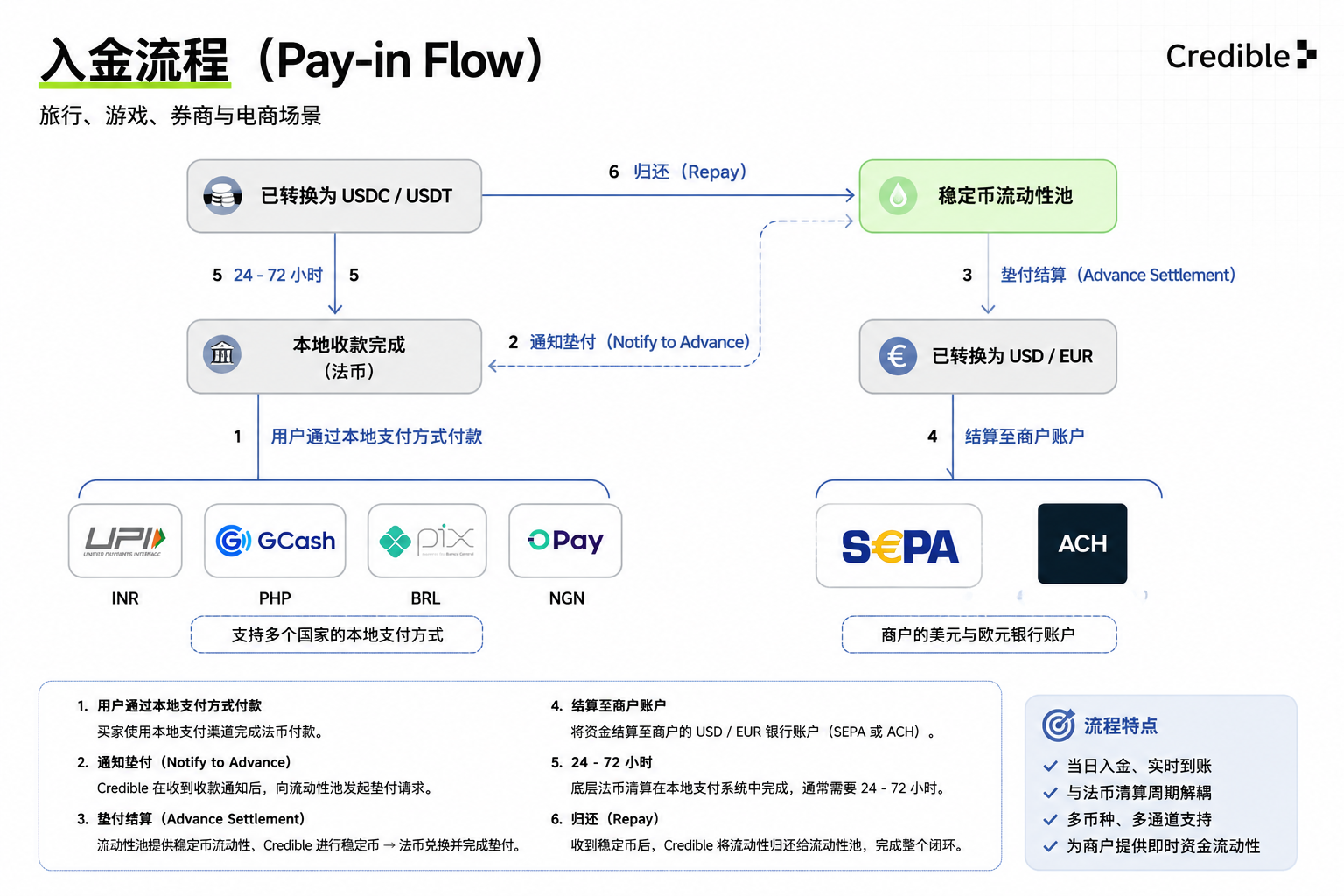
Step 1: Customers Pay Using Local Methods
Credible supports mainstream local payment channels in emerging markets, including:
- UPI (India)
- Pix (Brazil)
- GCash (Philippines)
- OPay (Nigeria)
- Local bank transfers and digital wallet networks
Through these local payment methods, merchants can directly accept payments in the local currencies and methods consumers use daily, without changing user payment habits.
Step 2: Credible Orchestrates Collection Across Multiple Providers
In the background, Credible connects multiple payment infrastructures, including:
- Local Payment Processors
- Banking Partners
- Wallet Aggregators
- On/Off-ramp Providers
Rather than relying on a single payment service provider (PSP), Credible dynamically selects the optimal payment path based on different transaction conditions, comprehensively considering:
- Success Rates
- Uptime
- Cost & FX Efficiency
- Compliance Requirements
Enterprises only need a single API integration, while Credible handles the payment complexities across different countries and regions.
Step 3: Payment Confirmation Happens Locally
When a user completes payment via UPI, Pix, or a digital wallet, Credible receives payment confirmation in real time.
At this point:
- The local payment has been verified;
- But fiat clearing in the traditional banking system may still require additional time.
Credible's core architectural innovation lies in separating Payment Confirmation from final Settlement. That is, after a user successfully pays, the merchant can receive funds without waiting for traditional bank settlement to complete.
Step 4: Instant T+0 Settlement via Stablecoin-Backed Liquidity
Once pay-in confirmation is complete, Credible immediately provides funds to the merchant in advance through a stablecoin-backed liquidity pool.
Merchants can receive in real time:
- USD
- EUR
- Stablecoins
The entire process requires no waiting for traditional bank clearing cycles, achieving true T+0 real-time settlement.
Credible essentially provides a layer of short-term payment financing capability to bridge the time gap between instant local payment execution and delayed fiat final settlement.
Step 5: Fiat Funds Settle Asynchronously and Reconcile Automatically
Although the merchant has already received funds in advance, Credible continues to complete fiat fund collection and clearing through local payment networks in the background.
When the fiat funds ultimately arrive:
- The credit exposure is closed;
- Fund balances are reconciled;
- Financial and ledger systems are automatically updated.
This mechanism reduces enterprises' dependence on:
- Prefunding
- Working Capital Buffers
- Multi-market decentralized settlement management
Step 6: Unified Reporting, Compliance, and Treasury Abstraction
Credible provides complete Pay-in infrastructure, including:
- Unified Settlement Ledger
- Transaction Monitoring & Fraud Controls
- KYB/KYC compliance management
- Compliance-aware Routing
- Consolidated Reporting across multiple markets
Through Credible, enterprises can obtain standardized, scalable payment collection capabilities covering multiple emerging markets without separately building payment operations systems in different countries.
b. Pay-out Detailed Mechanism
Credible provides real-time cross-border pay-out services for emerging markets through a stablecoin-backed liquidity settlement system.
With a single payment interface, Neobanks, Fintechs, and global Merchants can send funds to emerging markets while achieving T+0 instant settlement through stablecoin liquidity.
Compared to traditional cross-border payments which require:
- Prefunding local capital
- Managing Fragmented Local Rails
- Waiting for bank clearing cycles
Credible provides unified orchestration of the payment execution process, where users only need to initiate a single pay-out request, and the platform manages the entire process from verification, routing, to final delivery.





