






Building the "AWS of the AI Era": B.AI Unveils Major Upgrade with Multimodal Matrix and Responses API, Unlocking Computing Power Dividends to Build an Inclusive Intelligence Foundation


- Core Viewpoint: Through multimodal model launches, a unified Responses API upgrade, and a global settlement network, B.AI is building an "AWS of the AI era" style infrastructure platform, driving cost reduction and efficiency gains through scale effects while helping Chinese large models go global.
- Key Elements:
- The platform's daily Token throughput has surpassed 1.51T, gathering nearly 3 million users and serving multiple countries and regions worldwide.
- The platform cumulatively supports 70+ large models, with several top-tier image generation models newly added, expanding from text to high-precision visual generation.
- The unified Responses API upgrade supports "plug-and-play," allowing new models to seamlessly integrate with clients like Codex without additional configuration.
- It has introduced tiered supply strategies such as the "Mix 40% Off Group," while supporting both fiat and cryptocurrency payments to build a global intelligent settlement network.
- Chinese large models are performing strongly overseas, sweeping the top six spots in the highest call volume rankings over the past 7 days.
After B.AI's single-day Token throughput surged past 1.51T, the platform's ecosystem development has once again hit the accelerator. Recently, B.AI's large model matrix accelerated its rollout, adding multiple top-tier image generation models, completing its multimodal puzzle and achieving full coverage of 70+ top-tier large model compute across the entire platform. At the same time, B.AI has significantly upgraded its underlying unified Responses API, greatly improving interface response efficiency and stability, enabling AI coding tools like Codex and complex Agent workflows to easily achieve "plug-and-play" and "zero-friction" switching between multiple models.
Leveraging the underlying support brought by massive throughput, B.AI has launched a large model "discount season," continuously releasing "compute dividends" through platform scale effects. This series of major moves not only delivers extreme cost reduction and efficiency gains for global developers, but also paves the way for the strong "going global" of Chinese large models.
In this historic industry wave, B.AI is accelerating the construction of its platform ecosystem with forward-looking strategic positioning and outstanding technological iteration. Currently, B.AI has gathered nearly 3 million users, with services covering multiple countries and regions worldwide. Backed by its massive business scale, B.AI is comprehensively reshaping AI infrastructure, committed to becoming the "AWS of the AI era," making full-modal top-tier intelligence as stable, affordable, and accessible as water and electricity, truly building a solid foundation for the next generation of AI.
B.AI Ecosystem Development Accelerates Again, Building a Super Hub with Multimodal Scheduling, Unified API, and Global Settlement
In the cloud computing era, AWS fundamentally transformed software development by pooling IT resources such as compute, storage, and networking into standardized, on-demand cloud services. In today's generative AI era, the fragmentation of compute, models, and modalities similarly requires a powerful aggregator and orchestrator. As a next-generation AI infrastructure platform, B.AI has precisely identified this industry pain point, positioning itself beneath all large models and above all Agents. B.AI is committed to building a full-modal compute scheduling platform, constructing the "AWS of the AI era."
This vision is becoming a reality through continuous capability expansion. Recently, B.AI has welcomed a large-scale model rollout, with the core highlight being the addition of multiple industry-leading image generation models, formally expanding the platform's capability scope from single-modal text to the field of high-precision visual generation. As of October 10, B.AI has cumulatively supported 70+ large models across the entire platform, covering mainstream open-source and closed-source models worldwide. Developers only need to use B.AI as a single super entry point to freely and flexibly access the world's top large models, just like downloading apps from the App Store.
But "big and comprehensive" is only the starting point; B.AI cares more about being "smart and efficient." To address increasingly complex AI application development needs, B.AI has streamlined its ecosystem upgrade, significantly upgrading its unified Responses API to be fully compatible with upstream standard protocols. This upgrade brings a revolutionary "plug-and-play" experience: currently, as long as upstream supports the Responses API, all existing models on the B.AI platform can be uniformly accessed by developers through the /v1/responses interface.
More importantly, if B.AI subsequently adds support for new models launched by already-integrated vendors, developers need no additional configuration and can directly achieve automatic, seamless compatibility in clients like Codex. Models change, vendors change, but developers' integration methods need not change accordingly—this is precisely the certainty that an infrastructure layer should provide.
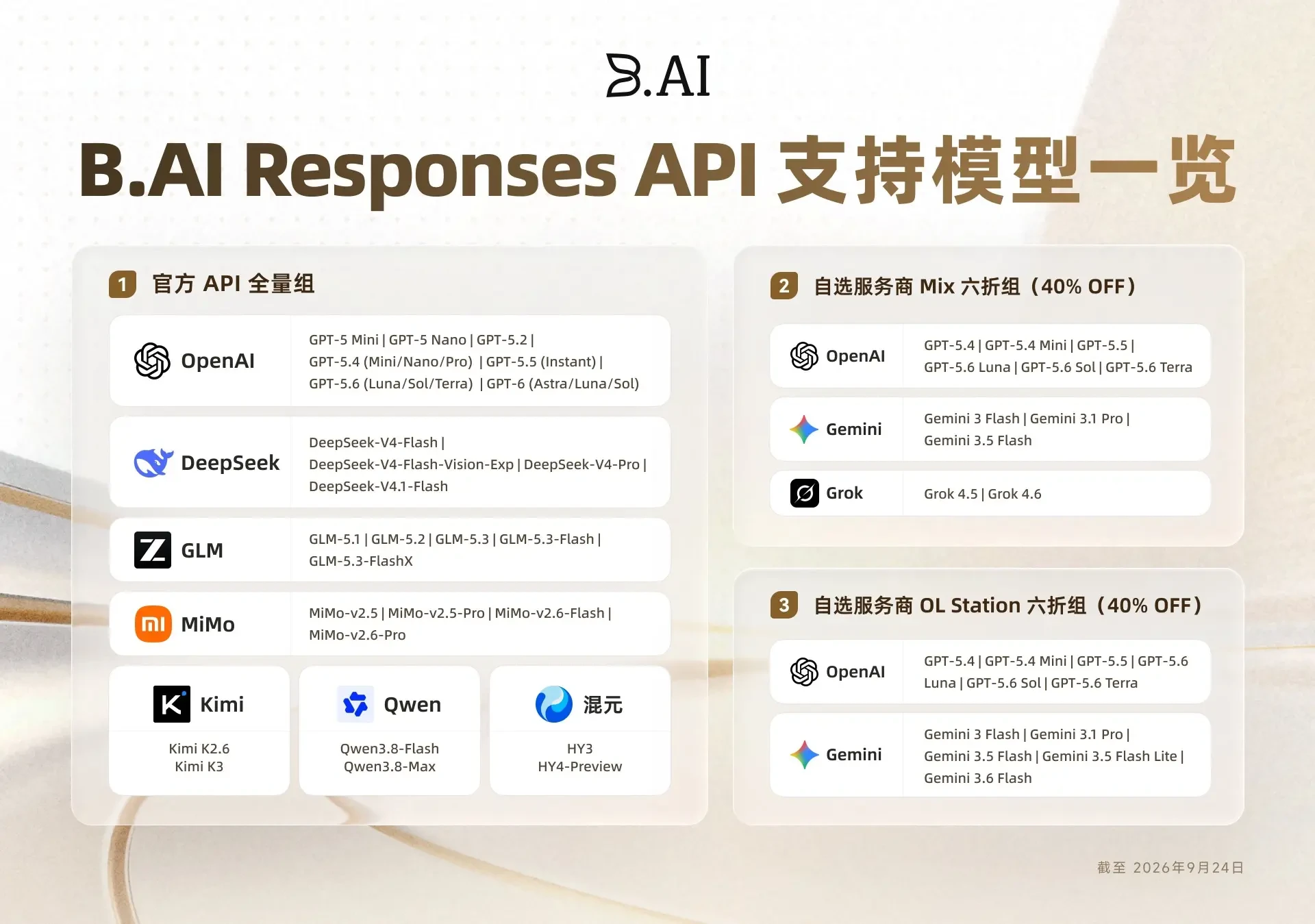
From a macro ecosystem perspective, B.AI has clearly built a dual-driven supply system of "all-around coverage" and "ultimate cost-effectiveness" in its latest Responses API-supported model matrix. As of September 24, data shows that the platform has established an "Official API Full Set" on one hand, spanning the world's top large model ecosystem, encompassing overseas frontier models such as OpenAI, and deeply integrating China's top model matrix including DeepSeek, Kimi, Qwen, Hunyuan, MiMo, GLM, and others, providing the most solid foundation for developers pursuing ultimate performance and full-scenario capabilities. On the other hand, targeting high-frequency calls and cost-sensitive business needs, B.AI innovatively launched the "Mix 40% Off Group" and "OL Station 40% Off Group." This clearly tiered supply strategy allows developers to freely switch between "top-tier all-around" and "large-scale cost reduction,"从容应对多元化的商业落地挑战。
Beyond unified model access, B.AI has also integrated Web2 and Web3 payment capabilities into the infrastructure layer, building an intelligent settlement network for global developers. The platform supports both traditional fiat currency and cryptocurrency payments, smoothing out the friction caused by cross-border payments, currency exchange, and settlement delays, allowing developers wherever they are to complete top-ups, calls, and settlements in the way they are familiar with.
When Agents become the next generation of software, the ecosystem entry point is no longer just model access, but who can package models, compute, multimodality, and payment settlement into a stable, unified, low-cost intelligent supply. Just as AWS once packaged underlying resources such as compute, storage, and networking into standardized cloud services, B.AI is laying exactly such a track—developers need not care where models come from, they only need to call intelligence itself.
Making Intelligence as Accessible as Water and Electricity, B.AI Reshapes AI-Era Infrastructure Through Scale Effects
When more and more developers and enterprises call models from the same entry point, whether the platform can steadily handle continuously growing requests becomes an unavoidable test. Massive data throughput and high-concurrency processing capability are precisely the hardest indicators for measuring the strength of an AI infrastructure platform.
Historical data shows that B.AI's platform has officially surpassed 1.51T in peak single-day Token throughput. This milestone breakthrough not only sets a new industry record, but also establishes B.AI's leading position in the next-generation AI infrastructure track with absolute technical strength and scale advantages. B.AI has become the preferred underlying pathway for global developers and enterprises building AI applications, truly shouldering the responsibility of being the compute hub of the AI era.
It is precisely this explosive scale growth that gives B.AI an extremely powerful "platform scale effect." By continuously returning the "compute dividends" brought by technical architecture optimization and massive scheduling to the market, B.AI makes "free" and "low-cost" no longer short-term concessions, but long-term results under scale effects.
Under this mechanism, low cost and a unified entry point not only lower the threshold for developers but also give model supply on the platform broader global reach. Chinese large models are direct beneficiaries of this effect. Since October 4, B.AI has launched a discount matrix for DeepSeek, Qwen, MiMo, and GLM series models, driving rapid growth in call volume across B.AI's global nodes. On October 9, B.AI's model rankings showed that among the top call volumes in the past 7 days, Chinese large models swept the top six, demonstrating extremely strong overseas performance. When price, performance, and access experience are all in place, a highly efficient, low-cost AI "Digital Silk Road" is unfolding here.
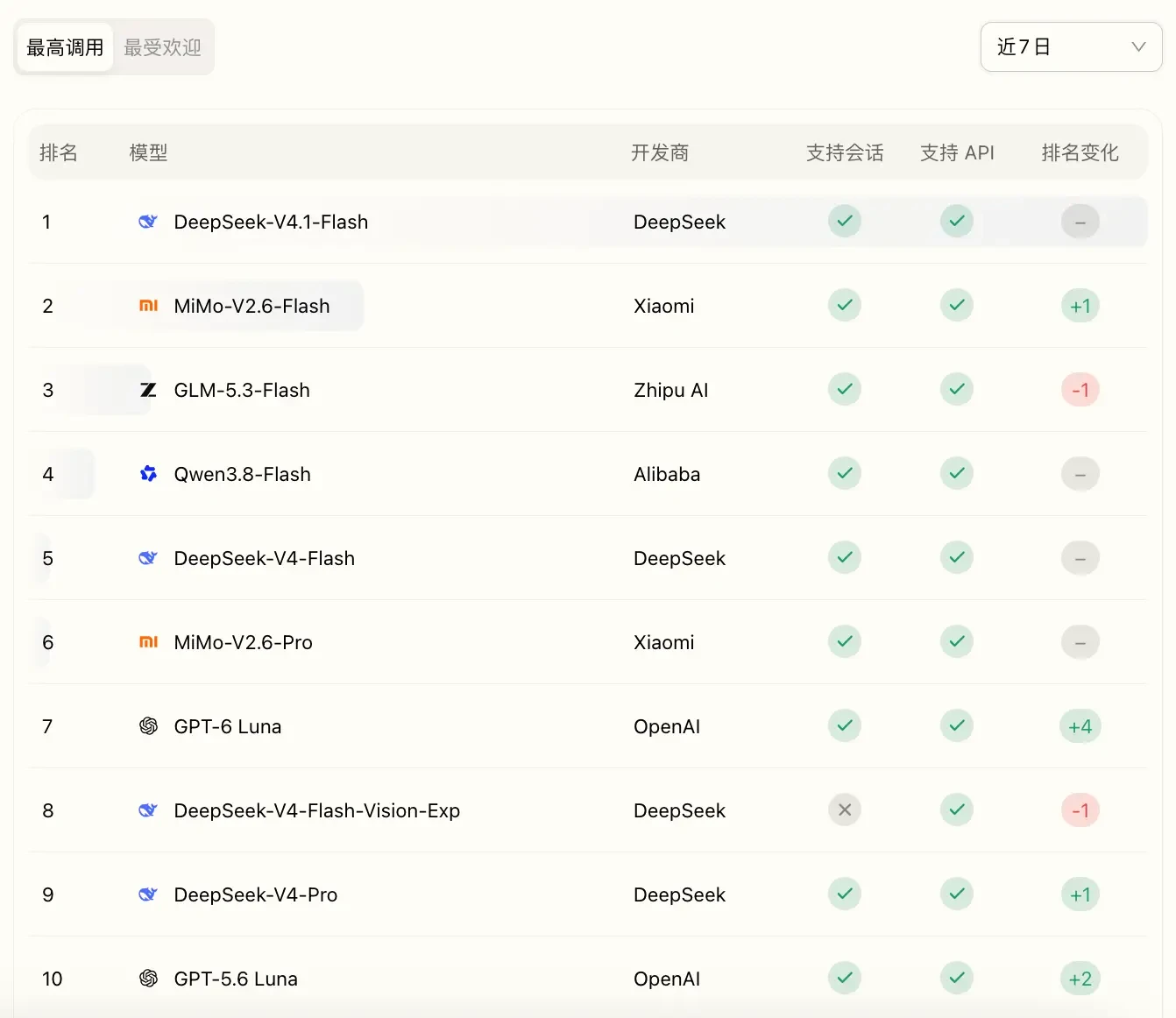
From establishing an industry-leading position with 1.51T single-day throughput, to creating a long-term discount mechanism through scale effects to reduce costs and increase efficiency, to giving back through a global compute network and accelerating large models' overseas expansion—B.AI has successfully built a highly coordinated, self-reinforcing commercial and technological closed loop. This closed loop not only validates the sustainability of its business model but also fully demonstrates B.AI's absolute leadership in ecosystem resource integration and global industry empowerment.
From cloud computing to artificial intelligence, every leap in technological paradigm is ultimately underpinned by an invisible layer of infrastructure. AWS made compute a public resource, spawning the entire cloud-native era. Now, as intelligence itself becomes a callable service, the threshold for innovation will also be redefined. What B.AI does is not make developers remember a certain model or a certain interface, but make intelligence as stable, accessible, and within reach as water and electricity.





