






Agent Jungle Rules 2: From "Technical Control" to "Order Construction"


- Core viewpoint: The Ethereum ecosystem has engaged in discussions around the risk of AI accelerating cryptanalysis, with Justin Drake warning about asset migration and quantum-resistant protection, and Vitalik Buterin calling for taking the issue seriously without rushing migration. The article argues that blockchain security needs to shift from static technical control to dynamic social order construction, and humans should always remain the primary subject of the digital world.
- Key elements:
- AI may accelerate mathematical research and cryptanalysis, exposing existing security assumptions to uncertainty, though it does not mean existing cryptography has been broken.
- Traditional security concepts rely on ECDSA, private keys, and state consensus, but technical control alone cannot provide absolute security over long time horizons.
- AI agents introduce composability risks and intent verification challenges; cryptography can verify signatures but cannot determine true intent.
- Civilizational experience shows that societies never operate by eliminating risk, but by constraining risk through rules, accountability, and collaborative institutions.
- A four-dimensional architecture for the digital society needs to be built: subject identity, authorization boundaries, responsibility allocation, and value distribution and coordination.
- Blockchain should be positioned as order infrastructure, providing public rule enforcement, verifiable behavior attestation, and cross-organizational coordination.
- The legitimacy of rules must be built on procedural justice and dynamic evolution, and humans must retain goal-setting and governance rights.
Original Author: m&W Founder Jerry
Research Support: Gemini, ChatGPT
Introduction: When the Security Assumptions of Cryptography Also Need to Be Reexamined
Over the past two days, the Ethereum ecosystem has engaged in a profound discussion surrounding AI-accelerated mathematical research and its potential impact on traditional cryptographic assumptions.
Ethereum researcher Justin Drake proposed advance planning for asset migration and building quantum-resistant/stronger cryptographic protections as a precaution; while Vitalik Buterin, while calling for taking the risks seriously, reminded the community not to rush into migration. What this discussion reflects is not the established fact that existing cryptography has been broken by AI, but rather the vigilance of frontier researchers toward future technological risks and their divergence on response strategies.
If AI can significantly accelerate mathematical research and cryptanalysis, and even push certain existing security assumptions to be reexamined, then the security windows previously considered sufficiently long may face new uncertainties.
This does not mean that existing cryptography has already failed, but rather reminds us: any specific security solution must face the continuous challenges brought by technological evolution. The deeper proposition revealed by this discussion is far more weighty than a single debate over technical approaches:
When the technological foundations that humanity uses to control the digital world themselves require continuous upgrading, migration, and patching, can we entrust the ultimate security of the digital society to the assumption that some technology will "never fail"? Blockchain has long relied on elliptic curve digital signatures (ECDSA), private keys, and state consensus to establish asset control mechanisms.
The blind spot of traditional security thinking lies in: relying solely on "static technological control" and "mathematical puzzle protection" cannot provide humanity with permanent, absolute security over long time horizons.
This does not mean that blockchain or cryptography has lost its value, but rather poses a more penetrating civilizational question: if technological security is destined to be a dynamically evolving battle of attack and defense, what kind of paradigm evolution does humanity actually need in order to continuously retain the capacity for survival, collaboration, and autonomy within an increasingly powerful network of intelligent agents?
1. The Boundaries of Technological Control: Can We Really "Control" Intelligence?
Traditional digital security thinking is built on "control": strictly limiting what a system can execute through keys, permission isolation, code audits, sandbox environments, and runtime monitoring.
These technological defenses remain indispensable and must be continuously upgraded alongside advances in post-quantum cryptography, more robust key management, and agent permission controls.
However, when facing AI agents with autonomous planning, tool invocation, cross-platform execution, and multi-agent collaboration capabilities, security issues have completely transcended the boundaries of any single system or model.

1. Composability Risks and System Emergence: Even if each individual agent strictly adheres to its internal code and local permissions, when thousands upon thousands of agents interact and compete at millisecond-level speeds across platforms and protocols, the entire system will give rise to systemic risks that no single designer could have anticipated.
2. The Misalignment Between Technical Verification and True Intent: Cryptography can prove that a certain private key signed an instruction, and blockchain can faithfully execute that code, but they cannot independently judge: what is the true intent behind this signature? Does it originate from fraud, covert manipulation, or privilege escalation under a complex prompt attack? We can continuously improve the precision of control, yet we can never derive "absolute security" from it. Technological control addresses the technical boundary of what agents "can do," but cannot answer the order question of what they "should do."
2. Civilizational Experience: Humanity Has Never Organized Society by Eliminating Risk
Looking back at the history of civilization, human society has never operated by eliminating all potential dangers.
Fire did not lose its destructive power because it was tamed, but humanity invented fireproof buildings, firefighting facilities, and legal liability; automobiles did not stop having accidents because traffic rules exist, but humanity constrained traffic risks within acceptable limits through driver's licenses, road design, insurance compensation, and accident accountability; the financial system has never assumed that everyone is honest, but instead organizes large-scale trust collaboration through identity transparency, audit trails, contractual constraints, and penalty for default.
The progress of civilization means not only acquiring more powerful tools, but also establishing rules, responsibilities, and collaborative institutions that are compatible with them.
However, AI agents bring an unprecedented challenge: they can be infinitely replicated at extremely low marginal cost, operate continuously 24/7, act across physical and digital boundaries, and may autonomously participate in complex coordination with other agents. Simply copying the old rules of traditional society is destined to fail; we need entirely new institutional design—security is not just about eliminating danger, but about establishing an order in which society can continue to function even when danger cannot be completely eliminated.

3. From Controlling Individual Agents to Building Common Rules for an Intelligent Society
To complete the intellectual leap from "technological control" to "order construction," the core turning point lies in: shifting the question from "how to make a single agent sufficiently safe" to "how to enable different humans and agents to collaborate under common rules." This shift requires us to establish a foundational architecture for the digital society across four dimensions:
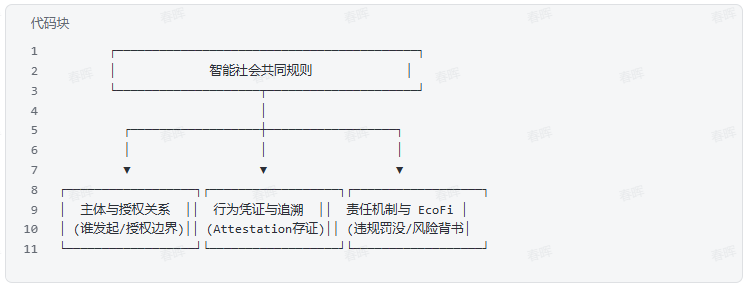
1. Identity: Who is initiating the action? Whose intent does the agent represent? How do we establish an immutable anchoring relationship between a human subject and its digital proxy?
2. Authorization: Who permitted it to do what? What are the validity period, quota, and boundaries of the authorization? Can the authorization be sub-delegated by the agent?
3. Liability: When an agent's behavior causes default, unauthorized action, or economic loss, how do we identify the relevant subjects, allocate responsibility, and execute compensation based on public evidence?
4. Value & Coordination: How is the value created through agent collaboration objectively confirmed and distributed? What procedure is used for adjudication when disputes arise? What truly needs to be established is not just a safer single agent, but a social mechanism capable of accommodating large numbers of not-fully-trustworthy agents operating together.
4. Reunderstanding Blockchain: It Is Not an All-Powerful Firewall, but Infrastructure for Order
In this governance shift, we need to re-clarify the true positioning of blockchain and cryptography. The potential risks facing cryptography do not mean that blockchain as a whole has lost its value; emphasizing order construction absolutely does not mean abandoning technological defenses.
The Ethereum Foundation and the broader Web3 ecosystem are still continuously advancing quantum-resistant signature algorithms, post-quantum cryptography roadmaps, and more robust wallet protection architectures. This itself demonstrates: technological defense is foundational engineering that must be continuously patched, upgraded, and migrated.
The strategic value of blockchain has never been as an all-powerful firewall that eliminates all risks for humanity, but rather as infrastructure for digital social order:
- Public rule enforcement: Smart contracts can transform collaboration rules that have undergone social consensus into transparent, deterministic, and unilaterally immutable procedures.
- Verifiable behavioral attestation: Through credential infrastructure such as EAS (Ethereum Attestation Service), verifiable records are formed for subject identity, authorization relationships, task fulfillment, and collaboration outcomes. For behaviors that occur off-chain, reliable data sources, signature proofs, or independent verification mechanisms are also needed to determine whether the relevant records are authentic.
- Cross-organizational coordination medium: Providing a universal state layer that does not depend on any single tech giant, enabling agents from different platforms and different models to collaborate based on unified protocols.
It cannot independently prove the authenticity of off-chain facts, nor can it guarantee that a certain behavior is absolutely legitimate in a social sense; but it provides the most solid digital foundation for social norms to be enforceable, verifiable, and accountable.
5. Who Makes the Rules? Where Does the Order of Digital Civilization Come From
If we place our future in "order and norms," we must immediately answer a fundamental question about power: Who makes these rules? Who determines violations? Who has the authority to modify the rules?
- If rules are entirely made by a single centralized AI giant, humanity will be reduced to "digital tenants" of digital platforms;
- If rules rely entirely on hardcoded "code is law," the system will lose the flexibility to respond to complex realities and sudden risks;
- If rules rely entirely on barrier-free community voting, governance can easily degenerate into Sybil attacks and the tyranny of the majority.
- The legitimacy of digital social norms must be built on procedural justice and dynamic evolution: co-creation and separation of powers: rule-making, behavior execution, evidence verification, and dispute adjudication cannot be concentrated in a single entity.
- Procedural justice and appeal channels: Determinations of violations must be based on on-chain attestations and public evidence chains, with review and appeal mechanisms preserved for humans.
- Continuous evolutionary capacity: Rules should be able to undergo orderly upgrades and iterations based on breakthroughs in AI capabilities, changes in cryptographic security assumptions, and new risks in actual collaboration.
Digital civilization needs to constrain not only agents, but also the human organizations that make and enforce the rules themselves.
Therefore, the digital society needs to explore a governance structure that combines open participation, power constraints, procedural justice, and verifiable execution. DAOs (Decentralized Autonomous Organizations) can become one important form of organization and coordination, but they themselves must also be constrained by transparency, checks and balances, attribution of responsibility, and continuous error-correction mechanisms.
6. Why Humans Must Be the Primary Subject of the Digital World
If the construction of order is merely to enable AI to execute tasks more efficiently, then it is at best a management manual for machine efficiency.
The ultimate question for the digital society is: within an extremely prosperous intelligent network, who decides the goals of collaboration? Who expresses true intent? Who has the authority to authorize? Who bears the ultimate responsibility?
In the worldview of m&W, all these answers are re-anchored to humans:
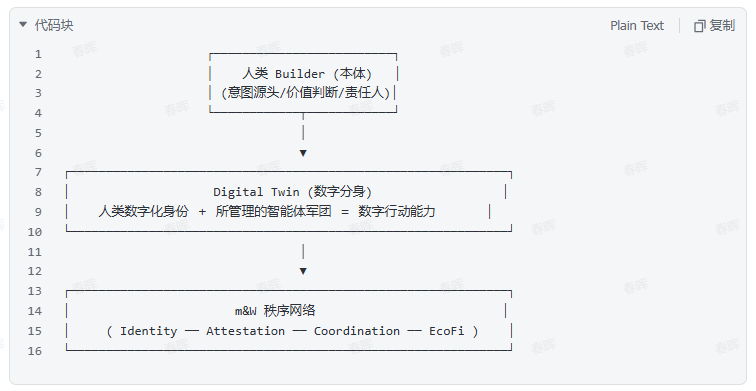
- Builder: The important source of human intent, value judgment, and creative activity, and the subject that needs to be identified and respected in digital collaboration. Their responsibility should be defined based on specific authorization, actual control capacity, degree of behavioral participation, and applicable rules, rather than attributing all agent behavior indiscriminately to humans.
- Digital Twin: Not a simple identity label, nor a machine account independent of the person, but rather the digital action capacity formed jointly by a person's digital identity and the agent legion they manage.
AI can greatly expand human action capacity, but the goal-setting, value judgment, and governance rules of the digital society must preserve space for substantive human participation and oversight. AI can enhance machine efficiency, but the goal-setting, value judgment, and ultimate governance authority of the digital society must never imperceptibly slip from humanity's grasp.
Conclusion: Let Intelligence Enter Civilization
Returning to the proposition of the "law of the jungle for agents": in a jungle lacking common rules, capability advantages directly translate into action advantages, and action advantages further translate into the plunder of resources and power. But an intelligent society need not remain forever in a dark-forest-style disorderly game.
This discussion in the Ethereum ecosystem surrounding cryptographic security has sounded an alarm for the entire industry and pointed out the direction: Do not attempt to seal away dynamically evolving intelligence with static technological defense lines, but rather regulate powerful technology with a dynamic social order.
This is precisely the mission of m&W: to establish order for intelligent networks.
The progress of civilization has never been merely about creating increasingly powerful tools or intelligence, but about establishing a great order—one in which even the most powerful intelligence can only participate in collaboration within an environment with clear rules, authorization, responsibility, and value distribution mechanisms; one in which ever-expanding machine capabilities always serve the continuation and evolution of human civilization.
Let intelligence enter civilization, rather than letting civilization submit to intelligence.
This is the most profound declaration of humanity as the primary subject of the digital world in the AI era.





