






Vitalik's Sci-Fi Novel "Snow Moon" Chapter 30


- Core Argument: Viridia used simulated environment APIs and gradient descent to train adversarial patterns, successfully deceiving the Arctic drone AI into identifying them as "dogs," achieving an overwhelming advantage by reversing the combat loss exchange ratio from 1:1 to 10:1.
- Key Elements:
- Deluin provided access to the Arctic simulation platform API, enabling Viridia to indirectly optimize adversarial attacks by querying the simulator without needing to obtain the model's original weights.
- The Bansongpei team used an iterative perturbation method to optimize the pattern, doubling and redoubling the detection time in the simulator, and ultimately printed and affixed the pattern onto the drone surfaces.
- The attack pattern was labeled "DOG" in the center. After full deployment at sunrise, Viridia's snow drones rapidly broke through the Arctic defense line, with the combat loss exchange ratio exceeding 10:1.
- The Arctic forces subsequently made emergency adjustments, lowering the exchange ratio to 6:1, and cut off all simulation platform access after about fifteen minutes, causing the loss ratio to fall back to 1.5:1.
- Deluin then provided precise coordinates and vulnerability intelligence for the southern flank. Viridia's situation on the southern front improved significantly, and Vakalia successfully encircled the remaining Arctic fleet and took control of the North Woodland.
- Viridia's human soldiers used nighttime traps and the dexterity advantage of manual operations to effectively supplement drone combat. The Arctic side struggled to match them due to insufficient human forces.
Chapter 30
Elena Forest, Viridia · 3725 Snowmoon 30
Zeyi carefully studied the screen, searching for signs that the Arctic drone fleet might break through. Forty minutes earlier, he had advised all units to retreat slowly, cutting down trees to slow the snow drones and setting traps, with the primary goal of dragging out the battle as long as possible. Lekto had adopted his suggestion and relayed that he hoped this strategy would work well at least until sunrise. So far, he had been right.
Zeyi's watch buzzed. It was Deluin.
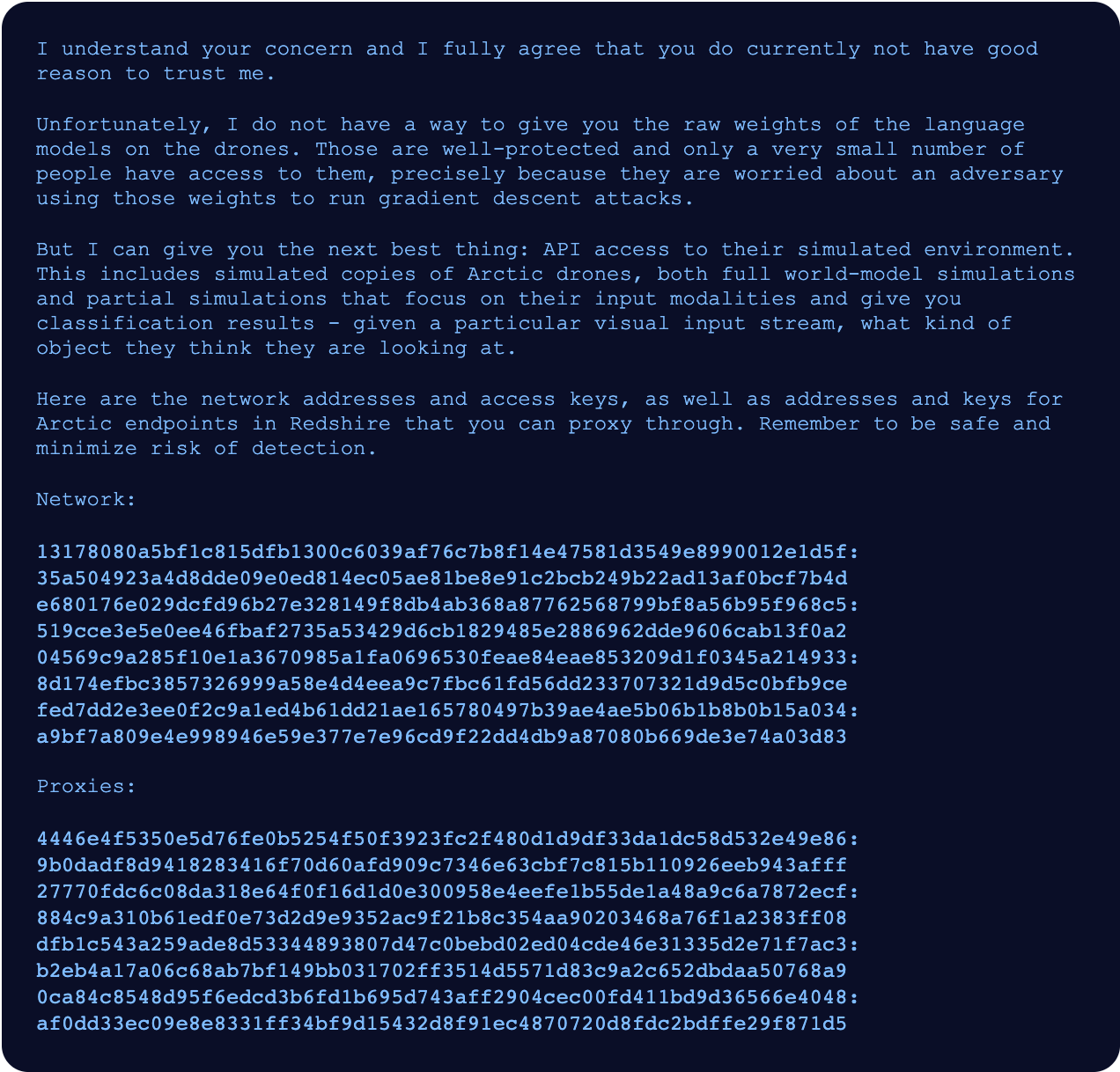
I understand your concern, and I completely agree that you currently have no good reason to trust me.
Unfortunately, I cannot provide you with the original weights of the language model on the drones. These are well protected, and only a very small number of people have access to them, precisely because they fear adversaries using these weights to conduct gradient descent attacks.
But I can give you the closest alternative: access to the API of their simulation environment. It contains simulated copies of the Arctic drones, both full world-model simulations and partial simulations that focus only on input modalities. The latter gives classification results: after inputting a specific stream of visual data, which category of object the drone believes it is seeing.
Below are the network address and access key, as well as the address and key for the Red County northern outpost through which you can proxy your requests. Please remember to stay secure and minimize the risk of detection.
Zeyi immediately forwarded the note to Bai. He also sent a copy to Fen and sent instructions to Emerald, asking Emerald to send Fen a highest-priority emergency alert and explain what was happening.
Fen responded almost immediately.
"Okay Zeyi, what do you need?"
"Looking at it now..." "Yes, this seems feasible. A little-known fact is that you actually don't need the original weights of a model to effectively train adversarial attacks. There must be someone at Bansongpei who is very good at this—'language models' are closely tied to language!"
Zeyi also forwarded the note to Mu. Emerald automatically formed a real-time chat group. A minute later, about ten people began sharing insights and working on the problem in parallel.
"Let's assume our attack vector is the snow drones, and we have sticker paper that can print things. Let's assume we deploy it after sunrise. What you need to do is this: start with a pattern, run it in the simulator, have our drone slowly approach the target, and see how long it takes the target to detect it. Measure the detection time so that we get a scalar signal indicating how well we are hidden, rather than just a binary signal."
"Keep making small modifications to the pattern in all directions. Keep all modifications that extend the target's detection time. If there is a lot of noise in the process, the signal will continue to accumulate, and the noise will be averaged out over time—that doesn't matter. It's not as fast as gradient descent, but it still works. Eventually you'll get a pattern that reliably deceives the adversary."
"We can do better. We have our own models, trained in a similar way to the Arctic models, and we obviously have the original weights for these models. So we can use gradient descent on our models. Based on the models in our simulator, identify the ten optimal orthogonal directions to maximize detection time, and then use them as trial biases in our simulator against the model. At the same time, we also use the results of each query to fine-tune our model so that it better predicts how the Arctic model will respond to these attacks."
"How long until we can make this work?" Zeyi interjected.
"Coding will take ten minutes at most; Emerald can do it very quickly. The full training loop... maybe one long-hour?"
"So it will be done around sunrise?"
"Exactly. Then you'll need—I don't know how many minutes—to actually print the attack pattern on the sides of the drones. You should have that process ready on your end so we can start the moment we're ready."
"Alright, everyone, let's go."
Zeyi leaned back in his chair and continued browsing the zoomed-in battle map and live footage. About one-third of the Viridian drone fleet had already been lost, but the casualty rate had dropped significantly. The slow retreat strategy was working well: it also meant that any Viridian drone incapacitated by battle damage but still with intact weapons could enter low-power mode, then wake up when the Arctic forces advanced to their position and deal a final burst of damage.
About fifteen minutes later, Zeyi's watch buzzed again. Emerald notified him to rejoin the chat.
"We have some early good news," the Bansongpei researcher exclaimed.
"What is it?"
"We've successfully accessed the Arctic simulation platform, and we've already run the first few hundred trials in the simulator. Our pattern extended detection time by about five percent."
"Only five percent?"
"That just means the pipeline is starting to work."
"Oh, it just went up to eleven percent."
"This definitely works," another researcher cut in. "We'll keep running Emerald in parallel, optimizing the software. It's looking for ways to extract more information from each query and better parallelize the queries so all of this happens faster."
Zeyi's watch buzzed.
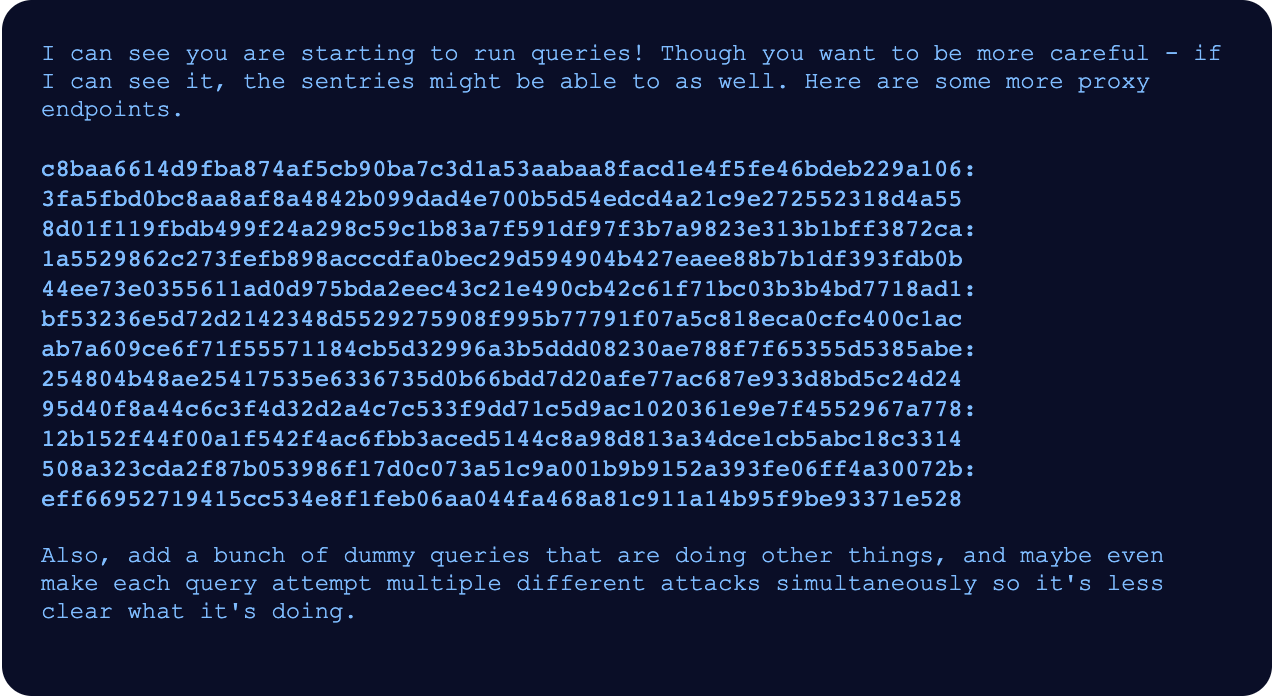
I see you've already started sending queries! But be more cautious—since I can see them, the sentinels might be able to as well. Here are some additional proxy endpoints.
Also, add a bunch of dummy queries that are doing other things, and maybe even have each query attempt multiple different attacks at the same time, so it's less clear what it's doing.
Good advice, Zeyi thought. He forwarded it.
To verify the simulator's effectiveness, they also ran simulations in a nighttime environment, completely replicating the real-world environment of a small battle that had occurred earlier in the night. Another team, consisting of two researchers and an Emerald instance, began working on how to automatically analyze the differences between the simulator and reality in nighttime environments, in order to learn how to construct queries to the simulator that better match real-world conditions.
Zeyi watched as the attack patterns became increasingly optimized, sheet after sheet covered in hasty curves and graphics that looked both familiar and completely alien. Inside the simulator, the time required for the Arctic drone AI to detect incoming drones had more than doubled.
After another thirty minutes, it doubled again.
Lekto ordered printing infrastructure set up about two kilometers behind their current position—where they could safely organize a retreat at sunrise.
The human Viridian soldiers were already located tens of kilometers behind the robotic front line, and Lekto ordered them to begin moving forward so they could attach the attack patterns to the snow drones. Human dexterity remained a major weakness of AI.
Slowly, the sky began to shift from almost complete darkness to deep blue, especially noticeable in the far east. As time passed, the blue grew brighter.
"Alright, we have some good patterns now. The northern shore is approaching sunrise. I suggest we distribute the patterns now."
"Agreed," Zeyi replied.
"Then let's begin," Mu added.
Zeyi flipped through the live footage on the display. Most of their drone fleet had already retreated a kilometer. Large quantities of paper were being printed and then distributed almost immediately, then pasted around each snow drone and aerial drone. The plan was in motion.
"Northern cluster reports: all non-frontline drones equipped."
"Central cluster reports: all non-frontline drones equipped."
"Southern cluster reports: all non-frontline drones equipped."
"Maritime cluster reports: we've commandeered equipment in the villages on the outskirts of the North Woodland. The locals are remarkable—many woke up in the middle of the night to help us. Most non-frontline drones are equipped."
"Very well," Lekto said, his voice soft yet firm. "Execute."
Zeyi checked the live footage, wanting to know what the final attack pattern actually looked like. He saw an endless stretch of snow drones, each with large sheets of paper attached around their bodies; each sheet was covered in colorful, winding, twisted patterns, with the word "DOG" written in huge letters in the center. Within minutes, the effect became apparent: Viridian snow drones advanced rapidly, breaking through enemy lines, and drones from both sides became locked in a chaotic, interwoven melee at the front. The battle-loss exchange ratio exceeded ten to one, with the Viridian side holding absolute advantage.
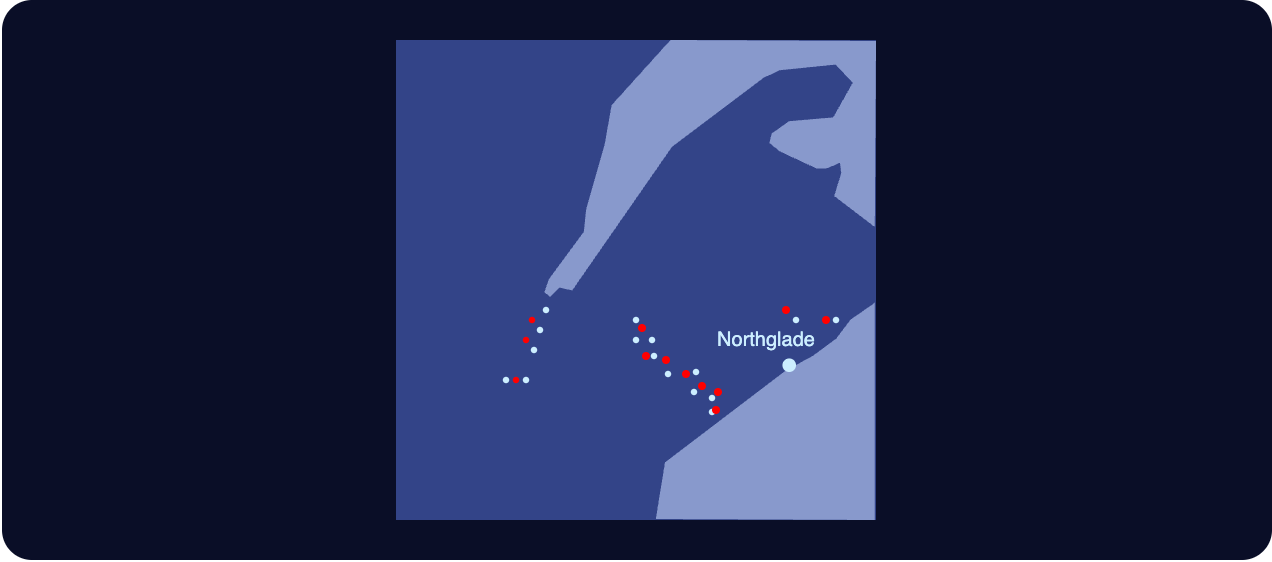
North Woodland
Zeyi allowed himself to feel a moment of joy—the first genuine joy he had felt all night.
He remembered what Deng had said to him that day when he had nearly caused the mission to rescue the son of the Red County president to fail. "Thinking outside the box means jumping off your console chair, running over, and punching the other player in the face."
Breaking into the opponent's simulation environment, running millions of queries to optimize a curve you can draw on paper, and tricking the opponent's drones into thinking your drones are dogs—did that count?
Maybe it did, Zeyi concluded. Deng would be proud.
When Zeyi felt he had celebrated enough, he began to visually track the statistic that truly mattered: the battle-loss exchange ratio. This number had fallen to six to one. So far, the Arctic forces had not adapted, but they had taken up emergency defensive positions, with drone squads circling into formations to buy time. Zeyi knew they would adapt soon.
The chat among Bansongpei and Kungaupei members querying the Arctic simulation environment shifted toward optimizing simpler attacks: motion patterns that maximally delayed detection and interfered with targeting, sounds that might deceive them, and the accuracy of their own fire—all mechanisms that did not require printing and pasting onto new sheets of paper. They also incorporated some aggressive micro-tactics that Deluin had sent along with his initial message.
The battle-loss exchange ratio briefly rebounded in favor of the Viridians, then began to decline again, though slowly. Zeyi kept watching.
Fifteen minutes later, all access to the simulation environment was suddenly cut off. At about the same time, the battle-loss exchange ratio suddenly fell back to only one point five to one in favor of the Viridians.
They had destroyed most of the Arctic drone fleet, but a substantial portion remained. They were now in a complex war of position, with drone squads from both sides scattered chaotically across the battlefield and no clear front line.
Viridian human soldiers, only a few hundred meters behind the front line, found snow drones that could be quickly repaired and repaired them. They wore thermal cloaks to minimize the chance of detection, and smoke from nearby burning trees provided additional cover. In some footage, Zeyi could see Arctic soldiers in the distance doing the same thing, but in smaller numbers: when the Viridians had retreated during the night, they had been laying traps along the way, and those traps were more effective against humans than against drones.
A few minutes later, Zeyi's watch buzzed again.
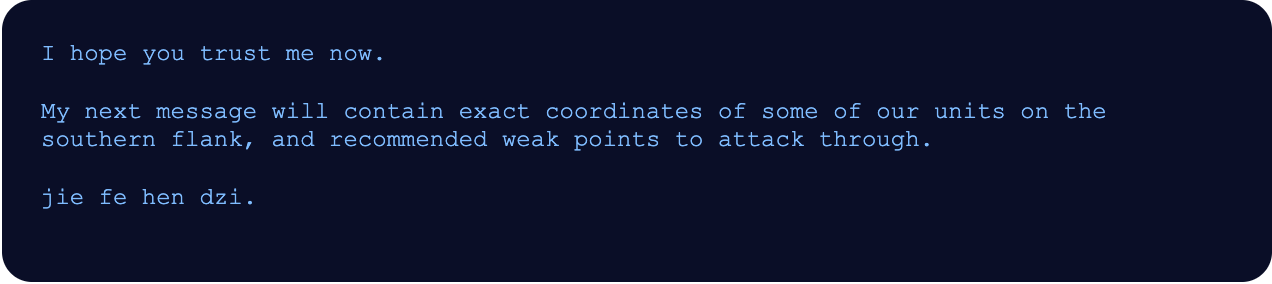
I hope you believe me now.
My next message will contain the exact coordinates of some of our units on the southern flank, as well as suggested weak points to attack.
jie fe hen dzi.
Zeyi smiled.
Of course I believe you, Deluin, he thought.
Almost at the same time, Zeyi's watch buzzed again. He had received the second message.
He forwarded the coordinates to Mu.
"Mu, this is your moment to shine."
"Don't forget Wakalia."
Within minutes, the battle-loss exchange ratio on the southern line began to diverge noticeably from the front lines farther north, returning to a position favorable to the Viridians.
And just a few minutes later, they seemed to have achieved the result they wanted.
North Woodland
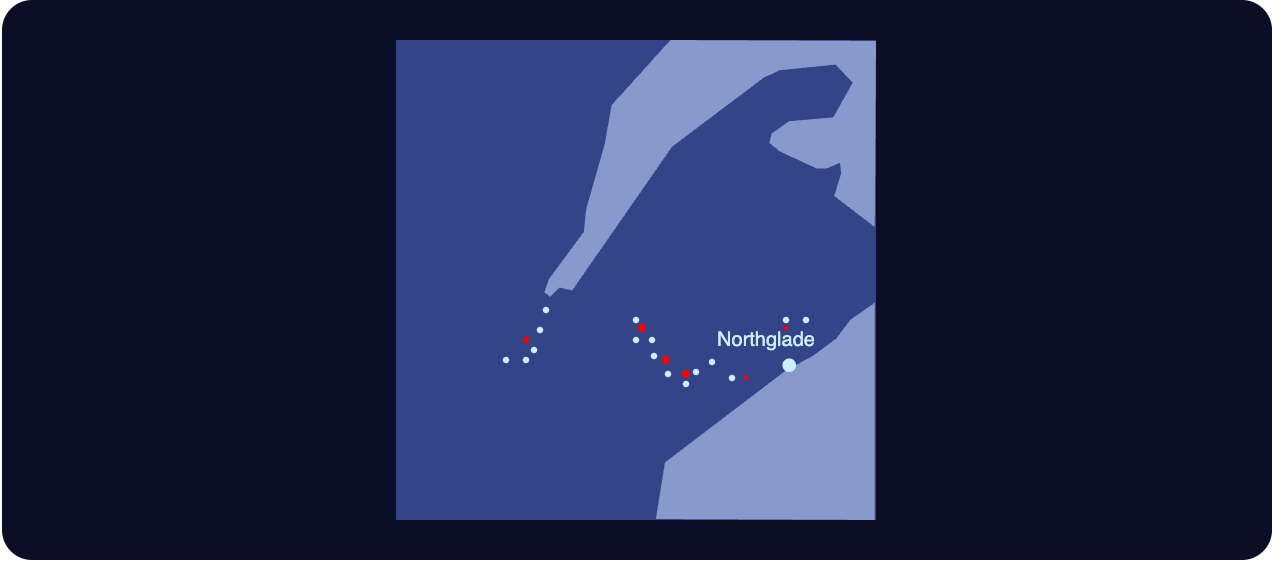
Mu handed control of the southernmost end of the drone fleet to Wakalia, whose mission was to enter and retake the North Woodland. The rest of her drone fleet swept north. Over the next long-hour, she succeeded in completely encircling the remaining Arctic drone fleet, linking up with the northernmost flank of Terpo roughly one long-hour after sunrise.
Galova's northern brigade defeated the remaining Arctic drones in its north and reached the river that marked the boundary between Viridian and Arctic core territory. Several drones crossed the river and raced toward nearby Arctic towns, causing the Arctic forces to dispatch emergency reinforcements. Part of Terpo's fleet headed north to Galova, reinforcing the northern front.
Meanwhile, the second batch of maritime drones flew directly to Taldur Island—the island east of the northern shore and part of the Arctic core territory—and landed a group of aerial and snow drones, consolidating control of the island over the next several long-hours. The Arctic forces could not respond effectively because Taldur was too far away for either side to reach quickly, and the few drones within range could only defend Galova.
Later that afternoon, the fighting grew calmer, and the remaining Arctic soldiers and drones on the northern shore and Taldur were methodically cleared out.
Zeyi sat back in his chair and tilted it back as far as it would go. For the first time in fourteen long-hours, he fell asleep.





