






Vitalik's Sci-Fi Novel "Snow Moon" Chapter 17


- Core Viewpoint: Viridia funds and allocates public resources through a decentralized graph funding mechanism and randomized committees, and leverages cryptographic voting systems to achieve secure governance, while facing the trade-off between professionalization and capture resistance.
- Key Elements:
- Graph funding decomposes funding allocation decisions into a tree-like or directed acyclic graph structure, where weights are allocated node by node by committees randomly selected by the cryptographic network.
- The system design faces a trade-off between professionalization and randomization: the more professionalized it becomes, the more susceptible it is to capture by special interests; the more randomized it becomes, the more likely it is to let the uninformed make decisions.
- Higher-level funding allocation introduces "randomization above a cutoff value," exempting outstanding projects from accountability pressure and providing space for their intrinsic motivation.
- Voting is completed on personal hardware via cryptographic keys, with security depending on the key registration process; the voting process cannot be verified or coerced by others.
- Zhege places greater emphasis on graph-funded technologies such as air filtration and ultraviolet lamps, and is concerned that Arctic peoples might leverage epidemiological technological advantages to launch attacks.
- The Viridia council voted to pass amendments restricting military surveillance-type products from entering the open hardware tier, raising tax tiers, and expanding the scope of repair restrictions.
Chapter 17
Meldan, Viridia · 3724 Fruit Moon 11
Gladias walked along a tree-lined path toward the massive circular council building ahead.
When he reached the side door of the building, he tapped the green circle with his watch.
The circle hummed.
Viridia Council
Invitation verified.
The door opened. Gladias stepped inside and followed the directions relayed through his watch. Forward, then right, then forward, then the third door on the left.
Gladias reached the door and tapped his watch again.
The door opened.
Inside, he saw a man wearing Viridian council robes.
"Gladias, thank you for coming!" the senator exclaimed.
"Thank you for seeing me, Senator Verdo!"
"Please, have a seat."
A robot slipped into the room.
"jie mo kai tu jie hei ja ma?" the robot asked.
Gladias stared in surprise.
Verdo smiled. "A few months ago, I adjusted its settings to do that. Just little things, to remind people that other countries exist, and that they matter."
Verdo tapped a few buttons on the robot's screen, then turned the screen toward Gladias.
The screen displayed Zhegoan script. Gladias's eyes wandered over it in confusion.
"Oh, if you want water, that's 'ja.' If you want tea, that's 'kai ja.' Literally 'plant water.'"
Gladias tapped "kai ja." If he was going to spend a few months in Zhego, he might as well start adapting to the environment, start drinking some tea—and learning the local expressions. The robot beeped to acknowledge the order, then quietly began gliding away from them. The door briefly opened, and the robot exited the room.
"So you think I should go to Zhego?"
"You're clearly intelligent. I obviously don't know what you said in the closed sessions, but from everything you said at the hearings, from your application to the Order years ago, I think you're a kind and smart person. We need more people like you actively serving our country. Being a Guardian is fine, but come on, you're just one out of a thousand-plus. I think getting some firsthand experience from Zhego and bringing it back could be more meaningful."
"If you think it's a good idea, I'd be happy to. But who should I talk to? That's what I wanted to hear your opinion on."
Gladias deliberately omitted any mention of Zeyi—not to hide that indirect connection, but because he wanted to get a completely independent answer from Verdo first.
"Hmm, my strongest connections are with some of their writers and musicians," he said with a gentle laugh. "Though I also know some people in their government, especially in security and health. I'll send you their contact information and give them a heads-up. I won't stop talking to them, but I think they can help you get started."
"Thank you, that would help a lot!"
"I only know two people there indirectly; my wife met them at a chance gathering at the Free City Institute of Economics. Zeyi and Bai, they're at Mingpengtai."
Verdo's eyes widened. "Honestly, you might be ahead of me. When you watch the Mingpengtai matches in Zhego, the players and the people training them are clearly first-rate. If I had to find someone to protect me against the Northlanders, I'd almost trust them over the actual Zhegoan military."
"How good are Zeyi and Bai? Have they competed in any tournaments?"
"The last thing Sera told me was that Zeyi won the semifinals, and then when Red Shire was invaded, they canceled the finals."
"Semifinals—city-level?"
"National."
Verdo's eyes were filled with surprise and delight.
"Then your connections are definitely better than mine. When you come back, you must tell me more about Zhego!"
"In any case, I'll introduce you to the others I mentioned, so you can meet them when you come. It's always good to get multiple perspectives."
Gladias nodded appreciatively.
"Oh, right—speaking of getting more perspectives, a Graph-funded steward is coming to visit me. Would you like to talk to him too?"
"About what?"
"Oh, his work, his feelings about Graph funding, and of course, Zhego."
"Of course, why not?"
A few minutes later, the door opened and another man walked in, wearing Viridian privacy robes but without a mask or hood.
"Belgor, good to see you again!"
"Good to see you too, Verdo!"
"Come meet Gladias, he's a Guardian."
"Nice to meet you, Belgor."
"Nice to meet you, Gladias!"
"So Gladias is considering going to Zhego soon. We thought maybe you could tell him more about Graph funding, and any advice on what he should do or study in Zhego."
"Of course, happy to. How familiar are you with how Graph funding works?"
"Honestly, not very."
"That's good."
He took out a handheld device and pressed some buttons. A diagram opened on the screen, and he showed it to Gladias.
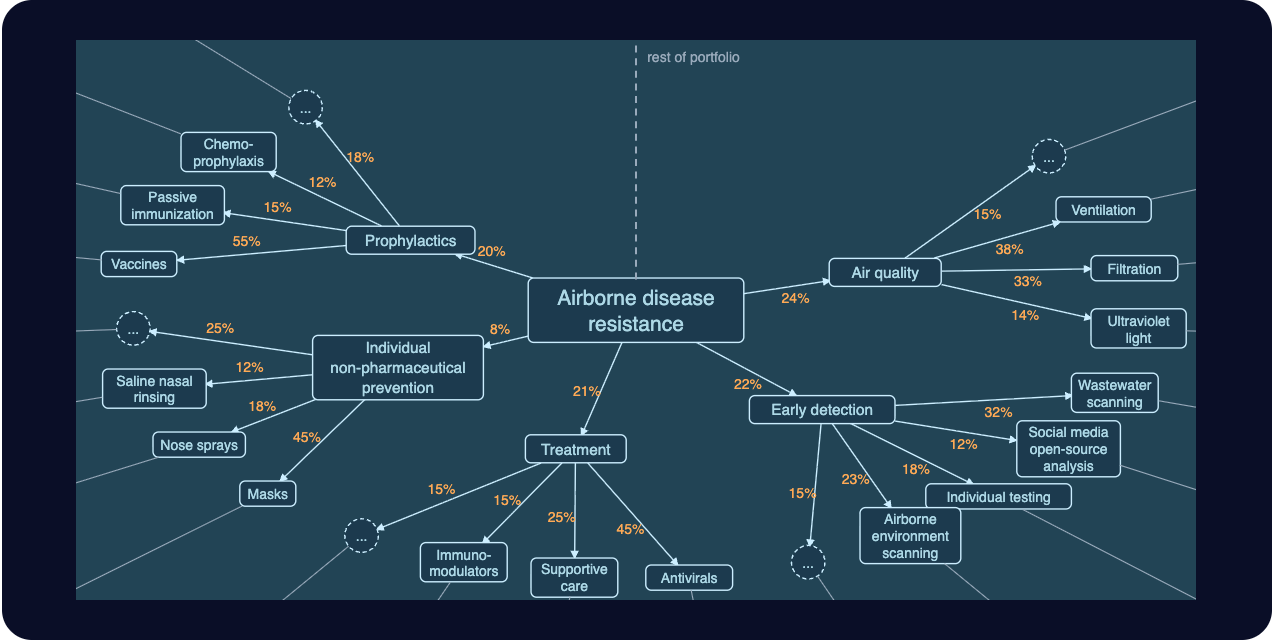
"This is a subgraph for airborne disease resistance. For each node in the graph, the encrypted network randomly selects a committee, which determines the weight assigned to the edge directly below that node."
"So it's as secure as the courts and the Order of Guidance. Having this kind of funding now is especially important, because the Northlanders just carried out the same attack on quadratic funding as they did on Blue Whale, but at ten times the scale—and of course, they'd try to interfere with any more traditional allocation method too."
"Oh, you're absolutely right. Even the Guardians have been attacked recently, though due to all the secrecy and internal communication barriers, at least for now the system has held."
"Oh, is that so? Good to hear. Though I regret that we don't have a good way to make these two things more democratic. Hearing from citizens' assemblies is good, and hearing from pioneers is good, but they're no substitute for actual public accountability."
"In any case, one difference between the design of Graph funding and the way the courts and the Order work is that Graph funding allows for much more specialization. After all, fund allocation is a fairly technical task."
"Our goal is to try to break each funding decision down into more manageable parts. Don't ask 'what percentage of Viridia's public funds should go to this UV lamp research.' Ask, what percentage should go to health, then within health, what percentage should go to airborne diseases, and so on."
"If a project benefits two domains: say, some kind of lamp is useful to some degree for both UVC lamps and defense, then the graph is no longer a tree but becomes a proper directed acyclic graph. A node can have multiple parents, and the funding obtained along all paths adds up."
"So committees are responsible for allocating funds to each node's immediate children?"
"Yes."
"Can they delete child nodes, or create new ones?"
"Yes, of course. That's how the graph gets made."
"That's interesting."
"I mean, this all depends entirely on the effectiveness of these committees, right? The more you specialize, the more likely it is to be captured by special interests, and the more you randomize, the more likely you are to have people making decisions about things they know nothing about?"
"Of course, there's always a trade-off."
"There's another trade-off. It turns out that it's fairly easy to get committees to distinguish good projects from bad ones, but very hard to distinguish good projects from good projects. So for the lower levels of the graph, there's recently been a movement toward randomization at the top. If a committee says you're in the top ten percent, then whether you're at ninety-one or ninety-nine, you have the same chance of getting in."
"That way, the further someone is above ninety, the less they have to bother catering to the committee, and they can just do what they think is right."
"Exactly. Sometimes you actually don't want accountability, you want to give space for people's intrinsic motivation. The people at the very top might even be smarter than the committee. That's what randomization above a cutoff does: accountability for those who couldn't succeed without it, exemption from incentives for the best—they can convince the committee their work is good enough with almost no effort."
"Anyway, that's the situation when zooming in at the individual project level."
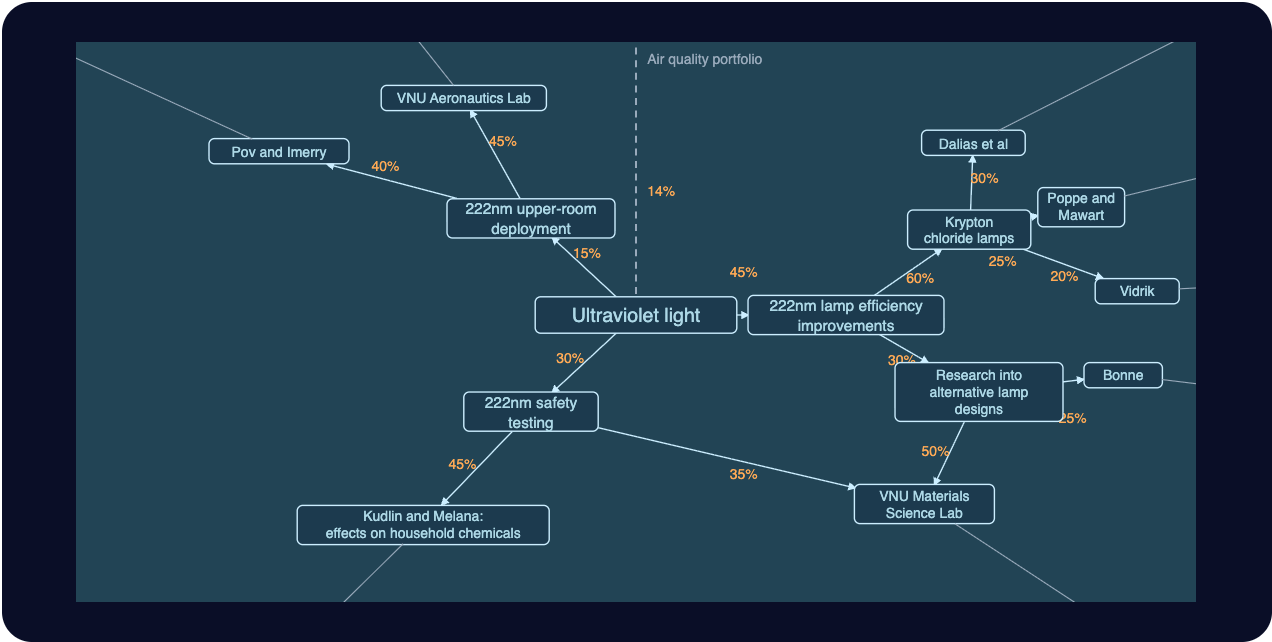
"Is it wise to have these randomly selected Graph funding committees making decisions at this level of granularity?"
"I'm not sure myself. The good thing about this design is that it can always evolve without changing the structure. A committee could decide to give the VNU Materials Science Lab 'ownership' of an entire category and let them allocate internally. In fact, for open-source social media analysis, that's basically what we do—eighty percent just goes to Silver Tongue."
"Blue Whale isn't happy about it, but hey, they chose to be so closed and proprietary about everything."
"So how does all this connect to Zhego?"
"Ah, a lot of this technology did reach Zhego, and they started taking air filters and UV lamps more seriously—some of them became paranoid, worried that the Northlanders might deliberately release a pandemic to attack them at some point."
"Is it possible for the Northlanders to attack them with a pandemic that ultimately wouldn't bounce back on themselves?"
"Well, if the North's anti-pandemic technology is far ahead of the rest of the world, then yes, they could release a pandemic that only they could effectively protect their own people from. That's an important reason why open-sourcing all this stuff is so valuable—at least the defensive stuff. Keep the whole world on a more level playing field, so no one can start a fire and be the only one wearing a fireproof suit."
"Anyway, if you do end up going to Zhego, please tell me what you learn about their public health situation when you get back—I'm curious!"
Gladias opened the door to his home and walked in.
Sera and the children were already eating dinner.
"Today's your first vote, isn't it?" Sera asked.
"Yes, glad you remembered!"
"So are you going out again tonight?" Ziven asked.
"Oh, no, the in-person part was the discussion months ago, and the key registration—I did that after the council meeting."
"There's been some discussion in our Guardian online discussion group recently too, though the chat automatically cuts off 7 days before the vote—there's a quiet period, to make more room for independent thinking, or so the saying goes."
"Ouch, so it cut off right after Red Shire was annexed. How did that go?"
"I think everyone who said we should remove military hardware from the top tiers of the title went quiet. Then the Eighteen proposed a new amendment raising the tax brackets and pushing further openness incentives. I'll probably vote for it."
"Glad to hear it."
"How did your council meeting go?"
"Good. The senator and the Graph funding guy both seem very supportive of me going. Though they said Zeyi might be a better contact to help me visit than anyone they know!"
"That actually makes sense—everyone knows the official Zhegoan government isn't where anything interesting happens."
"I think I'll talk to Zeyi, and then keep you both posted!"
Gladias, Sera, and the children ate a few bites of food. Soon, dinner conversation resumed.
"Febric, Hreda, want to share your news?"
"We're going to North Woodland for an exchange program in the winter term!" Hreda said proudly.
"Oh, that's far to the northeast, almost at the North Pole border," Gladias replied. "How interesting—we could fly a helicopter down from the mountains and glide back!" Hreda exclaimed. "And it's not even the border—North Woodland is over two hundred kilometers inland. This will be my first time going!"
"So what do you do there?" Gladias asked.
"Viridia's best mathematics university is there," Hreda replied. "My math scores were in the top five percent of my class, so I was admitted to go there for some special education."
"Me too," Febric added. "Though I'm studying computer science."
"Didn't Lily want to go to North Woodland too?"
Lily was in the bathroom and couldn't answer.
"Verl said if she can score seventy-five percent on her exams, he'll take her in the summer."
"She prefers summer, not so much the cold."
Gladias's handheld device buzzed.
"Alright, the hardware openness vote is starting."
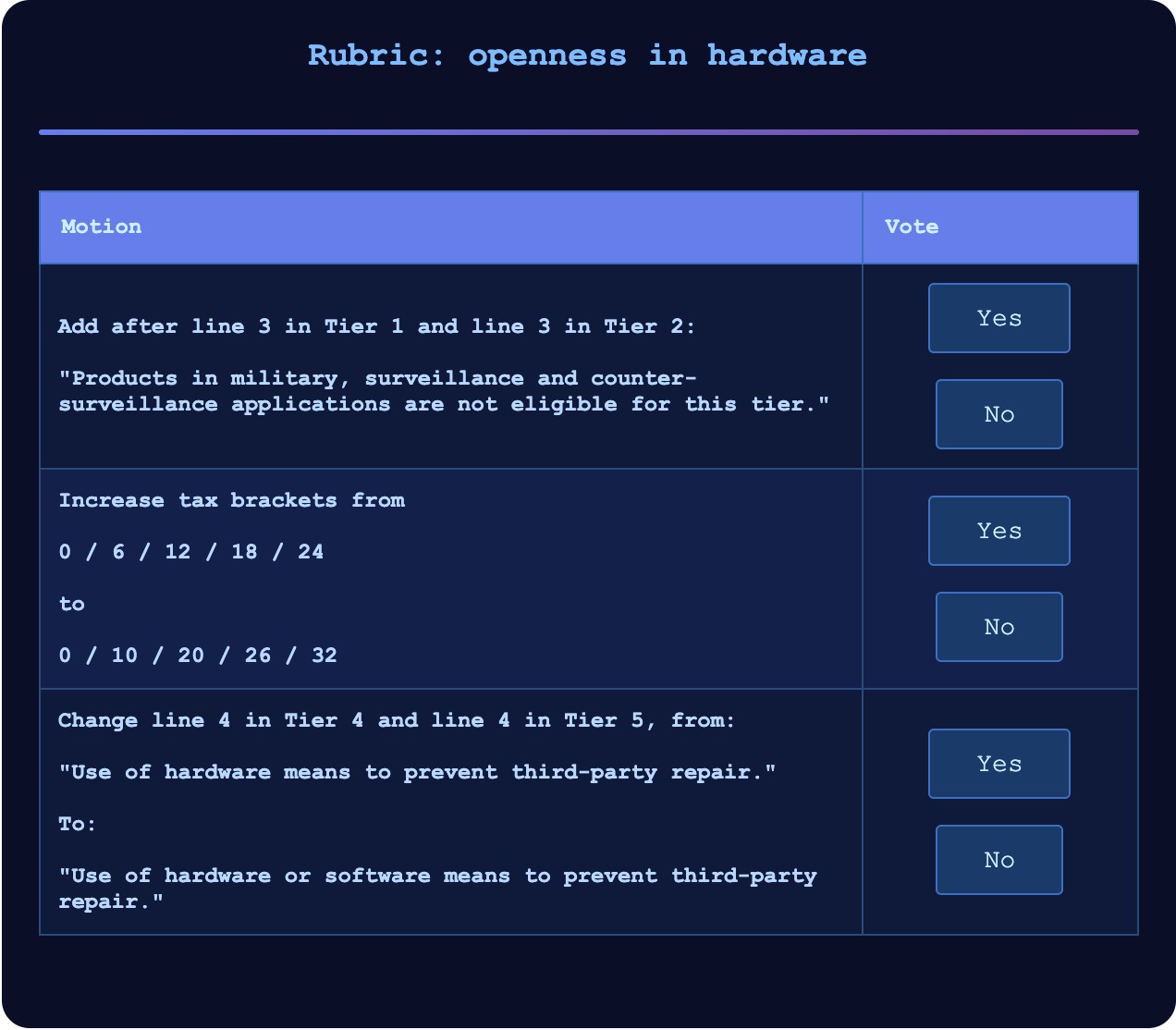
Rating Standard: Hardware Openness
Motion Vote
After Row 3 in Tier 1 and Row 3 in Tier 2, add:
"Products in military, surveillance, and counter-surveillance applications do not qualify for this tier."
Raise tax brackets from
0 / 6 / 12 / 18 / 24
to
0 / 10 / 20 / 26 / 32
Change Row 4 in Tier 4 and Row 4 in Tier 5 to:
"Using hardware means to prevent third-party repair."
To:
"Using hardware or software means to prevent third-party repair."
Gladias thought this felt a bit anticlimactic. Months of so much ceremony, in-person meetings, debates, and work before the vote. Then the vote itself was just... tapping a button on a screen.
Gladias thought this was reasonable. The way cryptography works, as long as the key registration is secure, this part can be done on his own hardware at home. Even if Delvot did come knocking and demand to stare over his shoulder throughout the entire fifteen-long-hour voting window, he couldn't prove to him that the key on his device was even the registered key—not while the real vote was being cast by Moff, Sera, or even Ziven as a distraction.
Gladias took one last look at the screen and casually pressed: No, Yes, Yes.





