






TRON Industry Weekly: Regulatory & Rate Hike Headwinds Fail to Break BTC Bulls' Confidence


- Core View: The Fed restarted rate hikes in September with a 25BP increase to 3.75%–4.00% and upgraded its inflation and rate forecasts, shifting the market's pricing focus to "economic resilience + elevated inflation + renewed policy tightening." After enduring regulatory setbacks and the rate hike shock, the crypto market staged a rapid rebound driven by short liquidations. The key question next week is whether BTC can hold $80,000 without short squeezing and break through the $82,000–$84,000 resistance zone.
- Key Elements:
- The September FOMC unanimously raised rates by 25BP, with the SEP lifting the median rate for end-2026 to 4.1% and raising PCE and core PCE forecasts to 3.7% and 3.4%, respectively.
- The U.S. economy presents a mix of "strong consumption, stable employment, weak manufacturing and housing": August retail sales rose 1.2% MoM, initial jobless claims came in at just 196,000, but new housing starts fell to 1.275 million units and manufacturing output declined 0.3%.
- The crypto market dropped first then sharply rebounded: BTC bounced from a low of around $75,000 to above $81,000, while ETH recovered from around $2,360 to $2,637, primarily due to short liquidations rather than macro improvement.
- The primary market saw approximately 33 funding rounds this week, with 14 in infrastructure and 6 in DeFi, as capital favored stablecoin payments, RWA, and institutional-grade crypto financial infrastructure.
- Regulatory progress diverged: the U.S. Senate did not advance the CLARITY Act, the SEC introduced a "innovation exemption" for tokenized securities; the UK's FCA issued final regulatory guidance, and Australia's ASIC set a deadline for licensing.
- Potential project Axon Finance positions itself as a PayFi-specific Layer 1, employing BFT sub-second finality, a sequencing layer with seqNo+WAL, pluggable compliance gateways, and Paymaster mechanisms.
I. Outlook
1. Macro-Level Summary and Future Predictions
- This Week's Macro Summary (September 14–20, 2026)
The core of global macro trading shifted noticeably this week—the market pivoted from previously discussing "when will rate cuts come" back to digesting inflation stickiness, energy price pressures, and the Federal Reserve resuming rate hikes. On September 16, the Fed unanimously voted 12-0 to raise the federal funds target range by 25bp to 3.75%–4.00%, a major turning point in this policy cycle; more critically, the September SEP showed that the Fed's median PCE inflation forecast for 2026 rose to 3.7%, core PCE to 3.4%, while the median policy rate forecast for end-2026 reached 4.1%, indicating that policymakers' vigilance toward inflation risks is markedly higher than mid-year. At the same time, the U.S. economy has not shown clear recession signs sufficient to force the Fed toward easing: August retail sales beat market expectations, initial jobless claims on September 17 were only 196,000, but real estate began to come under pressure, with August housing starts falling to about 1.27 million units; industrial production released on September 18 was flat month-over-month, with manufacturing output declining 0.3%. Therefore, the most important macro conclusion this week is not "economic recession," but rather that the combination of a still-resilient U.S. economy + elevated inflation + the Fed re-tightening has once again become the core of market pricing. This means financial conditions are tightening again, putting valuation pressure on high-valuation U.S. equities, long-duration assets, and global risk assets; on the first trading day after the Fed's rate hike, the effective federal funds rate also rose from 3.63% to 3.88%.
- Next Week's Predictions (September 21–27, 2026)
Next week is more of a "post-hike policy expectation repricing week" rather than a pure data week, as the U.S. will not release new CPI or PCE data. What truly matters is whether the market judges the September hike as a one-off inflation insurance move or the beginning of a new round of consecutive tightening. September 21–25 will feature密集 speeches from multiple Fed officials including Goolsbee, Williams, Jefferson, Barr, and Hammack, and the market will focus on finding their statements on further rate hikes, energy price pass-through, and inflation persistence; on the data front, August new home sales will be released on September 24, and August durable goods orders and the final Michigan consumer survey will be released on September 25, which will further verify whether high rates are beginning to suppress demand. My baseline judgment is that the macro environment next week will maintain a pattern of "high rate expectations difficult to dissipate quickly, long-end Treasury yields more likely to rise than fall, and elevated risk asset volatility": if Fed officials continue to reinforce their anti-inflation stance while durable goods orders and consumption-related indicators remain firm, the market will further raise expectations for subsequent rate hikes, putting pressure on U.S. equities, especially high-valuation tech assets; conversely, if economic data weakens significantly and Fed officials emphasize the need to observe policy effects after the September hike, Treasury yields and the dollar may pull back temporarily. Therefore, what needs the most vigilance next week is not a single economic data point, but rather the feedback loop of "economy continues to outperform expectations → Fed needs higher rates for longer → financial conditions tighten further."
2. Crypto Industry Market Movements and Alerts
- This Week's Crypto Market Review (September 14–20, 2026)
The crypto market this week exhibited a very typical structure of "decline on policy and rate hike shocks → concentrated risk release → short-covering driven rapid rebound." On September 14, BTC mainly traded around $76,400–$78,700, then the U.S. Senate failed to advance the CLARITY Act, regulatory expectations cooled rapidly, and on September 15 BTC fell to around $75,600, with ETH dropping about 4.6% that day to a low of around $2,360; on September 16, the Fed further raised rates by 25bp to 3.75%–4.00%, and BTC briefly dipped to around $74,955–$75,000 but did not form a sustained breakdown, indicating that the two major bearish factors of regulatory failure and rate hike had been relatively fully priced in within a short period. The real turning point came on September 17–18: BTC quickly counterattacked from around $75,000, breaking above $81,000 intraday on September 18, and as of September 20 remained in the $81,300–$81,900 range; ETH similarly rebounded from its September 15 low of around $2,360 to around $2,637 on September 19. This rally cannot simply be understood as a sudden improvement in the macro environment; the more important driver came from "selling pressure exhaustion after bearish news landed + short squeeze": around September 18, large-scale short liquidations occurred across the market, further creating被动 buying.
- Next Week's Alerts (September 21–27)
The most important thing next week is not to track whether BTC can continue to rise rapidly, but to observe whether this rally can truly transform from a "short-covering rally" into a "sustained new capital inflow rally." For BTC, the first focus is the $82,000–$84,000 resistance zone, where the $82,000 level has previously formed significant resistance multiple times; if it can effectively break through and hold above this area, it means the market has largely digested the rate hike and regulatory shocks, and the rebound structure has a basis for further continuation. Conversely, if BTC fails again to break $82,000, especially if it falls back below $80,000/$78,000, this rally is more likely to be proven as primarily driven by short covering, and attention should return to the $75,000–$76,000 support; once $75,000 is clearly breached, the next risk zone to watch is around $69,000–$72,000. For ETH, the key focus is whether $2,600 can transform from resistance into effective support and whether it can continue to break above this week's high of around $2,650. So the most critical validation signal for next week is: can BTC hold $80,000 without the help of large-scale short liquidations, and rely on spot and ETF new capital inflows to break through $82,000–$84,000; if not, beware of a secondary pullback after this week's sharp rally.
3. Industry and Sector Hotspots
From September 14–20, 2026, primary market fundraising in the crypto industry remained active overall. According to public statistics, approximately 33 investment and financing events were disclosed this week, of which 14 were infrastructure and 6 were DeFi, clearly becoming the two most capital-concentrated directions, while stablecoin payments, RWA, and institutional-grade data services continued to attract capital attention. Representative fundraisings include Kaiko receiving a strategic investment led by S&P Global, bringing its cumulative Series B funding to $110 million, with proceeds focused on on-chain capital markets data infrastructure; stablecoin infrastructure Fin.com completing a $20 million seed round, dtcpay completing a $15 million Series A, DeFi/RWA project Tare completing a $13.25 million seed round, and usd.ai obtaining $40 million in debt financing. Overall, capital this week did not concentrate on chasing a single hot narrative, but rather further tilted toward stablecoin payments, RWA, DeFi, and institutional-facing crypto financial infrastructure, with notable participation from traditional financial institutions.
II. Market Hot Sectors and Weekly Potential Projects
1. Potential Project Overview
1.1. In-depth: Total funding of $2 million, with participation from Infinite Alliance and UZ Capital—Building Axon Finance, a high-performance payment finance infrastructure dedicated to PayFi
Introduction
AXON Finance is a Layer 1 public chain built specifically for Payment Finance (PayFi). The project focuses on high throughput, sub-second transaction confirmation, and low-cost, predictable transaction fees, and integrates core capabilities including stablecoin settlement infrastructure, Account Abstraction, Fee Sponsorship, and a Pluggable Compliance Gateway.
In addition, AXON Finance supports financial application scenarios such as instant stablecoin settlement, AI Agent automated payments, on-chain money markets, and cross-border B2B payment settlement. The project also proposes a chain-native Controlled Payment Execution mechanism, supporting control policies such as payment amount limits, time windows, whitelist mechanisms, and revocability for automated payments, enhancing payment automation efficiency while balancing fund security and compliance management.
Protocol Mechanism Overview
1. The Five-Layer Architecture
The Complete Journey of a Payment from Top to Bottom
AXON's underlying architecture consists of five layers. The best way to understand this five-layer architecture is to observe the entire process of a payment from initiation to completion: a payment request first enters the Gateway Layer, then completes transaction sequencing in the Sequencing Layer, completes fund settlement in the Settlement Layer, and is finally written into the Layer 1 on-chain state (L1 State), while the entire process is continuously supported by the underlying on-chain primitives (On-chain Primitives).
The Panorama
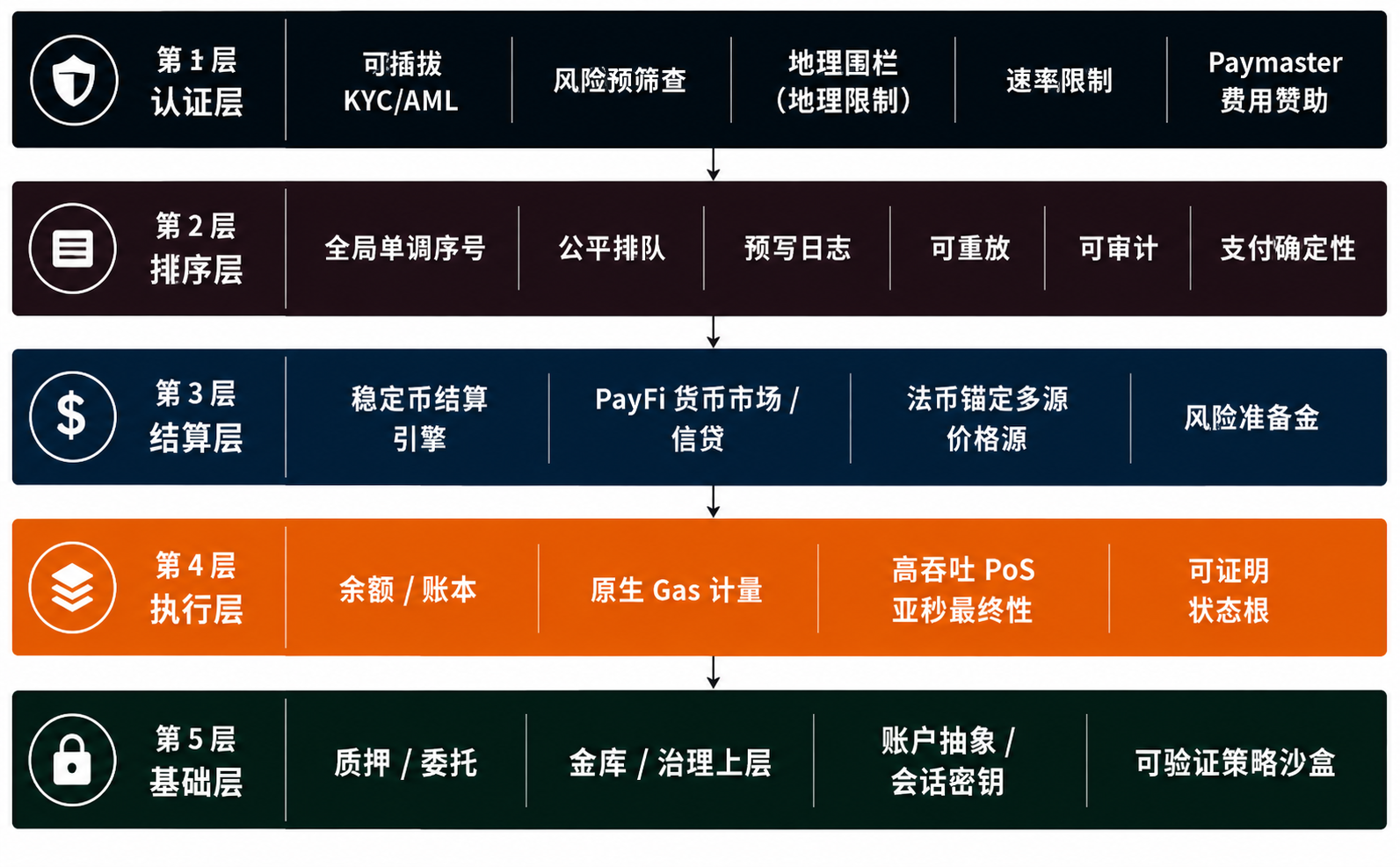
Responsibilities, Layer by Layer
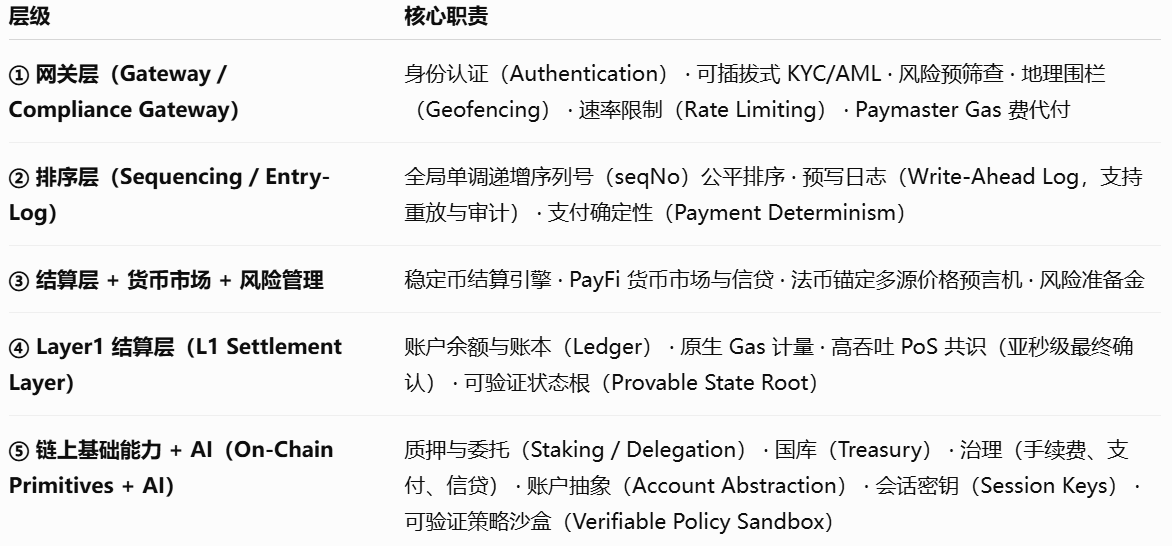
Core Functions of Each Layer
① Gateway Layer (Gateway / Compliance Gateway)
The Gateway Layer is the first entry point for payments entering the AXON network, uniformly responsible for identity authentication, compliance review, risk control, rate limiting, and Paymaster Gas fee sponsorship. AXON builds compliance capabilities into the underlying infrastructure rather than as an add-on module at the application layer, thereby achieving unified risk management and compliance control from the payment entry point (see 3.6 for details).
② Sequencing Layer (Sequencing / Entry-Log)
The Sequencing Layer is the core of Payment Determinism. The system assigns each transaction a globally unique and monotonically increasing sequence number (seqNo), sequences them in a fair queue, and writes transactions into a Write-Ahead Log that supports full replay and auditing. This mechanism forms the technical foundation for AXON's transaction traceability, recoverability, and auditability, ensuring that any anomaly can be accurately located and recovered (see 3.4 for details).
③ Settlement Layer + Money Market + Risk Management
This layer is the core business engine of AXON PayFi, integrating key components such as the stablecoin settlement engine, on-chain money market and credit system, fiat-anchored multi-source price oracle, and risk reserve fund, providing unified financial infrastructure for payments, lending, and fund management (see Part IV and 3.5 for details).
④ Layer 1 Settlement Layer (L1 Settlement Layer)
The Layer 1 Settlement Layer (also the core part of the architecture diagram) undertakes the foundational operating capabilities of the entire public chain, including ledger management, native Gas metering, high-throughput PoS consensus mechanism (supporting sub-second finality), and verifiable State Root generation, providing the entire network with a high-performance, secure, and verifiable underlying execution environment (see 3.3 for details).
⑤ On-Chain Primitives + AI
This layer provides underlying foundational capabilities for the entire AXON network, including staking and delegation, treasury management, and on-chain governance. At the same time, it provides AI-native capabilities including Account Abstraction, Session Keys, and Verifiable Policy Sandbox, providing underlying support for AI Agents to automatically execute payments, manage strategies, and enforce security controls (see 3.7 and Part V for details).
2. A Payment's Journey Through Time
Converting the above five-layer architecture from a Vertical Structure into a Horizontal Timeline yields the complete lifecycle of a stablecoin payment from initiation to completion.

This timeline fully embodies AXON's core design philosophy: every step in the payment process is Explicitly Modeled, Explicitly Ordered, and Explicitly Recorded. There is no ambiguous state such as "Probably Succeeded" throughout the process—from payment entering the gateway to final on-chain settlement, every step is Verifiable, Auditable, and Recoverable. This is precisely the core meaning of AXON's "Building Determinism into the Foundation."
3. Consensus, Sub-Second Finality & Performance Targets
Deterministic / BFT Finality
The typical representative is the Byzantine Fault Tolerant (BFT) consensus mechanism. When a transaction receives confirmation from a quorum of validating nodes, it immediately achieves irreversible Finality and will not be replaced or rolled back due to a longer chain appearing.
Its main characteristics include:
- No need to wait for multiple block confirmations; Finality is achieved once the transaction is confirmed;
- Finality can be achieved at sub-second levels (Sub-second Finality);
- For payment scenarios, this truly conforms to the semantics of "funds have been definitively received."
AXON's Choice: Deterministic Finality
AXON adopts Deterministic Finality as its underlying consensus mechanism because payment systems cannot be built on probability. Only when transactions can achieve irreversible, verifiable, and non-rollbackable finality within an extremely short time can the requirements of PayFi for real-time performance, determinism, and fund security be met.
4. Three Guardrails for Payment Determinism
To ensure payment determinism, AXON has built three core protection mechanisms.
① Deterministic Settlement
Based on the BFT Deterministic Finality introduced in Section 3.3, once a transaction is confirmed by the network, it is irreversible, with no probabilistic risk of rollback due to a longer chain appearing.
② Double-Spend Prevention
AXON guarantees at the underlying level that the same funds will never be paid twice.
The system assigns a globally unique sequence number (seqNo) to each payment at the Sequencing Layer, and all transactions are executed and settled strictly in sequence number order, mechanically eliminating double-spend problems caused by concurrent transactions.
③ Rollback Protection
When the system encounters anomalies, AXON will not enter an unrecoverable inconsistent state, but can accurately recover to the correct state relying on the Write-Ahead Log (WAL).
In other words, even if a failure occurs, the system can still clearly determine "what the correct state should be" and complete recovery accordingly, without causing confusion in fund states.
The Sequencing Layer: The Heart of Determinism
The core capability of payment determinism is concentrated in the Sequencing / Entry-Log Layer, which undertakes two seemingly simple but critically important responsibilities.
Global Monotonic seqNo Fair Queuing
Every transaction entering the system receives a globally unique and monotonically increasing sequence number (seqNo).
This means:
- All transactions in the system have a unique and deterministic execution order;
- There is no ambiguity about "which transaction happened first";
- It also significantly compresses the space for MEV (Maximal Extractable Value) and other manipulations based on transaction ordering.
Write-Ahead Log (WAL)
Before a transaction is actually executed, the system first writes the planned execution content into an append-only, tamper-evident Write-Ahead Log.
This log supports full replay.
As long as the same WAL is available, any node can re-execute all transactions and recover a completely consistent system state.
The Write-Ahead Log is a mature technology validated over time in the traditional database field, and it is precisely the key mechanism that enables databases to recover to a consistent state even after a sudden power outage.
AXON introduces this design into the payment system: as long as the WAL exists, the correct payment state can always be reconstructed. This is also an important technical foundation for AXON's "always traceable, always recoverable" capability.
A Payment as a State Machine
Under the combined effect of the above three safety mechanisms, a payment operates according to a strict State Machine, where every state change has clear meaning and can be verified.
A typical lifecycle is as follows:
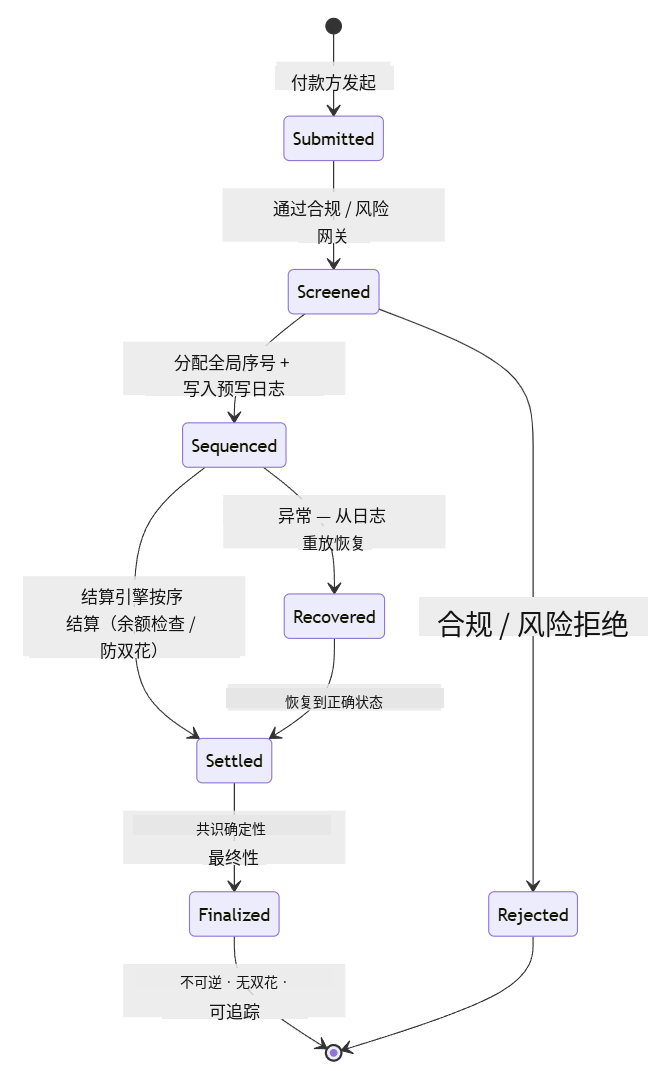
If an anomaly occurs during payment execution, the system will perform replay recovery (Recovered) based on the Write-Ahead Log (WAL), restore the transaction to the correct state, and continue execution.
AXON's key design philosophy is that there is no "Fuzzy State" in the payment process.
A payment is either:
- Explicitly rejected at the Gateway Layer (Rejected);
Or:
- Completes its entire lifecycle strictly following the deterministic path of Submitted → Screened → Sequenced → Settled → Finalized.
Even if an anomaly occurs during transaction execution, it can rely on WAL replay to recover to the correct state and continue subsequent processes, without situations where "funds are stuck at an unknown step" or "payment status cannot be confirmed." This is precisely the core value of AXON's payment determinism design.
5. Three Lines of Defense
To ensure the reliability of stablecoin





