DeepSeek Core Engineer's Long Post Goes Viral: I Had to Bury My Talent in Yesterday


- Core Viewpoint: Liu Shengyu, a core operator engineer at DeepSeek, published a post acknowledging that AI's ability to write operators will soon surpass humans. Engineers will not be "unemployed" but must "transition careers," shifting from hand-writing operators to becoming "mech pilots" of AI Agents, sparking widespread resonance in the industry regarding the fate of developers in the AI era.
- Key Elements:
- Liu Shengyu is a member of Peking University's Turing Class and former captain of the supercomputing team, having just delivered the main Attention operator for DeepSeek V4.1 (MQA attention with head dim=512).
- He judges that within six months to a year, AI will match or even surpass humans in writing operators, because AI continues to evolve in speed, parallelism, and model depth while humans cannot.
- He proposes "not unemployed but must transition careers": industry demand has already drifted from "people who can write high-performance operators" to "people who can use AI to produce operators faster."
- He is concerned that students relying on AI to complete assignments will lead to a gap in engineering capability, and that those with low engineering ability paired with AI will instead efficiently produce "shit mountain" systems.
- He clarifies that the purpose of writing was to bid farewell to the era of "purely hand-written operators," not to express unemployment anxiety or to provoke confrontation with closed-source institutions.
- He reiterates his commitment to staying at DeepSeek, because he believes the most cutting-edge intelligence should be supplied to society in an open and inclusive manner, avoiding monopoly by a few commercial oligarchs.
- The article ranked first on Zhihu's hot list and received hundreds of thousands of reads on WeChat official accounts, but public attention leaned toward geopolitical competition rather than his original intent of bidding farewell to an era.
Original Author: Long Yue
Original Source: Wallstreetcn
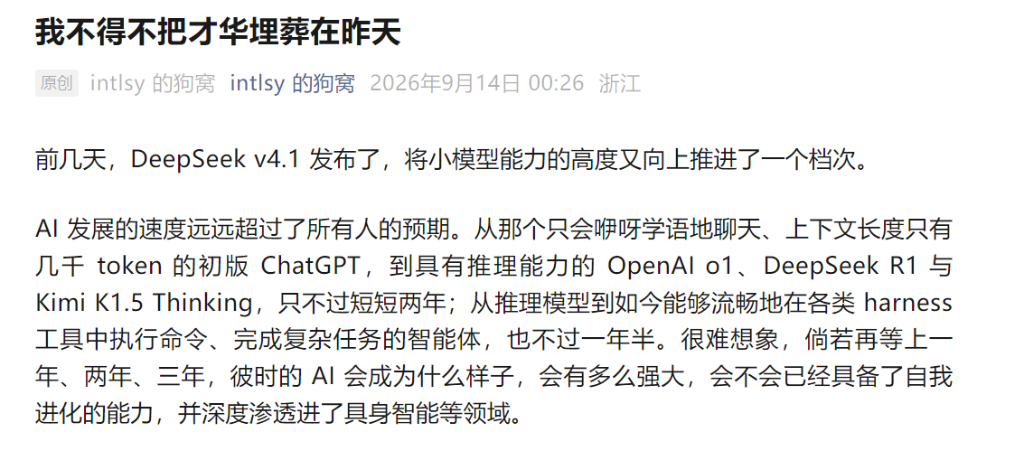
On September 14, Liu Shengyu, a young engineer who had just delivered the core operators for DeepSeek V4.1, published a long essay titled "I Had to Bury My Talent in Yesterday," documenting technological change and his personal journey. The piece went viral across domestic and international tech communities, sparking widespread discussion about the fate of developers and the evolution of technology in the AI era.
The hashtag #I Had to Bury My Talent in Yesterday# also climbed to the top of Zhihu's trending list.
As one of the core builders of the underlying infrastructure for large models, Liu Shengyu, a machine learning systems engineer at DeepSeek, has an impressive technical background. He was a member of Peking University's 2021 "Turing Class" in computer science, served as captain of PKU's Weiming Supercomputing Team, and represented the university at the International Collegiate Supercomputing Competition SC23. After joining DeepSeek in April 2025, he took on critical low-level operator R&D work, and just days ago completed the code delivery for DeepSeek V4.1's main Attention operator (MQA attention with head dim = 512).
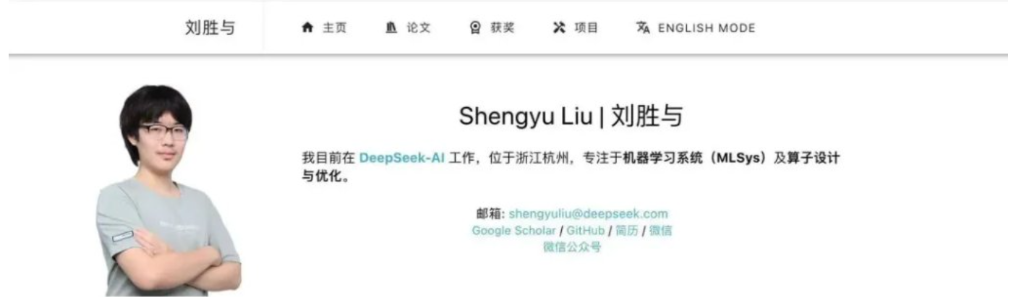
In the article, Liu Shengyu admitted that while he takes pride in the success of DeepSeek V4.1's core operators, he is also keenly aware of the irreversible march of technology.
"In another six months or a year, AI-written operators will most likely be just as good as mine, or even surpass mine," Liu Shengyu said bluntly. "AI can think 300 tokens per second, type a line of command in half a second, and write a piece of code in twenty seconds — I can't. AI can continuously improve in model depth, reasoning intensity, tool invocation volume, and even parallelism — I can't."
This rapid evolution has pushed developers into a profound technological paradox: the better he optimizes operators, the faster new models can infer and train; the faster model capabilities advance, the sooner AI will replace human-written operators.
Facing this irresistible trend, Liu Shengyu wrote: "Humanity has never hesitated in the matter of destroying itself... Of course I hope I won't be revolutionized, but if I must be, I hope the one who revolutionizes me is myself."
"I Won't Be Unemployed, But I Must Change Careers"
Addressing outside concerns about programmers' livelihoods, Liu Shengyu offered a clear-eyed assessment: engineers as a group won't face unemployment in the true sense, but they will inevitably undergo a profound "career transition."
"A career transition means I need to give up the field of operator design, writing, and optimization that I've deeply cultivated and been passionate about, and instead become an Agent's 'mecha pilot,'" he wrote. "Previously, my interests, my strengths, and what industry needed were basically aligned; now, industry demand has shifted from 'people who can write high-performance operators' to 'people who can use AI to produce high-performance operators faster.'"
He compared the loss of this craft to the impact of automated sock-knitting machines on traditional craftsmen. Even if experience still allows one to use the machine best, the former "joy of sitting by the window, listening to the rain, threading needles, and savoring time — was ultimately crushed by the roar of machines."
"I have more gears in my hands, but fewer rhythms in my heart," he lamented.
Beyond personal career transformation, Liu Shengyu also expressed concern about the degradation of engineering capabilities among the younger generation. If students generally rely on AI to complete complex coding assignments in minutes, there may be a gap in system architecture and abstract design capabilities. "A person with poor engineering skills, when paired with AI, can produce crap at several times the previous efficiency, planting all kinds of hidden dangers in systems and making the world more and more of a slapdash operation."
Clarifying Intent: A Dignified Farewell to the "Handicraft Era"
After the article's publication triggered excessive interpretations across platforms regarding geopolitics, institutional competition, and even unemployment anxiety, Liu Shengyu subsequently released a supplementary note clarifying his original intent.
He stated that the article was not an expression of anxiety about his livelihood, nor an attempt to provoke confrontation between DeepSeek and closed-source institutions like Anthropic. Its core motivation was simply a sincere farewell to the pure days of "purely handwritten operators."
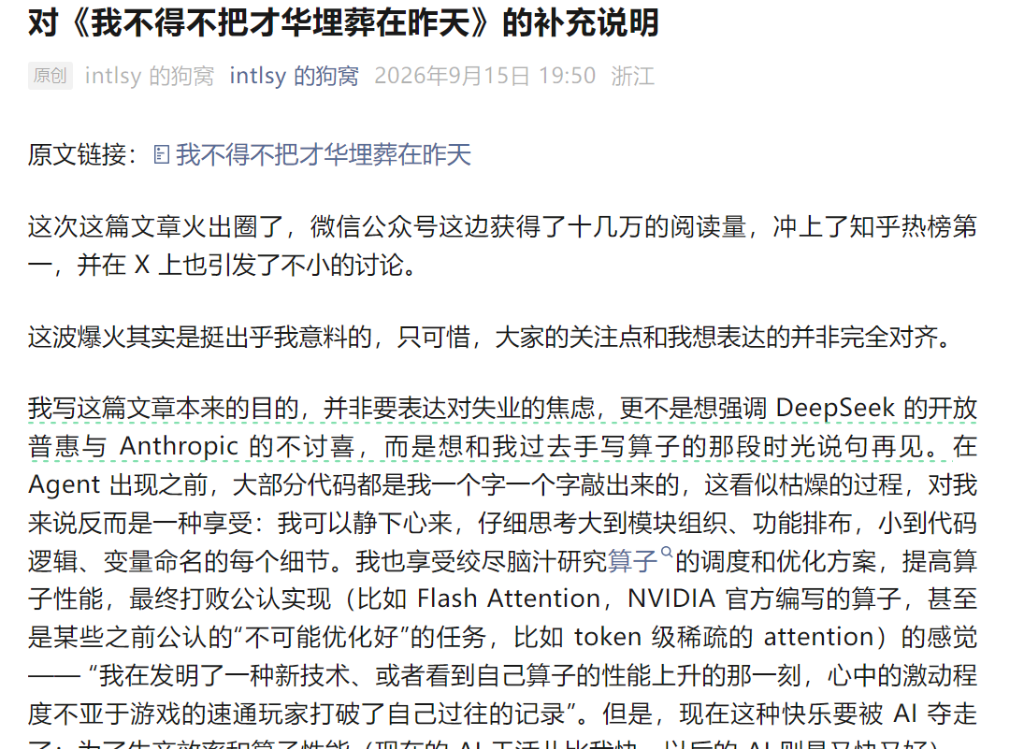
"I imagine that one day in the future, 'handwriting operators' or even 'programming' may become a recreational activity rather than a productive one, just as almost no one hunts with a javelin now, but uses it as a competitive sport," Liu Shengyu wrote. "This is essentially forcing me to give up something I once loved, and forcibly turn to another direction. Even if the new direction is equally fascinating, it doesn't feel good. As the title says: I had to bury my talent in yesterday."
Speaking about why he insists on staying at DeepSeek, Liu Shengyu reaffirmed his belief: the most cutting-edge intelligence should be supplied to society in an open, accessible manner, preventing core capabilities from being completely monopolized by a handful of commercial oligarchs.
"After having to bury my talent in yesterday, I still have tomorrow's light to chase," he said at the end of the supplementary note, stating that he will continue to devote himself to the new workflow of incorporating AI Agents into operator writing, embracing new technological tools while seeking a foothold in the new era.
The original text is as follows:
"I Had to Bury My Talent in Yesterday"
Original intlsy's Doghouse September 14, 2026, 00:26 Zhejiang
A few days ago, DeepSeek v4.1 was released, pushing the capabilities of small models up another notch.
The pace of AI development has far exceeded everyone's expectations. From the initial version of ChatGPT that could only babble in conversation with a context length of just a few thousand tokens, to OpenAI o1, DeepSeek R1, and Kimi K1.5 Thinking with reasoning capabilities — it took only two short years; from reasoning models to agents that can now fluidly execute commands in various harness tools and complete complex tasks — it's been only a year and a half. It's hard to imagine what AI will look like in another year, two years, three years — how powerful it will be, whether it will have gained the ability to self-evolve, and whether it will have deeply penetrated fields like embodied intelligence.
AI Is Getting Better and Better at Writing Operators
AI has also made rapid progress in the field of operator design and writing that I work in. In just one year, it has transformed from a little assistant that could only help me look up documentation, read code, and find bugs, into an operator master capable of independently reading CUDA, PTX, and SASS code, analyzing the stall time of each instruction through professional tools, and then independently optimizing operators. I believe that in the near future, it will also have the ability to independently design operator scheduling, evaluate the performance of different scheduling schemes, and implement and optimize them.
Of course I'm proud of DeepSeek v4.1's success — after all, I wrote its main Attention operator [1], and its excellence is a testament to my operators. But the wheels of the times roll forward, and no one can stop the advance of technology. I know very well that in another six months or a year, AI-written operators will most likely be just as good as mine, or even surpass mine. AI can think 300 tokens per second, type a line of command in half a second, and write a piece of code in twenty seconds — I can't. AI can continuously improve in model depth, reasoning intensity, tool invocation volume (frequency of interaction with the environment), and even parallelism — I can't.
Humanity has never hesitated in the matter of destroying itself. Why, knowing full well that "the better I write operators, the faster our new models can train and infer, the faster model capabilities advance, and the sooner I'll be replaced," do I still choose to optimize operators to the best of my ability? Partly because writing operators is like playing a game for me — it provides immense pleasure. The moment I invent a new technique, or see my operator's performance improve, the excitement in my heart is no less than that of a speedrunner breaking their own record. At the same time, when I see my operator's performance far exceeding the manufacturer's official operators, I feel immense pride. But beyond that, a more important reason is that even if I just "slacked off" or even deliberately sabotaged model training, other companies' models would still develop as usual and ultimately kill me all the same. "Of course I hope I won't be revolutionized, but if I must be, I hope the one who revolutionizes me is myself." When everyone is so bent on destroying themselves, I have no choice but to join this brutal arms race.
Then What About Me
When the day comes that AI writes operators better than I do, what will happen to me?
My judgment is: I won't face "unemployment," but I must "change careers." My livelihood can still be maintained, but this may mean I'll never have the chance to do the work I once loved again.
I once made a judgment about the changes of the times and my personal situation in the future: because the times are changing so fast (the AI development mentioned above is a good example), I simply cannot predict what will happen in five or ten years. But regardless, I believe that with my vision, judgment, initiative, and intelligence, I can stay at the table of the times and stand at the forefront again. However, this judgment can only guarantee that I won't be "unemployed," not that I won't need to "change careers." Rather, this judgment encourages me to change careers to avoid unemployment.
So what does changing careers mean? It means I need to give up the field of operator design, writing, and optimization that I've deeply cultivated and been passionate about, and instead become an Agent's "mecha pilot." Previously, my interests, my strengths, and what industry needed were basically aligned; now, AI has made what I'm good at into something it's better at, and shifted industry demand from "people who can write high-performance operators" to "people who can use AI to produce high-performance operators faster." To adapt to industry needs, I must inevitably give up the direction I once loved and turn to an unknown new direction. I believe I can continue to produce operators with high quality and efficiency by leveraging my understanding of engineering, upper-level model requirements, and lower-level hardware. I also know I might love this new direction (or might not), but the feeling of having one's passion taken away is truly unpleasant. That simple joy of sitting at my workstation and quietly writing operators for an entire afternoon may become a swan song this summer. I have to bury my talent in yesterday and become a mecha pilot. I have more gears in my hands, but fewer rhythms in my heart.
Here's a vivid analogy: You're a master of knitting sweaters, especially skilled at weaving various patterns and matching different colors. The sweaters you knit are durable and beautifully patterned, and wealthy people from miles around come to ask you to knit for them, earning you quite a bit of money. At the same time, you thoroughly enjoy the feeling of sitting by the window, brewing a pot of tea, gazing at the green mountains, flowing water, cattle, sheep, and chimney smoke outside, and quietly knitting sweaters for an afternoon. But one day, someone invents a magical machine that can automatically knit sweaters just by providing yarn and a pattern, with quality and texture no less than your handmade work, and far faster than you. You know very well that your peers can easily reach your former level with this machine, so you have no choice but to use it too. You also know that with the knitting skills you've accumulated over the past twenty years, even if everyone has the machine, your speed and quality can still surpass your peers. But that joy of listening to the rain by the window, threading needles, and savoring time — was ultimately crushed by the roar of machines.
I know this is helpless, but there's no way around it. My livelihood can be maintained, but the passion of old will most likely have to be abandoned. I'm someone who separates rationality and emotion fairly well — I can be very rational when I need to handle problems with reason, but sometimes I also show an emotional side. I remember I even cried a lot when I moved out of the rental apartment I'd lived in for a year, reluctant to part with past memories. Today's farewell to the era of handwritten operators and human-brain optimization is undoubtedly crueler than that.
I don't know if any readers have felt something similar, but I think that's just how it has to be.
Then What About People
As AI continues to advance, I also have concerns about some issues:
- Are students now more likely to use AI to complete assignments, especially practical Labs? Imagine two choices: one is to toil for eight hours to complete a Lab, and perhaps still not get full marks; the other is to fire up an AI model and, for a few cents and a few minutes, have AI directly write perfect code. Which would most students choose?
- The above point will lead to a severe lack of engineering capabilities among a large number of students, including the ability to organize code, build systems, think about potential future requirements and address them in advance in design, and abstract. So, against the backdrop of AI capabilities continuously strengthening, are these "engineering capabilities" still necessary? Will these engineering abilities gradually be abandoned by the times like the old "skill of proficiently writing x86 assembly," or will they remain valuable forever like "understanding the entire computer system from software to systems to hardware"? If it's the latter, that's dangerous — a person with poor engineering skills, when paired with AI, can produce crap at several times the previous efficiency, planting all kinds of hidden dangers in systems and making the world more and more of a slapdash operation.
- In future society, will power be more important than technology or intelligence?
These questions may need the times themselves to answer.
Conclusion
With the development of AI, future society may trend toward two extremes: communism and Cyberpunk 2077. In the former, productivity is greatly liberated, and people's living standards improve markedly; in the latter, a few tech companies control most resources, only a very few can use the most advanced AI and various technologies to achieve something close to "mechanical ascension," while most people can only use very weak AI. Class mobility will become increasingly difficult to achieve: you need the most powerful AI first to cross classes, forming a dead loop.
Guess — if An****pic company forever holds the world's most advanced AI, will future society become communism or 2077? Take a guess?
So, I still believe that the most cutting-edge intelligence should be supplied to everyone in an open, cheap manner. I don't trust Anthropic or OpenAI to do this, especially I don't want Anthropic to hold the most advanced AI or AGI — to put it dramatically, its severity is no less than letting Hitler acquire nuclear bomb technology before the Allies. This is also why I chose and insist on staying at DeepSeek: we research powerful, fast, accessible AI and open-source it, perhaps pulling the world back a bit from the 2077 end.
May the future world be well. May all the beauty be blessed.
[1] "Main Attention" only includes MQA attention with head dim = 512, and does not include the indexer used to select the top-k important tokens — that part was written by other (also very strong) colleagues