Why Is Circle Building Its Own Chain? A Complete Breakdown Before Arc's Mainnet Launch


- Core Viewpoint: Circle's self-developed L1 network Arc is scheduled to open its mainnet on September 16, 2026, positioned as an institutional settlement network for stablecoins, RWA, and foreign exchange clearing. Its centralized design stems both from the technical inevitability of BFT consensus and from the compliance floor set by the GENIUS Act. Its success will depend on whether the DTCC integration can be implemented in 2027.
- Key Elements:
- Arc was initiated and developed by Circle, completing a $222 million presale at a $3 billion valuation in May 2026, with a16z crypto leading a $75 million investment.
- It adopts Malachite consensus (BFT deterministic finality, with finality in approximately 350 milliseconds) and the Reth execution layer, with block times of about 0.5 seconds and a mainnet Chain ID of 5042.
- Under the GENIUS Act, Circle, as a PPSI, must fulfill AML/KYC obligations, resulting in centralized designs such as a built-in blacklist at the protocol layer and USDC as native Gas that does not pay interest.
- The validator set is completely closed, with a total of 12 nodes (Circle plus 11 institutions), including DTCC, ICE, Visa, Mastercard, BlackRock, and others. Collusion by 4 of them would be enough to halt the entire network.
- The ARC token has an initial supply of 10 billion, with 60% allocated to the ecosystem and 25% retained by Circle. The TGE has not yet launched, and key parameters such as the inflation rate and unlock schedule have not been disclosed.
- The CLARITY Act will undergo a procedural vote on September 15. Polymarket's odds of passage have already fallen from 82% to 16%. If it fails, regulation will return to a path of separate rulemaking by individual agencies.
- Compared with the meme boom around Robinhood Chain, Arc lacks operator interest alignment, a retail onboarding funnel, a tradable native token, and front-running infrastructure, making it difficult for market momentum to form.
Circle's self-developed Layer 1 network, Arc, is scheduled to open its public mainnet on September 16, 2026. From its inception in August 2025 and the launch of its public testnet on October 28, 2025, to completing a $222 million institutional presale at a $3 billion valuation in May 2026, the market's judgment of it has remained polarized: some see it as a watershed moment for traditional capital entering blockchain, while others denounce it as departing from decentralization and reducing itself to a private consortium chain for traditional finance.
Both claims can find supporting evidence. Setting aside the official marketing rhetoric for now, let us analyze it from four angles: why Circle is building its own chain, its consensus mechanism, how this chain differs from others, and what ordinary users can participate in.
1. Why Circle Is Building Its Own Public Chain
USDC has long been issued on Ethereum, Solana, and major L2s. As a user rather than an operator of these networks, Circle faces three structural constraints.
Financial friction from dual currencies. When enterprises execute cross-border settlements or large transfers, they must additionally purchase and hold ETH or SOL to pay transaction fees. This creates an additional exposure, an additional foreign exchange conversion, and an additional tax item on corporate books.
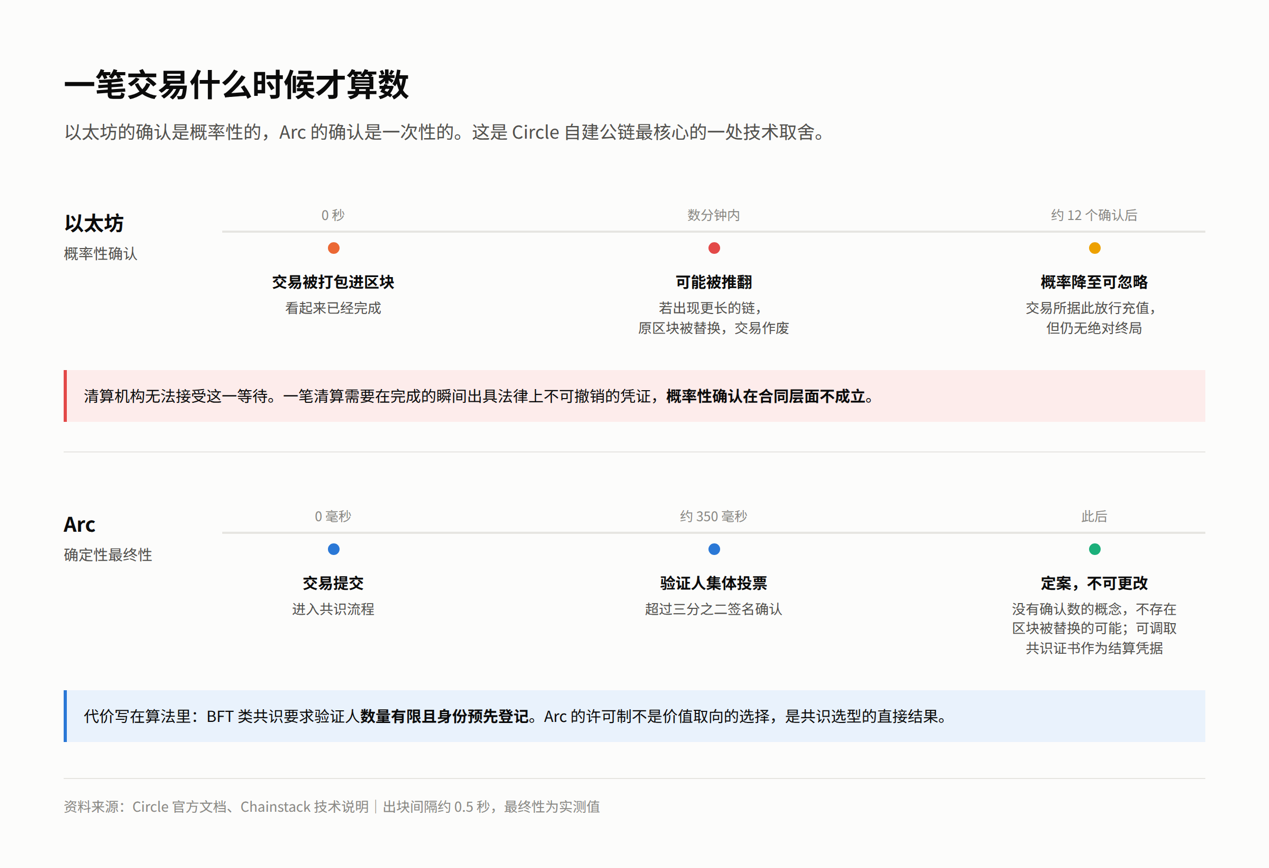
Transaction confirmation can be overturned. In networks like Ethereum, having a transaction included in a block does not equate to final confirmation. If another longer chain emerges, the original block will be replaced and its transactions invalidated. This phenomenon is called a block reorganization, and its probability of occurrence decays rapidly as subsequent blocks accumulate. Exchanges requiring a certain number of confirmations for deposits are essentially waiting for that probability to drop to a negligible level.
Crypto users are already accustomed to this waiting process, but clearing institutions cannot accept it. Clearing operations require legally irrevocable proof at the instant a transaction is completed; probabilistic confirmation does not hold up at the contractual level.
Lack of protocol control. Hard forks of the underlying public chain, MEV congestion, Gas price volatility, and sequencer failures all fall outside Circle's risk control scope.
Arc's positioning is not to compete as a general-purpose public chain for DeFi liquidity, but as a settlement network dedicated to stablecoins, tokenized real-world assets (RWA), and foreign exchange clearing.
2. Regulatory Framework: One in Effect, One Pending a Vote
Arc's architectural choices stem half from commercial motives and half from regulatory constraints. Only by clarifying this layer can we distinguish which designs come from Circle's preferences and which come from statutory obligations.
The GENIUS Act, already in effect
On July 18, 2025, the GENIUS Act took effect, becoming the federal regulatory framework for payment stablecoins in the United States.
The law sets four core obligations for issuers: reserves must consist of highly liquid, high-quality assets, with monthly disclosure of reserve reports and quarterly audits by third-party institutions; issuers with outstanding liabilities exceeding $10 billion must obtain federal licensure and become "Permitted Payment Stablecoin Issuers" (PPSI); PPSIs are classified as financial institutions under the Bank Secrecy Act, making anti-money laundering and customer identification mandatory requirements; issuers may not pay interest or yield to holders, which is the statutory dividing line between payment stablecoins and bank deposits.
The Federal Deposit Insurance Corporation (FDIC) has made clear that the reserve assets backing stablecoins are not covered by federal deposit insurance.
Against these provisions, several of Arc's designs can be traced directly. The built-in blacklist mechanism at the protocol layer corresponds to issuers' obligations under the Bank Secrecy Act; USDC serving as native Gas with no interest-bearing assets on-chain is a result of the yield prohibition; the audit trail mandatorily generated by EIP-7708 serves the evidentiary requirements of monthly disclosure and quarterly audits.
In other words, there is a legally set floor to Arc's degree of centralization. As a PPSI, even if Circle wished to build a censorship-resistant network, it could not do so.
The CLARITY Act, pending a vote
The Senate will hold a procedural vote (cloture) on the CLARITY Act on September 15, with Arc's mainnet launching the following day. The two timings are adjacent but not dependent, and the vote outcome does not affect Arc's launch schedule. The bill's impact on Arc is concentrated in the medium term.
First, jurisdictional division. The bill assigns the digital commodity spot market to the Commodity Futures Trading Commission (CFTC), while securities portions remain with the Securities and Exchange Commission (SEC). The 16 tokens already classified as commodities are explicitly placed under CFTC oversight, together accounting for approximately 78% of total crypto asset market capitalization.
Second, the legal basis for tokenized securities. The highest-weighted item in Arc's narrative is DTCC's plan to migrate DTC-custodied assets on-chain in the second half of 2027 and complete atomic settlement with stablecoins. What this plan lacks is not technical conditions but the legal certainty provided by market structure legislation. If the bill fails to pass, this foundation is absent, and the difficulty of realizing the aforementioned integration will rise significantly.
Third, the characterization of the ARC token itself. The bill establishes a path for tokens to escape securities classification: a four-step "mature chain test," accompanied by a hard 20% holding cap.
There is one inference here that requires self-verification: in ARC's initial allocation, Circle retains 25%, above that cap, while the ecosystem portion accounts for 60%, with no disclosure of who actually controls it. If the TGE's continued lack of a date is related to this, the inference can be falsified—simply observe how Circle ultimately handles that 25%. It should be noted that the whitepaper does not make any determination regarding ARC's securities status.
The bill has two other provisions indirectly related to Arc. The stablecoin yield provision prohibits yields with the nature of bank deposit interest but permits rewards tied to trading, payments, market making, liquidity provision, governance, validation, and staking. A joint comment from 78 banking groups argues that this line is easy to circumvent in engineering terms; Section 604 exempts non-custodial software developers from money transmitter registration and Bank Secrecy Act obligations, which law enforcement opposes, arguing it opens a compliance-free channel.
The prospects for the vote are not encouraging. A procedural vote only determines whether the bill can enter debate, not final passage. Republicans hold 53 Senate seats, among whom Rand Paul and Josh Hawley have explicitly opposed it, while Thom Tillis conditions support on strengthening ethics provisions; on the Democratic side, only two voted in favor at the committee stage, and seven others issued a joint statement saying the draft is deficient in three areas: ethics provisions, consumer protection, and illicit finance. On Polymarket, the bill's passage odds have fallen from 82% in February to 16% by the end of August.
If the vote fails, the result is not maintaining the status quo but a return to regulators making rules separately—the SEC's "Project Crypto," the CFTC, the Office of the Comptroller of the Currency (OCC), and the Treasury each going their own way, with comprehensive legislation potentially delayed until 2029.
3. Consensus Mechanism: Once Confirmed, Transactions Are Never Altered
Arc's consensus engine is Malachite, from Informal Systems—a team engaged in formal verification of Tendermint, which merged into Circle in 2025. The execution layer uses Reth, fully compatible with the Solidity toolchain. Block intervals are approximately 0.5 seconds, and the mainnet Chain ID is 5042.
This mechanism provides deterministic finality: after a transaction is submitted, validators vote collectively, and once more than two-thirds sign to confirm, it is finalized and cannot be altered thereafter, with measured latency of approximately 350 milliseconds. There is no concept of confirmation counts, nor any possibility of block replacement; the aforementioned reorganization risk is eliminated at the mechanism level.
The cost is written into the algorithm itself. BFT-type consensus relies on validator voting to reach agreement, requiring a limited number of participants with pre-registered identities, otherwise votes cannot be tallied. Arc's permissioned nature is not a choice of values but a direct result of its consensus selection. This point will be revisited when discussing the validator structure.
4. Main Differences from General-Purpose Public Chains
To meet compliance requirements, Arc has made the following changes at the underlying layer.
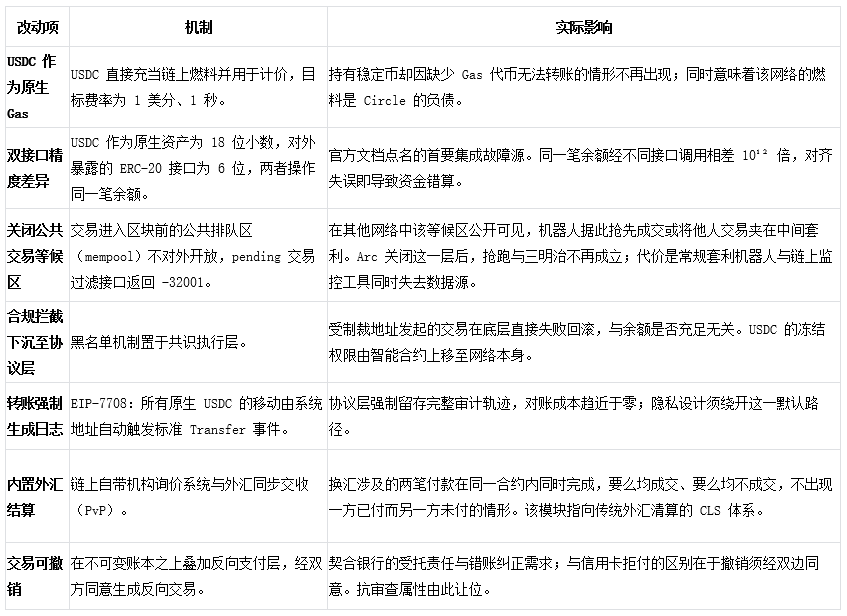
Two additional details need to be confirmed before integration.
The first is query cost. Ordinary nodes only retain complete state for a recent period, and earlier data must be retrieved from archive nodes that preserve all history, at higher cost. Arc draws this line at 127 blocks behind the chain head, about 1 minute; Ethereum's is about 25 minutes. That is to say, a transaction record from an hour ago is already historical data requiring paid retrieval on Arc. The operating costs of applications such as wallets, market data sites, and data services will therefore be significantly higher than on Ethereum.
The second is consensus certificates. Arc provides the arc_getCertificate interface, which can retrieve proof of which validators signed and confirmed a given transaction; arc_getVersion is used to query the node version. The significance of the former for institutions is that it is an archivable proof of settlement completion, and it is the technical landing point of the "legally irrevocable proof" mentioned in Section 1.
On privacy, Arc offers optional confidential transfers, where amounts are masked while addresses remain visible, implemented via TEE—an isolated region inside a chip that cannot be read externally. The security of this privacy layer rests on hardware manufacturers rather than cryptographic assumptions. The quantum-resistant roadmap proceeds in four phases, with quantum-resistant signature wallets supported from the genesis phase, allowing users to create them directly without needing to migrate later.
On cross-chain, CCTP and Gateway are natively integrated. CCTP's approach is to burn the corresponding USDC on the source chain while minting an equal amount of new USDC on Arc, with no third-party bridge contract holding funds in the process and no risk of cross-chain bridge attacks; users receive USDC issued by Circle itself, not a token receipt issued by a bridge. Gateway aggregates users' balances across multiple chains into a single address. This advantage comes from issuer status, not technology.
5. Validator Structure
Arc's validator set is currently completely closed. Circle has announced 11 founding validators, plus Circle itself, totaling 12 nodes:
- Financial infrastructure and exchanges: DTCC (Depository Trust & Clearing Corporation), ICE (parent company of the NYSE)
- Payment and clearing networks: Visa, Mastercard, MoneyGram, Global Payments
- Asset management and multinational banks: BlackRock, Standard Chartered, SBI Group, Sumitomo Corporation
- Crypto and conglomerates: Galaxy, Circle
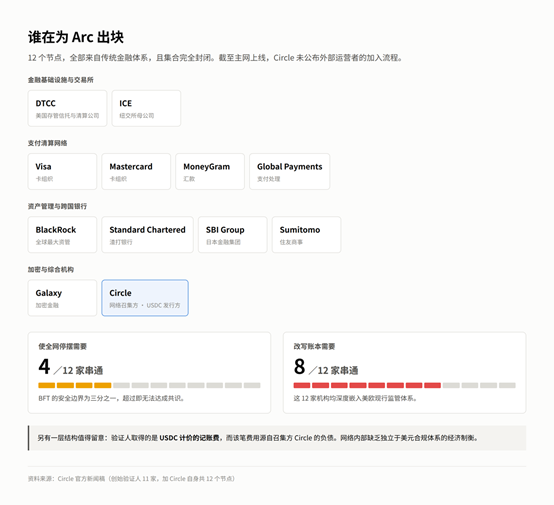
BFT's security boundary is one-third: among 12 nodes, 4 colluding can halt the entire network, and 8 colluding can rewrite the ledger. All 12 of these institutions are deeply embedded in the current US and European regulatory systems. As of the mainnet launch, Circle has not published a process for external operators to join the validator set.
There is another layer of structure worth noting: validators receive bookkeeping fees denominated in USDC, and these fees originate from the liabilities of the convening party, Circle. The network lacks an internal economic check independent of the dollar compliance system.
Adam Cochran's criticism points to the same place: "This is not an L1; calling it an L1 is an insult. This is a private, pre-approved-validator consortium chain." His argument: using USDC as Gas eliminates the economic incentive for validators to remain independent, making centralization inevitable.
The defense's response is that Arc was never built for DeFi, and institutions are willing to bear the cost of centralization for predictable costs and smooth access.
Both sides are arguing over definitions. The more practically meaningful question is whether the trust model is honestly disclosed: understood as "an institutional clearing network implemented with blockchain technology," Arc's design is self-consistent; measured against public chain standards for censorship resistance, it fails.
6. Current Status of the ARC Token
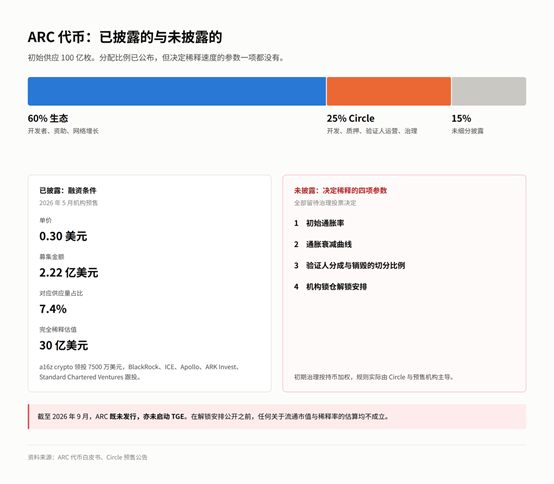
ARC and the September 16 mainnet launch are two separate matters; it has neither been issued nor had its TGE initiated at present.
Disclosed parameters. Initial supply of 10 billion tokens, with 60% allocated to the ecosystem, 25% retained by Circle, and approximately 15% not broken out in disclosure.
Financing. A $222 million presale was completed in May 2026 at a unit price of $0.30, corresponding to 7.4% of supply and a $3 billion fully diluted valuation. a16z crypto led with $75 million, with BlackRock, ICE, Apollo, ARK Invest, and Standard Chartered Ventures participating.
Token utility. Supporting the network's transition from PoA to PoS (the former having designated institutions take turns producing blocks, the latter having nodes that stake tokens produce blocks); governing economic parameters; converting stablecoin fees into ARC at settlement for distribution to validators and stakers. Fee stability on the user side and value capture on the token side are split into two layers.
Undisclosed parameters. Initial inflation rate, inflation decay curve, the split between validator rewards and burns, and institutional lock-up and unlock arrangements. All of these parameters are left to governance votes, and early governance is weighted by holdings, meaning the rules are effectively dominated by Circle and presale institutions.
Until unlock arrangements are made public, any estimate of circulating market capitalization and dilution rates does not hold.
7. Boundaries of Ordinary User Participation
Current phase (testnet)
What can be done. Claim test USDC and EURC, complete basic interactions on Uniswap and Curve, deploy contracts via Remix, or participate in Arc House's Architects points system—five tiers at 500, 3,500, 15,000, 40,000, and 90,000 points, with corresponding benefits including badges, priority event registration, quarterly briefings with the Circle team, and merchandise, with the highest tier including travel subsidies.
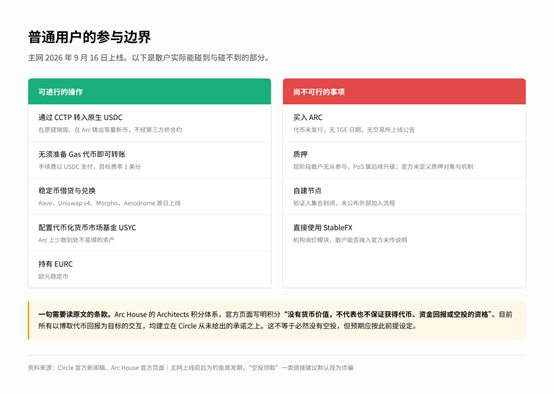
A clause that requires reading the original text. The official page states that Architect points "have no monetary value and do not represent or guarantee eligibility for tokens, financial returns, or airdrops." Currently, all interactions aimed at earning token returns are built on a promise Circle has never made. This does not mean there will necessarily be no airdrop, but expectations should be set on this premise.
After mainnet launch
What can be done. Transfer in native USDC via CCTP; complete transfers without preparing an additional Gas token; conduct stablecoin lending and swaps on Aave, Uniswap v4, Morpho, and Aerodrome; allocate to the tokenized money market fund USYC; hold EURC.
What is not yet feasible. Buying ARC (not issued); staking (inaccessible to retail at this stage, with PoS being a subsequent upgrade; some secondary sources claim staking will be available on mainnet day one, but the official side has not defined the staking target or mechanism); running a node. StableFX is an institutional RFQ module, and whether retail can access it directly has not been explained officially.
8. Can Robinhood's Meme Frenzy Be Replicated?
Before Arc's launch, a meme frenzy emerged on Robinhood, drawing user attention to Arc's launch and whether it could continue to replicate Robinhood's meme frenzy.
Robinhood Chain's Design Goals and Actual Trajectory
Robinhood Chain launched on July 1, 2026, positioned as a regulated venue connecting tokenized real-world assets to DeFi, with Stock Tokens—on-chain versions of stocks like Nvidia and Apple—as the anchor product. This design was widely seen at the time as a paradigm for traditional brokerages moving on-chain.
Actual trajectory diverged from design goals. After launch, what dominated on-chain activity was memes: a cat-themed token, CASHCAT, rose 2158% in a single week to a market capitalization of $156 million, while at that time the total scale of tokenized real-world assets across the entire chain was $12.81 million, of which the stock portion was $10.68 million. By proportion, real-world assets accounted for 4.1% of on-chain activity, while asset management and lending combined accounted for 78.8%. CEO Tenev initially called tokenized real-world assets a "durable direction" for the crypto industry, but as CASHCAT rose, he later said the chain "doing memes is not bad either."
Within two months, the network's DEX trading