High Rates Aren't the "Terminator" of US Stocks? Earnings Are?


- Core View: A JPMorgan report argues that high rates are not the terminator of US equity valuations — the key determinant of the valuation ceiling is earnings growth, not the yield level itself. As long as earnings growth remains above 15%, current valuations still have fundamental support.
- Key Elements:
- The 10-year US Treasury yield and S&P 500 valuations exhibit an "inverted U-shaped" relationship, with the threshold for compressing valuations at approximately 5%-6%.
- When earnings growth exceeds 20%, valuations can be supported up to 24x; at 10%-20% growth, about 20x; the lower the earnings, the lower the yield that can be sustained.
- The S&P 500 currently trades at about 22x 2026 EPS, corresponding to earnings growth of approximately 28%; if growth remains above 15%, there is still room for valuation re-rating in 2027.
- The 30 AI leaders trade at a forward valuation of about 30x, far exceeding the 19x for the rest of the S&P 500 and 14.3x for MSCI ACWI peers, with the premium stemming from earnings visibility and low leverage.
- Interest rate transmission is gradual, as companies primarily rely on fixed-rate, long-duration financing and hold approximately $2.4 trillion in cash that can earn higher interest income, offsetting some of the pressure.
- High rates exacerbate market divergence, with capital flowing to governments and large multinational corporations, squeezing consumption, real estate, and highly leveraged industries.
- Sector performance depends on the shape of the yield curve: steepening favors cyclicals, flattening favors tech; large-cap stocks are more resilient than small-caps.
Original author: Li Jia
Original source: Wallstreetcn
The market is treating "higher rates" as the death knell for US equity valuations. The 30-year Treasury yield has risen to about 5.40%, the highest in nearly 20 years; long-duration Treasuries have fallen about 10% over the past year, and the S&P 500's forward P/E has been compressed by roughly 3 turns. Yet at the same time, US stocks are still up about 16%.
But a JPMorgan report published on September 14 reached a very different conclusion: this round of rate increases is still some distance from truly suppressing valuations, and the key determinant of the valuation ceiling is not the yield itself, but earnings growth.
After sorting valuation data since 1950 into buckets by earnings growth, the team found that the relationship between the 10-year Treasury yield and the S&P 500's valuation multiple takes an "inverted U" shape—when yields rise moderately in the early stage, valuations may actually be supported; only after breaching a certain threshold does rising rates begin to significantly compress valuations. At current earnings levels, this threshold corresponds to a 10-year Treasury yield of roughly 5% to 6%.
More broadly, Wall Street strategists also do not view a renewed Fed rate hike as a signal that the bull market is over. Strategists at Goldman Sachs, Morgan Stanley, and JPMorgan all believe that as long as economic growth and corporate earnings remain resilient, a market pullback triggered by moderate rate hikes may prove to be only short-term volatility.
Goldman Sachs chief US equity strategist Ben Snider said the market has already priced in expectations of more than three rate hikes over the next year, while corporate earnings and balance sheets remain strong; Bloomberg statistics also show that what has historically truly threatened bull markets is usually a full hiking cycle, not a single rate increase.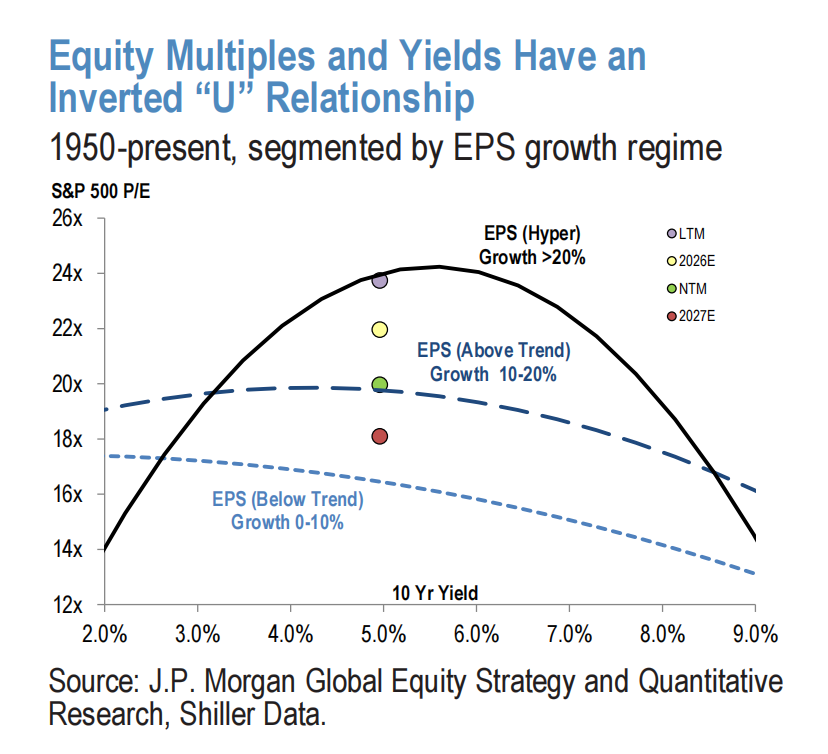
The threshold at which valuations truly come under pressure is 5%-6%
The first bucket is a super-growth environment with earnings growth above 20%, where valuation multiples can be supported at up to about 24x, corresponding to a 10-year Treasury yield of about 6%. The second bucket is an above-trend growth environment with earnings growth of 10%-20%, where the valuation multiple is about 20x, corresponding to a yield of about 5%. Overall, the lower the earnings growth, the lower the yield level the market can withstand.
The S&P 500 currently trades at about 22x 2026 EPS, corresponding to adjusted 2026 earnings growth of about 28%; the 2027 valuation is about 18x, implying earnings growth of about 21% (excluding one-off investment gains and losses). This means that as long as earnings growth can be maintained above 15%, there is still room for further re-rating of 2027 valuations.
There is another yardstick for measuring whether valuations are expensive. A two-stage dividend discount model shows that the current implied equity risk premium is about 7.2%, in the 69th historical percentile; the long-term PEG is about 2x. In other words, as long as companies can deliver average annual earnings growth of 13%-15%, the current valuation level is still broadly supported by fundamentals.
The 30 AI leaders currently trade at about 30x forward valuation, versus about 19x for the other 470 S&P 500 constituents and about 14.3x for MSCI ACWI peers. Such a valuation premium mainly comes from stronger earnings visibility, lower leverage, and more stable shareholder returns.
Productivity is another buffer. If productivity remains in the 1.5%-2.5% range, current yields can still support a valuation of about 20x; if AI further pushes productivity above 2.5%, the support for valuations will be even stronger.
How rates transmit to earnings: first look at debt structure, then cash flow
The impact of rising interest expenses on corporate earnings is gradual, because corporate debt overall is mainly financed at fixed rates and long durations.
In the short term, two forces are enough to partially offset the pressure from rising financing costs: first, improving profits in the financial sector; second, companies still hold about $2.4 trillion in cash, and these funds can earn higher interest income. At the same time, most companies' current borrowing costs remain below their 2023 peaks: the 30-year fixed mortgage rate is about 6.8%, below 8.1% in 2023; investment-grade bond yields are about 6%, below 6.5%; high-yield bonds are about 7.7%, below 9.6%.
The pressure truly worth watching comes from structural divergence. The "higher for longer" rate environment is crowding out consumption-related activity, residential and commercial real estate, as well as capital-intensive industries and highly leveraged companies that do not directly benefit from AI buildout.
The report describes this process as an "invisible hand": limited capital is flowing to the borrowers who bid the highest and have the best credit quality—governments and large multinational corporations. Therefore, higher rates do not necessarily mean across-the-board damage to overall corporate earnings, but they will significantly intensify divergence within the market.
Curve shape determines sectors: steepening favors cyclicals, flattening favors tech
Sector leadership also depends on how the yield curve changes.
If bear steepening occurs, meaning the spread between long- and short-term rates widens, cyclical sectors such as energy and financials are more likely to benefit; if bear flattening occurs, tech stocks have the relative advantage. At the same time, bond substitutes and long-duration non-tech sectors—including utilities, real estate, communication services, and consumer staples—are the most sensitive to rising rates.
In terms of style, the base case remains a shallow hiking cycle, meaning last year's "insurance-style" rate-cut expectations have reversed, but this has not evolved into aggressive tightening. Under this scenario, growth stocks and quality growth stocks are still expected to maintain their advantage; if inflation reaccelerates and the market begins to price in a broader hiking cycle, meaning another 4-5 rate hikes, the investment style could shift toward low volatility.
From a market-cap style perspective, large-cap stocks are more resilient. By contrast, small-cap stocks rely more on short-term floating-rate bank financing, so monetary policy transmission is more direct and the impact is greater.
The report also argues that this round of rate increases is mainly driven by fundamentals, rather than market concerns about Fed independence or US fiscal credibility. Long-end swap spreads are relatively stable, and long-term breakeven inflation rates have risen only slightly.