Global Payments Weekly 2026W36


- Key Takeaways: This week (Aug 31 - Sep 6) marked a structural turning point for the stablecoin industry: a consortium of 21 banks plans to issue compliant stablecoins, directly competing with existing public chain stablecoins for the B2B settlement market. Meanwhile, total stablecoin supply contracted by $1.5 billion, while over $500 million in capital flowed into infrastructure, shifting the competitive focus from "circulating supply" to "ownership of rails and use cases," with a critical window opening in the first half of 2027.
- Key Elements:
- 17 of the world's systemically important banks signed on to form a stablecoin consortium, but JPMorgan, HSBC, and BNP Paribas were absent, indicating divergent strategies among major banks. The consortium explicitly targets cross-Atlantic B2B settlement under GENIUS and MiCA regulations, rather than retail use cases.
- Circle first dipped then rebounded 14% on Sep 3, with the market interpreting that the bank consortium is not an existential threat to Circle. Meanwhile, the SEC proposed on Sep 1 that blockchain be used as an official record-keeping medium and that wallet addresses could replace mailing addresses, entering a 60-day comment period.
- Total stablecoin supply has contracted by $15 billion since May, but this week infrastructure projects including Félix, Cari, Diameter, OpenReserve, and Kast attracted over $500 million in investment, signaling that the industry's focus has shifted toward building the "railways" (transaction channels).
- The US OCC approved banking charters for Revolut and OpenReserve on the same day, while TabaPay acquired a bank and SoFi issued its own coin—marking "payment processors holding bank charters and issuing their own stablecoins" as the emerging default model in the US, with sponsor banks facing mid-term margin pressure.
- The Swift ledger officially went live, with weekend transactions between Citi and FAB/OCBC, and DBS and Citi, settling within two weeks, providing real-world evidence for "tokenized deposits over stablecoins." Cross-border payment providers expect to face dual-track competition around 2027.
- The Monetary Authority of Singapore proposed banning interest payments on stablecoins, becoming the third major jurisdiction after the US and EU to do so. Ethena Pay launched in 48 countries with 5-6% yields but deliberately avoided the US and Europe, showing the compliance space for high-yield stablecoin products is narrowing.
Author / Editor: WANG TAI
Coverage period: 31 August – 6 September 2026 (Week 36) · For traditional and crypto payments practitioners · ~4-minute read
1. The Week at a Glance

2. Industry Thermometer

3. Key Events of the Week
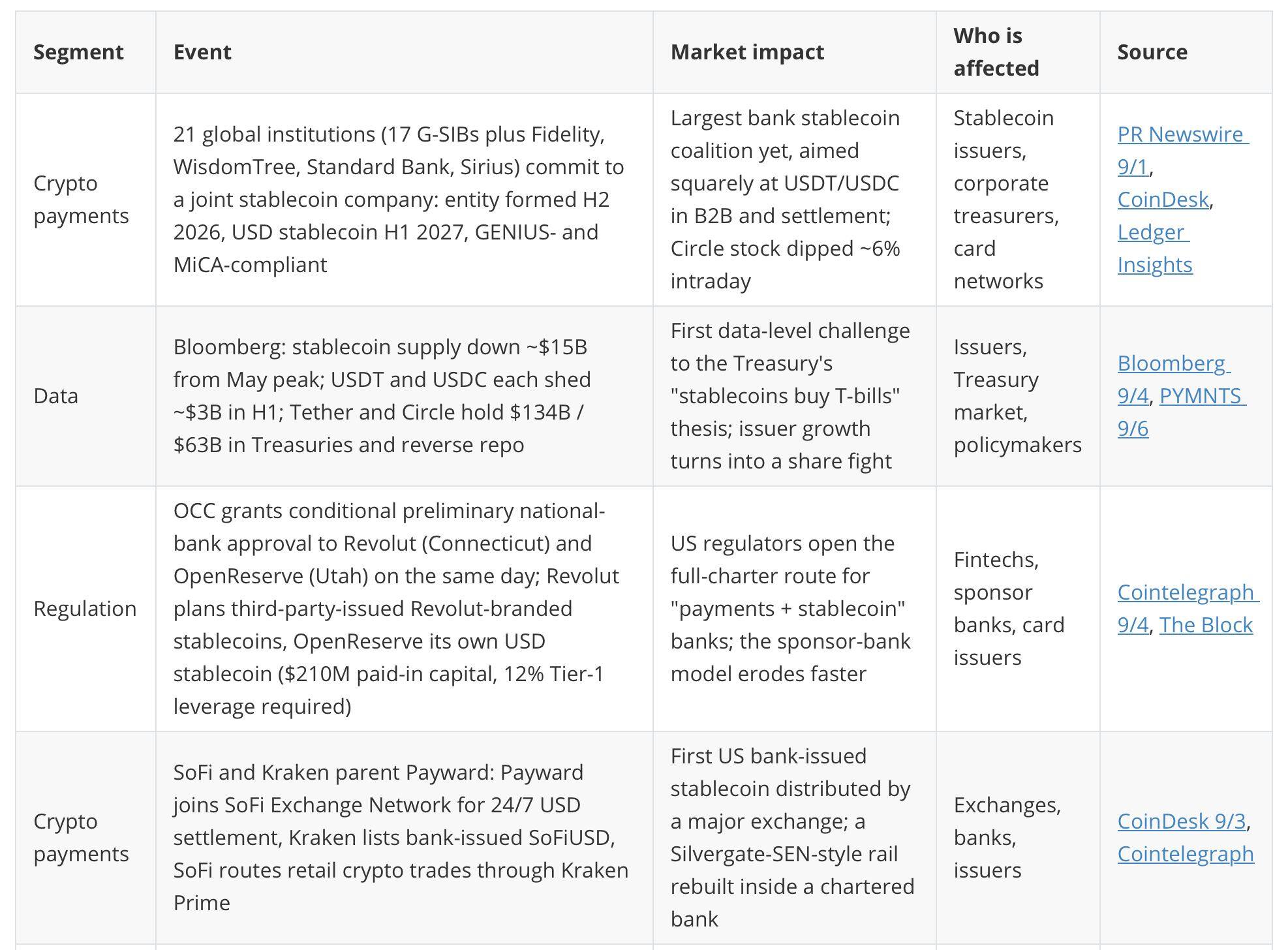
Why it matters (editorial analysis)
- The 21-bank coalition: last week it was "JPMorgan said to be evaluating"; this week 17 G-SIBs signed. Three things stand out — JPMorgan, HSBC and BNP are absent, so big-bank strategy is still split; the JV explicitly targets GENIUS and MiCA, i.e. transatlantic B2B settlement rather than retail; and Circle fell first, then rallied 14% on 3 Sep — the market does not see this as Circle's endgame.
- Shrinking supply vs. booming infrastructure: total stablecoin supply is down $15B since May, yet more than $500M went into stablecoin infrastructure this week (Félix, Cari, Diameter, OpenReserve, Kast). Competition is shifting from "how much is issued" to "who owns the rails and use cases" — Airwallex's product VP calling the search for use cases "a dead end" is the other side of the same coin.
- Two OCC charters in one day: with Revolut and OpenReserve approved, TabaPay buying a bank and SoFi issuing a coin, "processor/fintech holds a bank charter and issues its own stablecoin" is becoming the US default. Sponsor banks face a medium-term squeeze.
- Swift ledger goes live: Citi×FAB/OCBC and DBS×Citi's weekend transaction landed within two weeks of each other, giving the BIS chief's "tokenized deposits over stablecoins" remarks a working example. Cross-border PSPs will face two competing rails — public-chain stablecoins and bank tokenized deposits — around 2027.
- MAS bans yield: Singapore is the third major jurisdiction after the US and EU to prohibit interest on stablecoins. Ethena Pay's launch in 48 countries at 5–6% yield, deliberately skipping the US and EU, shows how fast the compliant space for yield-driven stablecoin products is narrowing.
4. Crypto / Web3 Deep Dive
4.1 Stablecoin data dashboard
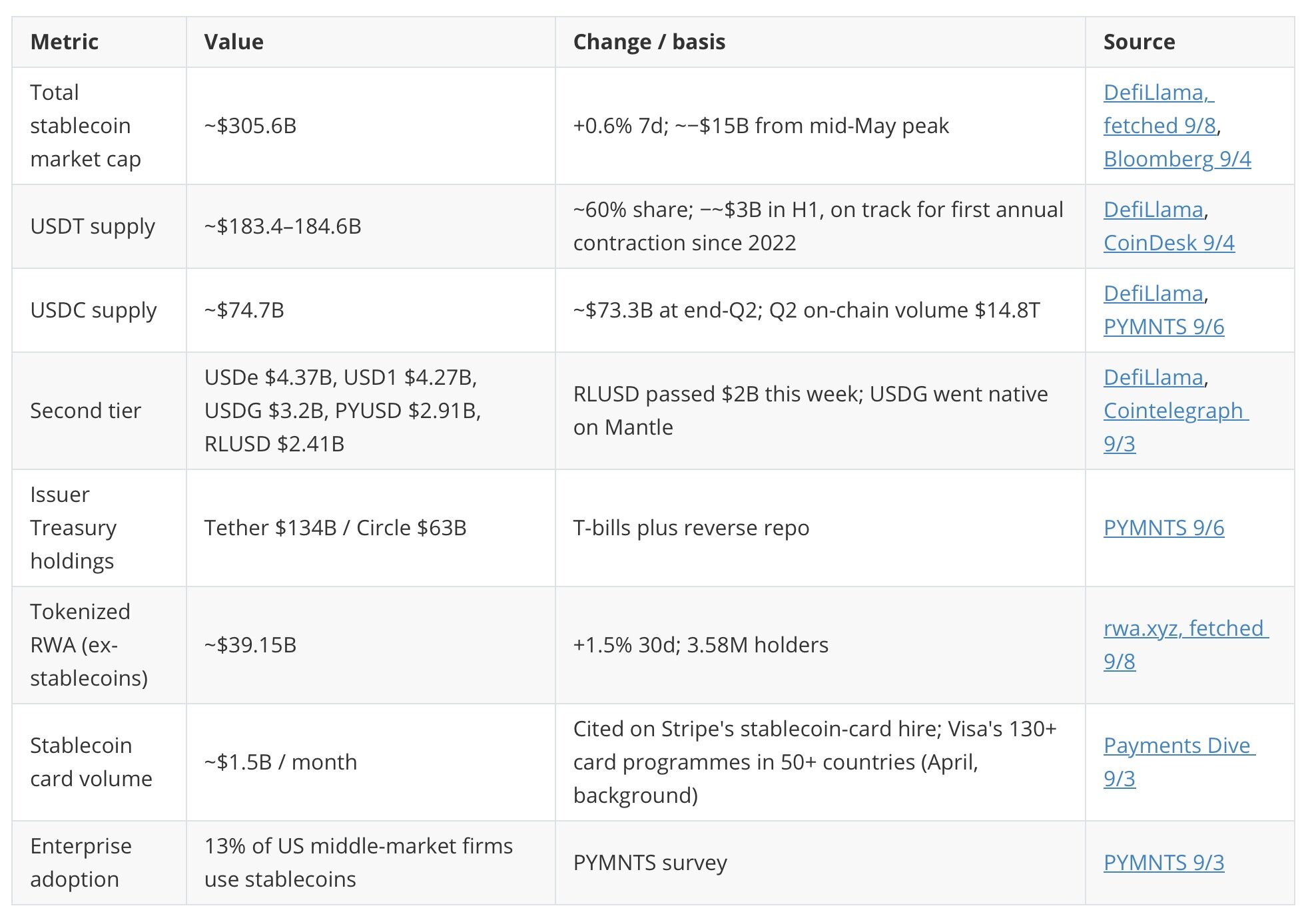
Note: no reliable public data this week on weekly on-chain stablecoin transfer volume; crypto-card top-up figures were not updated this week.
4.2 Theme of the week: banks fire on three fronts — issuance, settlement, distribution

Editorial view: after this week, "will banks enter" is no longer the question — it is which of three rails (public-chain stablecoins, bank-JV stablecoins, tokenized deposits) becomes the clearing layer. Shrinking supply says retail speculative demand has peaked, while capital and licences are pouring into B2B settlement and cross-border. H1 2027 — bank-JV launch, OCC accepting GENIUS applications, settlement chains such as Arc going live — is the window in which the structure sets.
4.3 Voices of the week

4.4 Regulatory week in brief
US: SEC proposes rewriting transfer-agent rules to accept blockchains as official records and floats wallet addresses in lieu of postal addresses, 60-day comment period (SEC 9/1); SEC sets a 17 Sep roundtable on 24-hour trading (SEC); OCC/FDIC finalise the definition of "unsafe or unsound practice", narrowing examiner discretion behind debanking (The Paypers 9/1); National Sheriffs' Association goes neutral on the CLARITY Act ahead of the 15 Sep Senate cloture vote (CoinDesk 9/4); Wyoming's FRNT adds Chainlink Proof of Reserve (Cointelegraph 9/2); two Thai businessmen sue Tether over a $42.4M USDT freeze — the first legal test of issuer freeze powers (Cointelegraph 9/2).
G20: finance ministers and central bank governors pledge "clear pathways" for digital-asset innovation, ask the FSB for findings on global stablecoins' cross-border effects, and call for longer large-value payment system hours (The Block 9/2).
Asia: MAS stablecoin consultation (see Key Events); Korea's FSC publishes a three-phase tokenization roadmap from Feb 2027 with stablecoin-linked on-chain settlement in phase 3 (FSC 9/4); Bank of Korea study finds direct fiat–stablecoin pairs on Binance weaken local currencies, with won stablecoin purchases of $64B a year, APAC's largest (CoinDesk 9/5); Japan's FSA seeks a trust-tax filing exemption for trust-based stablecoin transfers (Crypto Times 8/31); ASIC warns Australian crypto firms to hold AFS licences by 30 Sep (CoinDesk 9/3).
Mainland China and Hong Kong: no major new policy this week (background: Hong Kong's stablecoin licences remain with HSBC and Anchorpoint; mainland activity this week was UnionPay's and Ant International's overseas expansion). EU/UK: Revolut completed its USDT delisting in the EEA and Switzerland on 31 Aug, auto-converting balances to fiat (The Paypers); no new stablecoin rules from the ECB, EBA or FCA this week.
5. Traditional vs. Crypto Payments

6. Regional Watch

7. Action Items for Practitioners
Traditional payments
- Re-examine sponsor-bank dependence: TabaPay buying a bank, Revolut/OpenReserve winning OCC approval and SoFi issuing its own coin all point the same way — if your business relies on a sponsor bank's BIN or settlement account, evaluate owning a charter, switching correspondents or connecting to bank tokenized-deposit networks (Kinexys, Swift ledger) before 2027.
- A2A and real-time payments enter a "risk + rebate" phase: Visa's A2A Protect and the Fed's FedNow credits landed in the same week, showing networks and central banks both fighting for the control layer of account-to-account payments; acquirers and gateways should put A2A fraud scoring and dual FedNow/RTP enablement on the 2027 roadmap.
- Read UPI's and Pix's "more volume, flat value" carefully: both systems are saturating in small tickets while pushing into NFC and cross-border (Pix drops its NFC cap, UPI enters Uzbekistan, ECB–Pix link) — the defensive priority for card businesses in emerging markets is shifting from online to offline low-value.
Crypto payments
- File with MAS by 16 October: the proposed yield ban, 100% segregated reserves and 5-day redemption will reshape how XSGD/USDC-type products are distributed in Asia; licensed or applying firms should take a clear position on the foreign-stablecoin recognition clause.
- Lock in distribution and settlement slots before the bank JV launches: with the 21-bank coin due H1 2027 and the Swift ledger pilot ending in December, smaller issuers and infrastructure providers should secure exchange listings (see SoFiUSD×Kraken), card programmes or regional bank partnerships now, or risk being pushed to the retail fringe.
- Watch the 15 Sep CLARITY vote and the Tether freeze lawsuit: the former decides the 2026 fate of market-structure law and its stablecoin-yield provisions; the latter is the first judicial test of issuer freeze powers — products holding merchant funds should prepare freeze/appeal procedures and customer disclosures now.
8. Watchlist for Next Week
- 15 Sep Senate cloture vote on the CLARITY Act (60 votes needed): failure effectively pushes market-structure legislation into 2027; on 17 Sep the SEC's 24-hour trading roundtable will discuss stablecoins and tokenized deposits as the cash leg.
- Money20/20 Middle East, Riyadh, 14–16 Sep: expect clustered SAMA open-banking/instant-payment, Gulf stablecoin and cross-border announcements; track PayTabs–Amazon deal details and Standard Chartered's UAE expansion.
- Circle Arc mainnet (16 Sep) and whether stablecoin supply stops shrinking: Arc is Circle's direct answer to the bank coalition; also track DefiLlama's weekly total and whether NPCI formally unveils its AI-agent payment protocol at Global Fintech Fest, Mumbai, 9–11 Sep.
All data and events are drawn from public reporting; links point to original sources. Editorial analysis reflects judgement based on public information only and is not investment advice.