






波场TRON Industry Weekly Report: Non-Farm Payrolls Lean Hawkish, But CPI Will Determine Whether BTC Can Hold $80,000; A Detailed Look at KOR Protocol for Building Digital Content and IP Assetization


- Core View: The global macro environment is shifting from growth resilience to inflation and tightening risks, with the crypto market dominated by high volatility and choppy movements. Meanwhile, on the regulatory front, the U.S. is advancing the on-chain securitization of securities, while global stablecoin cross-border and compliance enforcement have become focal points.
- Key Elements:
- The U.S. August non-farm payrolls added 162,000 jobs, with the unemployment rate at 4.1% and hourly wages rising 3.1% year-over-year. The ISM Manufacturing PMI came in at 54.6. This economic resilience has weakened rate cut expectations, with the probability of a September hike rising to nearly 60%. Eurozone inflation climbed to 3.3%, and the European Central Bank may raise rates by 25 basis points.
- BTC hit a weekly low of $76,300, surged to $82,180, then pulled back to the $79,500–$80,000 range, posting a weekly gain of approximately 1.7%. ETH traded in the $2,358–$2,546 range, with total market cap retreating below $2.8 trillion. Structural trading opportunities remain.
- Funding hotspots are concentrated in stablecoins, payments, and banking infrastructure. For example, Felix Pago secured $200 million in financing. KOR Protocol completed a $7.5 million raise to build an on-chain clearing platform for digital content IP, covering rights confirmation, authorization, and royalty distribution.
- The U.S. CPI report on September 11 is a key data point. If inflation exceeds expectations, BTC may test support at $76,300–$77,000. If it comes in below expectations, BTC could break above the previous high of $82,200.
- The SEC has proposed incorporating blockchain record-keeping into the framework for securities transfer agents. The CFTC has defended its regulatory path for crypto perpetual futures. Poland's MiCA localization bill has hit obstacles, while Pakistan's mandatory licensing took effect on September 5.
I. Market Outlook
1. Macro-Level Summary and Future Projections
During the week of August 31 to September 6, 2026, the global macro narrative pivoted back from "growth resilience" to "inflationary pressures and monetary tightening risks." The US August non-farm payrolls added 162,000 jobs, the unemployment rate held at 4.1%, and average hourly earnings rose 3.1% year-over-year. Manufacturing and Services ISM PMI readings reached 54.6 and 55.4, respectively, indicating economic activity remains in expansion territory. This reduced the necessity for near-term Fed easing and prompted markets to raise expectations for a September rate hike. In the Eurozone, August inflation rose to 3.3% from July's 2.9%, primarily driven by higher energy prices. Although core inflation eased slightly to 2.4%, overall inflationary pressures remain evident.
From September 7 to 13, 2026, market focus will center on the US August PPI and CPI data, as well as the European Central Bank's interest rate decision. Markets currently expect US headline CPI to remain around 3.4% year-over-year, with core CPI potentially dipping from 2.5% to 2.4%. If actual inflation comes in higher than anticipated—especially if energy price increases begin transmitting to core goods and services—the probability of a Fed rate hike in September could rise further, providing support for Treasury yields and the US dollar while potentially weighing on global equities, gold, and crypto assets. Conversely, only a significant downside surprise in core inflation would lead markets to re-price the likelihood of rates remaining unchanged. Following the Eurozone inflation rise to 3.3%, the ECB is widely expected to hike rates by 25 basis points to 2.5% while maintaining a hawkish stance. Overall, the coming week will see global markets operating in a high-volatility environment characterized by "growth that hasn't stalled, resurgent inflation risks, and a retreat in easing expectations."
2. Crypto Industry Market Movements and Alerts
From August 31 to September 6, 2026, the crypto market exhibited a choppy pattern, initially weak before strengthening, then pulling back after an upward surge. BTC closed around $78,570 on August 31, dipped to a weekly low of approximately $76,300 on September 1-2, then rallied to a weekly high of around $82,180 on September 3, driven by dovish Fed official comments and short covering—marking a multi-month high. However, following the stronger-than-expected August non-farm payrolls report (162,000 jobs added) on September 4, markets raised the probability of a September rate hike, strengthening Treasury yields and the dollar. BTC subsequently pulled back and stabilized near the $79,500-$80,000 range over the weekend, finishing the week roughly 1.7% higher than August 31. ETH experienced wider fluctuations during the same period, hitting a weekly low of approximately $2,358 before surging to around $2,546 on September 3-4, then settling back to the $2,490-$2,515 range by September 6—a modest gain from its August 31 level of roughly $2,468. Total market capitalization briefly reached approximately $2.82 trillion mid-week before retreating below $2.8 trillion. Structurally, capital hasn't fully exited risk assets—ZEC surged nearly 40% during the week, and several major altcoins including BNB, XMR, and ADA posted notable gains—indicating that strong structural trading opportunities remain. However, BTC's failure to hold above $82,000 suggests that macro rate expectations remain the dominant near-term headwind.
Looking ahead to September 7-13, the core market variable will be the US August CPI report due September 11. Following the strong payrolls data, market expectations for a September 16 Fed rate hike have re-priced to nearly 60%, so BTC will likely continue trading in a high-volatility range this week. If CPI comes in below expectations and core inflation continues to cool, rate hike expectations could diminish, potentially allowing BTC to break back above $80,000 and test the previous high of $82,200. A decisive hold above that level could open up further upside toward the $84,000-$85,000 range. Conversely, if CPI runs hot, pushing yields and the dollar higher, initial support for BTC lies at $78,500-$79,000, with a breakdown potentially leading to a retest of the $76,300-$77,000 zone. For ETH, near-term focus is on support at $2,435-$2,450 and resistance at $2,525-$2,550; only a decisive breakout above resistance would open the path for further upside. The overall assessment is that market direction next week will be governed by macro data rather than purely on-chain narratives. Range-bound trading is more likely before the CPI release, with volatility expanding significantly after the data drops. Until BTC decisively breaks and holds above $82,000, this week's rebound should not be viewed as the start of a new trend rally.
3. Industry and Sector Hotspots
The financing narrative during the week of August 31—September 6 was remarkably clear: capital distinctly shifted from pure token narratives toward stablecoins, payments, tokenized deposits, crypto banking, and institutional-grade on-chain financial infrastructure. Felix Pago's $200 million comprehensive financing round, Cari's $32.5 million in bank capital, OpenReserve's $25 million Seed round, and Diameter Pay's $10 million Series A demonstrate that Stablecoin + Payment + Banking represents the week's most concentrated capital focus. Meanwhile, Firelight represents DeFi risk infrastructure, GAEA embodies AI × Crypto, and ParlayX represents prediction market infrastructure—showing that capital continues seeking Crypto Native projects with clear, practical real-world applications.
II. Hot Market Sectors and Promising Projects of the Week
1. Overview of Promising Projects
1.1. KOR Protocol: Building Global Digital Content & IP Assetization Infrastructure—Total Raise of $7.5 Million Led by 1k(x) and Blockchain Capital, with Participation from Republic, Sfermion, SevenX, and CAMP
Introduction
KOR Protocol is an on-chain clearing platform designed for creative content and digital assets. It spans the entire lifecycle of a creative work—from inception to commercialization—focusing on three core functions: verifying the provenance and copyright ownership of works, precisely matching works to parties in need, and automatically facilitating revenue distribution and value settlement for all participants.
Built on the Base network with stablecoins as its native settlement asset, KOR Protocol is purpose-built for a future digital content ecosystem where AI Agents can execute content licensing, purchasing, and settlement at machine speed.
Protocol Mechanism Overview
The KOR Protocol is architected around three core engines—Verify, Route, and Settle—and employs a layered SDK → Backend → Blockchain structure. Developers interact with the backend via the SDK, which handles transaction generation and signing, with the final on-chain submission executed from the user's wallet. This design encapsulates complex blockchain interactions behind the scenes, significantly lowering development and usage barriers while ensuring user asset self-custody and on-chain security.
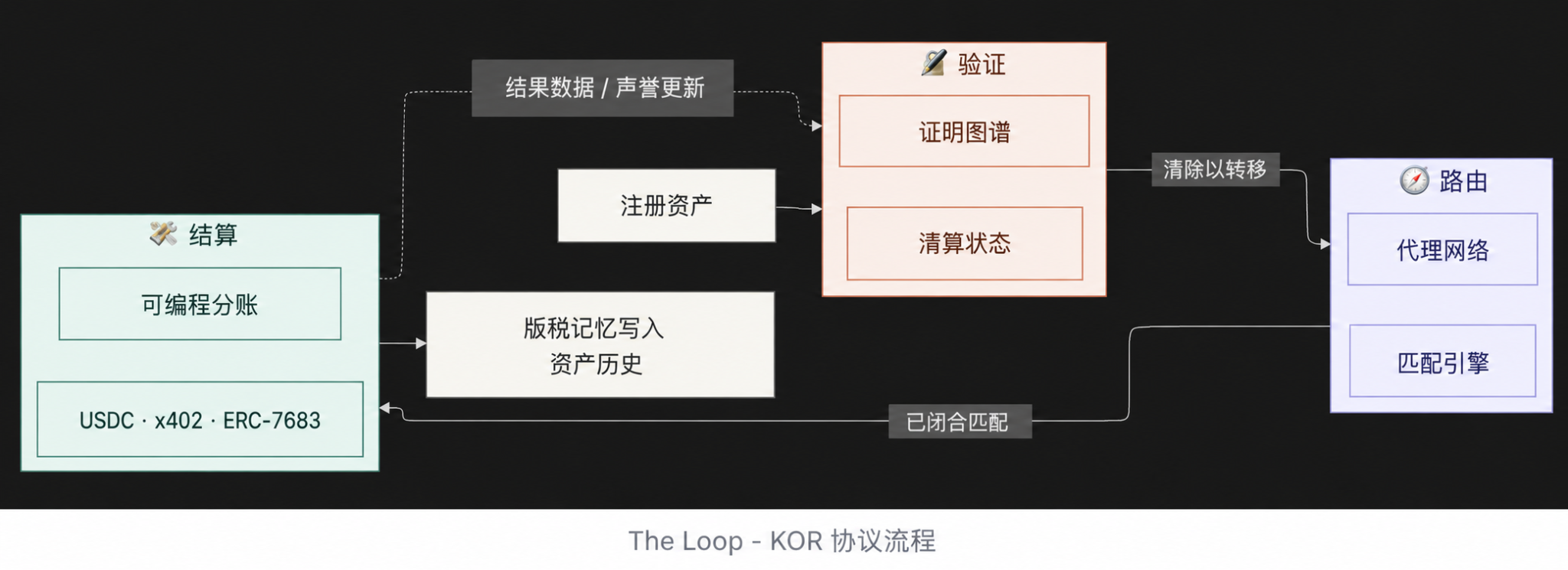
All operations within KOR Protocol follow a unified "Register → Route → Settle → Feedback" closed-loop process.
Registration: Creators first register their works with the protocol. The system generates a unique on-chain identity (Canonical ID) for the work, establishes proof of copyright and ownership (Attestation Graph), and confirms the work's copyright clearance status based on its current state.
Routing: Once a work is registered and eligible for licensing, the Route Engine matches and distributes content to potential licensees, facilitating content licensing and commercial partnerships. (This module is currently under development.)
Settlement: When a licensing transaction is reached, the Settle Layer automatically executes value settlement. All revenue is automatically split according to preset rules, paid out in stablecoins, and distributed to all participants in a single atomic on-chain transaction.
Feedback: After each settlement, the protocol writes the transaction outcome back on-chain, continuously accumulating copyright and commercial history for the work—including transaction timestamps, counterparties, license terms, and revenue records—building a complete, traceable digital rights asset archive.
1. Event Listener Service
The Event Listener Service is a core component of the KOR Protocol architecture, responsible for real-time monitoring and processing of various on-chain events generated by the protocol's smart contracts. It ensures all critical blockchain events are promptly captured, processed, and stored, facilitating subsequent data analysis, business calls, and system queries.

High-Level Architecture
- Connecting RPC Nodes
- The Event Listener Service connects to both Ankr and Alchemy RPC providers, accessing the Base/Ethereum networks through them reliably to continuously monitor events emitted by KOR Protocol smart contracts.
- Event Monitoring
- When KOR Protocol smart contracts emit new on-chain events, the Event Listener Service detects them immediately, ensuring no significant on-chain operations are missed.
- Message Queue
- Upon event detection, the system sends event data to AWS SQS (Simple Queue Service), decoupling "event listening" from "event processing." This design enhances system scalability and improves stability and fault tolerance under high-concurrency conditions.
- Event Processing Service
- A Consumer Service reads event data from AWS SQS, parses and decodes it, and extracts key business information for use by downstream systems.
- Data Storage
- Processed event data is written to a database and indexed for storage. This supports rapid querying of historical events while providing efficient data support for analytics, business dashboards, and other applications.
2. NFT Module
The NFT Module is KOR Protocol's digital asset creation module, comprising a suite of smart contracts developed and extended from various ERC standards. It enables creators to quickly create and manage NFTs and IP assets. Through this module, users can:
- Create their own NFT Collections;
- Mint NFTs from an NFT Collection and further register them as on-chain IP (intellectual property);
- Create their own IP Collections;
- Mint on-chain IP assets directly from an IP Collection;
- Mint NFTs directly using the protocol's official NFT contracts.
By unifying the NFT and IP creation process, KOR integrates digital content rights confirmation, assetization, and subsequent commercialization into a single protocol.

Mint IP from the Collection

KOR allows users to mint complete IP assets directly from a creator's IP Collection, eliminating the need for manual NFT registration and License Terms binding operations.
The entire process is automated by the SDK: it first mints an NFT from the creator's Collection, then automatically registers the NFT as an on-chain IP, binds the Collection's preset License Terms, and finally mints and sends the complete IP Asset to the user in one step. Compared to traditional multi-step on-chain processes, this one-click IP minting significantly lowers the barrier for creators and developers while improving the efficiency of digital copyright asset creation and circulation.
3. IP Module
The IP Module is the core module within KOR Protocol responsible for IP (Intellectual Property) asset management, primarily providing IP registration, management, and lifecycle maintenance capabilities, including:
- Registering NFTs as on-chain IP Assets;
- Creating KOR Token Bound Accounts for NFTs (modified from ERC-6551);
- Managing IP role permissions (e.g., copyright holders, licensees);
- Registering Derivative IP;
- Querying and retrieving on-chain IP information;
- Registering an entire NFT Collection as a single IP.
Through this module, KOR elevates NFTs from mere digital collectibles to on-chain IP assets equipped with copyright, licensing, and commercialization capabilities.
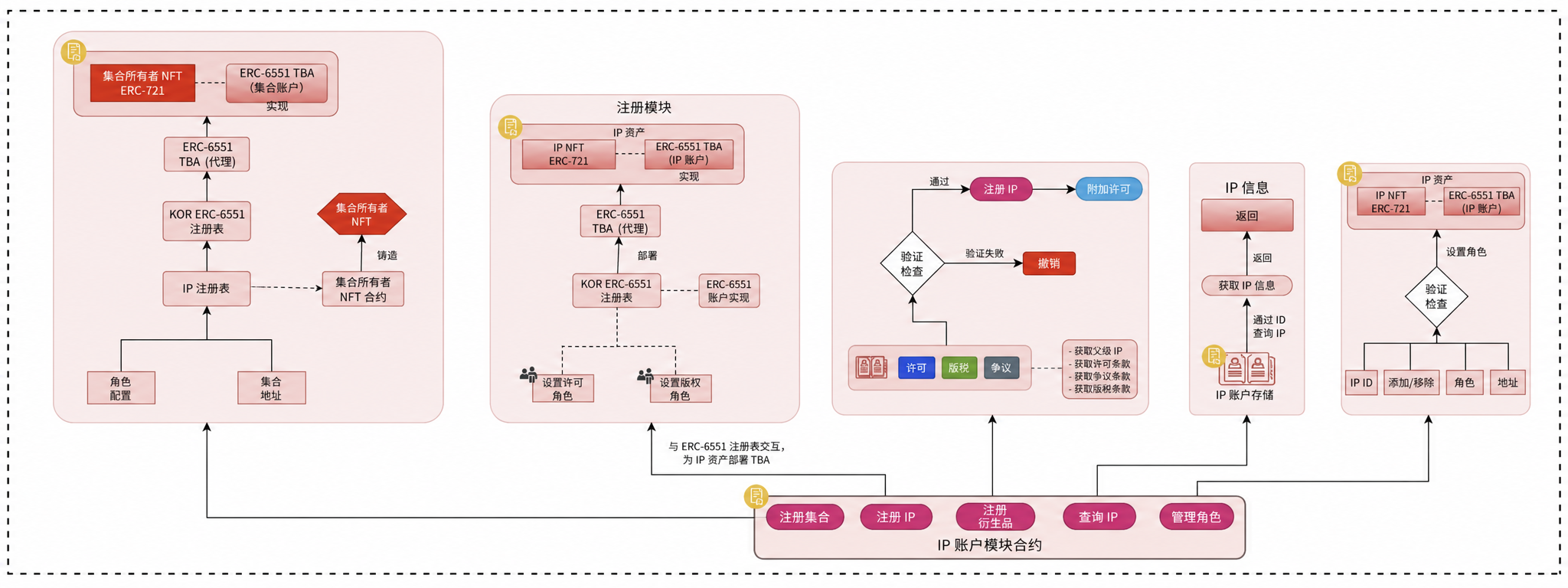
Register IP Asset

When a user registers an NFT as an IP Asset, the system first configures different role permissions for the IP, such as Copyright Role, Licensee Role, etc. Subsequently, the IP Registry creates a KOR Token Bound Account (modified from ERC-6551) for the NFT—the IP Account. This account serves as the IP's dedicated on-chain account, managing licensing, revenue, transactions, and subsequent commercial activities, granting each IP independent asset and permission management capabilities.
Register Collection as IP
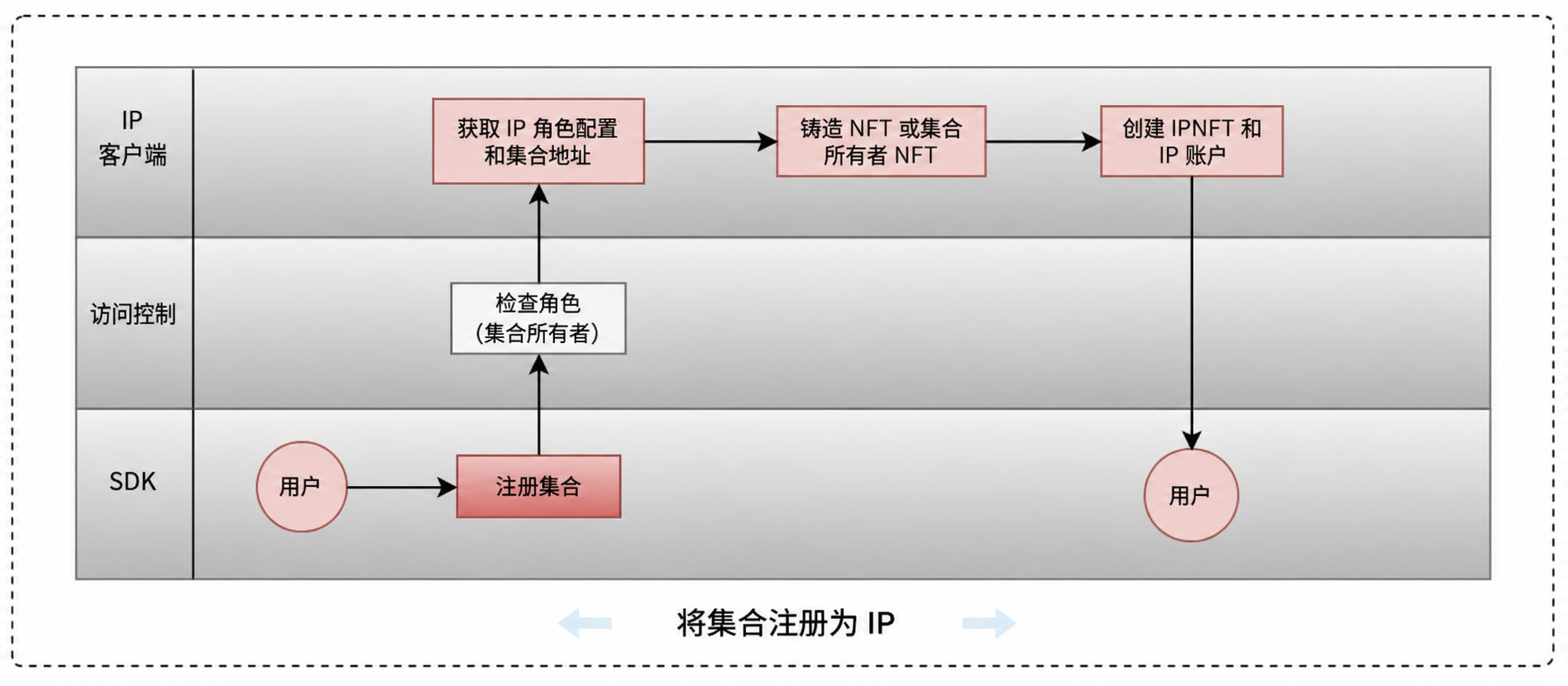
KOR also supports registering an entire NFT Collection as a unified IP, rather than just individual NFTs. During registration, users first configure the Collection's role permissions. The SDK then automatically mints an NFT representing the entire Collection on behalf of the creator and creates a KOR Token Bound Account (modified ERC-6551) based on that NFT—the Collection Account.
The Collection Account serves as the unified management account for an entire series of works, centrally managing copyright, licensing rules, and commercialization logic for all works within the collection. It provides a unified portal for batch licensing, revenue distribution, and IP operations, and also facilitates direct access for AI Agents and applications to call the entire IP collection without managing individual works one by one.
4. License Module
The License Module is the core module within KOR Protocol responsible for IP licensing and permission management. It manages IP licensing rules and commercialization processes, primarily providing the following functions:
- Binding License Terms to IP Assets;
- Binding unified License Terms to IP Collections;
- Minting License Tokens for derivative work creation;
- Registering new License Terms templates;
- Minting License Terms NFTs;
- Calling the Royalty Module to deploy Royalty Vaults and Royalty Tokens;
- Automatically generating License Terms PDFs and uploading them to IPFS for permanent storage.
The License Module integrates licensing agreements, copyright management, and revenue distribution into a unified workflow, making IP licensing and commercialization more standardized and automated.
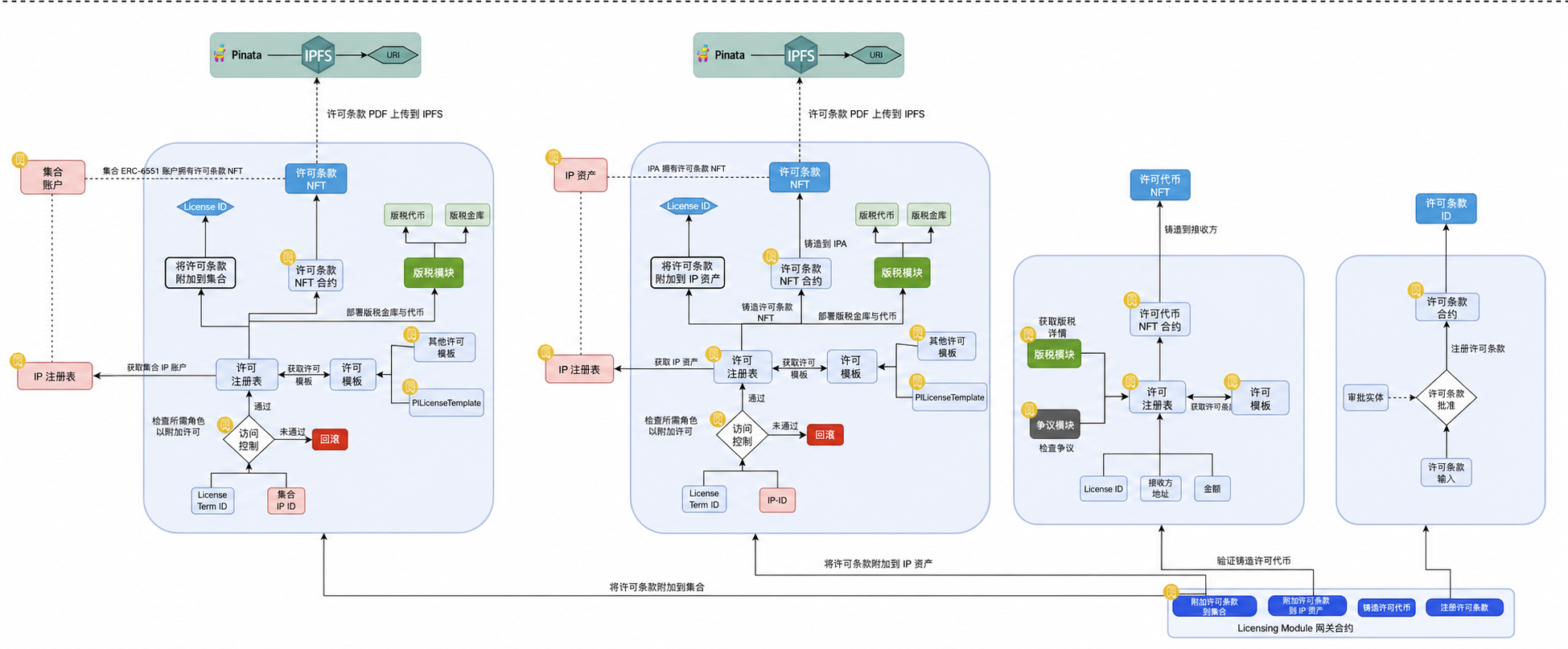
Attach License to IP

When binding License Terms to an IP Asset, the SDK first verifies that the operator has the necessary permissions. Upon successful verification, the License Registry binds the corresponding license agreement to the IP Account based on the input License Term ID and automatically mints a License Terms NFT as the on-chain licensing credential.
Subsequently, the system automatically generates a PDF of the license agreement and uploads it to IPFS for permanent storage. Once the license agreement is successfully bound, the License Registry calls the Royalty Module, which automatically deploys a Royalty Vault and Royalty Token for the IP, preparing for future royalty distribution and revenue settlement—integrating licensing, evidence preservation, and revenue management into a single streamlined process.
Attach License to Collection





