Ahead of the Non-Farm Payrolls report, Waller's remarks turned dovish, Tesla, SpaceX, Oracle, and other tech growth stocks saw significant gains. Next week's CPI becomes a key variable


- Core View: Fed official Waller's marginally dovish stance drove down U.S. Treasury yields, triggering sentiment repair on the valuation side of U.S. stocks and the crypto market. However, inflationary pressures have not subsided, and next week's August CPI data will determine the sustainability of this rebound.
- Key Elements:
- Following Waller's speech, market odds for a near-term Fed rate hike plunged from 63.2% to 50.4%; the 10-year Treasury yield fell approximately 5 basis points to around 4.75%.
- The market showed structural divergence: long-duration growth stocks like Tesla and Meta led gains, with Bitcoin breaking above $80,000. However, Broadcom plunged 6% on weaker-than-expected Q4 guidance, and the overall AI hardware chain underperformed the broader market.
- Snowflake surged over 20% on better-than-expected results driven by AI product penetration, indicating that the AI industry thesis has entered an earnings-delivery phase, reducing its sensitivity to rate-driven valuations.
- The widening U.S. trade deficit in July reflects stronger-than-expected domestic demand resilience. Combined with rising oil prices from escalating U.S.-Iran conflicts, this forms the fundamental basis for a marginal rebound in August CPI.
- The article outlines three CPI scenarios: higher-than-expected inflation would trigger pullback risks; in-line data would likely maintain range-bound trading; only significantly lower inflation could provide fundamental support for the repair rally.
Last night saw a "risk-on" rally in US markets. Following the previous day's encouraging ADP payroll data, Fed Governor Waller's remarks further signaled a dovish tilt, indicating a slower path to any rate hikes. All three major indices moved higher, while safe-haven and alternative assets like gold, silver, and Bitcoin rallied in tandem. Growth-oriented tech stocks saw particularly strong gains, yet the AI hardware supply chain notably underperformed the broader market. On the surface, this appeared to be a broad-based, cross-asset rally. However, a closer look at the underlying drivers reveals this was essentially a macro sentiment repair driven by marginally more dovish Fed rhetoric and lower Treasury yields, rather than a fundamental improvement or a shift in industry trends. With the FOMC meeting drawing nearer, trade data and geopolitical tensions suggest inflationary pressures haven't truly subsided. Next week's August CPI report will likely be the critical test for whether this repair can be sustained.
1. Market Recap: Structural Divergence Beneath the Surface Rally
As of the US market close on September 3rd, the Dow Jones Industrial Average rose approximately 580 points, or 1.08%, to 53,656 points. The Nasdaq Composite gained about 1.2%, closing near 26,572 points. The S&P 500 advanced roughly 1.04% to 7,743 points, and the Nasdaq 100 also closed up over 1%. Beneath the surface, individual stocks showed clear structural divergence. Firstly, traditional tech giants and related growth names led the gains: Tesla and SpaceX-concept stocks closed up about 6%, Oracle, Dell Technologies, and Meta all rose over 4%, and Microsoft gained more than 3%. Secondly, the AI hardware supply chain collectively weakened, with the Philadelphia Semiconductor Index putting in a flat performance and Broadcom tumbling 6% by the close. Storage and optical communications sectors also lagged the market. Thirdly, software stocks were mixed, but Snowflake stood out, surging over 20% after beating expectations (management attributed the growth to increased penetration of its AI products), representing one of the few instances of fundamental-driven gains.
In terms of asset correlation, gold and silver both climbed about 3%, Bitcoin broke through the $80,000 mark, the 10-year Treasury yield fell roughly 5 basis points to around 4.75%, and the US dollar index weakened. This improvement in risk appetite also transmitted to leading indicators in the Asia-Pacific region, with Hong Kong equity futures rising nearly 1% in overnight trading and the FTSE China A50 futures index gaining about 0.3%.
2. Deciphering Waller's Stance: Slower Hikes, but Inflation Concerns Persist
The direct trigger for this market move was the latest public statement from Fed Governor Christopher Waller last night: unless upcoming inflation data surprises to the upside, he leans towards supporting a hold on interest rates. This stance was quickly reflected in rate futures pricing. According to the CME Group's FedWatch tool, following Waller's speech, traders' implied probability of a rate hike within the coming weeks was significantly revised down to 50.4% from the previous day's 63.2%, a drop of over 12 percentage points.
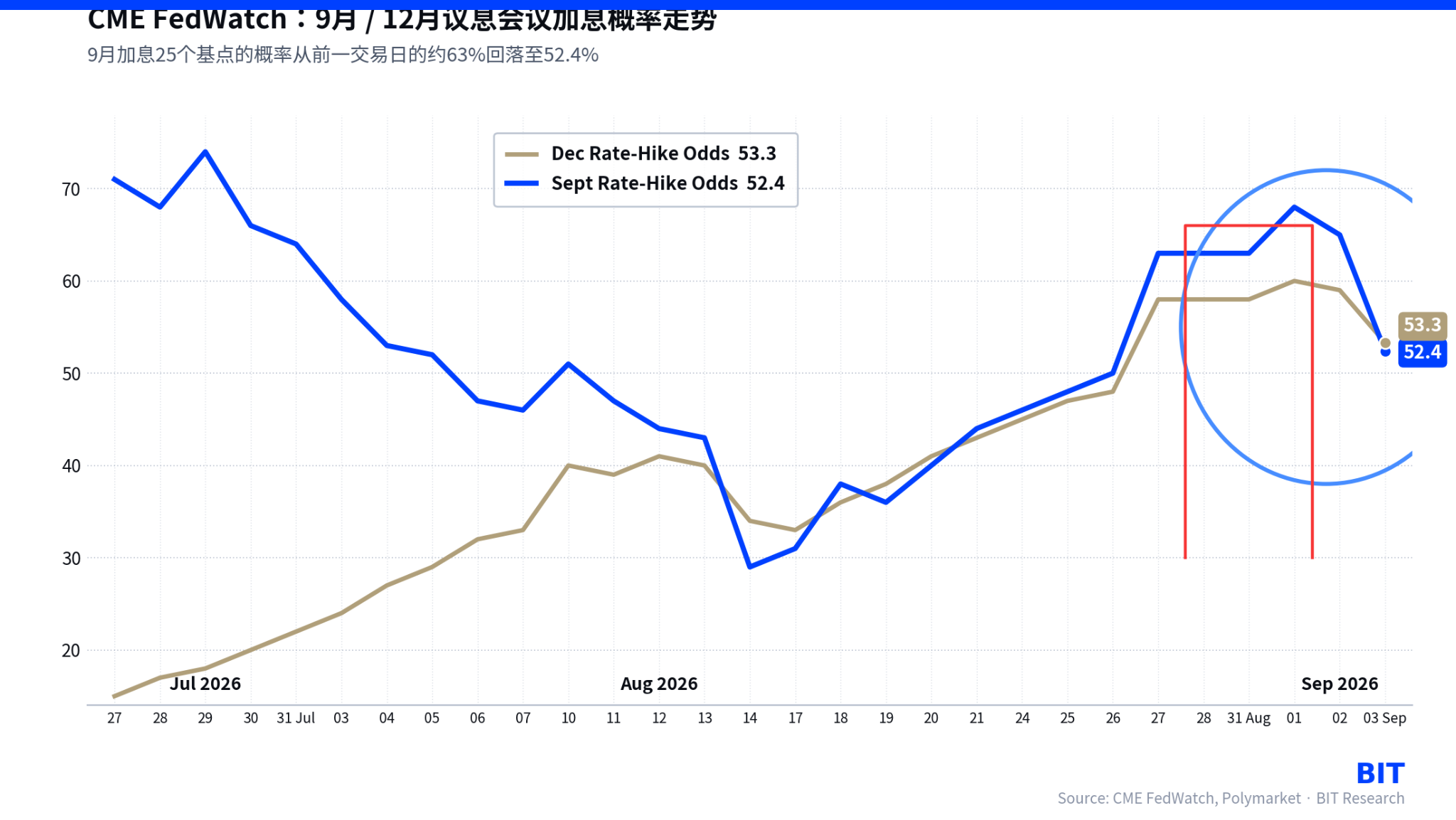
It's important to note that this is not an unconditionally dovish signal, but rather leans towards a middle ground of "slower hikes, lingering concerns." Recently, market anxieties over a September hike had been intensifying, based on the logic that the pace of disinflation could be interrupted. Any sign of a marginal rebound in the August CPI reading, even if not a large overshoot, could tilt the policy balance back towards tightening. Waller's statement essentially provides a marginal easing of these specific concerns. He explicitly linked the next rate decision to the August CPI data due next week but also expressed cautious optimism about recent signs of easing inflation and upcoming employment data. In other words, the Fed's current policy reaction function hasn't changed; inflation still holds high priority. What has shifted is a slightly greater short-term tolerance for "data surprises." This implies the sustainability of this sentiment repair hinges heavily on whether next week's data validates this optimism, leaving the core variable of inflation itself genuinely unresolved.
3. The Essence of Structural Divergence: Valuation Response to Macro Sentiment, Not Industry Logic
From an asset pricing perspective, the leaders from last night's session—Tesla, SpaceX concepts, Oracle, Dell, Meta, Microsoft, etc.—typically share characteristics as long-duration, high-valuation growth stocks. Their pricing is significantly more sensitive to the risk-free rate (i.e., Treasury yields) compared to value or cyclical assets. When Waller's comments drove yields lower, the discount rate assumptions for these assets improved, providing direct support on the valuation front. This is fundamentally a valuation repair driven by liquidity and interest rate expectations, not a substantive change in industry fundamentals.
In contrast, the pricing logic for the AI hardware supply chain remains more anchored to capital expenditure cycles and the competitive landscape within the industry, showing relatively weaker correlation to short-term interest rate fluctuations. Broadcom closed down 6% at $346.49. The company's Q3 revenue was $29.6 billion (up 86% year-over-year), with AI revenue hitting $16.7 billion (up a massive 221% year-over-year), comprising 56% of total revenue—certainly impressive results. However, its Q4 revenue guidance of $34.8 billion fell slightly short of the market's expectation of $35.05 billion. The market used this to re-evaluate Broadcom's potential and progress in displacing Nvidia in the custom AI ASIC space. The improved liquidity environment was insufficient to offset this specific negative information. The market's vote of no confidence reflects persistent doubts about an underlying "rising revenue without proportionate profit growth" narrative.
Snowflake's significant rally provides a meaningful contrast. In the same macro environment, its gains were driven primarily by its earnings validating the monetization potential of AI products—a textbook example of "fundamental-driven" upside. This suggests the market's logic for AI-related industries has shifted to an execution and results phase. The narrative-driven stage, which was highly sensitive to interest rates, appears to be over; now, concrete data and financial performance are required.
4. Inflation Pressures Persist: Dual Signals from Trade Data and Geopolitical Oil Prices
While Waller's remarks have temporarily eased market anxieties about rate hikes, zooming out to examine the fundamentals reveals that the drivers of inflation concerns and the threat of exogenous geopolitical shocks have not dissipated:
From a trade data perspective, the US July import/export figures serve as an important reference for assessing the August CPI trend. The merchandise trade deficit widened further during the month, primarily driven by strong domestic import demand. Capital goods imports maintained a healthy growth rate, indicating that corporate capital expenditure plans haven't been significantly suppressed by high interest rates. Consumer-side import demand also showed no significant weakness, with overall domestic resilience proving stronger than previously anticipated. Meanwhile, export performance was relatively sluggish, and the pace of decline in import prices slowed compared to earlier in the year. In summary, the current US economic picture is one of "supported domestic demand, weaker external demand," and it hasn't entered a recessionary cooling phase. This provides the fundamental basis for the risk of a marginal rebound in the August CPI.
The other key factor is the geopolitical transmission chain affecting crude oil prices. The US-Iran interim ceasefire brokered earlier through diplomacy collapsed in mid-August. This week has been particularly turbulent, with US-Iran military confrontation in the Strait of Hormuz re-escalating: On August 31st, the US launched a new round of strikes against Iran, pushing oil prices higher that day. Between September 1st and 2nd, the US expanded its strikes, destroying around 100 military targets inside Iran and, in a novel "tanker-for-tanker" reciprocal action, struck two Iranian government oil tankers anchored near Iran's coast. In response, Iran fired approximately 25 ballistic missiles and dozens of drones at a US base near Jordan, though most were intercepted or missed their targets. Consequently, Brent crude briefly surged towards $97 per barrel, with WTI holding above $90 per barrel. The upward move was only contained by the market interpreting US military actions as "restrained" in intent, coupled with OPEC+'s planned production increase for September. Oil prices are therefore consolidating at high levels rather than trending downwards.
Looking ahead to next week's CPI release, the risk of energy prices exerting marginal upward pressure on the August figure hasn't been eliminated. Should the situation in the Strait of Hormuz flare up again or even disrupt shipping traffic, imported inflationary pressures could become even more pronounced.
It's worth noting that last night's simultaneous rise in safe-haven assets like gold, despite oil prices remaining high, fundamentally stems from the improved liquidity expectations triggered by Waller's comments. This positive sentiment temporarily outweighed the potential negative of rising energy costs. However, this combination of "rate-friendly signals offsetting energy risks" is precarious. If next week's CPI confirms that the energy component is materially driving overall inflation, the market's currently optimistic pricing of Waller's dovish signals will face correction pressure. In other words, the easing of macro sentiment is real, but the deeper problem of inflation remains an unresolved overhang.
5. Looking Ahead to Next Week's CPI: Three Scenarios and Asset Pricing Paths
Next week's August CPI report will be the most significant data point ahead of the Fed's September FOMC meeting. Recalling the recently released July data, headline CPI was 3.4% year-over-year, with core CPI at 2.5%. While showing marginal easing from previous months, this remains significantly above the 2% policy target, indicating that the foundation for low inflation is not yet secure. Considering factors like domestic demand resilience and geopolitical oil price risks, the market will likely follow one of three paths following the CPI release:
1. CPI Higher than Expected: This would materially interrupt the disinflation narrative. The market would revise up the probability of a hike in September and beyond. The gains from this recent expectation-driven rally would face significant drawdown risk, with long-duration growth stocks, precious metals, and crypto assets leading the way lower due to their interest rate sensitivity.
2. CPI Generally In Line with Expectations: The Fed would likely stick to its "wait-and-see" policy path. However, officials are still expected to maintain a cautious tone. The market would likely view the November FOMC meeting as the next potential policy observation window. Risk assets would probably maintain a range-bound, choppy trading pattern.
3. CPI Significantly Below Expectations: This would reconfirm the disinflationary trend. The consensus expectation that conditions for rate hikes are becoming more lenient would be further solidified. It might even open up discussions about a more accommodative policy path within the year. The current recovery rally could gain further fundamental support, potentially extending its duration and magnitude beyond current expectations.
It must be emphasized that the nature of this rebound is closer to a temporary, expectation-driven repair. The Fed has released no signals regarding the start of a rate-cutting cycle, and the overall stance of monetary policy remains tight. Until the August CPI data is released, significant uncertainty regarding the directional trend in overseas markets persists. Implied volatility remains relatively elevated, and the risk of short-term volatility and pullbacks should not be underestimated.
Disclaimer: This article is for informational purposes only and does not constitute investment advice or an offer of any product. Data is as of the US market close on September 3, 2026 (EST), sourced from public information. The publisher does not guarantee its accuracy or completeness. This content contains forward-looking statements; actual results may differ materially. Investing involves risk. Prices can go up or down. Past performance is not indicative of future results. Investors may lose their entire principal. Product availability is subject to local laws and regulations. Please conduct your own evaluation and seek independent professional advice.