Robinhood Chain’s Sky-High Gas Fees: Is LPing a Better Business?


- Core Thesis: Robinhood Chain has seen a surge in trading volume just two months after launch, but on-chain fees have risen rapidly. In this high-fee environment, the win rate (around 40%) and cost-effectiveness for retail traders engaging in meme coin PvP trading have dropped significantly. Instead, selecting high-quality stock tokens or index tokens to create LP pools and earning trading flow fees is emerging as a more cost-effective strategy.
- Key Factors:
- Data shows that Robinhood Chain has processed 468 million transactions in the two months since launch, with 12.08 million active wallets. However, daily gas fees skyrocketed from $56,000 on August 23 to $3.75 million on September 1, sparking community complaints over exorbitant costs.
- The high fees stem from L1 data availability costs in the Arbitrum-based L2 architecture, compounded by high transaction taxes on token launch platforms like Pons (V2 curve fees and creator taxes at 1% each) and repeated failure costs in high-frequency PvP trading.
- According to Dune data, among traders who sold meme coins on Robinhood Chain over the past 30 days, roughly 59.9% of addresses are at a loss, with a win rate of only about 40%—reflecting how PvP strategies face a significantly higher profitability threshold under high friction costs.
- Using microduck token trading as an example: a trade showing a paper profit of 50% ($500) actually incurs approximately $62.7 in costs (including aggregation path fees, Hook fees, and creator taxes), meaning 12.54% of profits are consumed by intermediaries in the trading process.
- Alternative strategies focus on LPing: for instance, the ve(3,3) protocol UP's AAPL/USDG pool offers an APR of 21,950%; the OHM-like protocol NET, the stock dividend protocol Index, and the order book DEX Mancer's mainstream pools offer APRs of 2,341%, 1,261%, and 1,059%, respectively.
- Some degen traders are using Uniswap V4 custom high-fee LPs (e.g., the Rabbit token USDG pool set at an 8% fee) to achieve a 2,124% APR within 24 hours by leveraging high volatility—but this approach carries significant risk and resembles a disguised form of meme coin speculation.
Original author: 0xLonglife
The Robinhood Chain trenches remain red-hot. Data shows that in the two months since launch, Robinhood Chain has processed a cumulative 463 million transactions, with 12.08 million active wallets, DEX cumulative trading volume reaching $52 billion, and nearly 594,000 meme coin trading pairs on-chain.
Fees are a chain's most honest sentiment indicator: cumulative gas on Robinhood Chain has reached 4,274 ETH; DefiLlama data shows that Robinhood Chain's daily gas fees surged from approximately $56,000 on August 23 to around $3.75 million by September 1. The revenue stems from two factors: higher transaction volumes, and the fact that this chain isn't cheap — the community has begun complaining that "trading fees are getting increasingly expensive," with some even grumbling that transaction costs exceed those of the Ethereum mainnet.
High transaction fees are certainly bad news for traders. But from another angle, could this be good news for LP providers — the role most familiar to the farmers of DeFi Summer six years ago?
So we wanted to examine: in this fee environment, which offers better cost-effectiveness — continuing to PvP in the trenches, or selecting quality pools to provide LP?
Why Are Fees Expensive?
Robinhood Chain is an Arbitrum-based L2, and fees consist of two components:
L2 execution fee: on-chain execution cost;
L1 data fee: the data availability cost of posting transaction data to Ethereum.
Official documentation states that the L1 data fee fluctuates with Ethereum congestion and calldata size. Therefore, a simple transfer and a complex swap/launchpad transaction are not in the same cost tier. Platforms like Pons and long.xyz generate additional calldata and contract calls, with gas being only the first layer of cost. In effect, token launch platforms act as amplifiers of user fee expenditure.
Taking Pons as an example: Pons charges 0.0005 ETH for token launches, V1 swap fees are 1%; V2's default curve fee is 1%, creator tax can reach up to 10%, and Uniswap v4 hooks can continue charging 1% after tokens graduate. Fee distribution includes protocol fees, creator fees, PONS buyback and burn, meme token buyback and burn, Uniswap/LP rewards, and more. Even Pons' official account admitted in a post yesterday that over the past 24 hours, Pons was the platform with the highest user-paid fees among on-chain launchpads.
Therefore, Robinhood Chain's "expensiveness" operates on three levels: on-chain gas, token transaction taxes, miscellaneous fees, and the recurring cost of failed transactions in high-frequency PvP.
Using microduck as an example: suppose a user buys the token with $1,000 worth of ETH. The aggregator's trading route would likely be: WETH -- USDG -- NVDA -- microduck. Under this route, calculating with the most mainstream pools at each step, the user would pay over $20 in transaction costs at entry, primarily consisting of Pons V2 hook fees and creator taxes (1% each).
Similarly, if microduck rises 50% and the user sells, transaction costs would exceed $30. Ultimately, for a trade showing a paper gain of 50%, the theoretical profit is $500, but the actual profit is $437.30, with transaction costs of approximately $62.70.
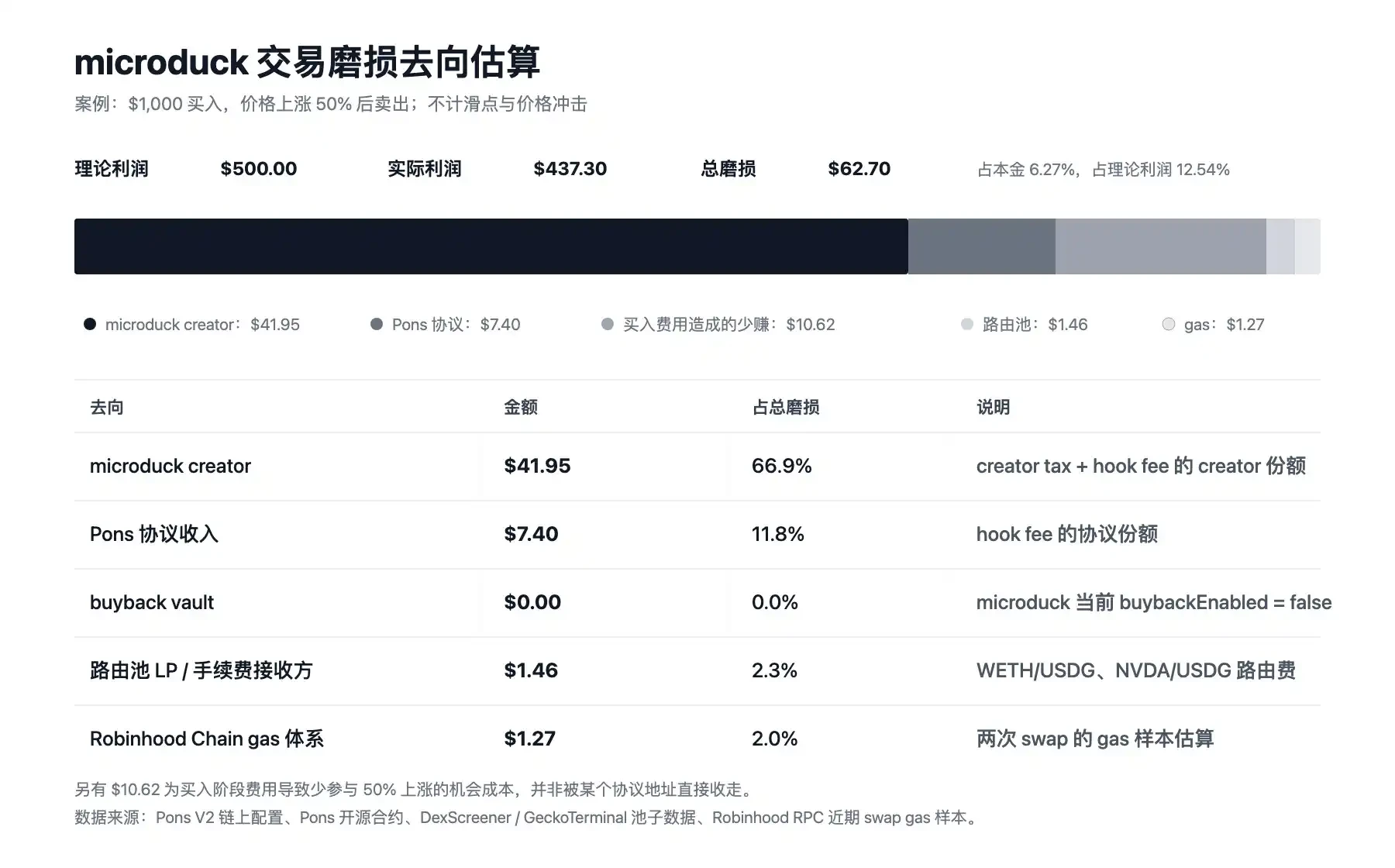
So there it is — after an investor finally hunts down a golden dog, 12.54% of the profits get siphoned off by transaction intermediaries.
The Actual Win Rate in Trench PvP
Many believe the trenches are a game of information asymmetry. But as fees rise, it increasingly becomes a game of cost control.
Dune data shows that over the past 30 days, among traders who sold memecoins on Robinhood Chain:
Profitable addresses: 479,514;
Losing addresses: 716,383;
Loss ratio: approximately 59.9%;
To be fair, this profit/loss ratio is respectable in a market environment where crypto hasn't fully turned bullish. However, the current data includes profit/loss figures from the first 50 days of Robinhood Chain's simpler gameplay mode. With capital now flooding into the RH chain, community feedback suggests the trenches have entered hell mode — foreign Twitter accounts are constantly reporting getting rugged — and the ratio of losing addresses is likely to deteriorate further.
Moreover, persistently high on-chain fees exacerbate a PvP paradox: the higher the fees, the higher the win-rate threshold for small accounts; the heavier the taxes, the larger the price move needed for short-term trades to be profitable. It's not that the trenches offer no opportunities — it's that they demand you act earlier, faster, and more accurately than most, all while paying increasingly higher friction costs. Over time, the more expensive fees become, the harder it is for low-win-rate speculative strategies to remain profitable in the long run.
Alternative Pools for LP Provision
This is where the cost-effectiveness of taking a different path — finding quality pools for LP provision — becomes increasingly apparent. Because PvP earns money from your counterparties, while LP earns money from the trading order itself.
Given this cycle's RH chain narrative centered on stock meme coins, and referencing Robinhood Chain pool data, we've selected several pools worth watching:
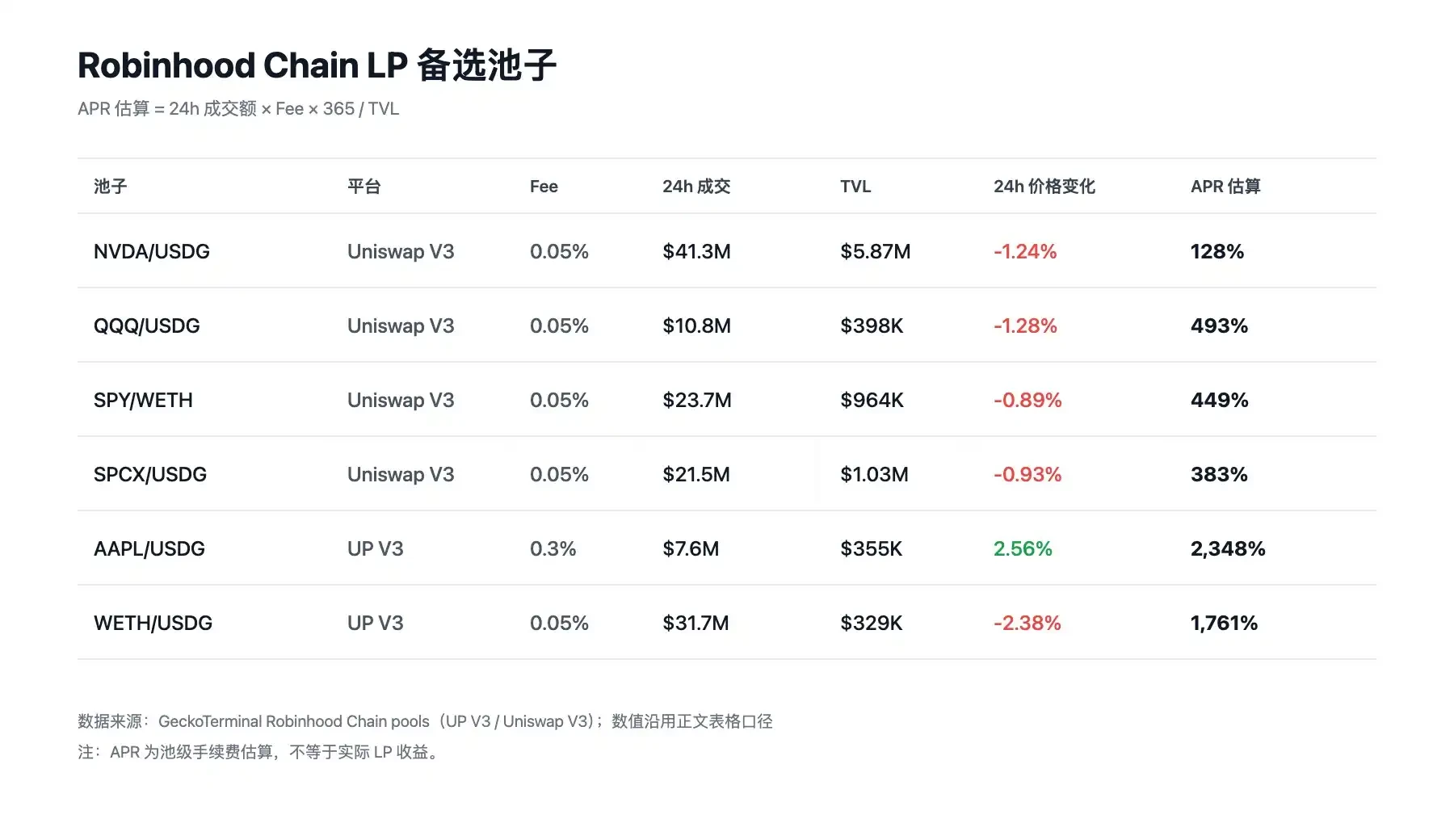
Here, we should explain the data dynamics: most tokens launched on platforms like Pons are stock tokens, and most users don't hold large quantities of these tokens. As a result, during transactions, the routing takes an extra step — and that extra step is exactly where our excess returns come from.
It should be noted that as a native ve(3,3) protocol on the RH chain, UP's AAPL/USDG and WETH/USDG APRs look impressive, but TVL is relatively small, and yield sustainability requires continued observation.
Of course, another approach is to select promising RH chain infrastructure projects for long-term holding and LP provision. We suggest investors focus on projects with delivered products and native RH chain protocols. Take the aforementioned ve(3,3) protocol Up, for example — benefiting from a rapid appreciation in its token valuation recently, the protocol's token is currently paired with WETH on its platform, boasting an APR as high as 21,950%.
Additionally, OHM (OlympusDAO)-style protocol NET, officially endorsed stock dividend protocol Index, and RH chain native order book DEX Mancer — barring unexpected developments, these projects should perform well over the long term, with their largest mainstream pools currently offering APRs of 2,341%, 1,261%, and 1,059%, respectively.
Finally, some savvy on-chain degenerates are taking a "cultivation path" approach — leveraging the high volatility of hot meme coins and LP scarcity by setting custom high fee rates on Uniswap V4, riding on-chain FOMO sentiment to generate impressive returns. Take yesterday's briefly viral Rabbit token, for instance: someone set up a USDG pool with an 8% fee rate. The pool reached a TVL of $328,000, captured $239,000 in 24-hour trading volume, ultimately earning $19,000 — an APR of 2,124%. Though this is somewhat like trading memes in another form — betting that the token won't quickly go to zero.
In summary, the operational playbook for Robinhood Chain under the new conditions seems to warrant a rewrite. In the low-fee era, the trenches could tolerate high-frequency trial and error; in the high-fee era, every click becomes a stake. For average users, the PvP win rate is only around 40%, further eroded by gas, platform fees, slippage, and failed transactions. In contrast, selecting quality stock tokens or index tokens for LP provision essentially positions you on the revenue-collecting side of trading flow.
In our view, in the current environment of rapidly rising Robinhood Chain fees, the more cost-effective strategy isn't indiscriminate trench warfare — but rather allocating a small position to high-conviction narratives, while using the main position to filter for LPs with high trading volume, more stable prices, and TVL that isn't too thin.
The trenches earn from directional calls amid chaos. LP earns from the chaos itself.