Global Payments Weekly 2026W35


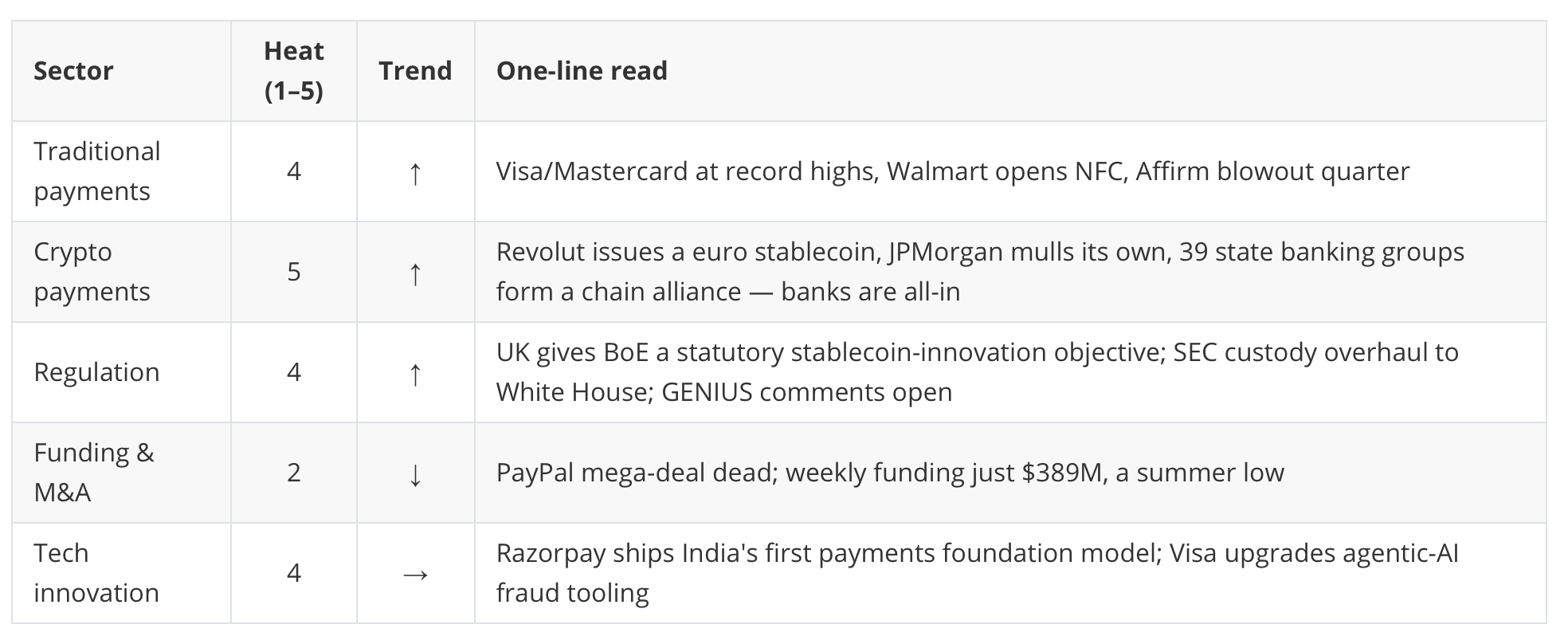
- Key Takeaways: This week's key developments in both traditional and crypto payments center on asset pricing discipline among major payments companies, a market reshuffle driven by retail giant NFC payment openness, and stablecoins accelerating into a multi-path competitive phase of compliance and tokenized dollars under regulatory and commercial bank momentum.
- Key Elements:
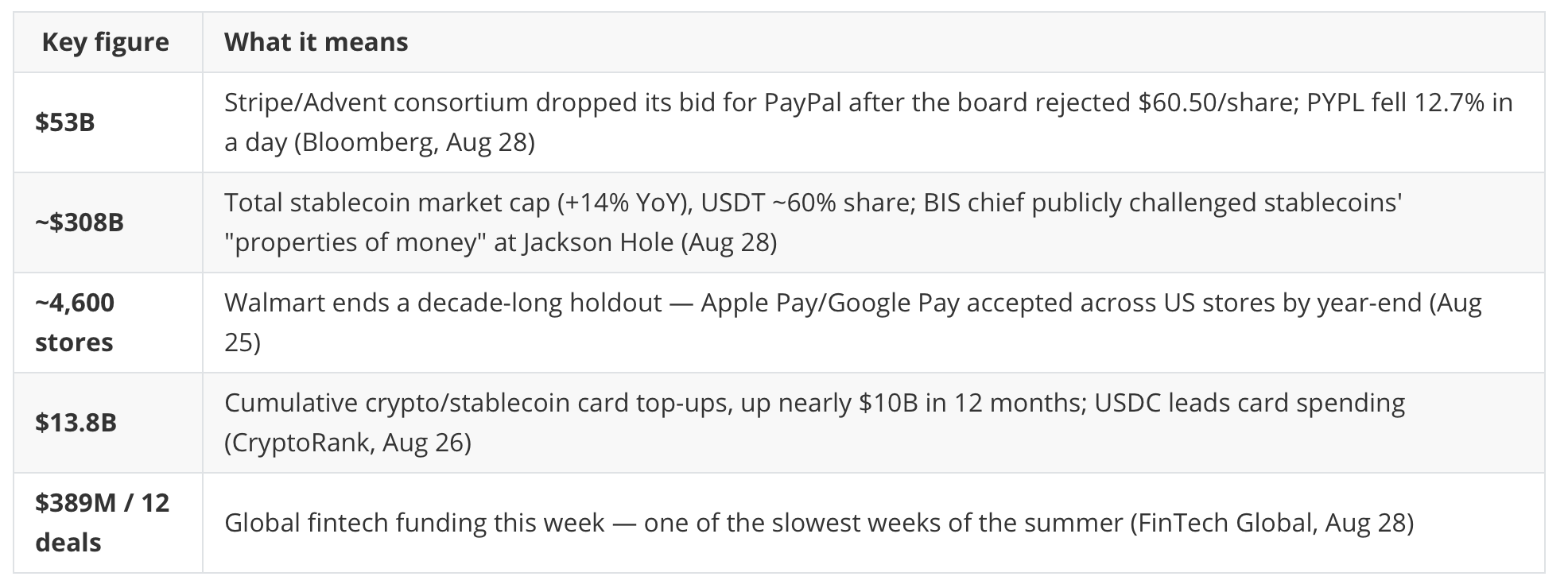
- The PayPal acquisition fell through after the $60.50-per-share offer was rejected; the consortium walked away rather than raising its bid, signaling stronger buyer-side pricing discipline for payments assets than expected. PYPL shares gave back roughly 30% of their gains, and the mega-M&A narrative may cool for now.
- Walmart has opened up NFC acceptance while simultaneously advancing its own OnePay and BNPL offerings. For issuers and networks, this represents a structural tailwind for contactless card payment volumes, and competitive reactions at the checkout stage warrant close attention.
- Revolut delisted USDT under MiCA and issued a compliant euro stablecoin, EURR — issued via Stripe's Bridge. Payment giants are becoming stablecoin "contract manufacturers," highlighting MiCA's dual effect of both expulsion and cultivation.
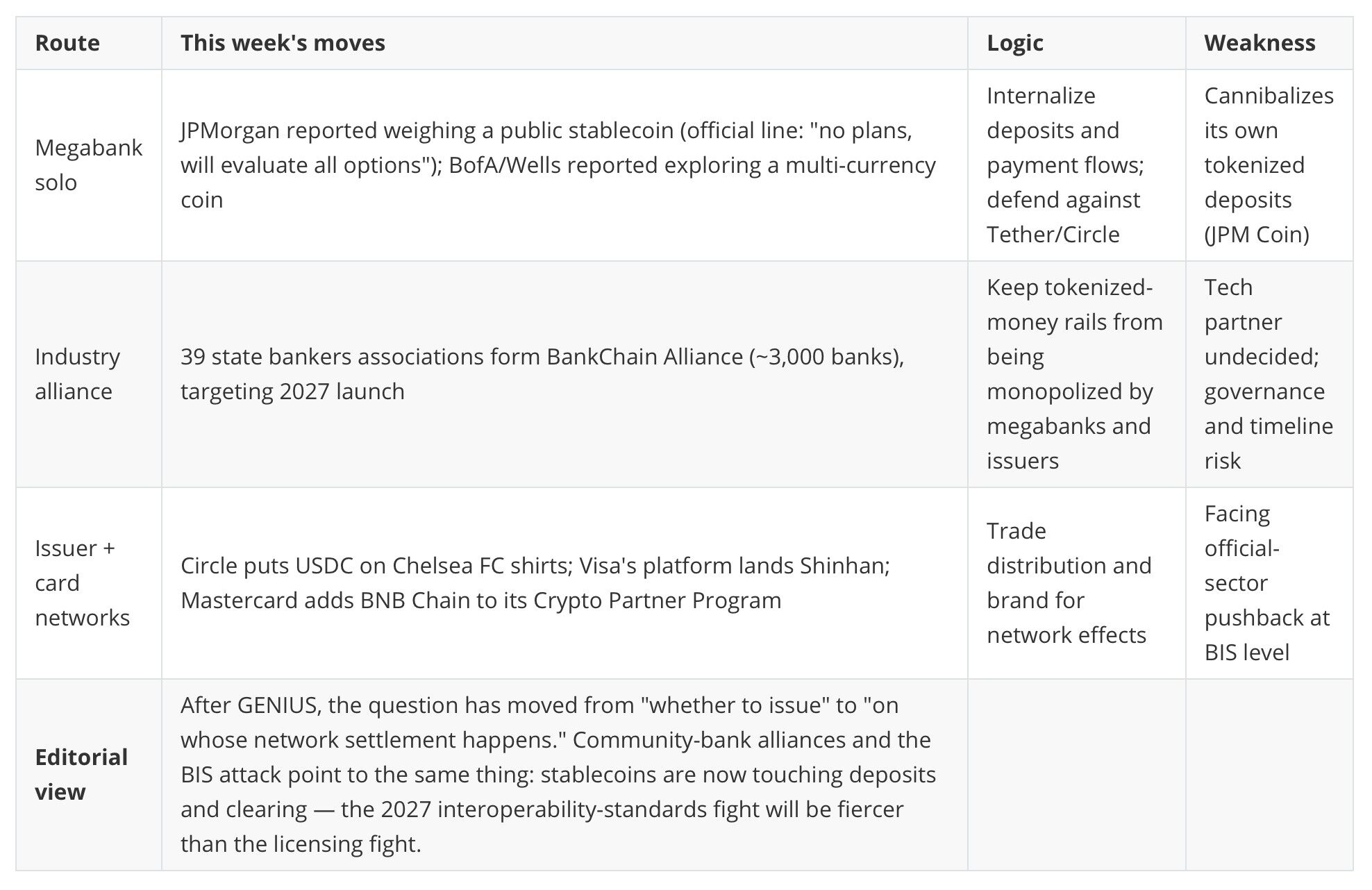
- JPMorgan (independently), a community bank coalition, and TCH (via a separate route) are advancing tokenized dollars in parallel — at least three tracks coexisting. Interoperability, rather than issuance, is becoming the next competitive battleground for infrastructure providers.
- Swift delayed its ISO 20022 migration, while TCH RTP announced a cross-border pilot for H1 2027 with on-chain settlement maturing. The delays in legacy messaging migration are widening the window for alternative solutions.
Author / Editor: WANG TAI
Coverage period: Aug 24 – Aug 30, 2026 (Week 35) · For traditional & crypto payments practitioners · ~4-min read
1. The Week at a Glance
2. Industry Thermometer
3. Key Events of the Week

Why these matter (editorial analysis)
- PayPal deal collapse: the consortium walked rather than raised after a $60.50/share rejection — buy-side price discipline on payments assets is stronger than the market assumed. PYPL gave back the ~30% gained since talks surfaced; expect the large-cap consolidation narrative to cool near-term.
- Walmart opens NFC: this is repositioning, not surrender — Walmart is simultaneously pushing its own OnePay and BNPL. For issuers and networks it is a genuine card-present contactless volume windfall; watch how aggressively OnePay counters at checkout.
- Revolut EURR: MiCA's expulsion effect (USDT delisting) and incubation effect (a compliant euro stablecoin) landed at the same company in the same week — and the issuer is Stripe's Bridge. Payment giants are becoming the stablecoin "contract manufacturers."
- JPMorgan & BankChain: megabanks solo, community banks in alliance, TCH on its own track — at least three parallel routes to tokenized dollars. For infrastructure providers, interoperability, not issuance, becomes the next competitive interface.
- Swift's ISO 20022 delay: with TCH's RTP announcing a cross-border pilot for H1 2027 and on-chain settlement maturing, every slip in legacy messaging migration hands the alternatives a wider time window.
4. Crypto / Web3 Deep Dive
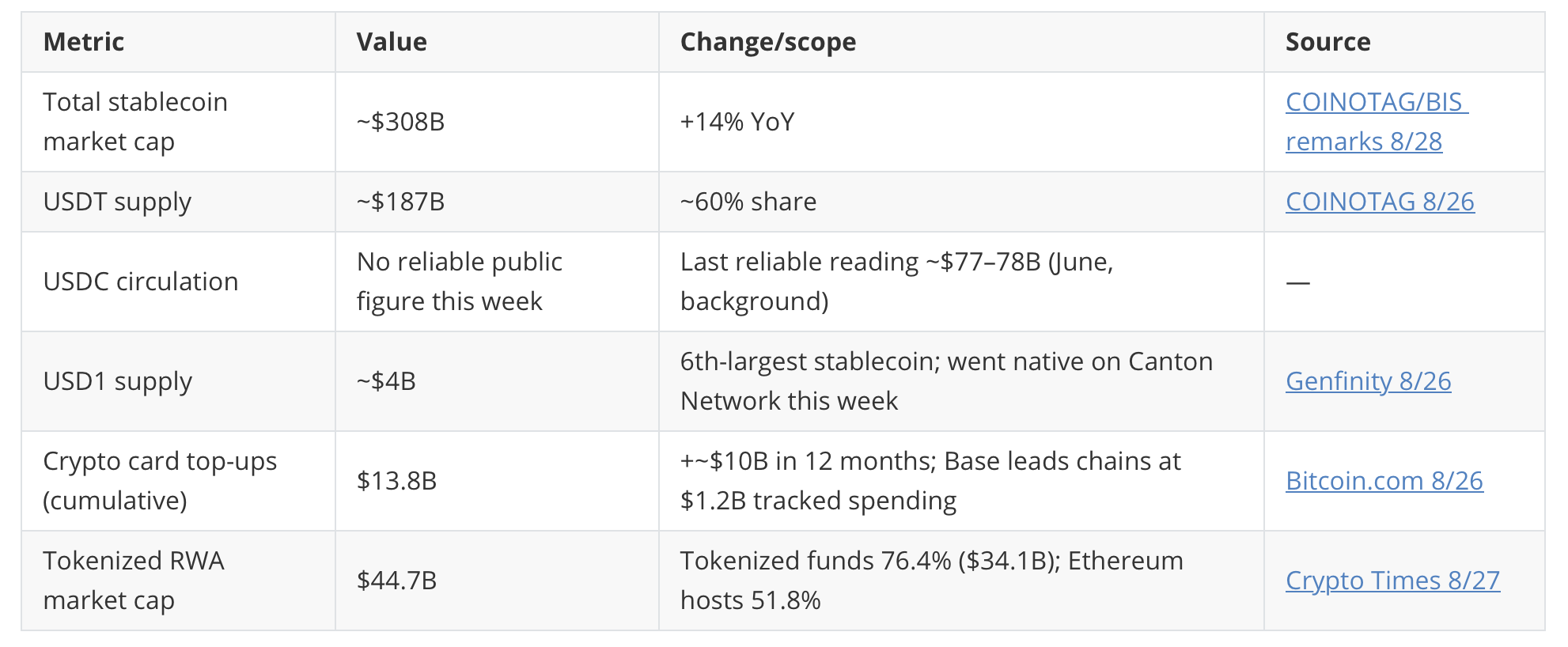
4.1 Stablecoin data dashboard
4.2 Theme of the week: banks pile in — three parallel routes to tokenized dollars
4.3 Voices of the week

4.4 Regulatory week in brief
US: SEC sent its crypto-custody rule overhaul for advisers/funds to the White House (OIRA) (The Block 8/26); the Blockchain Association backed Treasury's GENIUS Section 3 proposed rules — comments due Oct 19 (The Block 8/25). UK: BoE gets a statutory stablecoin-innovation objective (see Key Events). EU: MiCA enforcement effects turn visible — Revolut delists USDT and issues compliant EURR. No major new policy from Mainland China or Hong Kong this week (background: PBOC expanded e-CNY operators to 30 banks mid-August; Hong Kong's HKDAP advancing in institutional use).
5. Traditional vs. Crypto Payments

6. Regional Watch

7. Action Items for Practitioners
For traditional payments practitioners
- Re-price your wallet channel strategy: Walmart's NFC opening delivers structural card-present contactless volume in the US — issuers and acquirers should model the tap-to-pay share shift now, and watch OnePay's counter-moves at checkout.
- Don't slow ISO 20022: Swift's deferral is a buffer, not an exemption — keep structured-address work on schedule, and add TCH RTP's cross-border pilot (H1 2027) to your cross-border product roadmap review.
- Pick BNPL partners on credit quality: the Affirm/Klarna divergence shows underwriting, not GMV growth, determines partner durability — build performance triggers into co-brand and distribution deals.
For crypto payments practitioners
- Align EEA products with MiCA now: Revolut's USDT delisting is the signal — plan compliant-stablecoin substitution (EURC/EURR-class) and liquidity migration for European flows within the year.
- File GENIUS comments (due Oct 19): the foreign-issuer prohibition bites July 2028 — lock in your structural path (US entity, agency issuance, or exit) during the comment window.
- Position at the bank-interoperability layer: with megabanks, state-bank alliances and card networks building in parallel, the "connector" role (compliant settlement, cross-network clearing) is scarcer than issuance — the Shinhan × Visa template is replicable with regional banks.
8. Watchlist for Next Week
- Aug 31: Revolut's USDT delisting across the EEA — watch where European USDT liquidity migrates (EURC/EURR/USDC) and whether other platforms follow.
- Sept 1: Wero launches in Luxembourg; TCH RTP's new rules take effect in September — two bellwethers for legacy rails' self-renewal in Europe and the US.
- The announcement window ahead of Money20/20 Middle East (Sept 14–16, Riyadh) — expect concentrated Saudi/UAE licensing and product news; also track large banks' and issuers' position papers in the GENIUS comment docket (closes Oct 19).
All data and events are drawn from public reporting; links point to original sources. Editorial analysis reflects judgment based on public information and is not investment advice.