






LIT surges to new highs, Lighter and Robinhood surprisingly share the same origins


- Core Thesis: The LIT token has surged nearly 5x in 5 months. The key driver is that Lighter, backed by its US compliance narrative, top-tier distribution channels, and the founder's rare network, has become the project with the strongest "American legitimacy" in the Perp DEX sector.
- Key Elements:
- LIT has risen from a March low of $0.7794 to $3.79, a gain of nearly 5x, with a market cap of $865 million, ranking 76th globally, and up 75% in the last 30 days.
- Founder Vladimir and Robinhood founder Vlad Tenev are alumni of the top public high school TJ, and Vladimir previously served as an early advisor to Robinhood. The two companies are deeply intertwined, with Robinhood Chain's perpetual contracts exclusively supplied by Lighter, sharing revenue on a 50/50 basis.
- Lighter is a project registered in Delaware, USA, with tokens directly issued by a US C-Corp. The founder was invited to the CFTC's Technology Advisory Committee to help set legal operating standards for DEXs, gaining a first-mover advantage in shaping regulatory rules.
- Rapid business expansion: In April, it became the exclusive perpetual contract provider for Telegram Wallet (covering 150 million users); in July, it launched on Robinhood Chain; in August, it received support for KRW trading pairs on Upbit, and it has implemented a zero-fee strategy for retail traders.
- Strong funding background: Secured $68 million led by Founders Fund and Ribbit Capital at a $1.5 billion valuation, with participation from Robinhood Ventures. Its core technology is built on zero-knowledge proof matching verifiability, and its on-chain perpetual market share has grown from 1% to 10%-20%.
From the end of March this year, when LIT hit an all-time low of $0.7794, to today, five months later, LIT has surged nearly 5x, peaking at $3.79. It's up 75% over the past 30 days and 24% over the past week.
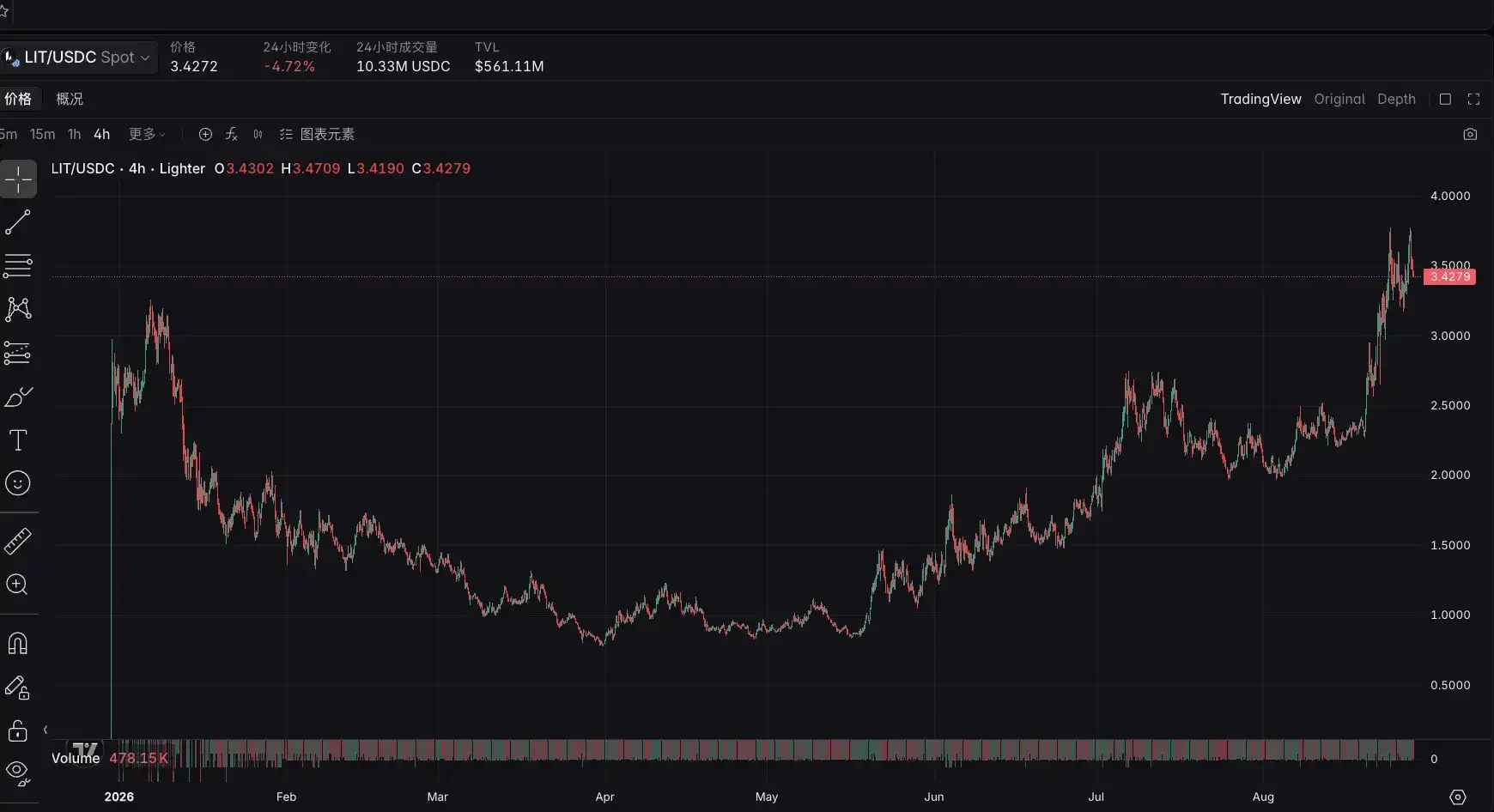
LIT is arguably one of the best-performing tokens in the crypto market this year, currently ranking 76th globally by market cap with a valuation of $865 million. In the early stages of this bull run, where Bitcoin and HAPE are also rallying, it's only natural for altcoins to follow suit—a rising tide lifts all boats. But LIT's surge isn't just about the broader market lifting it up.
Perp DEXs have been a core sector over the past two years, with Hyperliquid as the benchmark. It has been navigating the US market remarkably smoothly recently. Regulatory, compliance, and institutional access hurdles have barely slowed it down, setting an expectation for the entire sector: this business is viable in the US. Lighter, being in the same lane, naturally ranks among the core projects of these two years.
But when it comes to "American legitimacy," Lighter sits even further ahead than Hyperliquid. After all, it's a US-native project, incorporated in Delaware, with its token issued directly by an American C-corporation, rather than routing through Cayman or Swiss foundations like most projects do. Lighter's founder, Vladimir, is a Russian immigrant who came to America as a child. Under the Trump administration's "America First" narrative, this identity is a pass that can't be bought.
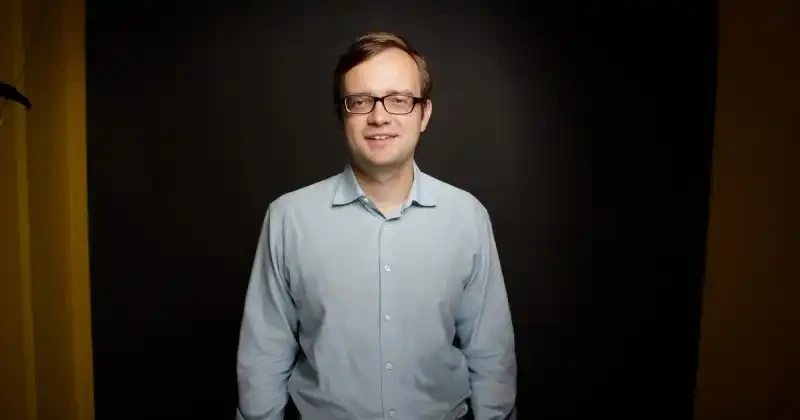
Lighter founder Vladimir
That's why, on August 20, when the newly established Innovation Advisory Committee of the US Commodity Futures Trading Commission (CFTC) held its first meeting to discuss "what a decentralized exchange needs to look like to operate legally within the United States," Lighter's founder and CEO Vladimir was right there at the table offering his input.
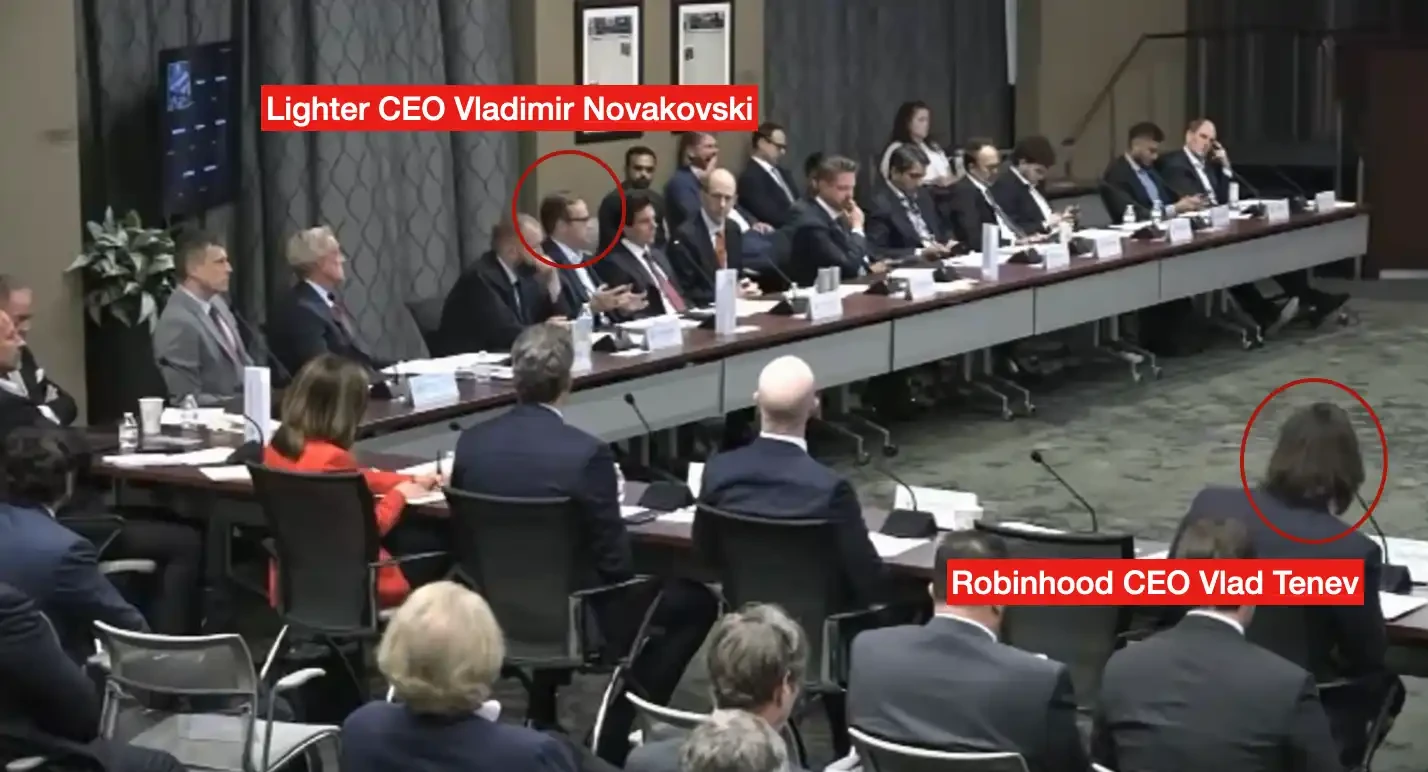
First meeting of the CFTC Innovation Advisory Committee on August 20
Meanwhile, Lighter's business itself is in an expansion phase. In April this year, the Telegram wallet launched perpetual contracts, exclusively powered by Lighter, covering 150 million registered users. On July 1, Robinhood launched its own chain, with Lighter providing the perpetual contract engine and splitting revenue 50/50. Lighter still charges zero fees to retail users—maker and taker fees across all 241 markets are 0. On August 24, Upbit, Korea's largest exchange, listed the LIT/KRW trading pair, and the token jumped another 22% that day.
Combined, these factors might explain most of this rally. But they still don't fully explain one thing: why, among all the Perp DEX projects out there, it's precisely Lighter that managed to turn Robinhood—America's largest retail brokerage—into its distribution channel, and walk away with a 50/50 revenue split.
On a podcast hosted by Laura Shin, Lighter's founder and CEO Vladimir shared an anecdote from the past.
He said he'd joked with his team that this partnership had been brewing for 12 years—or, looking at it from another angle, maybe even 25 years. "Because Robinhood's founder, Vlad Tenev, and I were high school classmates—we were the only two Vlads in our entire school."
We Were the Only Two Vlads in High School
Lighter's founder Vladimir and Robinhood's founder Vlad Tenev were the only two Vlads in their high school.
The two Vlads attended Thomas Jefferson High School for Science and Technology, or TJ for short. It's one of America's most elite, famous, and hardest-to-get-into public STEM high schools, gathering the strongest math and science students from the Washington DC metro area. Many go on to top universities and careers in tech and finance, making it a recognizable credential signal in Silicon Valley, quant, and startup circles.
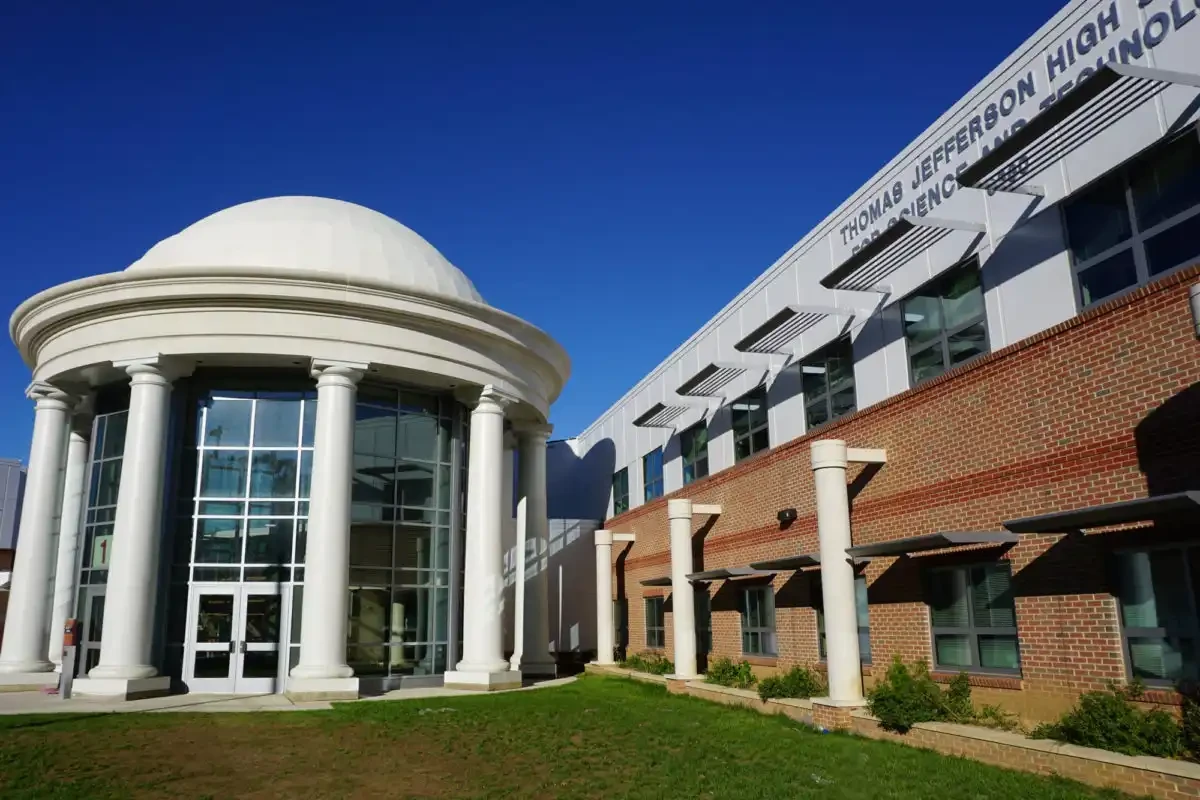
TJ High School
Since Lighter's founder is three grades ahead of Robinhood's founder, we'll refer to them as "Big Vlad" (Lighter's founder) and "Little Vlad" (Robinhood's founder) for clarity throughout this article.
During his senior year, Big Vlad was one of the most famous students at the school.
That year, he placed first in the US Physics Olympiad; then represented the US at the 32nd International Physics Olympiad in Antalya, Turkey, bringing home a silver medal; and later made it to the national finals of the Intel Science Talent Search with a project titled "Optimal Hologram Design for Optical Neural Computing." Only two students from his school made it to the finals that year—and while most others on the list were 16 to 18 years old, Big Vlad was just 15.
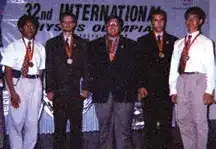
2001 Physics Olympiad team, second from left: Lighter founder Big Vlad
Big Vlad later recalled those days on Quora, saying he still remembers walking into his first math team practice two weeks into school, unsure how long he'd last on that team given his skill level. So to sharpen his competitive edge, he and a few classmates started organizing extra after-school sessions focused on math team, computer team, and Olympiad training. That after-school training culture has persisted to this day.
When Little Vlad first entered high school, his first impression of Big Vlad was as the senior organizing after-school competition training. It was through these sessions that the two Vlads began to get familiar with each other.
Big Vlad Was Actually an Early Advisor to Robinhood
Soon after, 16-year-old Big Vlad graduated from high school and entered Harvard, where he finished in just two years. He was then personally recruited by Ken Griffin, founder of the renowned hedge fund Citadel, to join the firm.
That was Big Vlad's first job—doing quantitative research, tasked with building high-frequency trading systems for the foreign exchange market. He later moved to Graham Capital, a global macro and trend-following fund managing over $10 billion in assets, where he rose to portfolio manager and director, staying for seven years.
Big Vlad's office was conveniently commutable from New York City, and Little Vlad was in New York at the time.
It was two years after the Lehman crisis. Little Vlad had started a company called Celeris, which didn't work out. In January 2011, he pivoted to Chronos Research, selling low-latency trading software to banks and hedge funds, achieving modest success with several million dollars in annual revenue.
As a portfolio manager at a billion-dollar quant fund, Big Vlad was a natural prospect for Little Vlad pitching his low-latency trading software. A quantitative macro fund the size of Graham was exactly the standard target customer for a product like Chronos.
Public records don't definitively confirm whether they did business together at that time, but we believe the quant industry was small back then. After the 2010 Flash Crash, the entire Wall Street arms race was centered on latency. One Vlad was on the buy side, the other on the sell side—it's likely they had close exchanges.
Because in 2013, when Little Vlad started his next venture, Big Vlad became his early advisor, providing considerable support to his junior's early entrepreneurial journey. And that venture of Little Vlad's was Robinhood—now a household name across America.
Robinhood's original name was actually Cash Cat. (Yes, that's where the biggest memecoin on Robinhood Chain comes from.)
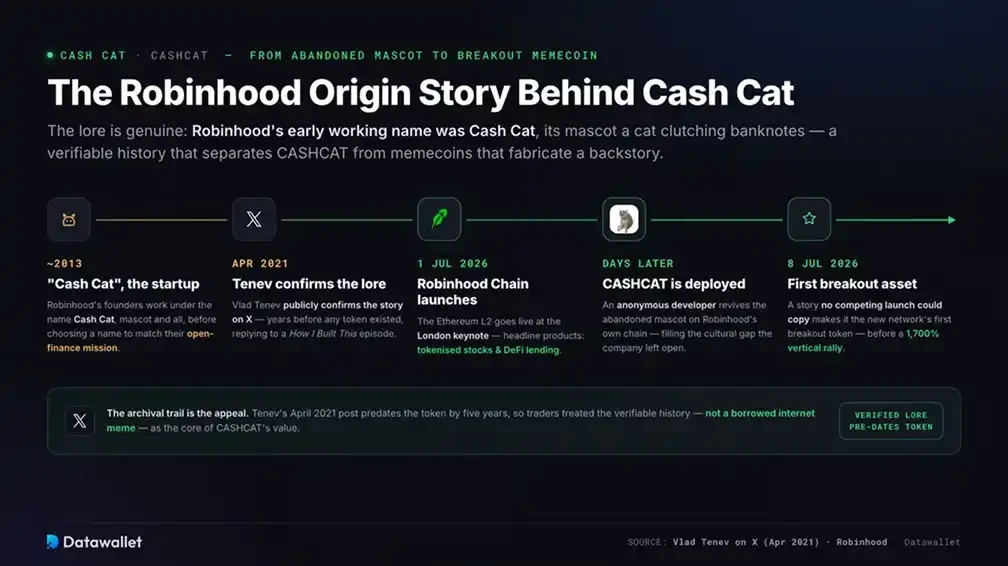
Little Vlad didn't think the low-latency trading software business was cool enough. Even if he kept at it for another 30 or 40 years and built the ultimate version of it, he still wouldn't want to tell his grandkids about it. He wanted to build a mobile app for commission-free stock trading.
On the podcast, Big Vlad recalled that period twelve years ago: "I was an early advisor to Robinhood. I think their company was called Cash Cat before that, right? They had just changed the name to Robinhood and were building a waitlist. I already knew the team back then and was involved in some things."
Over the following year, Big Vlad changed jobs himself. He joined Addepar, a wealth management software company, as VP of Engineering. Addepar was founded by Joe Lonsdale, co-founder of Palantir, who was mentored by Peter Thiel.
Addepar was in Mountain View; Robinhood was in Palo Alto. The distance between the two locations is less than ten kilometers. Their relationship grew even closer.
When the Senior Starts a Company, the Junior Naturally Supports
This was a period when both Vlads' careers were thriving.
Big Vlad hired two interns under him—one named Scott Wu, who a decade later built the AI coding agent Devin, with his company valued at $10.2 billion and acquiring Windsurf last year; the other named Alexandr Wang, who sold Scale AI to Meta this year for $14.3 billion and now leads Meta's superintelligence lab.
The competition circuit is a small world.
In November 2017, two years after leaving Addepar, Big Vlad teamed up with Scott Wu to found an AI social networking company called Lunchclub. The idea was to use machine learning to match people—analyzing users' backgrounds and goals to set you up for lunch with someone worth meeting.

Lunchclub early UI
In September 2019, Lunchclub raised a $4 million seed round led by a16z. Among the angel investors was none other than Robinhood's co-founders.
When the senior starts a company, the junior naturally supports.
In August 2020, Lunchclub raised another $24.2 million in a Series A led by Lightspeed with Coatue following, pushing the valuation past $100 million. The investor list for that round included Hollywood's super agent Michael Ovitz, PayPal co-founder Max Levchin, Quora founder Adam D'Angelo—and Little Vlad.
That year, Little Vlad was on the eve of the pinnacle of his career. The pandemic drove millions of American retail investors into mobile stock trading, and Robinhood's user base exploded. In April of the following year, Coinbase went public directly on Nasdaq with an opening valuation of $100 billion; in July, Robinhood itself went public; in November, Bitcoin hit its all-time high of $69,000.
But soon after, several historic events in the crypto industry would directly shape the direction of both Vlads for the next five years.
In May 2022, Luna collapsed to zero, wiping out over $40 billion. In November, FTX went bankrupt—the industry's largest centralized exchange fell, and users couldn't get their money back.
Big Vlad spotted an opportunity here. He believed exchanges could make the matching process itself verifiable. Using zero-knowledge proofs, every single trade could be mathematically proven fair—nobody could cut in line, nobody could misappropriate funds.
He named this venture Lighter.
Big Vlad later said that when they started building Lighter, on-chain perpetual contracts accounted for just 1% of the entire perps market. At that time, the ceiling for this track was Hyperliquid. By this year, Lighter's on-chain share has grown to 10-20%.
In November 2025, Lighter raised $68 million at a $1.5 billion valuation, led by Peter Thiel's Founders Fund and fintech veteran Ribbit Capital, with Haun Ventures following. And of course, Robinhood Ventures was in on it too.
Robinhood and Lighter: A Powerful Alliance
On July 1, 2026, the Robinhood Chain mainnet went live. It's Robinhood's own Ethereum Layer 2 network, built on Arbitrum technology, with 100-millisecond block times, no native token, and gas fees settled in Ethereum.
The perpetual contracts running on Robinhood Chain are Lighter's.
Rather than routing Robinhood's orders to its main order book, Lighter runs a separate book—they call these Lighter Domains. The two books are independent, but since both are built on Ethereum, market makers can quote on both sides simultaneously using the same balance sheet, and moving funds between the two books is nearly instantaneous. The Robinhood book uses USDG as collateral and quote asset, while Lighter's main book uses USDC, with revenue split 50/50.
Big Vlad admitted on the podcast that this creates friction for market makers. But he also explained why they still come: "Because they know that among the order flow coming from Robinhood, the proportion of retail orders is very high—that's ultimately the traffic they want."
However, due to policy reasons, Americans currently can't use it. Perps in the Robinhood wallet are excluded in the US, UK, Canada, Switzerland, UAE, and Singapore.
But both Vlads are members of the new Innovation Advisory Committee, and Big Vlad is working with the CFTC to obtain a license for decentralized perpetual contracts.
That license would cover both Lighter's own front-end and brokerages like Robinhood that plug in—similar to how Robinhood's prediction market currently operates under Kalshi's license.
"It's just that right now, nobody has obtained this kind of license yet," Big Vlad said.


