






CZ on Stress Resistance, Adaptability, and Lifelong Motivation: Do Your Best and Let the Universe Decide


- Core Insights: Binance founder CZ (Changpeng Zhao) looked back on his entrepreneurial journey in a podcast interview, emphasizing that his ability to withstand pressure stems from a worldview of "isolating matters" and "simulation theory." He frankly admitted that if he were to rebuild the platform, he would avoid engaging with U.S. users from day one. He also noted that payments and on-chain rights confirmation have not yet met early expectations, while RWA and stablecoins are areas he only came to understand later.
- Key Elements:
- Management Style: CZ said he does not proactively track project progress, only retaining employees who proactively drive work forward. He only keeps in mind the three to five important matters he personally needs to handle.
- Rebuilding Assumption: If he could go back to 2017, the core decision would be "not touching U.S. users from day one." He would also launch financial products such as futures earlier and more comprehensively, while blocking certain high-risk regions and strengthening communication with regulators.
- Most Stressful Moments: The first was the two weeks after the ICO listing when the token price plummeted; the second was the more than ten months he was "stuck" in the U.S. due to judicial proceedings. The core stress came from uncertainty about outcomes.
- Stress Management Methodology: Reducing emotional transmission by isolating different matters (e.g., separating legal disputes from product meetings); setting no specific wealth or performance goals, adhering to the simulation theory of "do your best and let the universe decide."
- Industry Reflection: He believes Bitcoin has been validated as a store of value, but daily payments and on-chain asset rights confirmation (such as property certification) are progressing slowly. Conversely, the rapid growth of stablecoins and RWA (Real World Assets) was not foreseen in the early days.
- Sustained Motivation: His main focus now is on the free education platform "Giggle Academy." The number of students has grown from over 100,000 at the beginning of the year to approximately 1.2 million. The joy of helping others is the core driver behind his continued high-intensity work.
Source: "Meanders" Podcast
TL;DR:
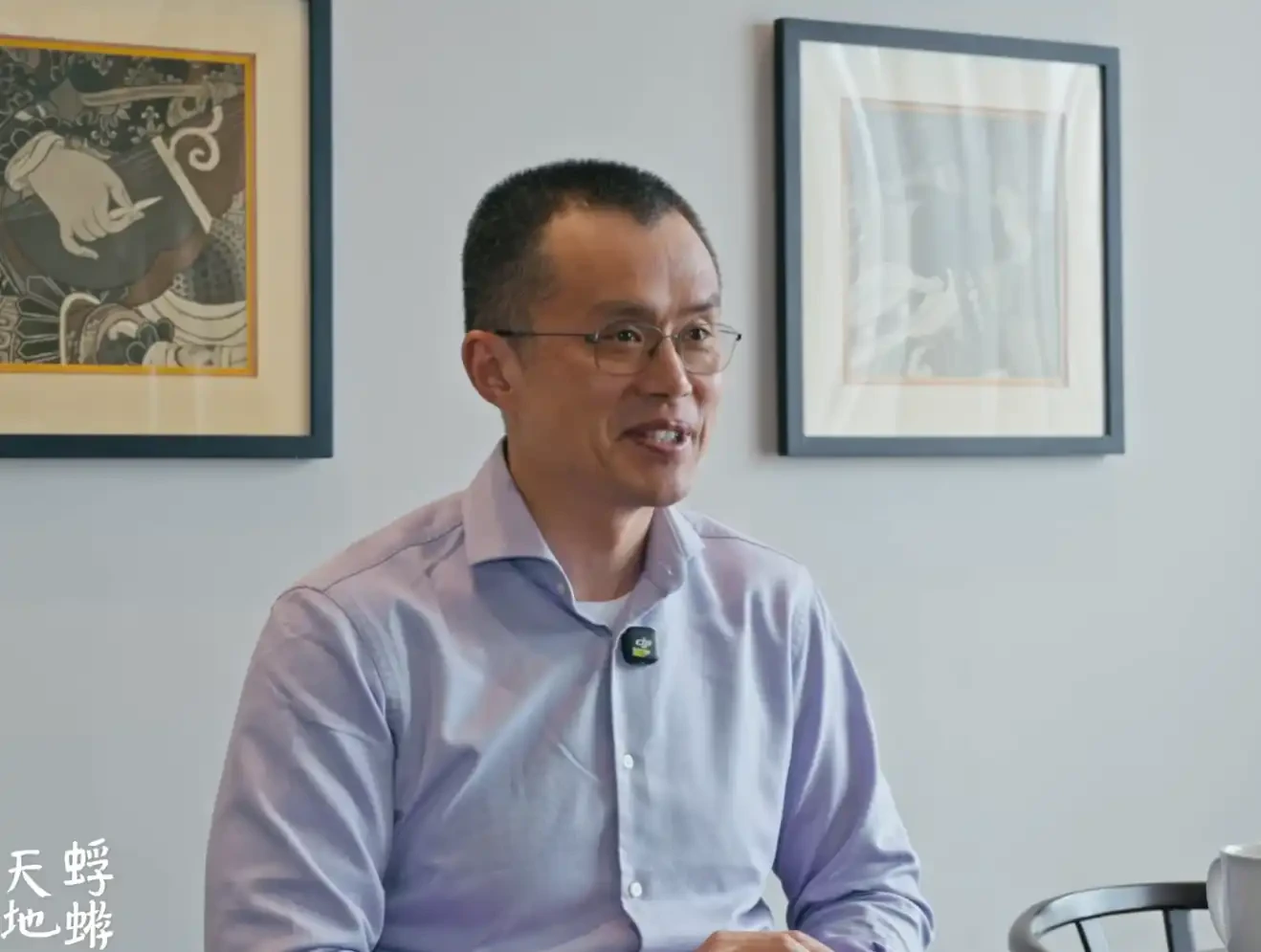
Chatting in Bhutan, CZ says he's no longer among the busiest, but replies to messages as soon as he sees them; he only keeps people who push projects forward on their own, and only holds three to five things he needs to do himself in his head.
If he were to rebuild a global exchange: from day one, he wouldn't touch US users; futures and financial products would launch earlier and be more comprehensive, while blocking certain regions. What the book "The Binance Life" couldn't capture was the emotion of those moments.
The two most stressful periods: the ICO price drop right after listing, and the 10-plus months stuck in the US—what really weighs on you is uncertainty. He handles pressure by compartmentalizing things, setting no wealth goals, and believing in simulation theory: do your best and leave the rest to fate. Founders often underestimate difficulty, and must adapt and be passionate; pure busywork done just for peace of mind can be skipped.
He still believes Bitcoin has value, but payments and on-chain verification haven't lived up to early visions; RWA and stablecoins are things he came to understand later. He keeps working because helping people brings him joy—Gaggle Academy has grown from a few hundred thousand kids at the start of the year to about 1.2 million now.
CZ appeared on the "Meanders" podcast to discuss handling pressure, adaptability, and lifelong motivation. Below is the full conversation between host Han Yang and CZ:
Busy or Not, How He Replies to Messages, How He Manages
Han Yang: I have a small question—are you tired right now?
CZ: Not too bad, a little, but fine.
Han Yang: Do you think you're one of the busiest people in the world?
CZ: No, I'm definitely not. I think in the past few years, I might have been among the busiest, but in the last two years, not so much.
Han Yang: It's been three years since I first met you. No matter what time I message you, you always reply—it feels like you don't have a time zone.
CZ: I reply as soon as I see a message. If I see it and don't reply, I'll forget it later. After meetings, I might take a few minutes to check and reply to messages. I do this in the morning when I wake up and before bed at night. When I'm chatting with friends, I'll check occasionally. But if I'm focused on something serious, I'll wait. Your messages are quick to reply to, so I'll answer them first, otherwise I'll forget.
Han Yang: Do you think you reply to 500 messages a day?
CZ: Yes, definitely, probably more. Sometimes right after replying to one, I have to scroll way down to find a previous one. I can reply to a lot of messages within a few minutes.
Han Yang: I can imagine you're handling a ton of things at once. How do you make sure your head keeps up with everything? Like where one thing stands, and where another stands.
CZ: I still have a lot of miscellaneous things going on, and even as CEO, I had tons of miscellaneous stuff, so my tracking isn't great. When someone comes to me, I tell them what to do, but after that, I won't proactively check on them a day or a week later. I generally don't do that. So the people I work with need to be very proactive—they need to push you forward. If they need another meeting tomorrow or the day after, they schedule it; I don't go find them tomorrow. If anyone I work with requires me to ask about project progress, I usually won't keep them. And in that case, the project probably has issues. So I hope that if they have updates tomorrow or a week later, they message me, and I'll remember. I need self-driven, proactive people. The people around me are all quite proactive. Also, what's important to me: you can hold three to five important things in your head, but those are things I need to do; the rest are theirs, and they need to report to me proactively.
If He Rebuilt a Global Exchange with Today's Experience
Han Yang: Speaking of three to five things, that actually connects to my second question. I've written about Binance before and looked at a lot of your public statements. I remember around 2017-18, you emphasized wanting Binance to be a faster, more user-friendly, and safer company. But looking at your comments in 2025, especially this year, you've stressed that you might have underestimated legal, compliance, and political factors back then. If you had all your current experience, went back to 2017, and started a global crypto exchange from scratch, what constitutional rules or absolutely non-negotiable principles would you set for yourself?
CZ: Looking back with hindsight, it's clearer. I think the first rule is: don't touch US users. From day one, don't touch US users. Their definition for centralized financial platforms is: if you touch US users, you need US regulation and a US license. They don't implement this 100% consistently, but they have the right and the power to do so. Also, looking back, in some areas we didn't execute fast enough. Yesterday someone online asked me, aren't these two conflicting? Do you want to be more careful or faster? If I could look back with today's experience, some things I wouldn't hesitate on, and some things I just wouldn't do at all.
Han Yang: Can you give an example? What's something you wouldn't hesitate on if you did it again?
CZ: Many small product features. I might have launched futures earlier. Maybe even other financial products earlier, covering more financial products. But I'd block certain regions entirely. Also, communication with regulators—I might have done more there. First, it's not my strength, and second, we're not in one country—we need to communicate with over 100 countries, and that's hard to manage. So that's an area where I'd do more.
Han Yang: From a third-party perspective, Binance is already one of the exchanges that communicates most with regulators.
CZ: Binance is definitely the most—no "one of" about it.
Han Yang: But you still think it's not enough?
CZ: Coverage is still a bit insufficient. And if you really want to do it properly, the cost is very high. It's not just about money—you need to hire good people, spend lots of time, and spend lots of time managing it. When you've hired a big team all doing this, the CEO ends up spending a lot of time on it. These are costs. If you do this, you might have less for products. Because Binance is global, there are so many countries to communicate with. Most companies only need to deal with one regulator. The regulator's expectation is: most traditional companies spend 30% of their time on me, and they expect you to spend 30% of your time on them. But if you have to spend that 30% across 100-plus regulators, it's very difficult. So it's not just about adding people. You can't have everyone everywhere acting fully independently—they still need to report up, and many decisions need to be made, so senior leadership spends a huge amount of time. There might be other ways to do this better.
What Couldn't Be Explained in "The Binance Life"
Han Yang: When I read your book "The Binance Life," I had a strong feeling. Sometimes when writing about the past, you get stuck in a "what do I do" state. Some things are so complex that it's hard to explain them to others. Is there anything that was incredibly important back then, which people now underestimate, but that you as the author also struggled to convey to readers?
CZ: I definitely have that feeling. Sometimes, the emotions of the moment can't be expressed. For example, in 2019, there was a hack. For a whole week, withdrawals were paused, but trading continued while the system was being upgraded. I basically didn't sleep for those seven days—I'd catch a few minutes here and there. The engineers basically went without sleep for three to five days. The pressure of that moment, I don't think the book conveyed it clearly enough. Also, dealing with law enforcement in a few countries. Some law enforcement agencies are very unreasonable—some even break the law. They used public funds to trade, lost money, and asked us to cover it. That kind of communication is extremely stressful. Some of this is described in the book, some isn't—for various reasons, some things still can't be put in the book. So when you write a book, there's always a lot you can't include. And what you do include sometimes can't be described comprehensively. But that's just how it is.
Han Yang: Your answer is really interesting. I thought you'd mention a specific thing that was underestimated, but hearing you out, what you regret to some degree is that the emotion of those moments is hard to convey through text.
CZ: Right. I don't think my expressive ability is that strong, and my writing ability isn't that strong either. So a lot of the inner pressure and thoughts from back then, overall, weren't expressed clearly enough in the book. I wrote the book in simple language because my Chinese and English are both limited, so I described events with very simple words. At the same time, I didn't particularly want to spend too much ink describing what I was thinking. I figured I'd let readers read and feel for themselves what it was probably like.
The Two Most Stressful Periods
Han Yang: Now that you've been through all this, looking back, what really put enormous pressure on you?
CZ: I think about two things, and it's pretty simple. One is the ICO. Right after we finished the ICO and trading opened, the coin price dropped. Those two weeks were very stressful. After that, going to the US to handle the US situation. I was basically stuck there for over 10 months. They told me at the time: if you come, you'll wait six months, then serve four months in prison. If it were 100% certain, you'd know what to expect. When I went, I thought prison was a very small probability, because no one had ever been imprisoned for a single violation of the US Bank Secrecy Act—no one, I was the only one. There was no fraud, no user losses. So I thought I might get a few months of house arrest in the US. House arrest is easy for me—I don't like going out anyway; as long as I have internet at home, I'm fine. The most stressful part in the US was the uncertainty. I didn't know if they'd eventually let me go, or if they'd keep adding more and more charges, just keep grinding me. That period of uncertainty was extremely stressful.
Han Yang: So, do you sleep well?
CZ: Generally, I sleep well. The last couple of days haven't been great, but it's cyclical. 80% of the time, my sleep is fine. I usually get about 6 hours at night, and I take a nap during the day—about 30 minutes to an hour—so it adds up to seven or eight hours. I rarely hit 8 hours, but 7 hours is common.
How CZ Handles Pressure
Han Yang: Before I first met you, I'd already written an article about Binance. A lot of friends asked what I should ask you. Most people wanted me to ask: as the founder of a company growing that fast, you go through massive changes in a short time with enormous pressure. They wanted to know how you actually deal with that pressure and change.
CZ: First, in the early years, I definitely slept less and it was more fragmented. Sometimes I'd get three or four hours at night, and the pressure was greater then. But I've always had a habit of napping—a 30-minute nap during the day clears your head a lot. As for pressure, I don't know how I developed this personality, but I'm very resistant to stress. I've been that way since childhood.
For example, when I was young, if my parents argued at home, my sister and I would see it—they'd both be in bad moods. We'd go to school together, and my parents' fight would affect my sister's mood at school. But when I got to school, my friends couldn't tell I was in a bad mood—they'd never notice my parents had fought. My sister's friends would say, why are you in a bad mood today? I'd separate things—compartmentalize. When I'm handling company matters, many people have told me: the previous meeting was extremely stressful, dealing with US lawyers, the lawsuit, the US case; the next meeting might be a product meeting. Maybe one or two people attended both, and they'd say, wow, how were you suddenly so calm at the product meeting? For me, they're two different things. The pressure is still there—I can definitely feel it—but I generally keep these things well separated.
Second, in terms of stress resistance, my worldview has always been like this. I rarely set goals for myself. I never say I must be ranked a certain number, must be this rich, must make this much money, must grow this many times, or grow a certain percentage each year. I generally don't set those goals. I just do my best. If the market is bad this year, the company's performance might decline, but I gave it my all—I didn't slack off, and I didn't make major mistakes. It's the same when handling problems. No matter how hard the problem, I just do my best to handle it.
I mentioned in my book that I believe in simulation theory. I believe the world is simulated, so it's like a game. It being simulated doesn't mean the game isn't important. But in this game, I just need to do my best—what else can I do? When I face a hard problem, I do my best to solve it; when I face an easy problem, I also do my best. As long as I've done my best, I leave the outcome of the hard problem to fate. With this mindset, the pressure drops a lot. The pressure is still there, but it's like accepting your lot. Whatever happens, happens. You do your best, and after that, you just wait—lie back and win.
What Founders Often Underestimate, and Whether Effort Really Helps
Han Yang: So, how's your digestion?
CZ: My digestion is pretty good. My intestines sometimes act up, but my stomach is fine.
Han Yang: We're alike. Sometimes if I eat raw fish and it's not perfectly fresh, my intestines get a bit off, but my stomach never has issues. Because I'm increasingly realizing that the more excellent founders you talk to, the more you see that stress resistance is a crucial prerequisite. People usually talk about PMF and growth when discussing startups, but many overlook the founder's ability to handle pressure. Honestly, in entrepreneurship, product, technology, IQ, or EQ—these are all easy to see. But what they don't talk about is stress resistance. As a founder, anyone successful has to carry a huge amount of pressure. So as a founder myself, I want to ask a founder question. You invest now and see tons of founders, and you're also an excellent founder yourself. What are some things a founder should know—including what the younger you should have known—that people who haven't been very successful, who haven't been through this journey, couldn't possibly imagine?
CZ: Most people underestimate how hard something is. Most people starting a business think a normal case is actually a great case. 80-90% of startups fail, but a founder is always optimistic. So first is optimism, second is the stress resistance I mentioned, and third is adaptability. Some people are very smart but don't adapt. Their IQ can be high, but their ability to change is very weak—they need structure, and that structure is hard to change. But in entrepreneurship, you not only need to be smart, you also need to be able to change, accept change, and adjust at any time. Also, a founder needs to love what they're doing. Without that passion, nothing else sustains. This work is exhausting—all startups are exhausting.
Han Yang: You also said you do your best at work. But how do you determine whether some of your efforts back when you were building Binance—there's a saying, don't use tactical diligence to mask strategic laziness—how do you know what you're doing is macro-useful, versus what's just to make yourself feel better, to feel like you're trying?
CZ: Anytime you feel like something is just to make yourself feel like you're working, don't do it. What you do must have meaning. If you ever feel like this is just to make myself happy, that kind of thing doesn't need to be done. You might as well do nothing and rest. Idling is also a form of adjustment. When you're tired, you can idle for a bit. That's not laziness. If you don't idle, don't rest, you can't go further. As an entrepreneur, there's no need to fool yourself. Most investors aren't watching how many hours you work. So this is entirely self-managed. Most entrepreneurs don't need external force to push them. From my perspective, if I have nothing to do, I listen to audiobooks. I usually don't listen to music. I can idle sometimes, that's fine too.
Han Yang: Do you scroll short videos now?
CZ: Occasionally, but not much. I have one advantage: when I scroll, I get bored. The recommendation algorithm is too uniform—after three or four videos, they're all the same, so I lose interest.
The "Consensus" in Crypto Today
Han Yang: Let me ask a blockchain question. Back then, the crypto pioneers had many


