






Korea's Gap with the Global Crypto Market Is Wider Than Four Years Ago


- Key Takeaway: Retail liquidity in Korea's crypto market is recovering rapidly, but the industry ecosystem is clearly falling behind in the global blockchain growth wave due to regulatory gaps—especially in perpetual contracts, prediction markets, stablecoins, and RWA, where there is zero legal pathways for domestic operations. The gap has widened compared to 2021.
- Key Factors:
- When market sentiment warms, trading volumes on exchanges like Upbit and Bithumb can rebound 2.5 to 3 times in the short term, showing that Korean retail liquidity returns quickly.
- Following the Terra collapse in 2022, Korea's crypto ecosystem lost its appeal, and the industrial vitality seen in public chains, DeFi, and blockchain gaming during the 2021 bull run has significantly faded.
- Global blockchain growth is taking a "barbell shape": on one end are perpetual contracts and prediction markets (speculation-driven), and on the other are stablecoins and RWA (integration with the real economy), while native on-chain products overall lag behind Bitcoin.
- Korea has no explicit ban on perpetual contracts but also no legal basis for operating them; prediction markets are treated as illegal gambling with Polymarket blocked; stablecoin regulation continues to face legislative delays; and the RWA framework is out of sync with global definitions.
- Exchanges in Singapore have already launched Bitcoin perpetual futures, and the U.S. CFTC has approved KalshiEX-related products, showing global regulatory innovation ahead of Korea.
- Korean financial institutions are already preparing stablecoin businesses, and some participants are choosing to issue RWA products overseas, indicating potential supply-side willingness.
- Korea's advantage lies in the fact that once regulations are in place, industry building could outpace most countries—but currently, all four key tracks lack clear legal pathways.
Original Author: @100y_eth
Original Translation: AididiaoJP, Foresight News
The glory days of the Korean crypto market may be over. But for global protocols, Korea remains a market worth taking seriously.
Granted, during the latest prolonged bear market, trading volumes on exchanges like Upbit and Bithumb dropped significantly. Yet, whenever market sentiment warms up even slightly, trading volumes rebound 2.5 to 3 times within a short period. This shows one thing: retail liquidity in the Korean crypto market returns quickly.
But the industry itself is another story.
Compared to the past, the Korean crypto ecosystem has lost much of its appeal. During the 2021 bull run, Korea had a presence on the global crypto stage: a solid investor base, active communities, and a steady stream of companies and projects spanning public chains, DeFi, GameFi, NFTs, infrastructure, wallets, and more.
After the Terra collapse in 2022, everything changed.
The On-Chain World Is Splitting into Two Extremes
While the Korean crypto industry has slowed down, the global blockchain sector has carved out a rather interesting path.
Bitcoin's 2025 high is nearly double its 2021 peak. Yet the native on-chain products that boomed in 2021 and 2022 have seen growth that lags far behind.
The market pie has clearly grown bigger. The question is: who actually captured the gains?
The answer is actually simple—one category is driven by speculative demand, while the other connects crypto to the real economy.
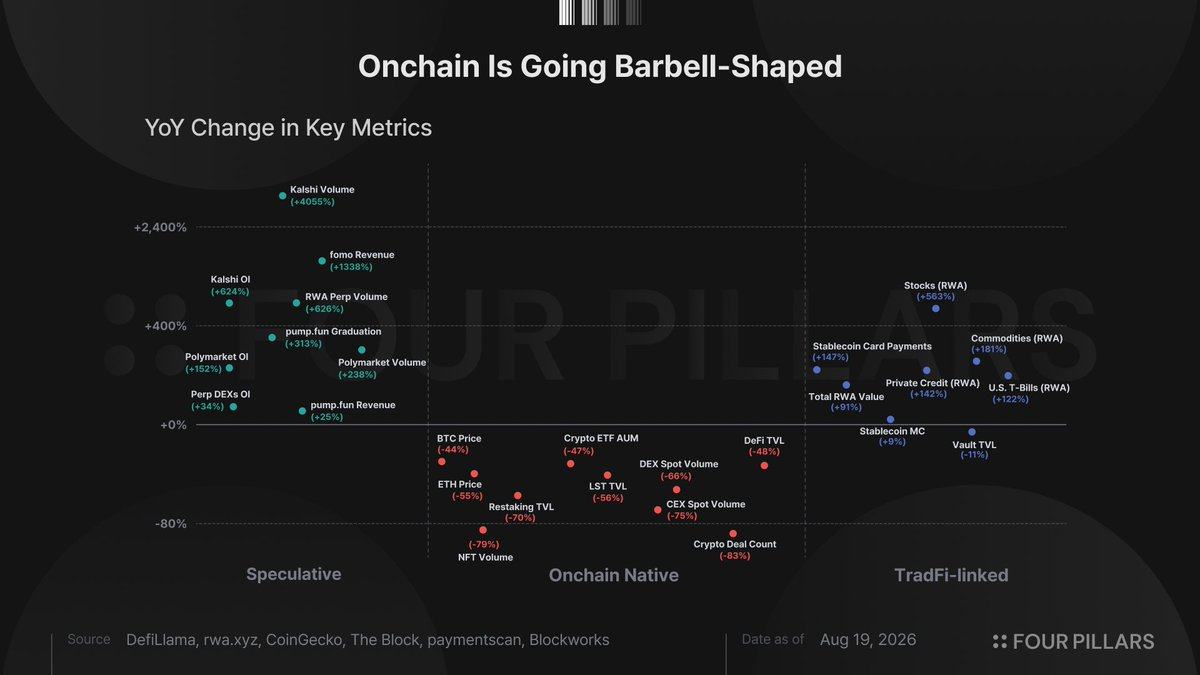
Even when the market was recently hovering near lows, the year-over-year data already told a clear story: DeFi total value locked fell sharply, spot trading volumes on both decentralized and centralized exchanges, liquid staking token lockups, NFT trading volumes, and crypto fundraising deals all saw notable declines.
In other words, the native on-chain products that defined the previous bull market have seen steeper declines than Bitcoin, which serves as the market's factual benchmark.
On the flip side: even in such a difficult market, a few sectors are still booming.
Perpetual contracts (Perps) and prediction markets feed on speculative demand; stablecoins and RWA connect crypto to the real economy.
So, the blockchain industry is indeed growing this cycle. But the shape of that growth is more critical—it has formed a barbell: one end is speculation, the other is integration with the real economy.
Korea's Blockchain Industry Is Falling Behind
Perpetuals, prediction markets, stablecoins, and RWA are precisely the four sectors driving the strongest growth in the global blockchain industry this cycle.
And what about Korea? Of these four tracks, how many can genuinely thrive domestically?
Zero.
Currently, the Korean blockchain industry lacks a legal pathway to properly operate in any of these four directions.
Perpetuals: Korea has no explicit law banning perpetual contracts. However, the Financial Supervisory Service takes a very conservative stance on extending credit related to crypto assets. Under the current legal framework, there is also no legal basis for formally conducting crypto derivatives business domestically.
Prediction Markets: In Korea, prediction markets are typically treated as illegal gambling. Recently, the Korea Communications Standards Commission blocked domestic access to Polymarket.
Stablecoins: The Digital Asset Basic Act, which is expected to bring stablecoins under regulatory oversight, has been delayed repeatedly. As of now, there is still no legal basis for companies to issue and circulate stablecoins.
RWA: Although Korea has an STO framework, it is heavily tied to "fractionalized investment products," which is not the same as what the global market typically means by RWA. Korea currently has no regulatory framework for RWA. Regulators recently indicated that tokens backed by Korean securities and issued overseas, sold only to foreign investors, would be difficult to deem a violation of the Electronic Securities Act. But for Korean institutional investors to actually enter RWA products, the limitations remain clearly defined.
Perpetuals are a trading innovation that emerged organically from the crypto market. The Singapore Exchange has already launched bitcoin and ether perpetual futures, and the U.S. Commodity Futures Trading Commission has approved KalshiEX's bitcoin perpetual futures.
Prediction markets are another type of innovation—one that can turn nearly anything in the world into a tradeable interface. Recently, they have also begun showing potential as hedging venues and even next-generation insurance products.
Stablecoins and RWA are a different story. They have decoupled from crypto market sentiment, achieved product-market fit on their own, and are becoming the underlying infrastructure for the next generation of finance.
None of these innovations are truly happening in Korea.
This creates a strange paradox: the gap between Korea and the global market today is actually wider than it was in 2021.
This doesn't mean no one is moving. The regulatory framework remains unclear, but financial institutions are already preparing stablecoin businesses; on the RWA front, some players have chosen to issue products overseas first.
Korea still has one clear advantage: once the regulatory environment is in place, this market could build out its industry faster than most other countries.
Hopefully, Korea will soon provide clear regulatory frameworks for perpetuals, prediction markets, stablecoins, RWA, and related sectors. That would genuinely reopen room for growth in Korea's blockchain industry.


