






Unitree IPO Soars 600% on Day One: Why Is the Humanoid Robot Concept Igniting Capital Markets?


- Key Takeaway: Unitree surged 600% on its IPO debut, with retail subscriptions exceeding 8,000 times oversubscription, cementing its position as a global core humanoid robotics player. By leveraging full-stack in-house hardware development, the company has pushed the G1's price down to 99,000 RMB, breaking through the industry's mass-production price barrier—but the market must remain cautious of valuation bubbles and delivery risks.
- Key Factors:
- Unitree's stock opened sharply higher on its first trading day, hitting an intraday peak of roughly 600%, triggering multiple trading halts and ranking among the top by trading volume—reflecting an extreme liquidity premium.
- Retail subscription multiples exceeded 8,000 times during the public offering phase, setting a rare record in the hard-tech sector and demonstrating intense market enthusiasm for the "first humanoid robot stock" narrative.
- The core product matrix spans quadruped robots (Go2, B2) and humanoid robots (H1, G1), with the G1 base model priced at $16,000 (approximately 99,000 RMB), breaking the industry's price barrier for mass production.
- Major players' strategic moves—Tesla advancing its Optimus project and Nvidia releasing the GR00T foundation model—have served as macro catalysts for this valuation surge, driving a repricing of the embodied intelligence sector.
- The company has achieved full-stack in-house development of core components including motors, reducers, and controllers, with its hardware cost advantage forming a key moat for scaled production.
- Investors should closely monitor mass-production delivery timelines, order conversion rates in industrial and service scenarios, as well as valuation mean-reversion risks and share unlock pressure once the initial trading euphoria subsides.
Overview
Unitree Robotics, the global leader in embodied intelligence and legged robots, has officially completed its initial public offering (IPO) and been listed on the stock exchange. On its first trading day, Unitree Robotics stock opened to a massive influx of buy orders, surging over 600% intraday and triggering multiple temporary trading halts. During the public offering phase, retail investor subscription multiples exceeded 8,000 times, setting a rare oversubscription record in the hard-tech sector in recent years. This trading frenzy, driven by the convergence of AI large models with physical entities, has not only established Unitree Robotics as a core publicly listed player in the global humanoid robotics space but also sparked deep discussions in the capital markets regarding the commercialization pace and valuation rationality of the embodied intelligence industry chain.
Key Takeaways
Unitree Robotics stock demonstrated an extremely high liquidity premium on its first trading day, opening sharply higher and reaching an intraday peak gain of approximately 600%, with full-day trading volume ranking among the top in its sector.
The retail subscription phase recorded an oversubscription ratio exceeding 8,000 times, reflecting the market's intense enthusiasm for the concept of the first major humanoid robotics listing.
The core product matrix covers quadruped robots (Unitree Go2, B2) and general-purpose humanoid robots (Unitree H1, G1), with the G1 base version bringing humanoid robot pricing down to the $16,000 range (approximately RMB 99,000), breaking the industry's mass-production price barrier.
The accelerated布局 of global AI giants in embodied intelligence, including Tesla's advancement of the Optimus project and NVIDIA's release of the GR00T foundation model platform, constitutes the core macro catalyst behind this valuation surge.
The company has achieved a high degree of full-stack in-house R&D across core components such as motors, reducers, and controllers, with the cost advantage of self-developed hardware becoming a key moat supporting its scalable mass production.
Investors should closely monitor mass-production delivery cycles, order conversion rates for industrial and service scenario deployments, and the risk of valuation mean reversion after the initial trading day sentiment fades.
Market Frenzy Behind Unitree's First-Day Surge
Trading Details: 8,000x Retail Subscription and 600% Opening Surge
According to public offering data disclosed by the stock exchange and underwriting institutions, Unitree Robotics triggered fierce competition among global institutional funds and individual investors during its public offering phase. The preliminary valid subscription multiple for the online offering exceeded 8,000 times, reflecting the extreme demand in both primary and secondary markets for pure-play robotics concept targets. On its first trading day, Unitree Robotics stock opened with a sharply higher gap, and with multiple large buy orders lifting the price intraday, the share price surged approximately 600% above the IPO price at one point.
The trading characteristics of this surge were typical high turnover and high volatility. As trading progressed, bulls and bears engaged in intense position exchanges, with the daily turnover rate climbing rapidly and trading volume setting a record for first-day trading among comparable tech hardware listings. According to relevant tech sector reports from Bloomberg and Reuters, this surge reflects global liquidity seeking hard-tech core assets with disruptive technological breakthroughs.
Why Capital Markets View Unitree as a Core Humanoid Robotics Target
The core reason capital markets have granted Unitree Robotics an extremely high valuation premium lies in its scarce commercial monetization capabilities and technology deployment progress. Compared to most startups still in laboratory R&D stages or relying on external concept-based fundraising, Unitree Robotics has already established mature cash flow support in both the consumer and industry-level quadruped robot markets.
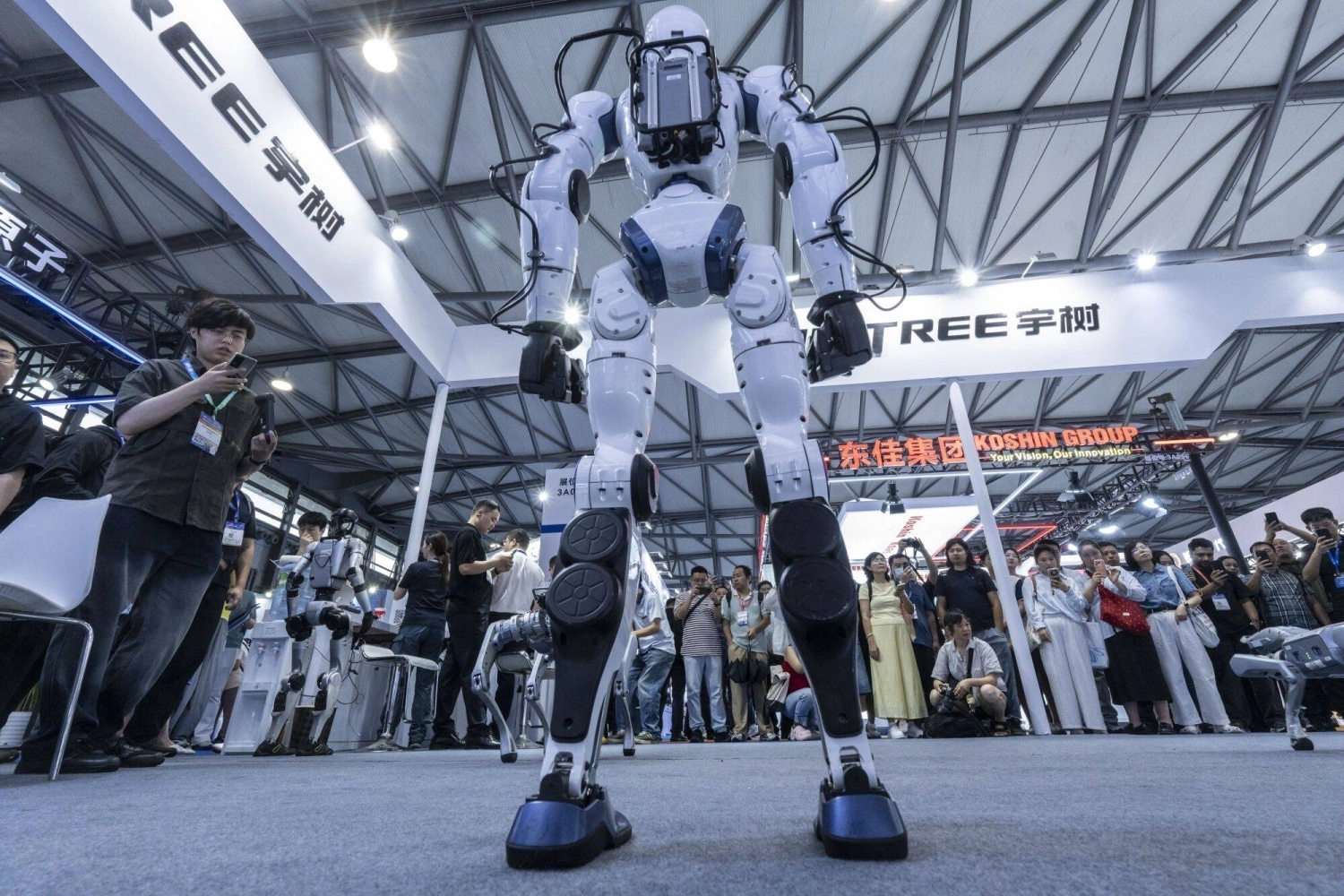
More importantly, Unitree Robotics has successfully transferred its dynamic control expertise in quadruped robots to the bipedal humanoid domain. The company's successive launches of the full-size general-purpose humanoid H1 and the mass-production intelligent humanoid G1 not only demonstrate high-dynamic motion control capabilities such as running and backflips but also achieve a commercial closed loop in mechanical structure and perception algorithms. In the public capital markets, Unitree Robotics has become one of the very few humanoid robot manufacturers with actual mass-production shipment data.
The Commercialization Inflection Point for Embodied Intelligence and Humanoid Robotics
Product Matrix Evolution: From Quadruped Robot Dogs to Humanoid Robots G1 and H1
Unitree Robotics' product evolution path demonstrates a strong engineering-driven deployment logic. According to Unitree Robotics' official technical documentation, the company initially opened up the global market with its Go1 and Go2 series of consumer quadruped robots, and subsequently introduced the B2 industrial-grade quadruped robot for vertical scenarios such as power grid inspection and fire rescue, securing a leading share of global legged robot shipments.
Building on this foundation, Unitree Robotics quickly entered the blue ocean of humanoid robotics. The H1 humanoid set a world record for running speed among full-size humanoids with its advanced powertrain, while the next-generation G1 humanoid agent further integrates multimodal large models and reinforcement learning algorithms. With 23 to 43 degrees of freedom across its joints, the G1 can execute complex coordinated robotic arm operations and fine-grained object manipulation, demonstrating the potential to evolve from pure dynamics control toward general-purpose labor replacement.
Hardware Cost Control and Global Supply Chain Advantages
The biggest pain point restricting the large-scale adoption of the global humanoid robotics industry is the high cost of hardware manufacturing. The per-unit assembly cost of traditional industrial robots and some overseas high-end humanoid robots often reaches hundreds of thousands of dollars, severely limiting their penetration into factory production lines and home services.
Unitree Robotics has broken this deadlock through full-stack in-house development of core power units. The company has independently developed high-torque-density outrunner motors, precision planetary reducers, high-performance magnetic encoders, and integrated drivers, significantly reducing the production cost of core transmission systems. Leveraging a mature precision machining and consumer electronics supply chain network, Unitree Robotics has successfully compressed the G1's starting price to approximately RMB 99,000, making humanoid robots economically viable for small and medium-sized enterprises and the high-tech consumer market for the first time.
Global AI Giants' Expansion and Valuation Reshaping of Humanoid Robotics Concept Stocks
Technological Resonance Between Tesla Optimus and NVIDIA GR00T Ecosystem
The surge of humanoid robotics concept stocks in the secondary market is inseparable from the collective push of global tech giants in the embodied intelligence ecosystem. Tesla CEO Elon Musk has repeatedly emphasized that the Optimus humanoid robot will constitute the vast majority of the company's long-term market value and is accelerating real-world work testing in its automotive gigafactories.
Meanwhile, semiconductor giant NVIDIA has launched Project GR00T, a general-purpose humanoid robot foundation model, along with synthetic data generation and model training toolchains based on the Isaac simulation platform, dramatically shortening the development cycle from algorithmic simulation to physical reality. This industrial resonance—from underlying compute, foundation models to end hardware—has prompted global capital to reassess the market potential of Physical AI.
Cross-Asset Liquidity and Valuation Divergence in the Tech Hardware Sector
Against the backdrop of structural macroeconomic transformation, growth capital is searching globally for new narratives with trillion-dollar potential market space. The slowing growth of traditional consumer electronics and general software sectors is driving risk-off and growth capital to accelerate into cutting-edge frontier tracks represented by embodied intelligence.
For investors focused on global tech innovation and asset rotation, the migration trend of cross-market liquidity is particularly critical. Many traders dedicated to capturing global tech cycles and digital economy spillover effects typically observe liquidity pricing mechanisms through mainstream digital asset trading platforms such as MEXC, enabling them to seize trading opportunities arising from frontier tech asset volatility in a multi-asset environment.
Register for MEXC now and claim up to 10,000 USDT in newcomer rewards!
Core Variables and Potential Risks Investors Should Monitor Going Forward
Mass-Production Delivery Capability and Gross Margin Stability
As the first-day sentiment catalyst is gradually digested by the market, Unitree Robotics' long-term investment logic will return to fundamental delivery capabilities. The primary variable to consider is the actual conversion speed of the order backlog. While the low-price strategy is conducive to quickly capturing market share, yield rate control during large-scale batch assembly, after-sales maintenance costs, and component supply chain resilience will directly determine whether its overall gross margin can be maintained at a healthy level.
Furthermore, the operational stability and Mean Time Between Failures (MTBF) of the robot hardware in actual industrial manufacturing, warehouse logistics, and special operations scenarios will be decisive indicators for enterprise customers' continued reorder decisions.
Valuation Correction and Lock-up Expiry Pressure After Sentiment Fades
Historical market patterns show that growth-oriented tech stocks experiencing extreme first-day gains often face sharp price volatility and valuation corrections in the early post-listing period. The over 8,000-fold retail subscription and 600% first-day gain include a considerable proportion of short-term speculative capital and arbitrage trading positions.
As market sentiment gradually stabilizes in subsequent trading days, the stock price may converge toward fundamental intrinsic value. Investors should pay particular attention to the share lock-up expiry schedules of early-stage venture capital institutions and cornerstone investors, as well as the potential liquidity tightening impact on high-valuation growth stocks amid macro interest rate fluctuations.
Potential Risks and Scenario Analysis Across Different Market Conditions
Commercialization Shortfalls and Technology Iteration Risks
According to industry research institutions and industrial observations from the Financial Times, the humanoid robotics technology roadmap has not yet fully converged. The industry remains in a rapid evolution phase regarding sensor solutions (pure vision versus LiDAR multimodal approaches), joint actuation schemes (electric versus electro-hydraulic drives), and dexterous hand degree-of-freedom designs.
If downstream customers' return on investment (ROI) calculations for humanoid robots fall short of expectations, leading to delayed industry procurement demand, or if competitors achieve breakthrough progress in end-to-end embodied intelligence algorithms, Unitree Robotics may face the dual challenges of technology roadmap adjustments and extended commercialization cycles.
Valuation Evolution and Secondary Market Scenario Projections
Based on current liquidity and risk appetite in the tech sector, Unitree Robotics' future trajectory may unfold in two primary scenarios:
In the base case scenario, the company continues to secure bulk orders in industrial manufacturing and scientific research/education through its cost advantages, with annual humanoid robot shipments steadily climbing while overseas quadruped business maintains stable cash flow. In this scenario, after a reasonable technical correction following the first-day surge, the stock price is expected to establish a center around key moving average support levels, forming a long-term upward channel aligned with fundamental growth.
In the bear case scenario, the excessively front-loaded valuation bubble from the first day triggers concentrated profit-taking by institutional funds, while industrial scenario deployment progresses slower than optimistic market expectations, leading to a phased slowdown in quarterly revenue growth. In this scenario, the stock price may face an extended period of volatile downward correction, with valuation multiples converging toward traditional high-end equipment manufacturing companies.
James Mitchell's Exclusive Insights
From the perspective of market microstructure and cross-asset cycles, the astonishing 600% first-day gain for Unitree Robotics fundamentally reflects global capital's fervent pursuit of physical entity monetization vehicles as AI software narratives face diminishing marginal returns.
What truly matters is not the emotional climax created by the 8,000-fold first-day subscription, but rather the fundamental paradigm shift in robot hardware manufacturing. By combining full-stack in-house developed components with China's mature precision manufacturing supply chain, Unitree Robotics has successfully reduced humanoid robot prices to below RMB 100,000. This price breakthrough represents the decisive inflection point determining whether embodied intelligence can transition from laboratory research toys to general-purpose production tools.
The market, in its current frenzy, may partially overlook the difficulty of hardware-software co-evolution. While physical motion capabilities in current humanoid robots are already highly mature, the generalization capabilities of the embodied intelligence brain and cerebellum remain in early exploration stages. The generalization boundaries of end-to-end reinforcement learning models determine task success rates in unstructured complex environments—a challenge that cannot be fully resolved in the short term through hardware cost reduction alone.
This logic bears a striking structural resemblance to the evolutionary trajectory of the blockchain ecosystem. Just as the Bitcoin network requires an underlying compute network to establish decentralized trust, and the Ethereum ecosystem depends on Decentralized Physical Infrastructure Networks (DePIN) and distributed execution layers, the ultimate form of Physical AI similarly requires deep synergy between decentralized data collection, edge computing, and physical hardware terminals. As embodied intelligence devices are deployed at scale globally, future machine-to-machine micropayment settlements based on smart contracts and decentralized compute coordination will open entirely new narrative dimensions for cross-asset fintech.
Investors should maintain rational restraint at this stage, avoiding blindly chasing highs at emotional extremes, and instead focus on tracking mass-production delivery rates, hardware gross margin changes, and the conversion efficiency of R&D spending into actual commercial orders in subsequent quarterly earnings reports.
Frequently Asked Questions
What type of robotics company is Unitree Robotics?
Unitree Robotics is a globally renowned high-tech enterprise specializing in legged robots and embodied intelligence, focused on the R&D, production, and sales of consumer and industry-grade quadruped robot dogs, general-purpose humanoid robots, and core actuation joint components.
Why did Unitree Robotics stock surge 600% on its first trading day?
The surge was primarily driven by market capital's pursuit of the scarcity value of the first major humanoid robotics listing, the frenzy fueled by over 8,000-fold oversubscription during the retail subscription phase, and the macro-level industry valuation reshaping triggered by global tech giants accelerating their presence in the embodied intelligence track.
What is the core price of Unitree Robotics' humanoid robot?
The official starting price of the G1 base version, Unitree Robotics' mass-production intelligent humanoid robot, is approximately RMB 99,000 (about $16,000), far below the industry's typical price tag of hundreds of thousands of dollars for comparable products, significantly lowering the commercialization barrier for embodied intelligence robots.
What are Unitree Robotics' core competitive moats in hardware manufacturing?
The company has achieved full-stack in-house R&D and production of core transmission components including motors, reducers, controllers, and encoders. Combined with efficient supply chain integration capabilities, it maintains leading advantages not only in motion control algorithms but also has established a deep moat in whole-machine Bill of Materials (BOM) cost control.
What are the main commercialization challenges currently facing the humanoid robotics industry?
Key challenges include insufficient generalization capabilities of end-to-end large models in unstructured complex scenarios, relatively long validation cycles for operational reliability and safety in industrial and home service environments, and yield rate and supply chain stability management during early-stage mass-production delivery.
What does the over 8,000-fold retail subscription imply for future trading?
The exceptionally high subscription multiple reflects extremely high market attention and significant short-term speculative capital participation. While this drove the first-day surge, it also implies intense share turnover in the early listing period, potentially leading to higher secondary market volatility once initial sentiment subsides and lock-up expiry periods approach.
What financial and operational indicators should investors monitor going forward?
Going forward, investors should focus on quarterly actual delivery/shipment volumes of humanoid and quadruped robots, order conversion rates for enterprise-level scenarios, changes in overall gross margins of core business, and the actual output efficiency of R&D investments in software and hardware upgrades.
Disclaimer
The information provided in this article is for reference, learning, and academic exchange purposes only and does not constitute any form of investment advice, financial analysis, legal opinion, tax consultation, or recommendation to buy or sell any specific financial asset. Stocks, initial public offering (IPO) targets, crypto assets, and related derivative markets carry extremely high price volatility and investment risk, influenced by multiple factors including macroeconomic trends, market supply-demand sentiment, industry regulatory policies, and changes in company fundamentals, which may lead to significant or total loss of invested capital.
Historical market data, subscription multiples, technical analysis indicators, and industry development forecasts do not constitute guarantees of future returns. Investors should conduct thorough independent due diligence before participating in any financial market transactions and make prudent decisions based on their own financial circumstances, risk tolerance, and investment objectives. The MEXC Crypto Pulse team and its affiliated personnel assume no legal liability for any financial losses, trading decisions, or operational consequences arising from direct or indirect reliance on the content contained herein.


