






AI hidden landmine? US tech giants' off-balance-sheet liabilities swell to $3 trillion, about 5 times annual capital expenditure


- Core Viewpoint: The AI infrastructure-related commitments disclosed off-balance-sheet by the nine major US tech giants total approximately $3 trillion, far exceeding their annual capital expenditure. Since accounting standards do not require these to be recorded on balance sheets, they constitute a potential massive hidden debt risk.
- Key Elements:
- The nine companies' off-balance-sheet commitments total approximately $3 trillion—five times their combined $600 billion in capital expenditure over the past year—and have surged about 50% within two months.
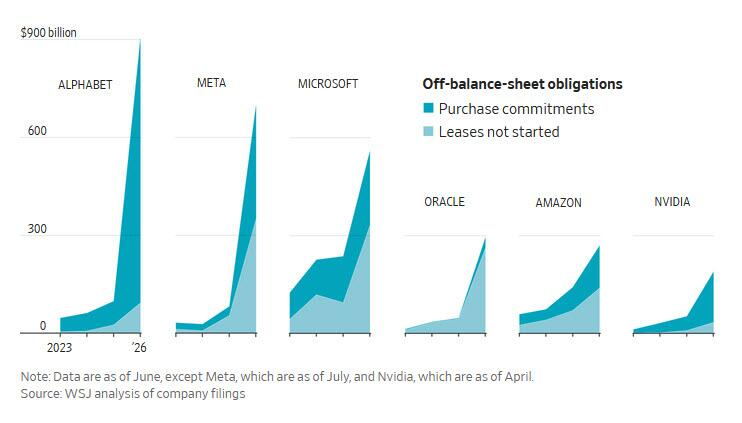
- The core components consist of approximately $1.2 trillion in "commencement-date leases not yet started" (such as Meta's $347 billion commitment) and approximately $1.9 trillion in "purchase commitments," both of which legally remain off the balance sheet until delivery.
- "Residual value guarantees" (RVG), an off-balance-sheet structure totaling approximately $70 billion, allow chip giants like Nvidia and Broadcom to leverage their own credit to back customer financing, creating contingent liabilities.
- Broadcom's "Big Sky" project guarantees $35 billion in debt, with Bank of America estimating its AI platform could accumulate $370 billion in senior debt by mid-2029.
- Rating agencies such as Moody's and S&P have expressed concerns over such contingent obligations and plan to include them in adjusted debt calculations, but market pricing remains insufficient.
- Alphabet and Amazon have already seen negative free cash flow, with capital expenditure exceeding operating cash inflows and requiring sustained dependence on external financing.
- Core divergence in risk assessment: Optimists believe AI demand growth will be sufficient to cover the bills; pessimists point out that the commitments are irrevocable, and low-cost competition from Chinese open-source models could systematically compress profit margins, with related token prices having already fallen more than 50% within weeks.
Original Author: Dong Jing
Original Source: Wallstreetcn
The real financial commitments of U.S. tech giants to AI infrastructure are far more alarming than the publicly disclosed figures suggest.
According to a Wall Street Journal report on August 18, nine top tech companies — including Google parent Alphabet, Meta, Microsoft, Amazon, Oracle, Nvidia, Broadcom, SpaceX, and AMD — disclosed roughly $3 trillion in total off-balance-sheet commitments in the footnotes of their latest securities filings, the vast majority of which are directly tied to AI infrastructure buildout.
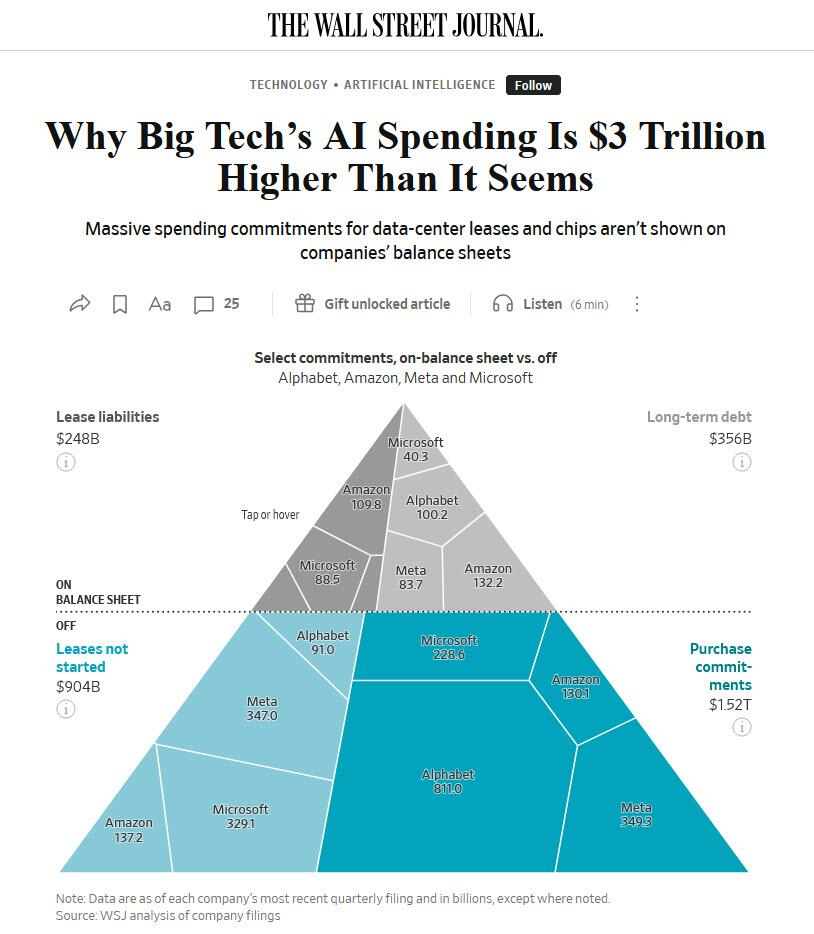
That figure is approximately five times the combined capital expenditures of roughly $600 billion these companies made over the past year, and about three times their outstanding lease and long-term debt balances. Even more striking: this total has grown by roughly 50% in just two months, up from approximately $1.8 trillion previously.
The core components of this hidden liability pile are approximately $1.2 trillion in "uncommenced leases" and roughly $1.9 trillion in "purchase obligations." Under current accounting standards, neither of these spending commitments needs to be recorded on the balance sheet until delivery or lease payments begin, allowing them to legally remain off the books.
Meanwhile, as a Wallstreetcn article previously reported, citing a Bloomberg report from August 15, a new type of off-balance-sheet guarantee structure known as "Residual Value Guarantee" (RVG) has reached approximately $70 billion in scale. Chip giants including Nvidia and Broadcom are leveraging their own credit to back customer financing, and these contingent liabilities have yet to be fully priced by the market — a growing source of unease for bond investors.
Alphabet and Amazon have both recently posted negative free cash flow — with capital expenditures exceeding operating cash inflows. This means hyperscalers will remain dependent on capital market financing for the foreseeable future, and if the $3 trillion in off-balance-sheet commitments are ever triggered, it would deliver a profound shock to tech companies whose balance sheets were once regarded as "fortress-like."
$3 Trillion in Off-Balance-Sheet Commitments: How Accounting Rules Make Massive Debt "Disappear"
The Wall Street Journal's analysis shows that these nine top tech companies have been able to legally keep their off-balance-sheet commitments away from the balance sheet through two mainstream accounting treatments.
The first category is "uncommenced leases."
Take Meta's "Hyperion" data center project in Louisiana — a site spanning the equivalent of roughly 1,700 football fields — as an example. Meta initially signed leases starting in 2029 with a four-year initial term and options to renew for up to 20 years, while also committing to compensate bondholders if it exits the leases early.
Because Meta determined that the probability of actually having to make such payments was low, it did not record any liability on its balance sheet. Under accounting standards, the lease obligation can remain off-balance-sheet until lease payments formally commence. Meta has disclosed approximately $347 billion in total commitments under such "uncommenced leases."
According to the Wall Street Journal's calculations, uncommenced leases across all analyzed companies have reached roughly $1.2 trillion in off-balance-sheet obligations — about four times the figure disclosed a year earlier.
The second category is "purchase obligations."
Data centers require enormous amounts of hardware, including Nvidia chips for training and running models, as well as memory chips. To lock in supplier capacity, tech companies commonly sign long-term purchase contracts well in advance. Under accounting rules, purchase obligations do not need to be recorded on the balance sheet until the products or services are actually delivered. The analyzed companies' total purchase obligations amount to approximately $1.9 trillion.
Combined, these two categories form the bulk of this roughly $3 trillion "time bomb." Even if revenues never materialize as expected, signed purchase contracts and leases cannot, in most cases, be unilaterally cancelled.
"Residual Value Guarantees": $70 Billion in Off-Balance-Sheet Contingent Liabilities Quietly Accumulate
As the Wallstreetcn article noted, beyond these large-scale off-balance-sheet leases and purchase obligations, a new type of structured arrangement known as the "Residual Value Guarantee" (RVG) is rapidly expanding within the AI financing ecosystem, reaching approximately $70 billion in scale and becoming another little-known layer of hidden risk.
The structure operates in three tiers: a special purpose vehicle (SPV) borrows funds to purchase chips, with the debt backed by cash flows from the AI company's usage contracts; if that AI company stops paying, the chips are subleased or sold to repay the debt; if a shortfall remains, the guarantor — typically the chip manufacturer — covers the difference.
Chip giants such as Nvidia and Broadcom thus act as the ultimate backstops, yet these guarantee obligations are typically not recorded on their balance sheets. Meta's own filings confirm this logic: "The probability of payment under the RVG guarantees is not probable, and therefore no liabilities have been recorded to date."
Broadcom has extended this logic to a project codenamed "Big Sky" — the company guaranteed a $35 billion debt deal in which investors including Apollo Global Management and Blackstone purchased custom AI chips and leased them to Anthropic. The senior debt received an investment-grade rating, lowering financing costs.
Bank of America strategists estimate that Broadcom's AI XPV platform could accumulate $370 billion in senior debt by mid-2029.
Nvidia CEO Jensen Huang has said the company may provide residual value support of up to 25% for relevant opportunities, describing the approach as "case-by-case," with the goal of "helping unlock a broader pool of independent capital while maintaining disciplined risk exposure."
Nvidia last week announced a $500 billion financing partnership with six U.S. investment institutions, including BlackRock and Goldman Sachs — partly to bring in external capital and alleviate the "circular financing" trap in which AI companies fund purchases of one another's products.
Rating Agencies Sound the Alarm, Bond Markets Struggle to Price Risk
The Wallstreetcn article also noted that rating agencies have publicly expressed concerns over the rapid expansion of RVG structures.
Moody's stated in a report that "the key risk is that these transactions are occurring in high concentration over a short period," and warned that a significant increase in Broadcom's contingent obligations "would constrain Broadcom's financial flexibility and could pressure its credit profile, even if leverage on its existing debt remains low."
S&P Global Ratings, for its part, has characterized Broadcom's residual value support as "contingent debt-like obligations" and explicitly stated it would incorporate such amounts into its adjusted debt calculations.
The core anxiety for bond investors is: when will these off-balance-sheet contingent liabilities actually convert into real losses on financial statements? DoubleLine portfolio manager Mariya Entina put it bluntly:
"It feels like gaming the system to get favorable treatment from the rating agencies to get the highest rating possible... We are entering the era of financial engineering. When you do financial engineering, you are masking financial reality."
CreditSights analysts, meanwhile, likened Nvidia's residual value support to "selling a put option," noting that "it's pro-cyclical — it costs almost nothing during boom times, but it becomes most critical in a severe downturn when customers default and hardware market values decline."
TCW's Co-Head of Global Credit, Brian Gelfand, said:
"This is not plain vanilla investment-grade credit underwriting. It's far more complicated than that. Given the off-balance-sheet nature, tail risk is on the higher side."
Some market participants hold a relatively optimistic view. John Lloyd, Head of Global Multi-Sector and Corporate Credit at Janus Henderson Investors, believes that triggering residual value support would require extreme conditions.
"You would have to see token usage growth rates fall off a cliff, and that is not what we are seeing at all," he said, stressing that these companies "are not trying to hide contingent liabilities — they are trying to finance them."
Bull-Bear Divergence: Sustained Demand or a "Boom-Bust" Cycle
Opinion is sharply divided on whether these off-balance-sheet liabilities constitute a systemic risk.
On the bullish side, advocates argue that surging demand for AI tools has already lifted equity markets and created shortages of core hardware — itself strong evidence of robust demand in the years ahead — and that tech companies will generate sufficient cash flow to cover all of their bills.
The bearish case centers on two overlapping risks:
First, the vast majority of purchase obligations and signed leases are irrevocable — regardless of whether revenue materializes, the bills must be paid;
Second, Chinese open-source models are now delivering near-parity performance at a fraction of the cost of frontier models. If enterprises and consumers shift en masse to these cheaper alternatives, hyperscaler profits will face systemic compression — while the infrastructure bills cannot be reversed.
It is reported that related token prices have fallen more than 50% cumulatively over the past few weeks.
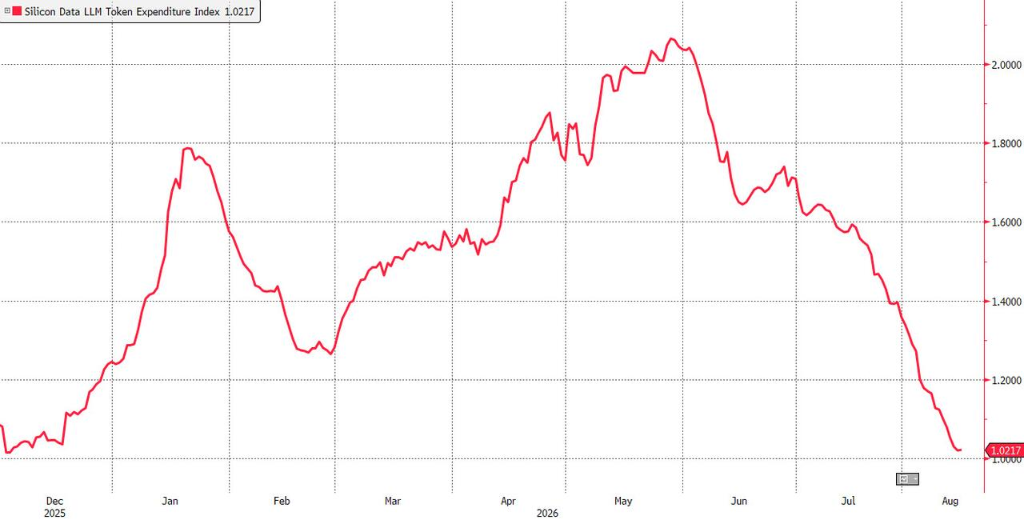
Structurally, the current danger lies in the compounding of timing mismatches and information opacity: capital expenditure commitments have arrived ahead of revenue and free cash flow; substantial depreciation costs remain deferred, and once construction-in-progress is successively placed into service, it will create a concentrated drag on profits; and because companies apply inconsistent standards in classifying and disclosing off-balance-sheet liabilities, any cross-company comparison of true leverage faces inherent uncertainty — making it difficult for investors to fully assess overall risk exposure.
As analysts have pointed out, these liabilities do not yet constitute an imminent solvency crisis. But they are a misalignment of timing and disclosure — a wall of deferred depreciation, and a bill whose full extent has yet to be seen.


